AQA · GCSE · Physics
Properties of Waves
Master the fundamentals of Waves for GCSE Physics, from transverse and longitudinal oscillations to the electromagnetic spectrum and the Ripple Tank required practical. This comprehensive guide will help you secure top marks by focusing on key definitions, calculations, and examiner expectations.
- 5 min read
- 3 worked examples
- 5 practice questions
- 6 key terms
Study Notes
Overview
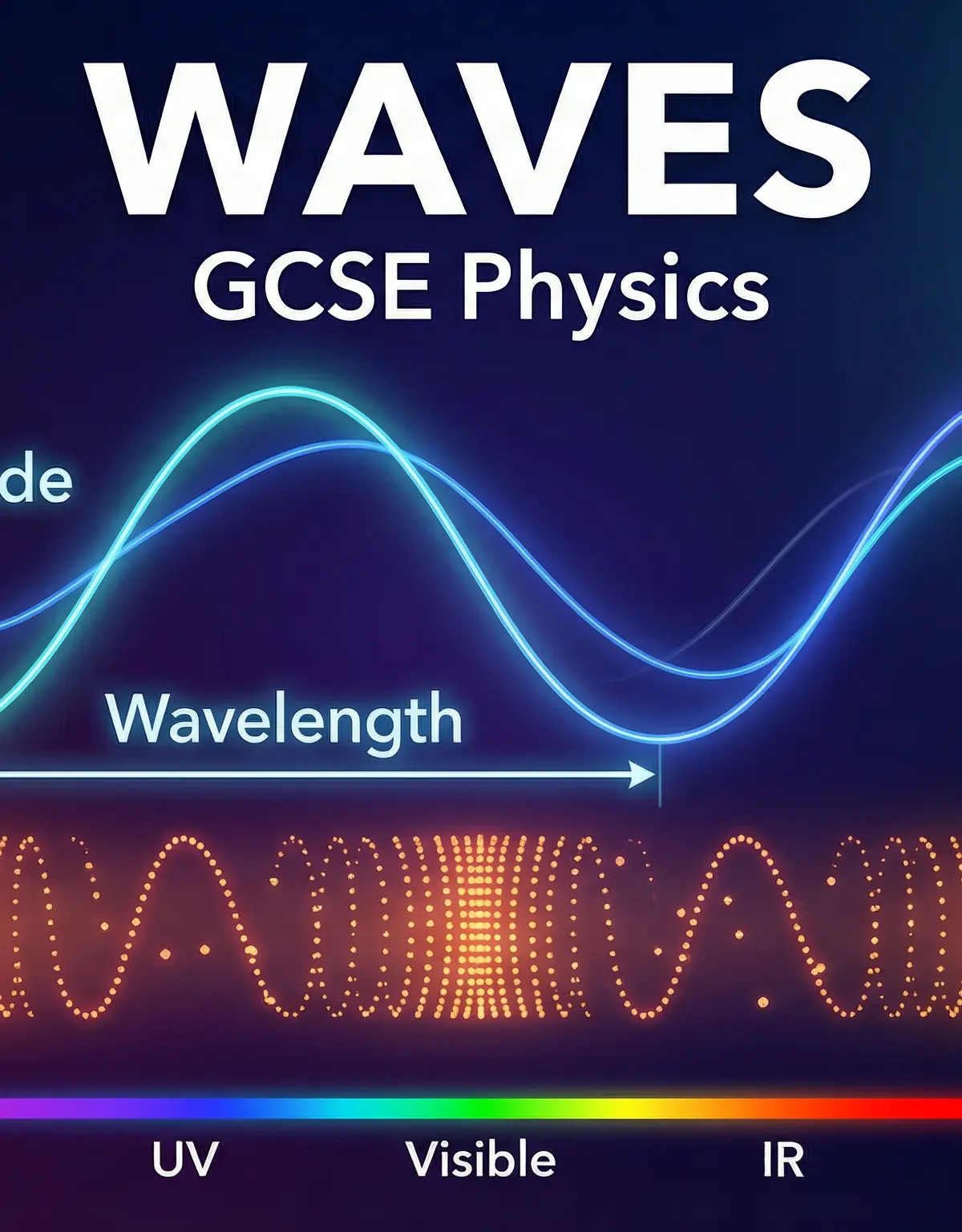
Waves are a fundamental concept in Physics, describing how energy is transferred from one place to another without the permanent transfer of matter. This topic is crucial because it forms the basis for understanding everything from how we see light and hear sound, to how our mobile phones communicate and how doctors use X-rays. Examiners frequently test this topic through a mix of qualitative descriptions—such as comparing wave types—and quantitative applications like the wave equation (v = f \lambda).
In your exam, you can expect questions ranging from simple 1-mark definitions to complex 6-mark required practical descriptions involving the Ripple Tank. Understanding waves also provides essential synoptic links to other topics, such as energy transfer and electromagnetism. This guide will walk you through the core concepts, common pitfalls, and the exact terminology examiners are looking for to award full marks.
Key Concepts
Concept 1: Wave Types and Particle Oscillation
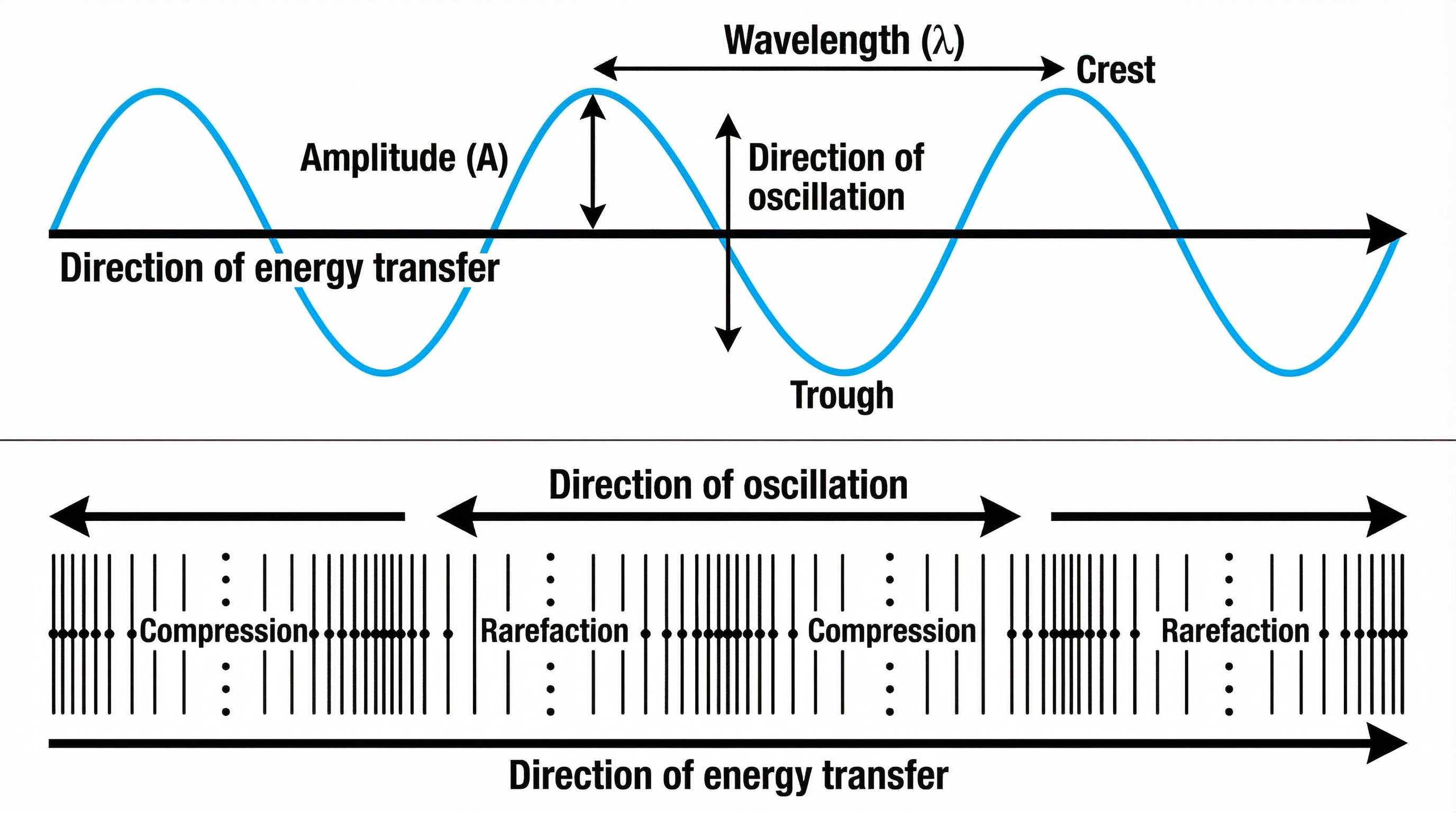
A wave transfers energy without transferring matter. The particles of the medium oscillate (vibrate) about a fixed position, but they do not travel with the wave. There are two primary categories of waves that you must be able to define and distinguish: transverse and longitudinal.
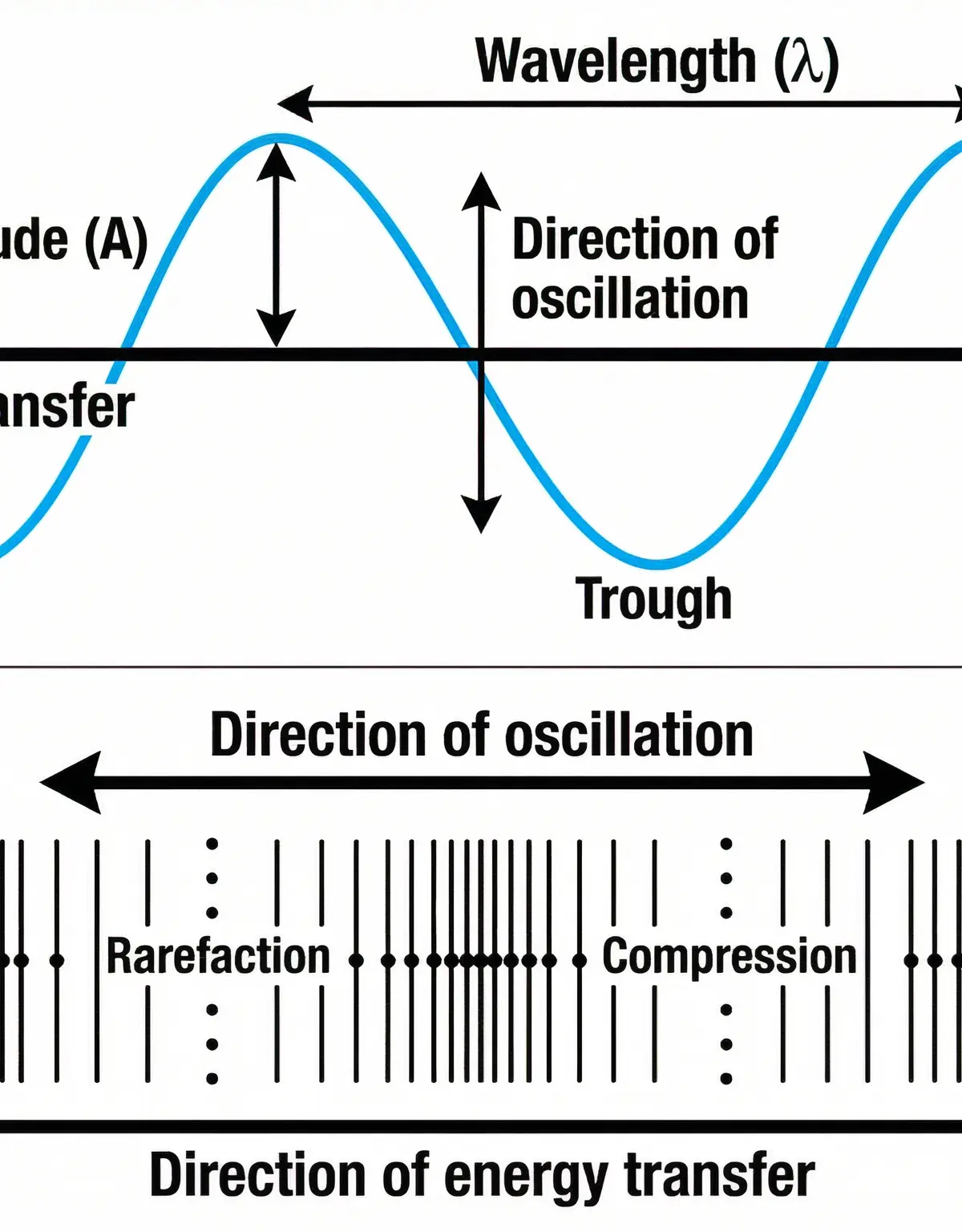
In a transverse wave, the oscillations are perpendicular (at right angles) to the direction of energy transfer. Examples include light, all electromagnetic waves, and ripples on the surface of water. When defining a transverse wave, you must explicitly state that the oscillation is perpendicular to the energy transfer; simply saying the wave moves "up and down" will not earn marks.
In a longitudinal wave, the oscillations are parallel to the direction of energy transfer. Sound waves are the most common example. These waves feature regions where particles are bunched together, known as compressions, and regions where they are spread apart, known as rarefactions. Mentioning compressions and rarefactions is essential for securing marks when describing longitudinal waves.
Concept 2: Wave Properties
To describe waves accurately, you need to understand four key measurements:
- Amplitude: The maximum displacement of a point on a wave away from its undisturbed (equilibrium) position.
- Wavelength (\lambda): The distance from a point on one wave to the equivalent point on the adjacent wave (e.g., from crest to crest).
- Frequency (f): The number of waves passing a fixed point each second, measured in Hertz (Hz).
- Period (T): The time taken for one complete wave to pass a fixed point, measured in seconds (s).
The period and frequency are inversely related by the equation T = 1 / f. Examiners often test this by providing one value and asking you to calculate the other.
Concept 3: The Electromagnetic Spectrum
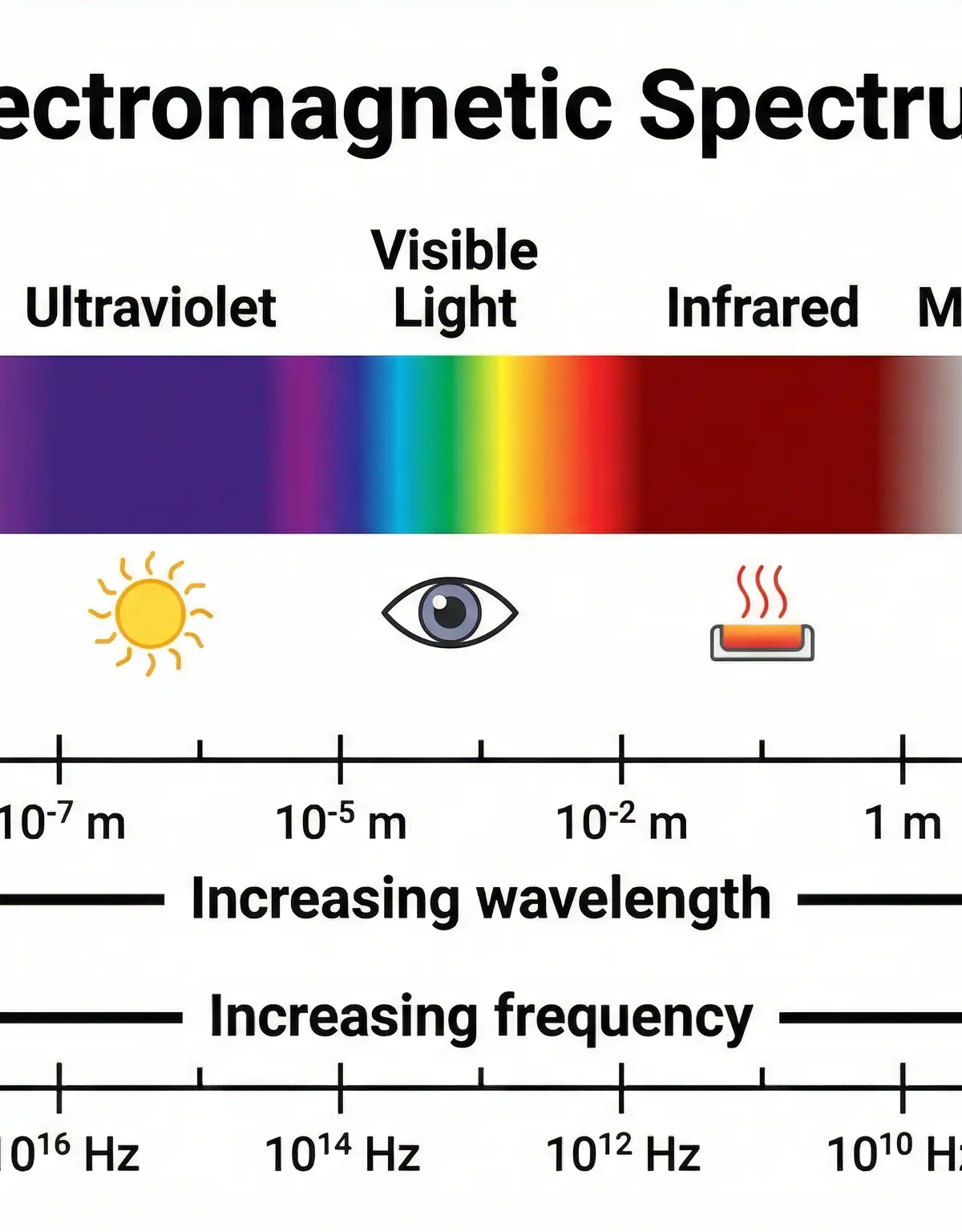
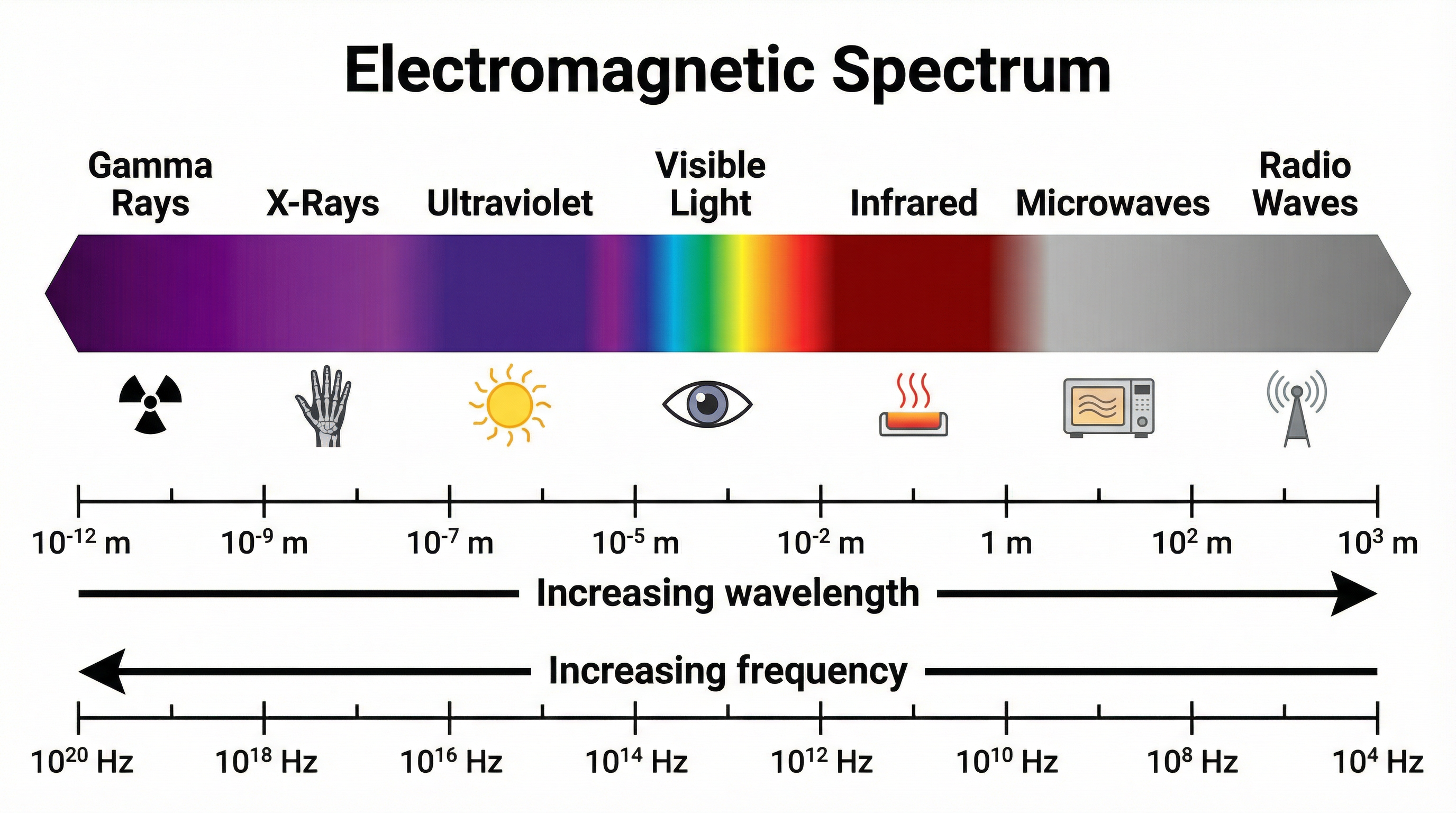
The electromagnetic (EM) spectrum is a continuous range of transverse waves that all travel at the same velocity in a vacuum (the speed of light, 3 \times 10^8 \text{ m/s}). The waves are grouped based on their wavelength and frequency.
From longest wavelength (and lowest frequency) to shortest wavelength (and highest frequency), the spectrum consists of: Radio waves, Microwaves, Infrared, Visible light, Ultraviolet, X-rays, and Gamma rays. As you move from radio to gamma, the energy of the waves increases, which is why UV, X-rays, and gamma rays are hazardous ionising radiations.
Mathematical/Scientific Relationships
The most critical relationship in this topic is the Wave Equation, which links the speed of a wave to its frequency and wavelength:
v = f \lambda
Where:
- v is wave speed in metres per second (m/s)
- f is frequency in Hertz (Hz)
- \lambda is wavelength in metres (m)
Crucial Examiner Tip: You must ensure all values are in standard units before calculating. If wavelength is given in centimetres (cm), divide by 100 to convert to metres. If frequency is given in kilohertz (kHz), multiply by 1000 to convert to Hertz.
Practical Applications
The Ripple Tank Required Practical
The ripple tank experiment is a standard method for measuring the speed of water waves and is frequently the subject of 6-mark questions.
To measure the wavelength, you should use a stroboscope to freeze the wave pattern. Rather than measuring a single wave, you measure the distance across 10 wavelengths and divide by 10. This technique is specifically credited in mark schemes because it significantly reduces random error.
To measure frequency, count the number of waves passing a point in a given time (e.g., 10 seconds) and divide by the time. Finally, use the wave equation (v = f \lambda) to calculate the wave speed. For a validity check, you can repeat the measurements and ensure the calculated speed remains constant.
Visual Resources
2 diagrams and illustrations
Interactive Diagrams
2 interactive diagrams to visualise key concepts
Conceptual Flow Outline
Flowchart for solving wave equation problems correctly.
Conceptual Flow Outline
Methodology flow for the Ripple Tank required practical.
Worked Examples
3 worked examples — open one to explore the question and available guidance.
Practice Questions
Test your understanding — click to reveal model answers
A sound wave has a frequency of 170 Hz and a wavelength of 2.0 m. Calculate the speed of the sound wave.
Hint: Use the formula $v = f \lambda$. Check if units need converting.
Explain why X-rays are more dangerous to human health than radio waves.
Hint: Think about the relationship between frequency, energy, and ionisation.
A wave has a period of 0.02 seconds and a speed of 1500 m/s. Calculate its wavelength.
Hint: You need to find frequency first using the period.
Describe the method a student should use to measure the frequency of ripples in a ripple tank.
Hint: How can you make counting fast waves more accurate?
Compare the properties of microwaves and visible light.
Hint: Identify similarities (they are both EM waves) and differences (position in spectrum).
Test your understanding of Properties of Waves
Active recall beats re-reading. Take an instant quiz now to test what you’ve learned and lock it into long-term memory.
7 days Premium · Then free forever · No card, no charge