AQA · GCSE · Physics
Scalar and Vector Quantities
Master the invisible forces that power our modern world! This comprehensive guide covers everything from drawing perfect magnetic field lines to applying Fleming's Left-Hand Rule and calculating the motor effect, ensuring you secure maximum marks on your GCSE Physics exam.
- 6 min read
- 3 worked examples
- 5 practice questions
- 6 key terms
Study Notes
Overview
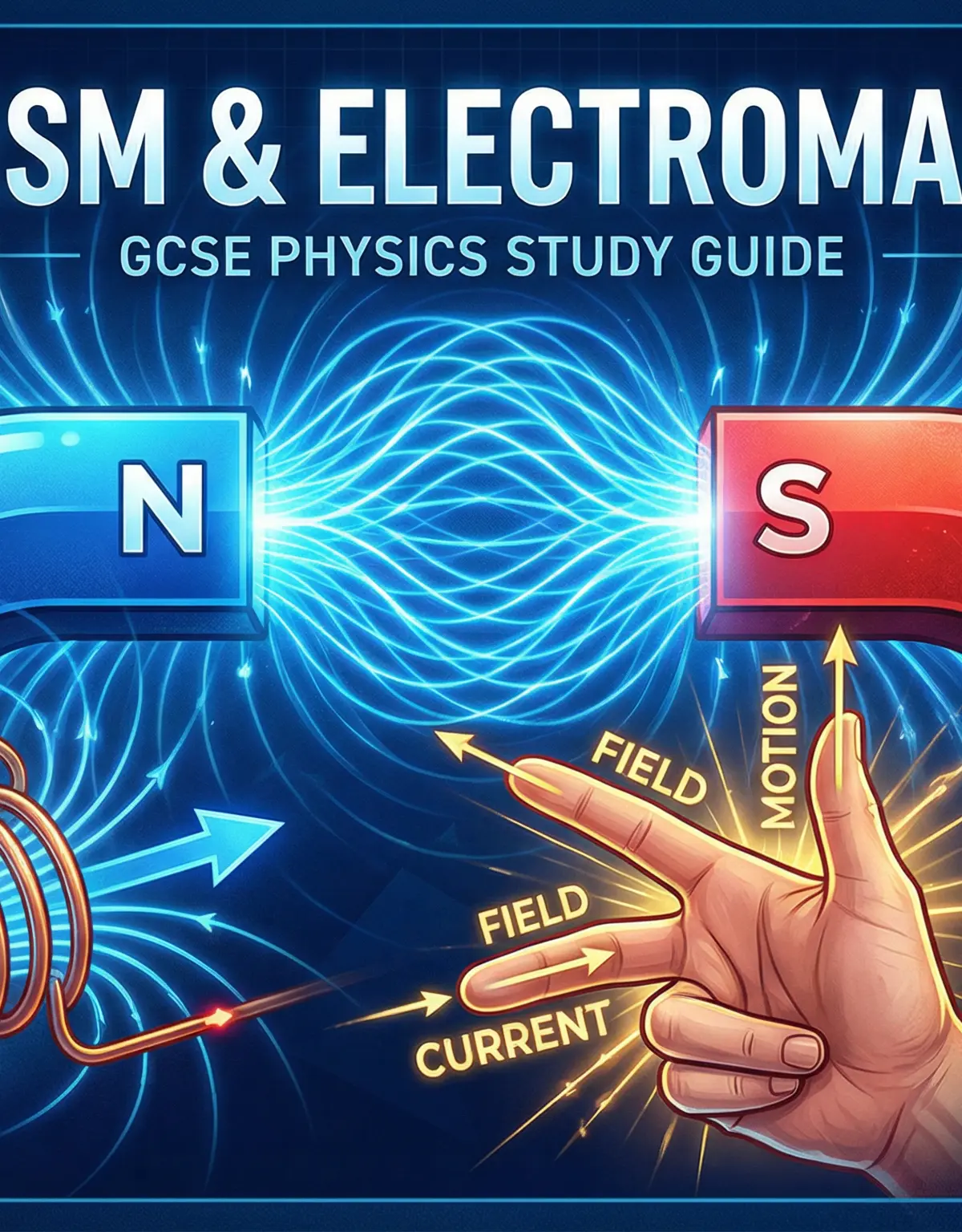
Magnetism and electromagnetism form a cornerstone of GCSE Physics, explaining the invisible forces that power everything from electric motors and hospital MRI scanners to the speakers in your headphones. Examiners frequently test this topic because it requires both conceptual understanding (like why induced magnets behave the way they do) and practical application (such as using Fleming's Left-Hand Rule).
This topic connects closely with electricity and forces. You will be expected to draw precise diagrams, explain phenomena using correct terminology, and perform multi-step calculations using the F = BIl equation (Higher Tier). Understanding the distinction between conventional current and electron flow is critical here.
Listen to the revision podcast below for a complete walk-through of the topic, including a quick-fire recall quiz!
Key Concepts
Concept 1: Permanent and Induced Magnets
Magnets can be broadly categorised into two types: permanent and induced.
A permanent magnet produces its own magnetic field constantly. The magnetic field cannot be turned off. Examples include bar magnets made of ferromagnetic materials like iron, steel, cobalt, or nickel. They always have a North and a South pole. The fundamental rule is: like poles repel, opposite poles attract.
An induced magnet is a material that becomes a magnet only when placed in an existing magnetic field. Crucial Exam Point: Induced magnets always cause a force of attraction. They never repel the permanent magnet that induced them. When the permanent magnet is removed, the induced magnet loses most or all of its magnetism quickly.
Example: Picking up paperclips with a bar magnet. The paperclips become induced magnets and are attracted to the bar magnet. When the bar magnet is removed, the paperclips fall because they lose their induced magnetism.
Concept 2: Magnetic Fields
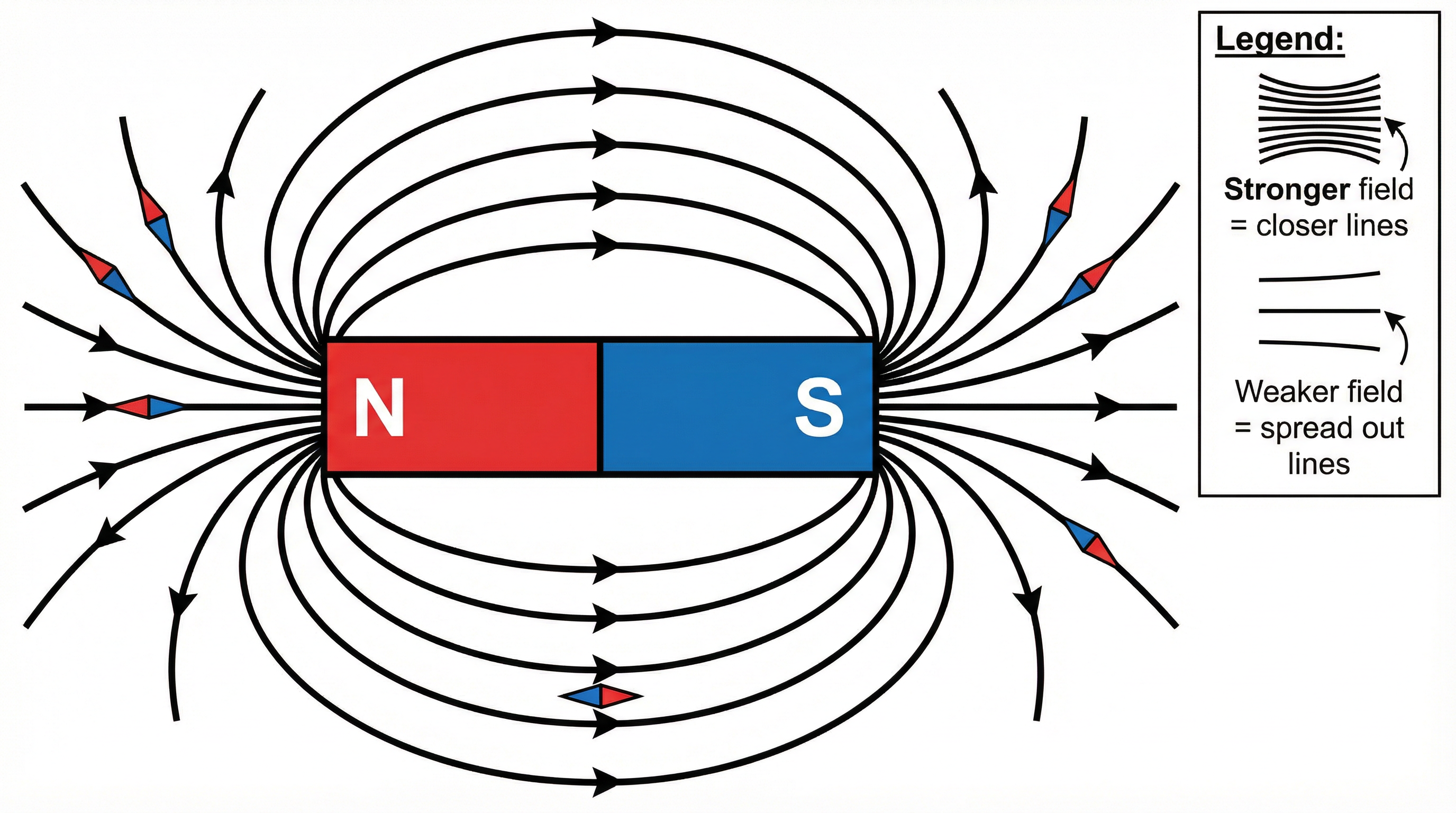
The region around a magnet where a force acts on another magnet or on a magnetic material is called the magnetic field.
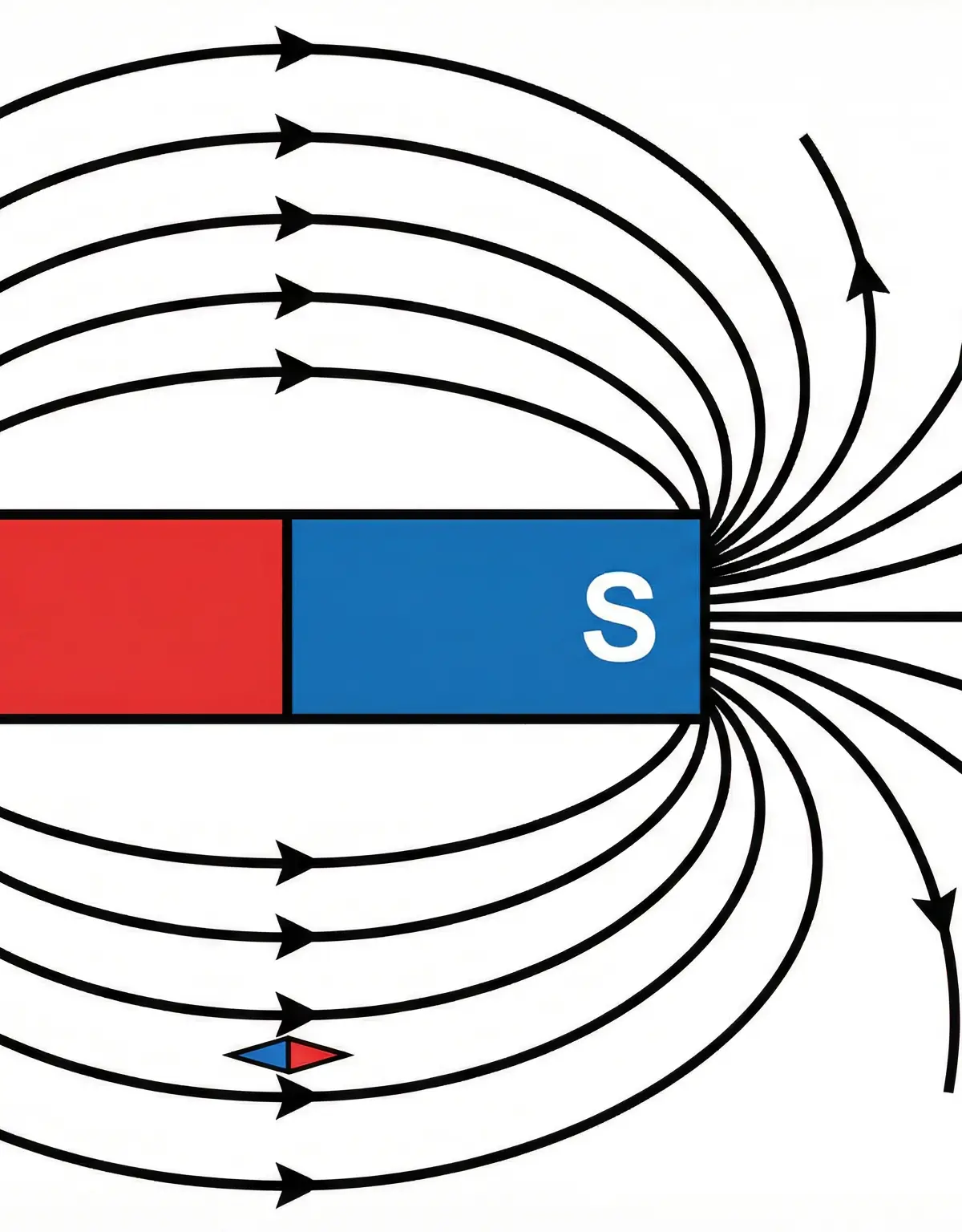
Examiners frequently ask candidates to draw magnetic field lines. To secure full marks, you must follow these rules:
- Direction: Lines must always point from the North pole to the South pole outside the magnet.
- Density: The closer the lines are together, the stronger the magnetic field. The field is strongest at the poles.
- Never Cross: Field lines must never touch or cross each other. This is physically impossible.
Concept 3: Electromagnetism (The Solenoid)
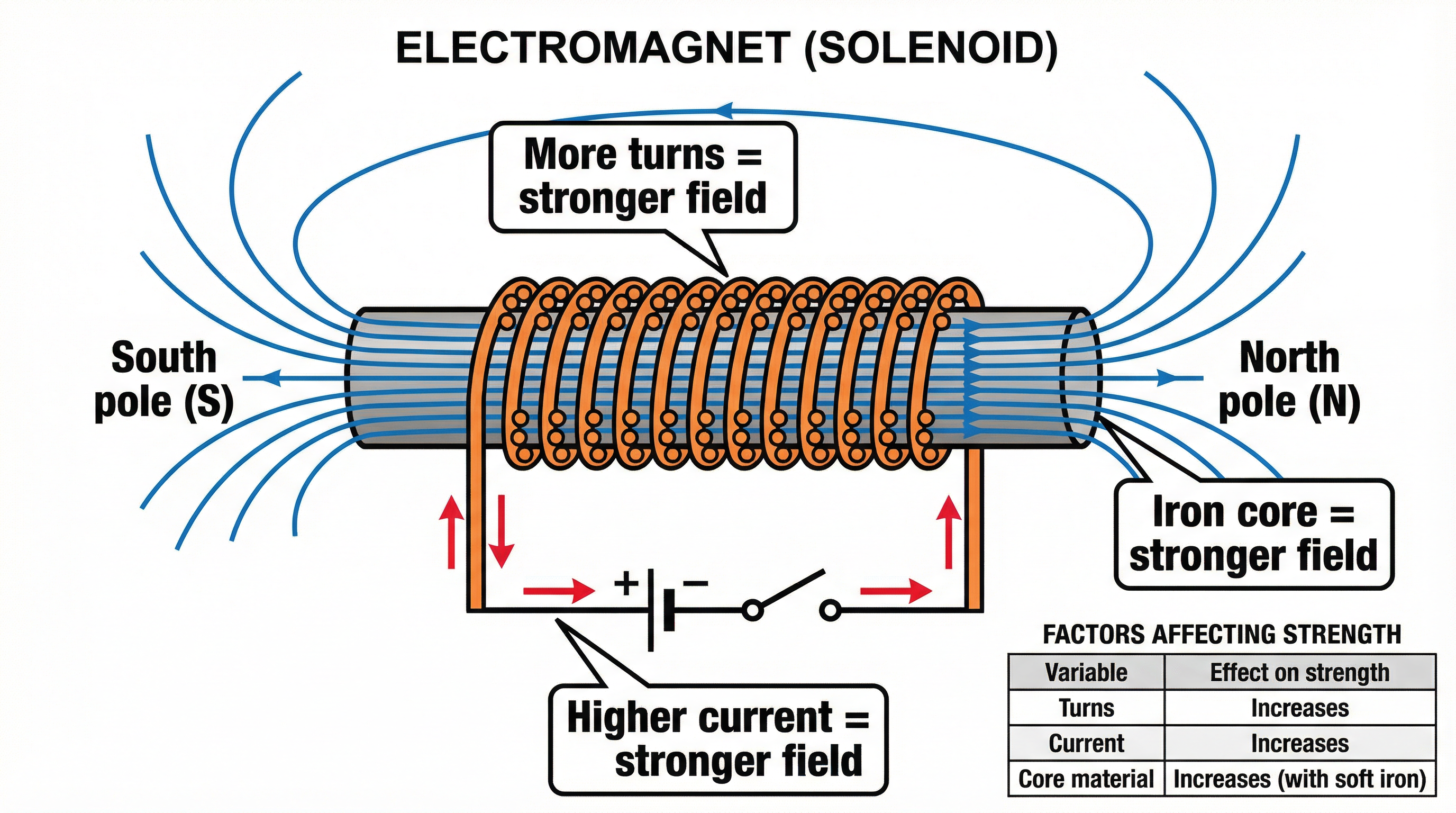
When an electric current flows through a wire, it produces a magnetic field around the wire. If we shape the wire into a coil, called a solenoid, the magnetic field becomes strong and uniform inside the coil, resembling the field of a bar magnet on the outside.
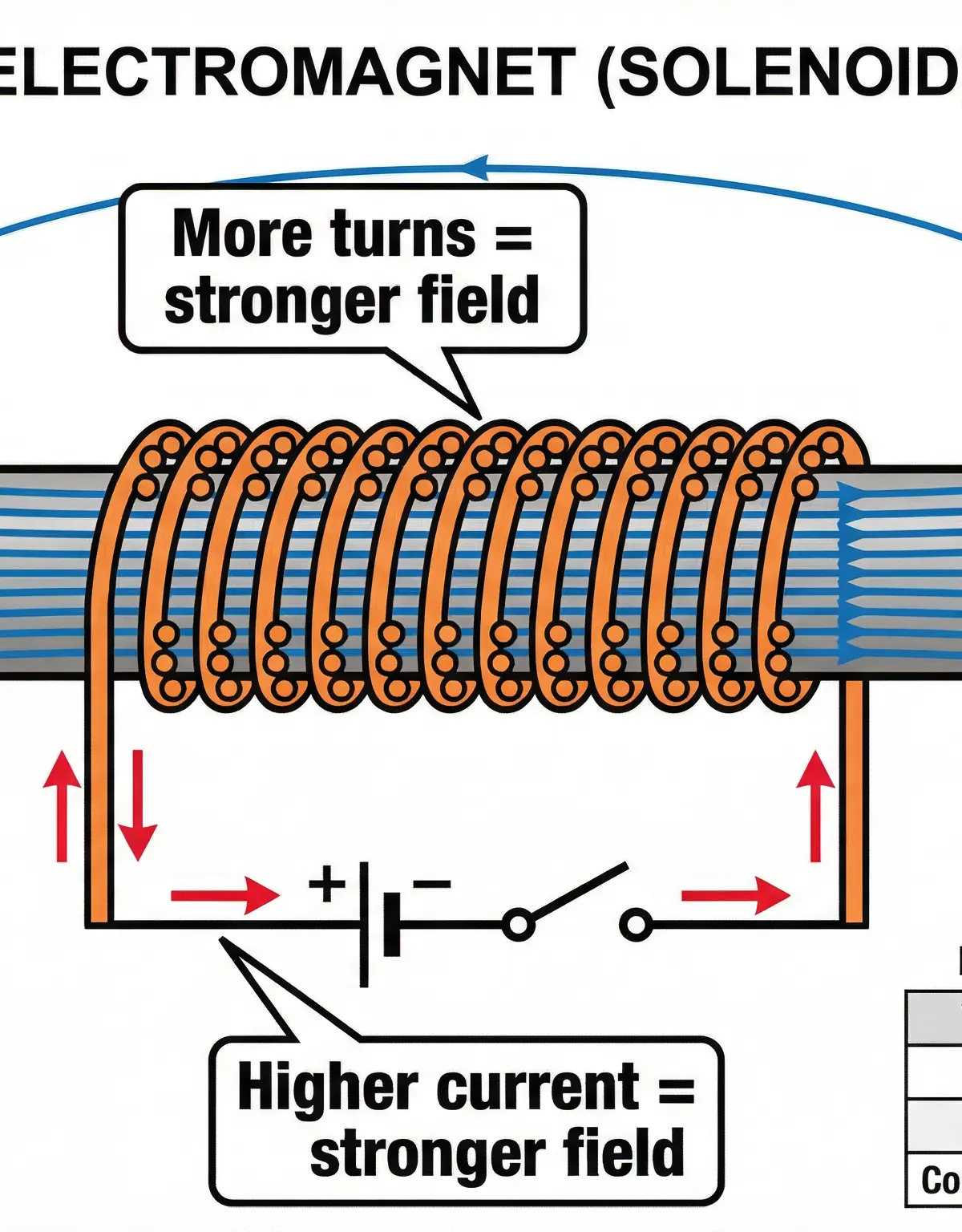
An electromagnet is simply a solenoid with an iron core. Examiners often ask how to increase the strength of an electromagnet. There are three ways:
- Increase the current flowing through the wire.
- Increase the number of turns on the coil (keeping the length the same).
- Add a soft iron core inside the solenoid.
Concept 4: The Motor Effect and Fleming's Left-Hand Rule (Higher Tier)
When a wire carrying a current is placed in a magnetic field, the magnetic field around the wire interacts with the external magnetic field. This interaction causes a force to be exerted on the wire. This is known as the motor effect.
The force is always perpendicular (at right angles) to both the direction of the magnetic field and the direction of the current. If the wire is parallel to the magnetic field, it will experience zero force.
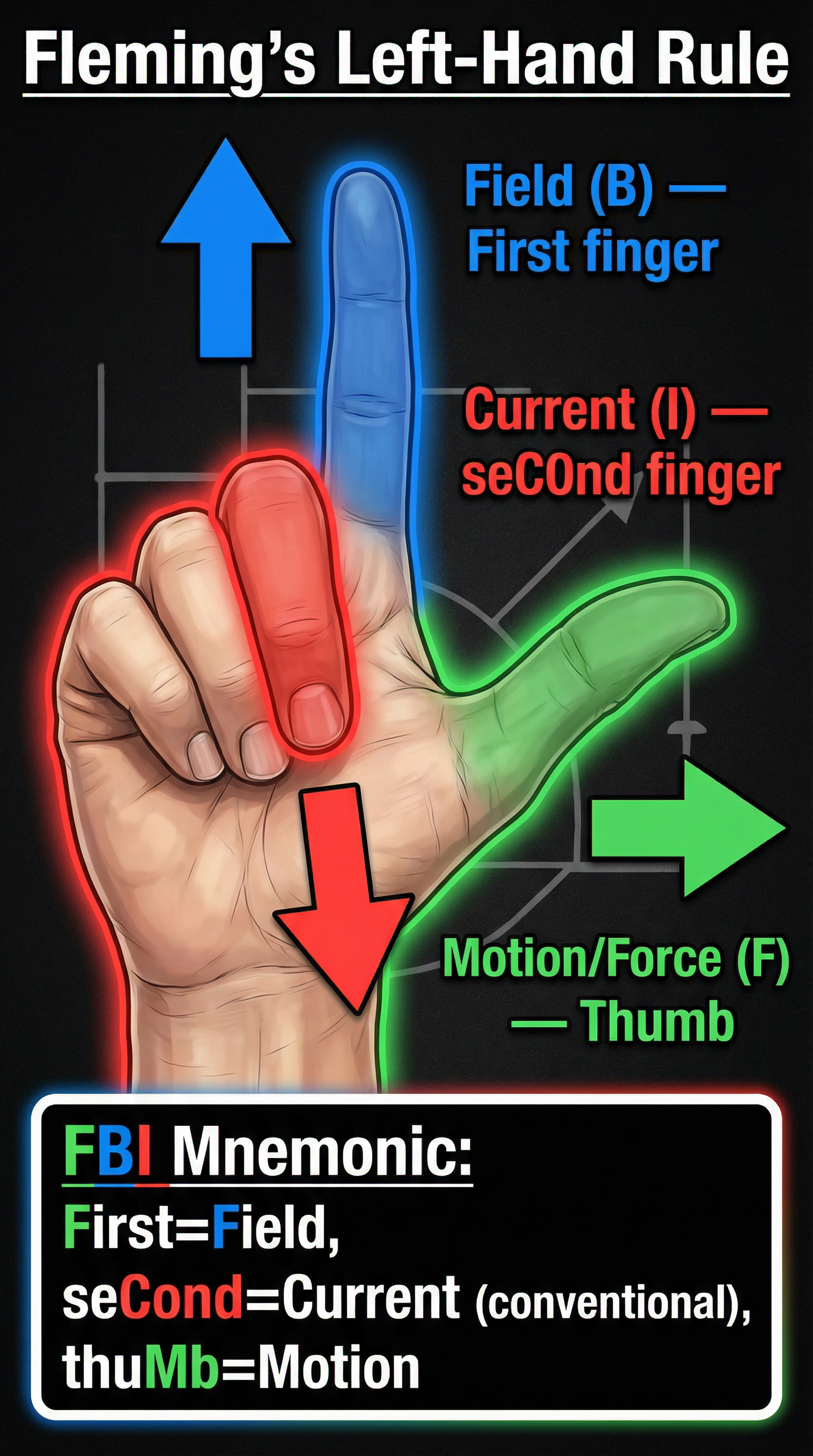
To determine the direction of the force, we use Fleming's Left-Hand Rule:
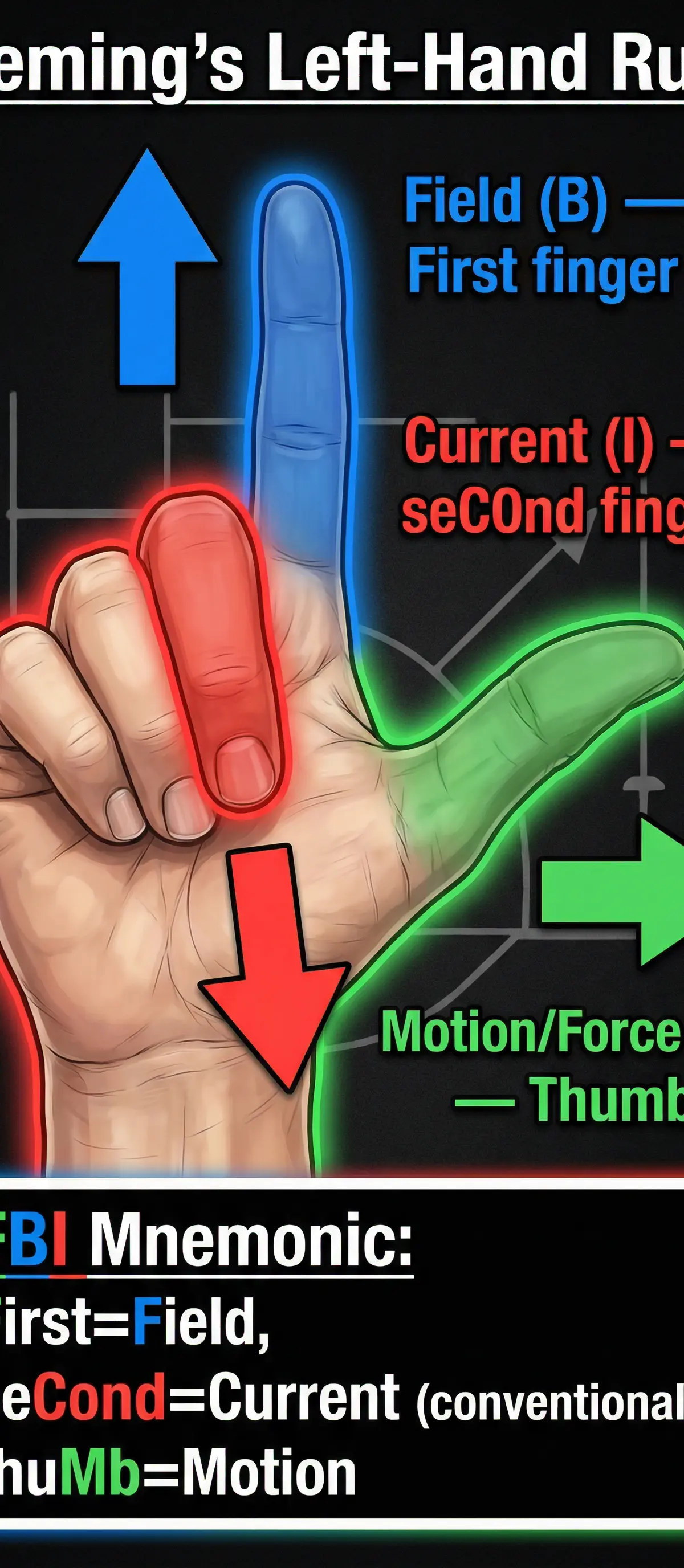
- First finger = Magnetic Field (North to South)
- seCond finger = Current (Conventional current: positive to negative)
- thuMb = Motion (Force)
Examiner Tip: Questions sometimes state the direction of electron flow. You must reverse this direction to find the conventional current before applying the left-hand rule!
Mathematical/Scientific Relationships
Force on a Conductor (Higher Tier)
The size of the force acting on a conductor in a magnetic field depends on the magnetic flux density, the current, and the length of the wire in the field.
F = B \times I \times l
Where:
- F = Force in Newtons (N)
- B = Magnetic flux density in Tesla (T)
- I = Current in Amperes (A)
- l = Length of the conductor in Metres (m)
Common Pitfall: Examiners often give the length in centimetres (cm). You must divide by 100 to convert to metres (m) before calculating.
Practical Applications
- Electric Motors: Use the motor effect. A coil of wire carrying a current in a magnetic field experiences forces that cause it to rotate. A split-ring commutator reverses the current every half turn to keep the motor spinning in the same direction.
- Loudspeakers: Variations in an alternating current cause a coil to move back and forth in a magnetic field, vibrating a cone to produce sound waves.
- Scrap Yard Cranes: Electromagnets are used to lift heavy magnetic materials (like steel cars). They are useful because the magnetism can be turned off to drop the load.
Visual Resources
3 diagrams and illustrations
Interactive Diagrams
2 interactive diagrams to visualise key concepts
Conceptual Flow Outline
Comparison of permanent and induced magnets.
Conceptual Flow Outline
The process of creating an electromagnet.
Worked Examples
3 worked examples — open one to explore the question and available guidance.
Practice Questions
Test your understanding — click to reveal model answers
Explain why an induced magnet will never repel a permanent magnet.
Hint: Think about how the poles align when the induced magnet is placed in the field.
A student builds an electromagnet. Suggest two ways they could increase the strength of the magnetic field produced.
Hint: Remember the 'TIC' acronym.
A straight wire is placed in a uniform magnetic field. The wire carries a current of 4.0 A and experiences a force of 0.12 N. The length of the wire in the field is 15 cm. Calculate the magnetic flux density. (Higher Tier)
Hint: Rearrange F = BIl to find B. Don't forget to convert cm to m!
State the rule used to determine the direction of the force on a current-carrying wire in a magnetic field.
Hint: It involves your hand.
Describe the pattern of the magnetic field inside a solenoid.
Hint: Are the lines curved or straight? Are they close together or far apart?
Test your understanding of Scalar and Vector Quantities
Active recall beats re-reading. Take an instant quiz now to test what you’ve learned and lock it into long-term memory.
7 days Premium · Then free forever · No card, no charge