AQA · GCSE · Physics
Static Electricity
Unlock top marks in AQA GCSE Physics by mastering Static Electricity (4.2.5). This guide breaks down electron transfer, electric fields, and Higher Tier sparking, giving you the examiner's perspective on how to secure every point.
- 6 min read
- 3 worked examples
- 5 practice questions
- 6 key terms
Study Notes

Overview
Static electricity is a fundamental concept in physics that explains everything from a balloon sticking to a wall to the immense power of a lightning strike. For your AQA GCSE exam, this topic (specification point 4.2.5) is all about the build-up of charge on insulating materials and the non-contact forces this charge creates. Examiners test this through a mix of explanations, diagrams, and application questions. A solid understanding is crucial as it forms the basis for understanding current electricity and electromagnetism. Expect questions that require you to explain charging by friction, draw precise electric field diagrams, and, for Higher Tier candidates, explain the phenomenon of sparking. Mastering the specific vocabulary, like 'electron transfer' and 'non-contact force', is essential for gaining full credit.
Key Concepts
Concept 1: Charging by Friction
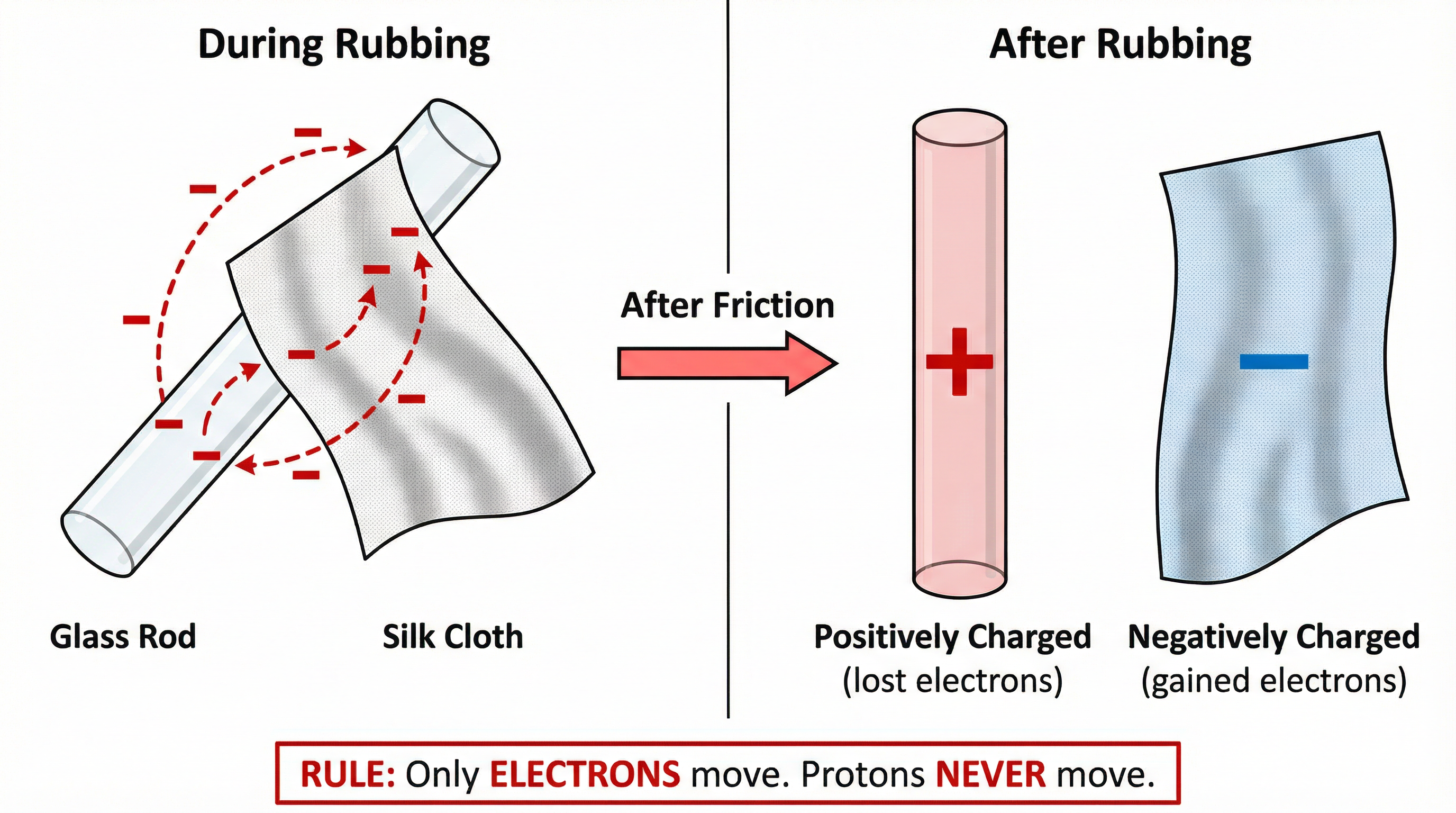
This is the process where static charge builds up. It relies on one of the most important rules in this topic: only electrons move. When two different insulating materials are rubbed together, friction provides the energy to transfer electrons from one material to the other. Protons are locked in the nucleus of atoms and are never transferred in this process. An examiner will immediately reject any answer that suggests protons or positive charges move.
- The material that loses electrons is left with more positive protons than negative electrons, so it becomes positively charged.
- The material that gains electrons now has more negative electrons than positive protons, so it becomes negatively charged.
Example: When a polythene rod is rubbed with a duster, electrons are transferred from the duster to the rod. The rod gains electrons and becomes negatively charged. The duster loses electrons and becomes positively charged. The total charge remains the same; it has just been separated.

Concept 2: Electric Fields
Every charged object is surrounded by an electric field. This is a region where another charged object will experience a non-contact force. You must use the term 'non-contact force' in your explanations. The rules of interaction are simple:
- Like charges repel (positive repels positive; negative repels negative).
- Opposite charges attract (positive attracts negative).
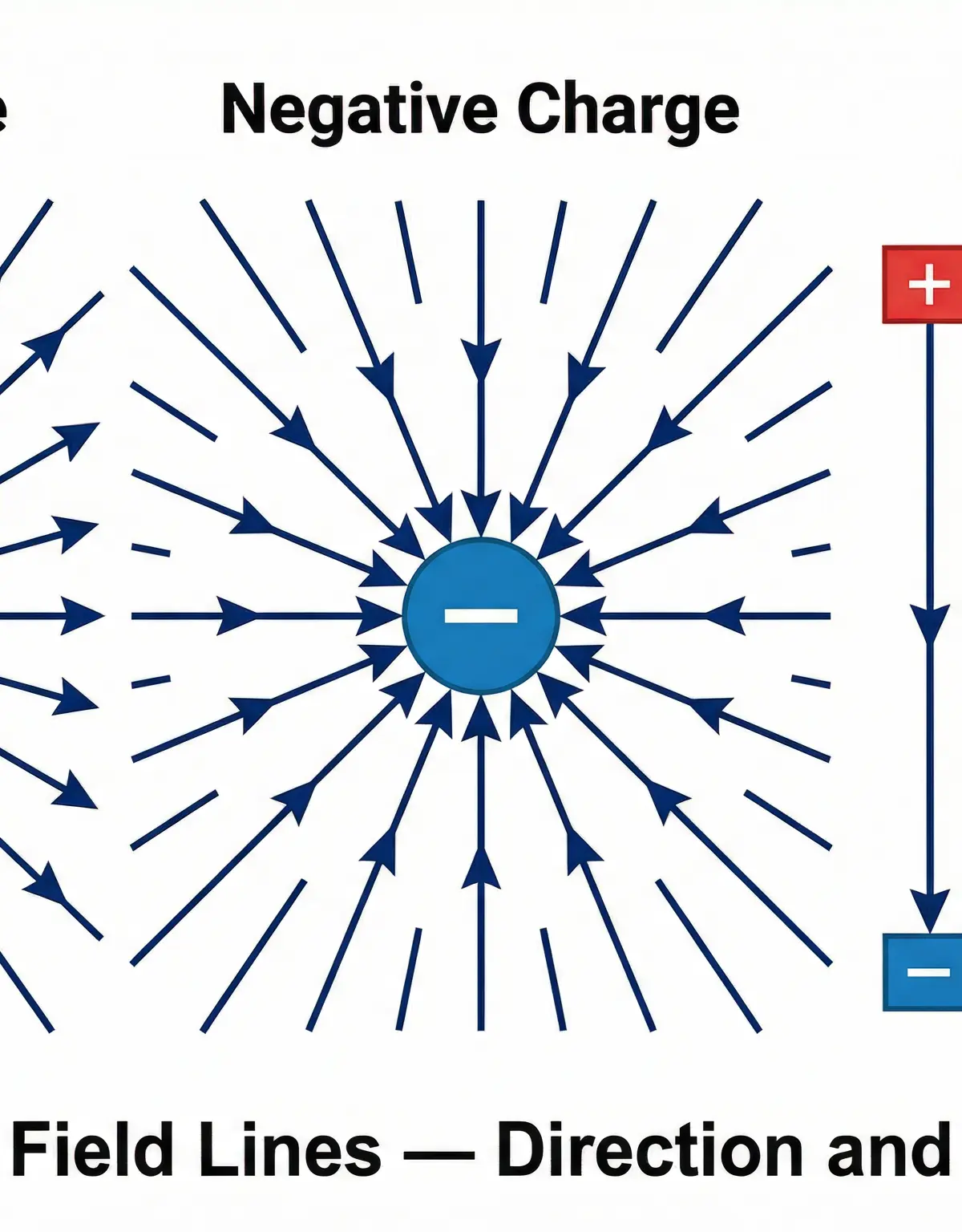
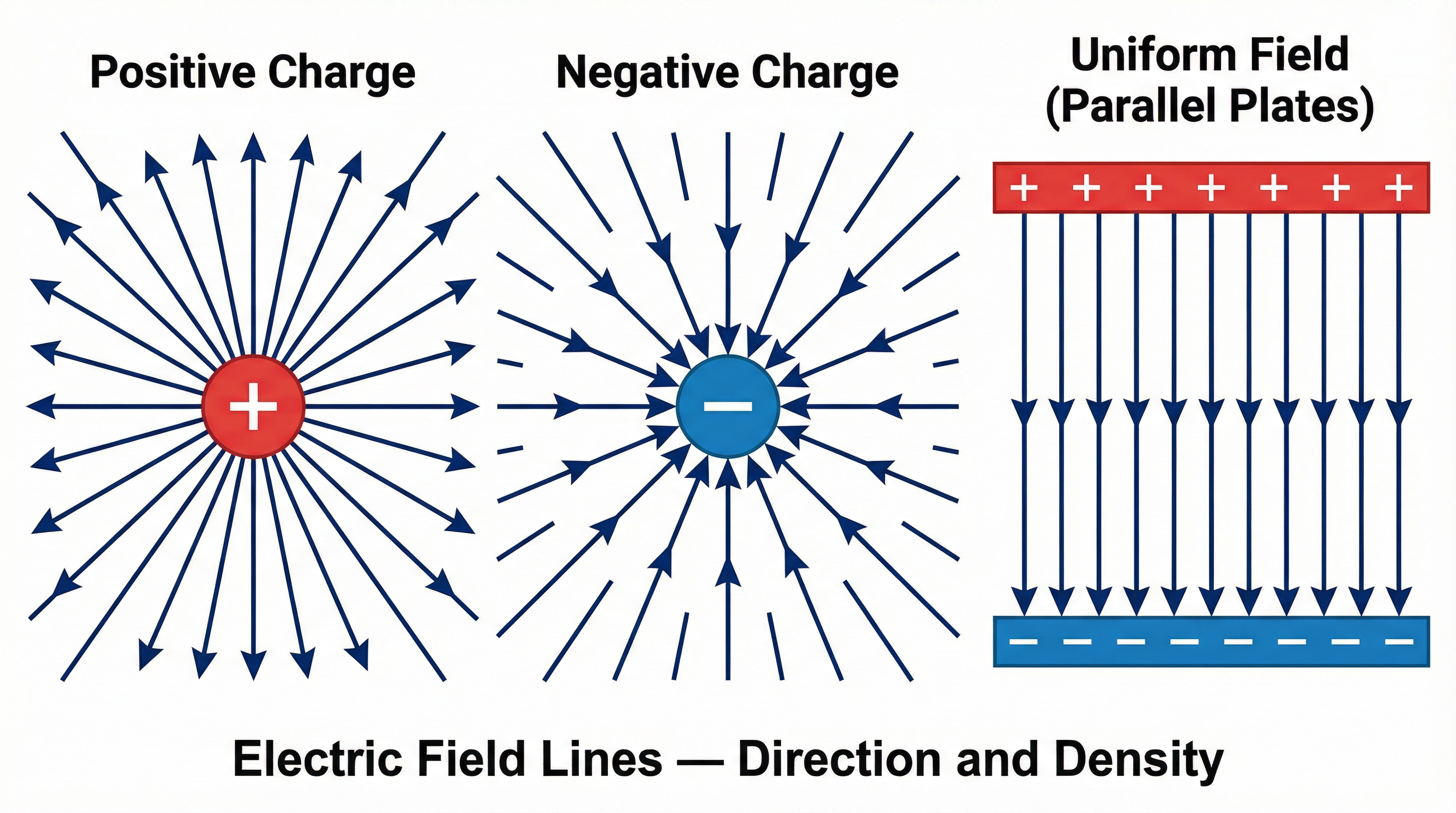
We represent these fields using electric field lines. These are not just pretty patterns; they are a precise language that examiners expect you to speak fluently. The lines show the direction of the force that would be exerted on a positive test charge. Therefore:
- Field lines always point away from positive charges.
- Field lines always point towards negative charges.
The spacing of the lines indicates the strength of the field. The closer the lines, the stronger the electric field. Field lines must never cross, and they must always meet a surface at a right angle (90°).
Concept 3: Sparking and Ionisation (Higher Tier Only)
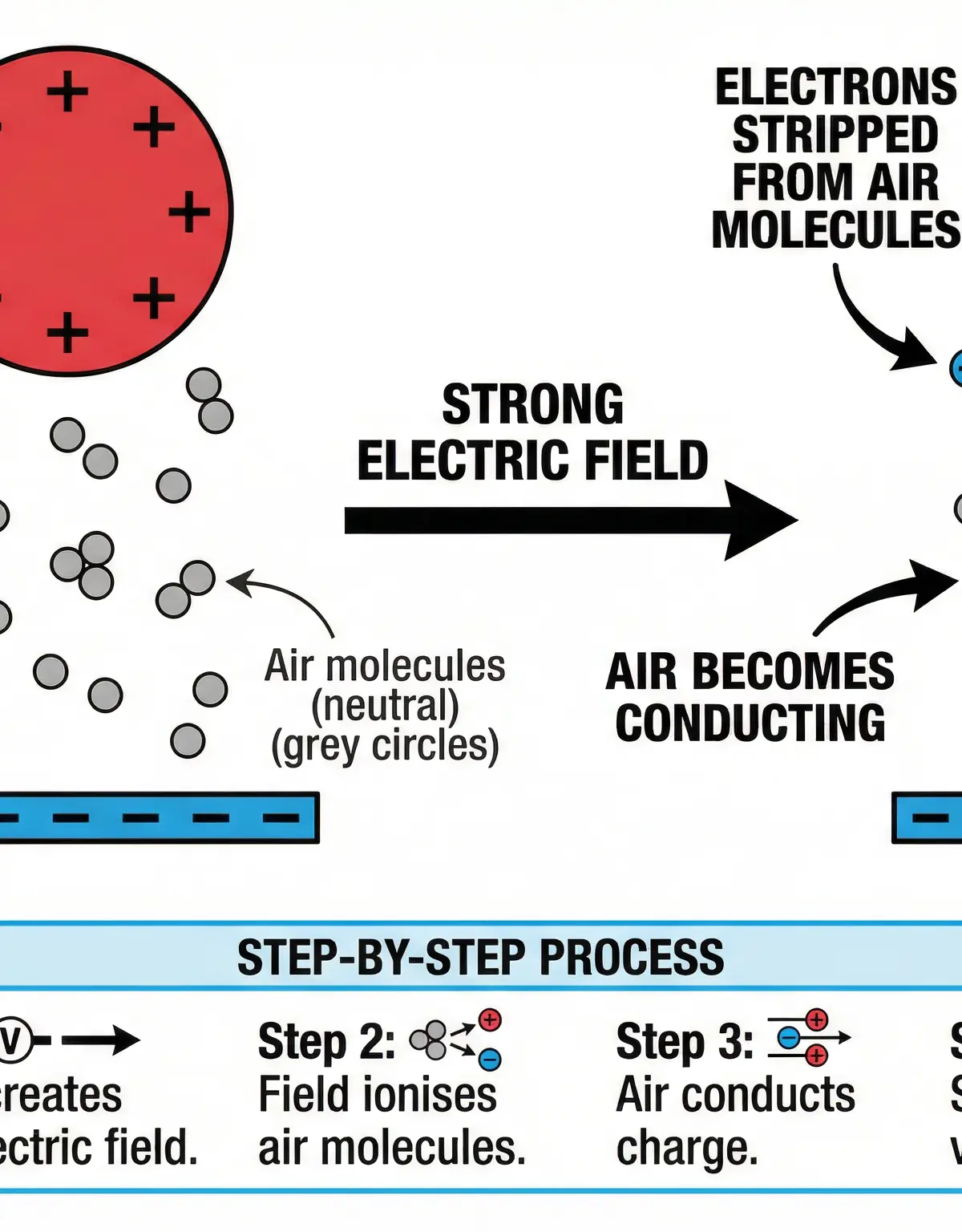
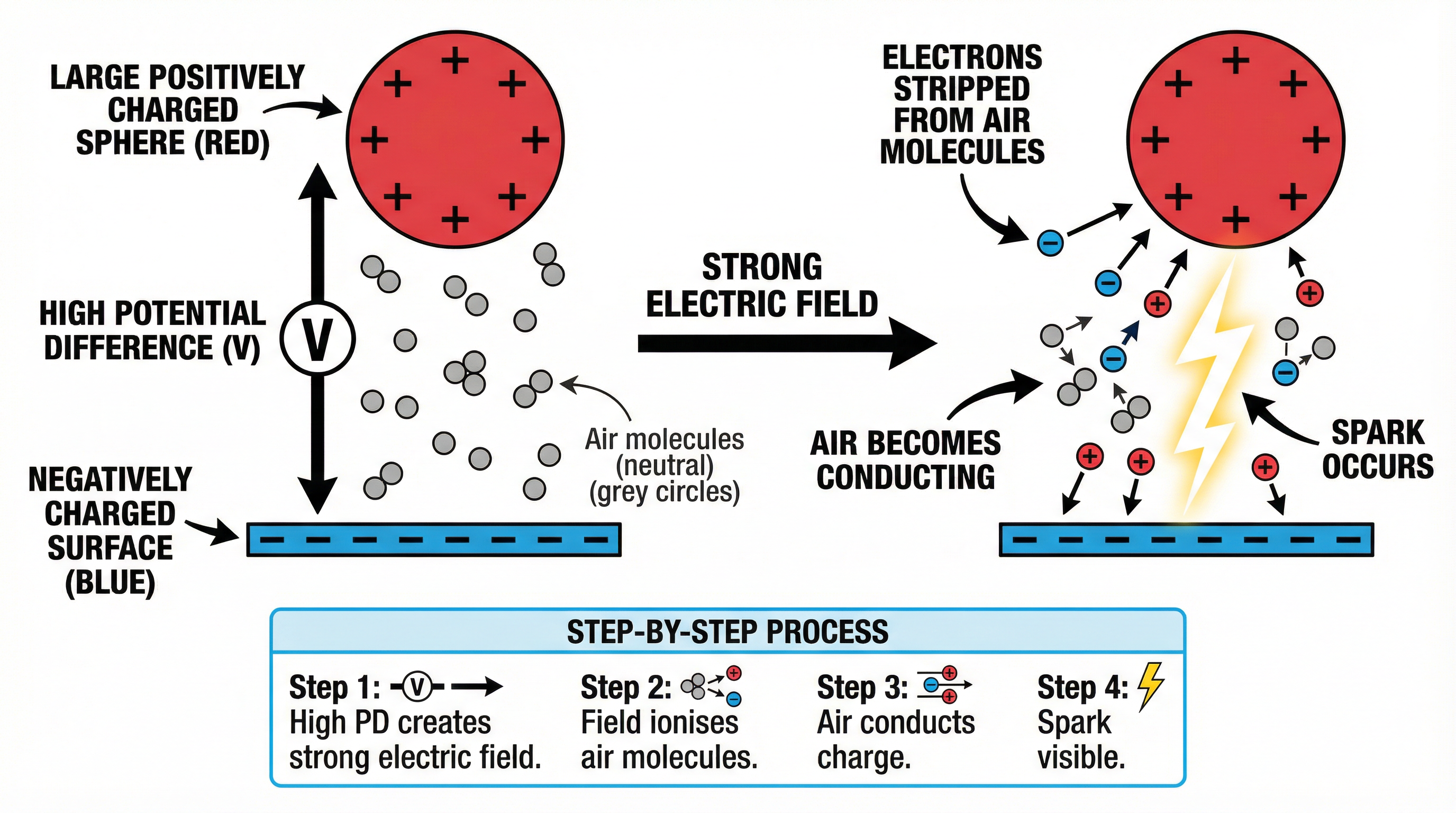
This is a key differentiator for Higher Tier candidates. When a large amount of charge builds up on an object, it creates a large potential difference between the object and its surroundings (e.g., the air or an earthed conductor). This high potential difference creates a very strong electric field in the gap.
Air is normally an insulator. However, if the electric field is strong enough, it can exert a huge force on the atoms in the air. This force is strong enough to strip the outer electrons away from the air molecules. This process is called ionisation. The air is turned from a gas of neutral molecules into a mixture of positive ions and free electrons.
This mixture of charged particles (a plasma) is an excellent electrical conductor. Charge can now flow rapidly across the gap, from the object to the ground or to another object. This rapid flow of charge is what we see as a spark. The energy released heats the air, causing it to glow brightly.
Mathematical/Scientific Relationships
There are no complex formulas to memorise for this specific topic at GCSE level. The key relationships are conceptual:
- Force and Distance: The strength of the electric force between two charged objects decreases as the distance between them increases.
- Field Strength and Line Density: The strength of the electric field is directly proportional to the density (closeness) of the electric field lines.
Practical Applications
Static electricity isn't just an abstract concept; it has major real-world applications and dangers.
- Inkjet Printers and Photocopiers: Use static electricity to direct charged ink droplets or toner particles onto the correct parts of the paper.
- Paint Spraying: Car panels are given a static charge, and the paint droplets are given the opposite charge. This ensures the paint is attracted to the panel, resulting in an even coat and less waste.
- Dangers and Prevention: Sparks from static discharge can ignite flammable gases or dust, for example, during aircraft refuelling. To prevent this, aircraft are connected to the earth with a conductor (a process called 'earthing') to allow any charge to flow away safely.
Visual Resources
3 diagrams and illustrations
Interactive Diagrams
2 interactive diagrams to visualise key concepts
Conceptual Flow Outline
Flowchart showing the process of charging by friction.
Conceptual Flow Outline
Flowchart showing the steps leading to an electrical spark.
Worked Examples
3 worked examples — open one to explore the question and available guidance.
Practice Questions
Test your understanding — click to reveal model answers
Describe how you could demonstrate that an inflated balloon has become charged. [3 marks]
Hint: Think about how a charged object interacts with other small, light objects.
A plastic rod is charged negatively. Draw the electric field around the rod. [3 marks]
Hint: Remember the rules for field line direction and how they meet a surface.
Explain why a person might get an electric shock when touching a metal tap after walking on a carpet. [4 marks]
Hint: Think about charging by friction, conduction, and the role of the metal tap.
Two identical, negatively charged spheres are brought close to each other. Describe and explain the motion of the spheres. [3 marks]
Hint: What is the rule for how like charges interact?
During aircraft refuelling, a copper wire connects the aircraft to the ground. Explain why this is a necessary safety precaution. [4 marks] (Higher Tier elements)
Hint: Think about friction, charge build-up, and the danger of sparks.
Test your understanding of Static Electricity
Active recall beats re-reading. Take an instant quiz now to test what you’ve learned and lock it into long-term memory.
7 days Premium · Then free forever · No card, no charge