Pearson Edexcel · A-Level · Physics
Nuclear and Particle Physics
Master the fundamental building blocks of the universe and how we study them. This topic connects the microscopic world of quarks and leptons with the macroscopic technologies of particle accelerators, essential for securing top marks in your Physics exam.
- 6 min read
- 3 worked examples
- 5 practice questions
- 6 key terms
Study Notes
Overview
Welcome to Nuclear and Particle Physics. This topic takes you to the very edge of our understanding of the universe, exploring the fundamental particles that make up everything around us and the forces that govern their interactions. It's a cornerstone of modern physics, bridging the gap between theoretical models like the Standard Model and practical applications such as particle accelerators.
For the exam, this topic is heavily assessed on your ability to apply conservation laws to particle interactions and to mathematically model the paths of charged particles in magnetic and electric fields. You'll need to be comfortable calculating energy conversions (especially using E=mc^2), analyzing bubble chamber tracks, and explaining the specific functions of components in devices like cyclotrons and linear accelerators. This connects strongly to your earlier studies of circular motion, electric fields, and magnetic fields, bringing them all together in high-energy contexts.
Key Concepts
Concept 1: The Standard Model
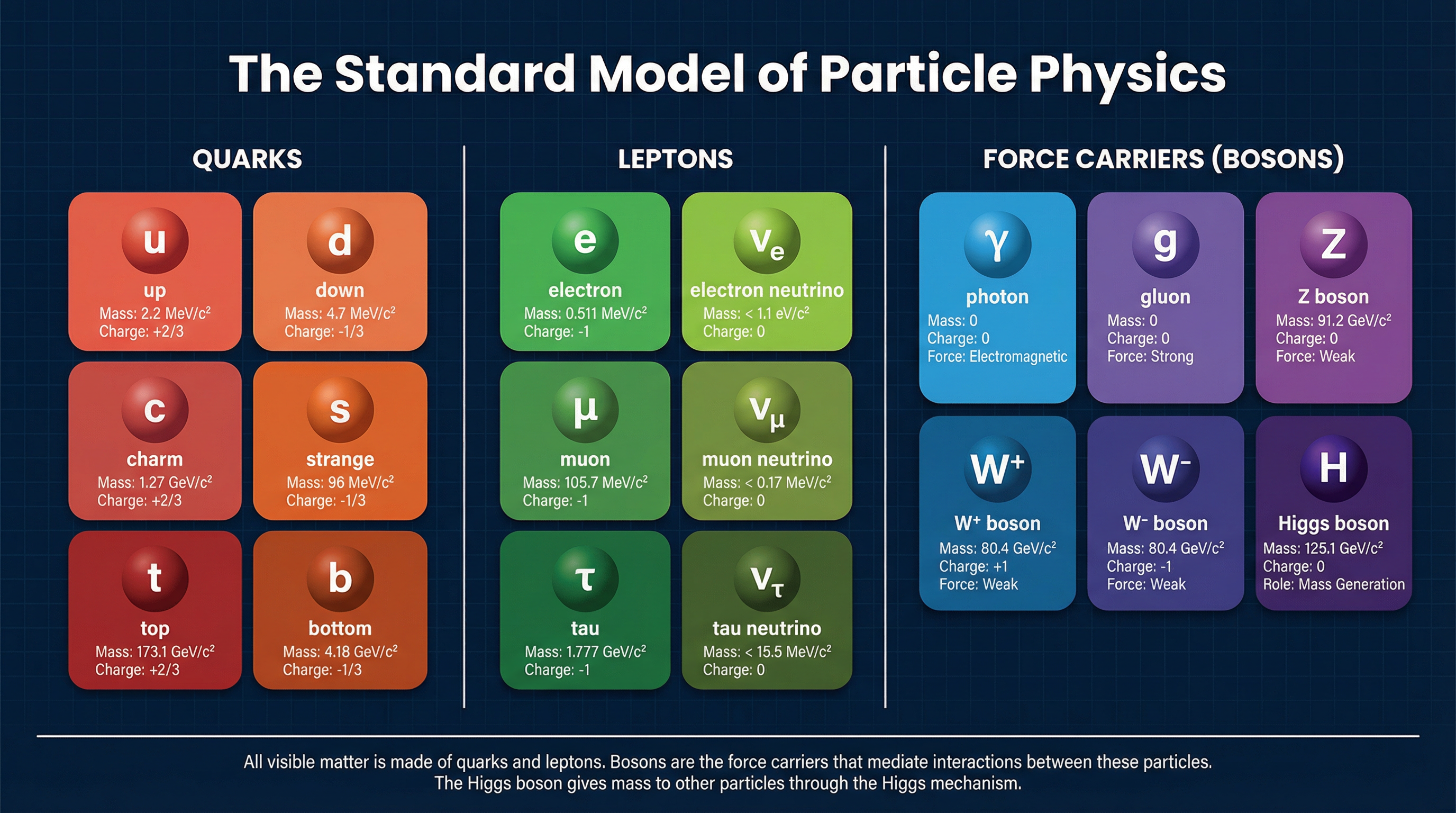
The Standard Model is the theoretical framework that describes all known fundamental particles and three of the four fundamental forces (excluding gravity). It divides particles into two main families: fermions (matter particles) and bosons (force carriers).
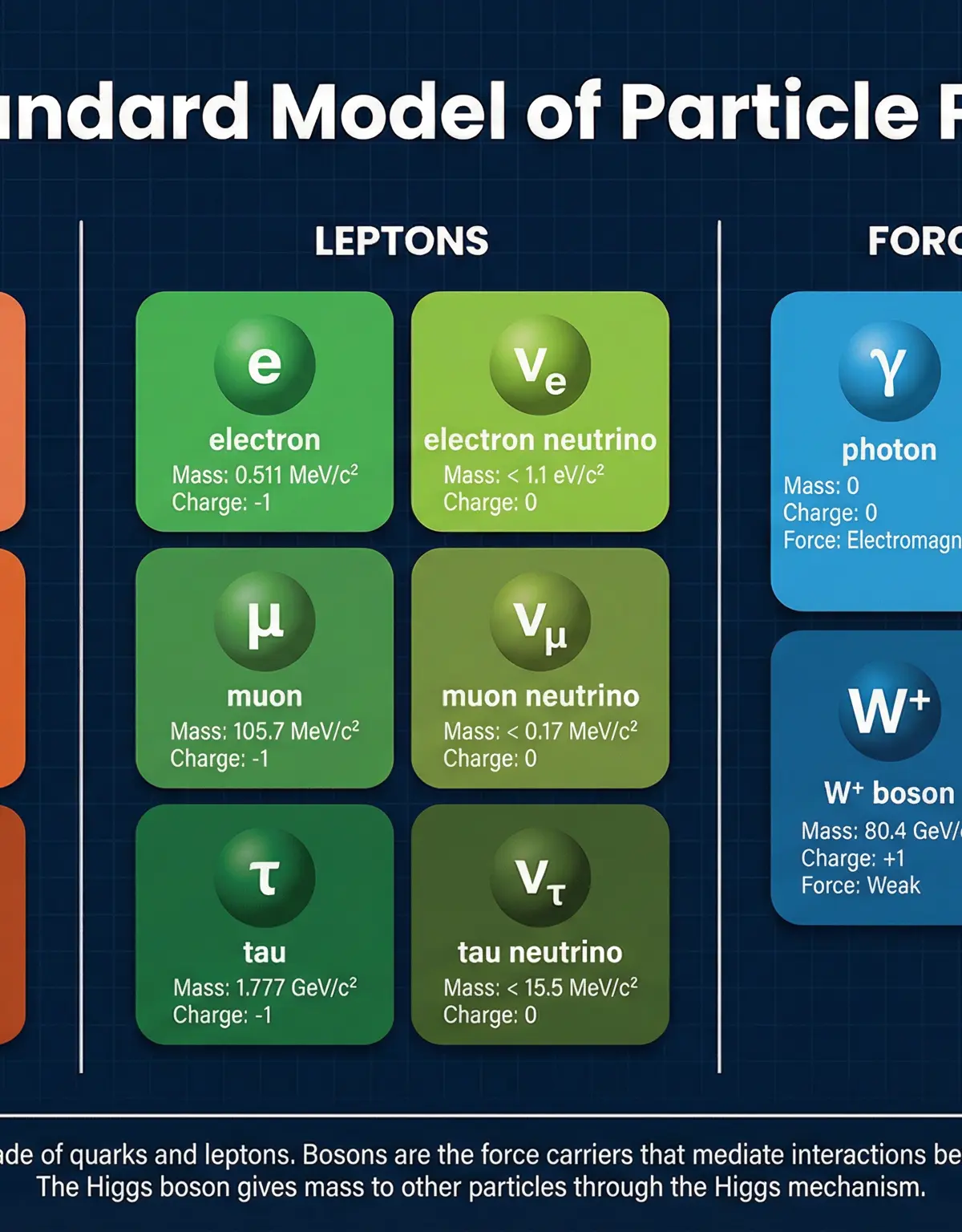
Fermions are further split into quarks and leptons.
- Quarks experience the strong nuclear force. They combine to form hadrons (like protons and neutrons). The key quarks to know are up (u, charge +2/3e) and down (d, charge -1/3e). A proton is uud and a neutron is udd.
- Leptons do not experience the strong nuclear force. The most familiar lepton is the electron (e^-). Others include the muon (\mu^-) and the tau (\tau^-), each with an associated neutrino ($
u_e,
u_\mu,
u_\tau$).
Bosons mediate the forces:
- Photon (\gamma): Electromagnetic force.
- Gluon (g): Strong nuclear force (binds quarks together).
- W and Z bosons (W^+, W^-, Z^0): Weak nuclear force (responsible for radioactive decay).
Example: In \beta^- decay, a neutron (udd) turns into a proton (uud). At the quark level, a down quark changes into an up quark, emitting a W^- boson, which then decays into an electron and an electron antineutrino ($\bar{
u}_e$).
Concept 2: Conservation Laws
Examiners love testing your ability to apply conservation laws to determine if a particle interaction is possible. In any interaction, the following must be conserved:
- Charge (Q)
- Baryon Number (B): All baryons (protons, neutrons) have B=+1. Antibaryons have B=-1. Mesons and leptons have B=0.
- Lepton Number (L): Conserved separately for each generation (electron lepton number, muon lepton number, etc.).
- Energy and Momentum
Strangeness (S) is a special case. It is conserved in strong and electromagnetic interactions but can change by \pm 1 in weak interactions (like decays). This is a frequent trap in exams!
Concept 3: Particle Accelerators
Accelerators use electric and magnetic fields to increase the kinetic energy of particles and steer them. The golden rule here is:
- Electric fields accelerate (they do work on the particle, changing its speed).
- Magnetic fields steer (they provide a centripetal force perpendicular to velocity, changing direction but NOT speed).
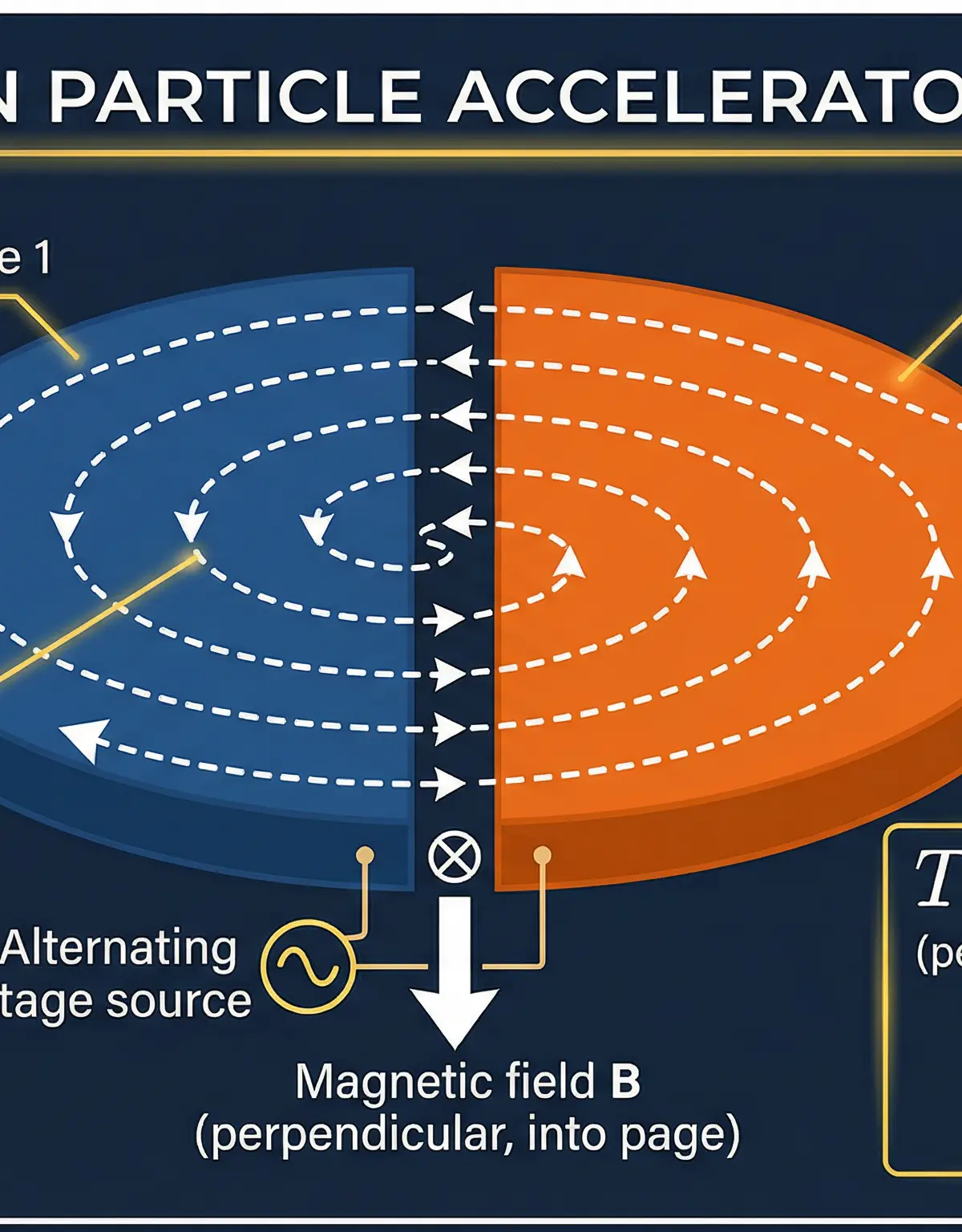
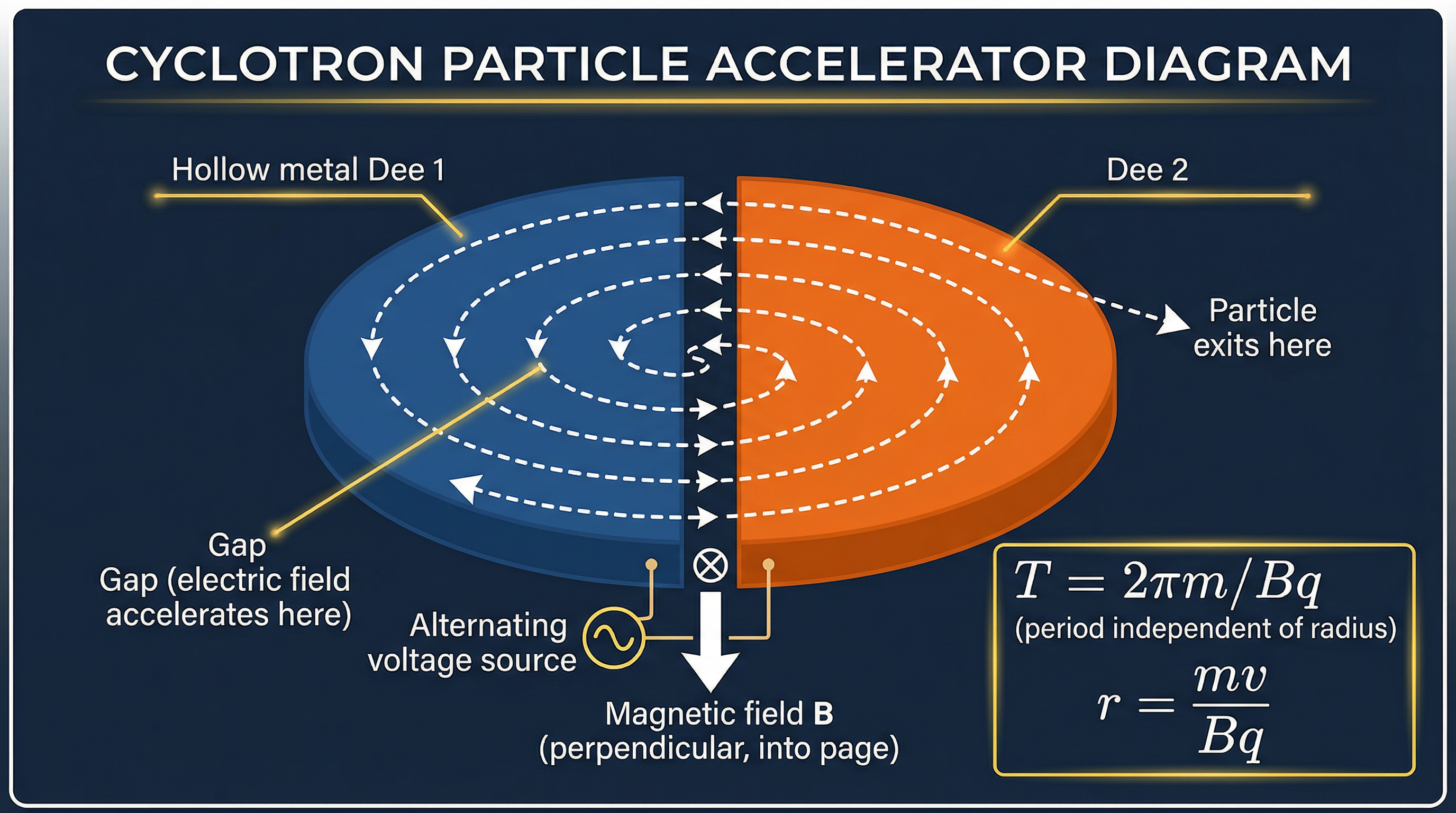
In a cyclotron, particles are accelerated across a gap between two D-shaped electrodes ('dees') by an alternating electric field. A uniform magnetic field perpendicular to the dees makes the particles move in a circular path. As they gain energy, the radius of their path increases, but crucially, the time taken to complete one semicircle remains constant. This allows a fixed-frequency alternating voltage to remain in sync with the particles.
Concept 4: Analyzing Particle Tracks
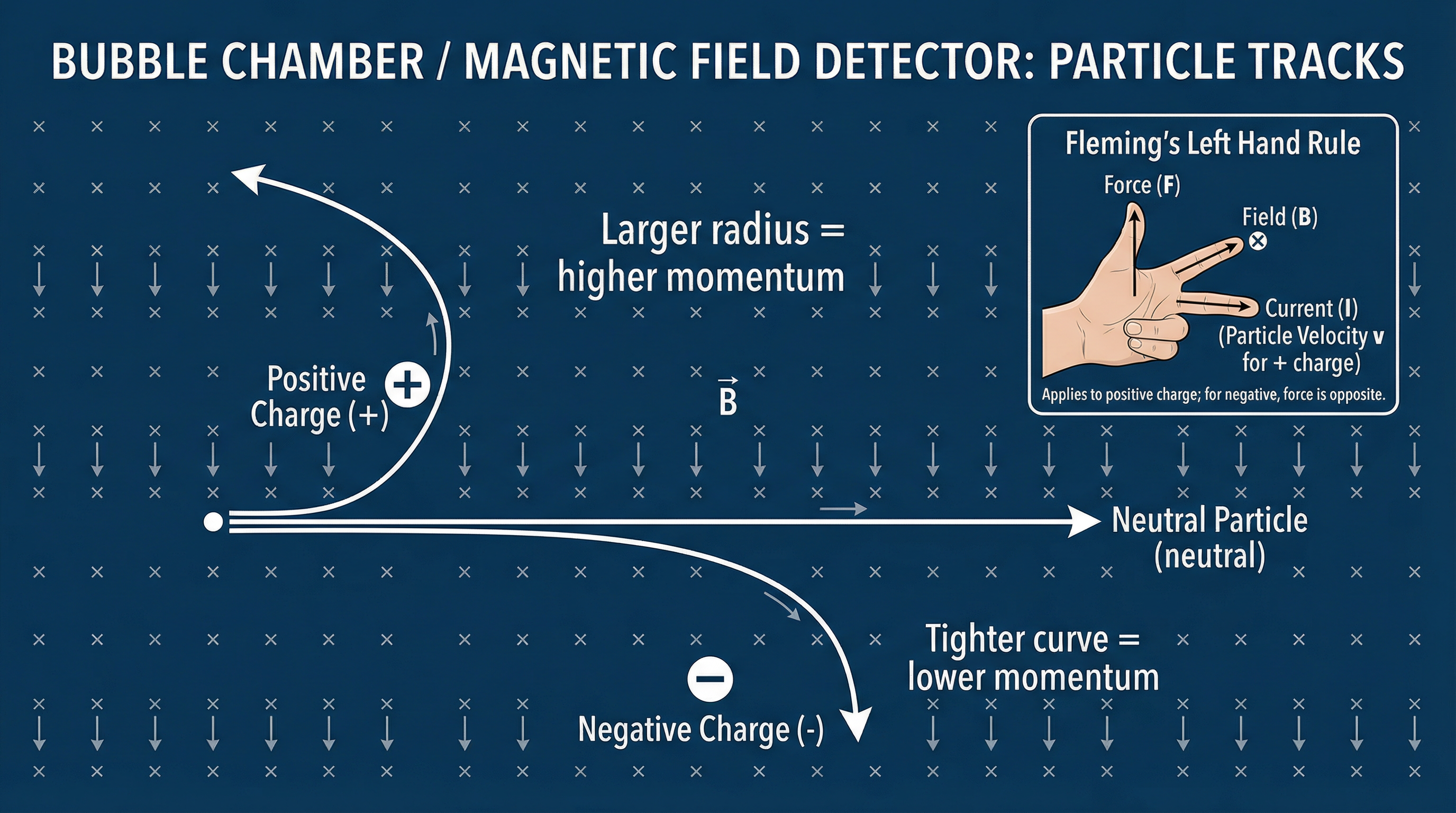
When charged particles pass through a detector (like a bubble chamber) in a magnetic field, they leave curved tracks.
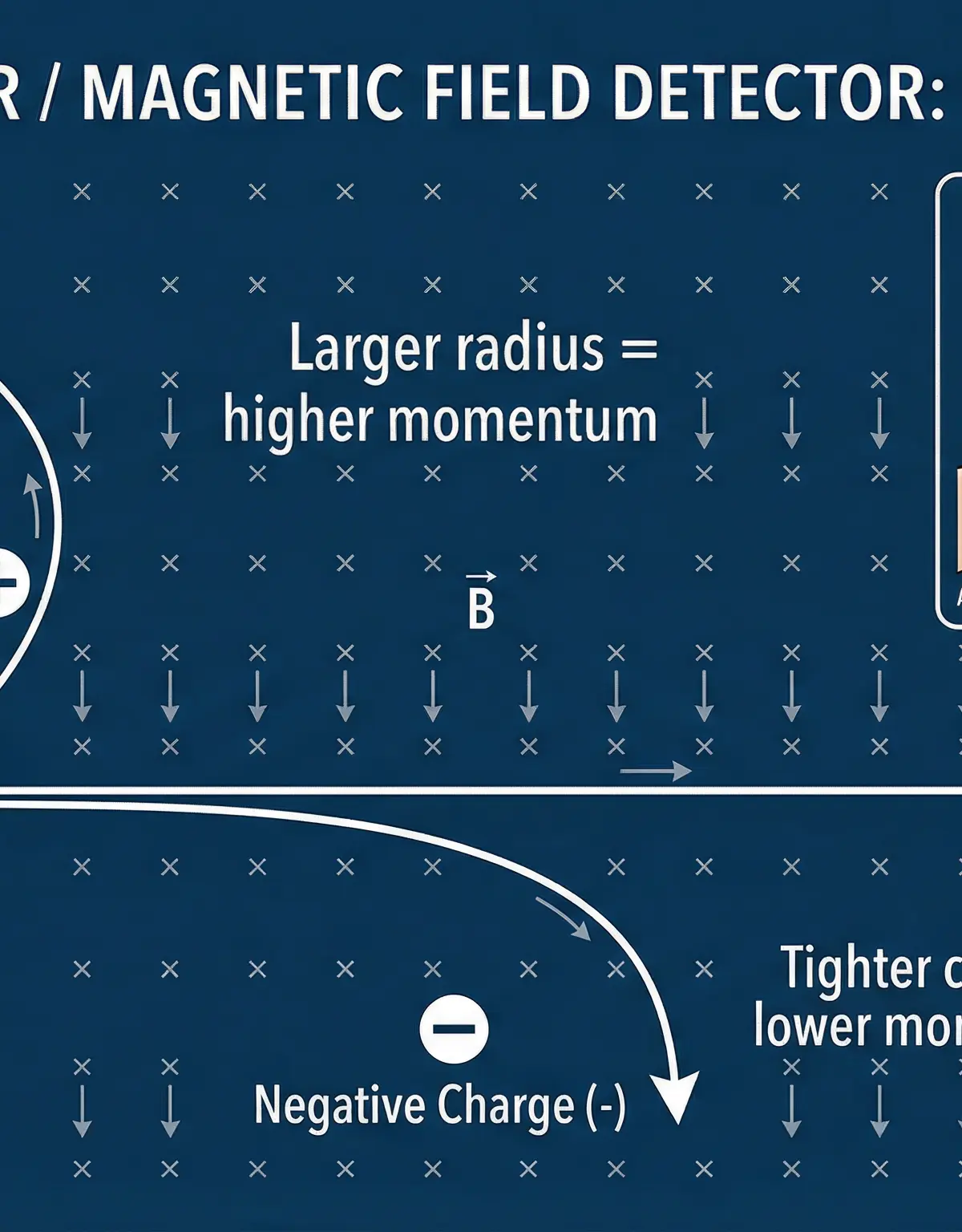
- Direction of curve: Use Fleming's Left Hand Rule to determine the charge. Remember, conventional current is opposite to the flow of negative charges.
- Radius of curve: Relates to momentum. A larger radius means higher momentum (r = mv / Bq). A spiraling track indicates the particle is losing energy (momentum decreases, so radius decreases).
Mathematical/Scientific Relationships
- Mass-Energy Equivalence: E = mc^2
- Used for calculating energy released in annihilation or required for pair production.
- Examiner Tip: Remember to divide total energy by 2 if asked for the energy of a single photon in annihilation.
- Radius of path in a magnetic field: r = \frac{mv}{Bq} or r = \frac{p}{Bq}
- r = radius (m), m = mass (kg), v = velocity (m/s), p = momentum (kg m/s), B = magnetic flux density (T), q = charge (C).
- Time period in a cyclotron: T = \frac{2\pi m}{Bq}
- Note that T is independent of velocity v and radius r. This is why the frequency of the accelerating voltage f = 1/T can remain constant.
Practical Applications
Particle physics isn't just theoretical.
- PET Scanners (Positron Emission Tomography): Use \beta^+ emitting isotopes. The emitted positrons annihilate with electrons in the patient's body, producing pairs of gamma photons that are detected to build a 3D image of functional processes, like brain activity or tumors.
- Cancer Therapy: Linear accelerators (linacs) are used in hospitals to accelerate electrons or protons to high energies to target and destroy cancer cells while minimizing damage to surrounding healthy tissue.
Visual Resources
3 diagrams and illustrations
Interactive Diagrams
2 interactive diagrams to visualise key concepts
Conceptual Flow Outline
Classification tree of fundamental particles in the Standard Model.
Conceptual Flow Outline
The cycle of acceleration and steering in a cyclotron.
Worked Examples
3 worked examples — open one to explore the question and available guidance.
Practice Questions
Test your understanding — click to reveal model answers
A stationary \pi^0 meson decays into two high-energy photons. The rest mass of the \pi^0 is 135 \text{ MeV}/c^2. Calculate the frequency of each photon produced. (4 marks)
Hint: Convert the mass to Joules first using $E=mc^2$, then remember the energy is shared between TWO photons.
Explain why high energies are required to investigate the structure of nucleons. (2 marks)
Hint: Think about the de Broglie wavelength equation.
An electron is moving at 3.0 \times 10^6 m/s perpendicular to a uniform magnetic field of 0.050 T. Calculate the radius of its circular path. (3 marks)
Hint: Use the formula derived from equating magnetic and centripetal forces.
In a particle detector, a track is observed spiraling inwards. The magnetic field is directed into the page. Explain why the track spirals and determine the charge of the particle if it curves clockwise. (4 marks)
Hint: Why would the radius decrease? Apply Fleming's Left Hand Rule.
State the quark composition of a neutron and show that its total charge is zero. (2 marks)
Hint: Recall the charges of up and down quarks.
Test your understanding of Nuclear and Particle Physics
Active recall beats re-reading. Take an instant quiz now to test what you’ve learned and lock it into long-term memory.
7 days Premium · Then free forever · No card, no charge