Pearson Edexcel · GCSE · Physics
Density and States of Matter
Master Edexcel GCSE Physics Topic 14.1: Density and States of Matter. This guide breaks down the essential particle model, the density formula (ρ = m/V), and the Core Practical for measuring density, providing examiner insights and memory hooks to help you secure top marks.
- 6 min read
- 3 worked examples
- 5 practice questions
- 6 key terms
Study Notes
Overview
Welcome to your deep dive into Density and States of Matter, a cornerstone of your Edexcel GCSE Physics course. This topic is all about the particle model — a powerful idea that explains the properties of solids, liquids, and gases by looking at how their tiny particles behave. You'll learn why a block of steel is denser than the same-sized block of wood, and what actually happens when ice melts into water. This isn't just abstract theory; it connects directly to other key areas like Energy (internal energy and latent heat) and Forces (pressure in gases). Examiners frequently test this topic through a mix of calculations, particle diagrams, and a 6-mark question on the Core Practical for measuring density. Mastering this topic means you'll be confident in tackling a wide range of question styles, from simple definitions to complex practical analysis.
Key Concepts
Concept 1: The Particle Model
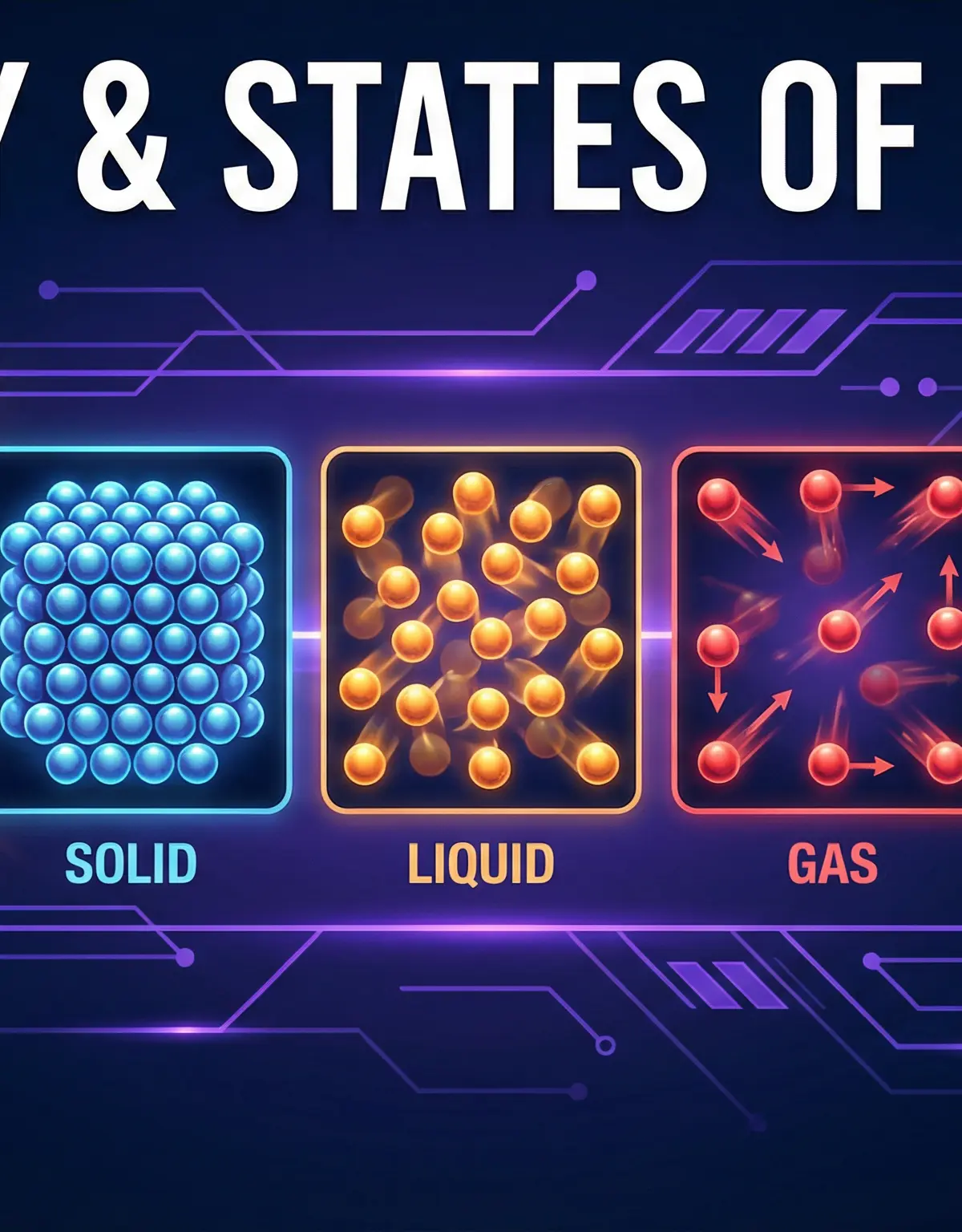
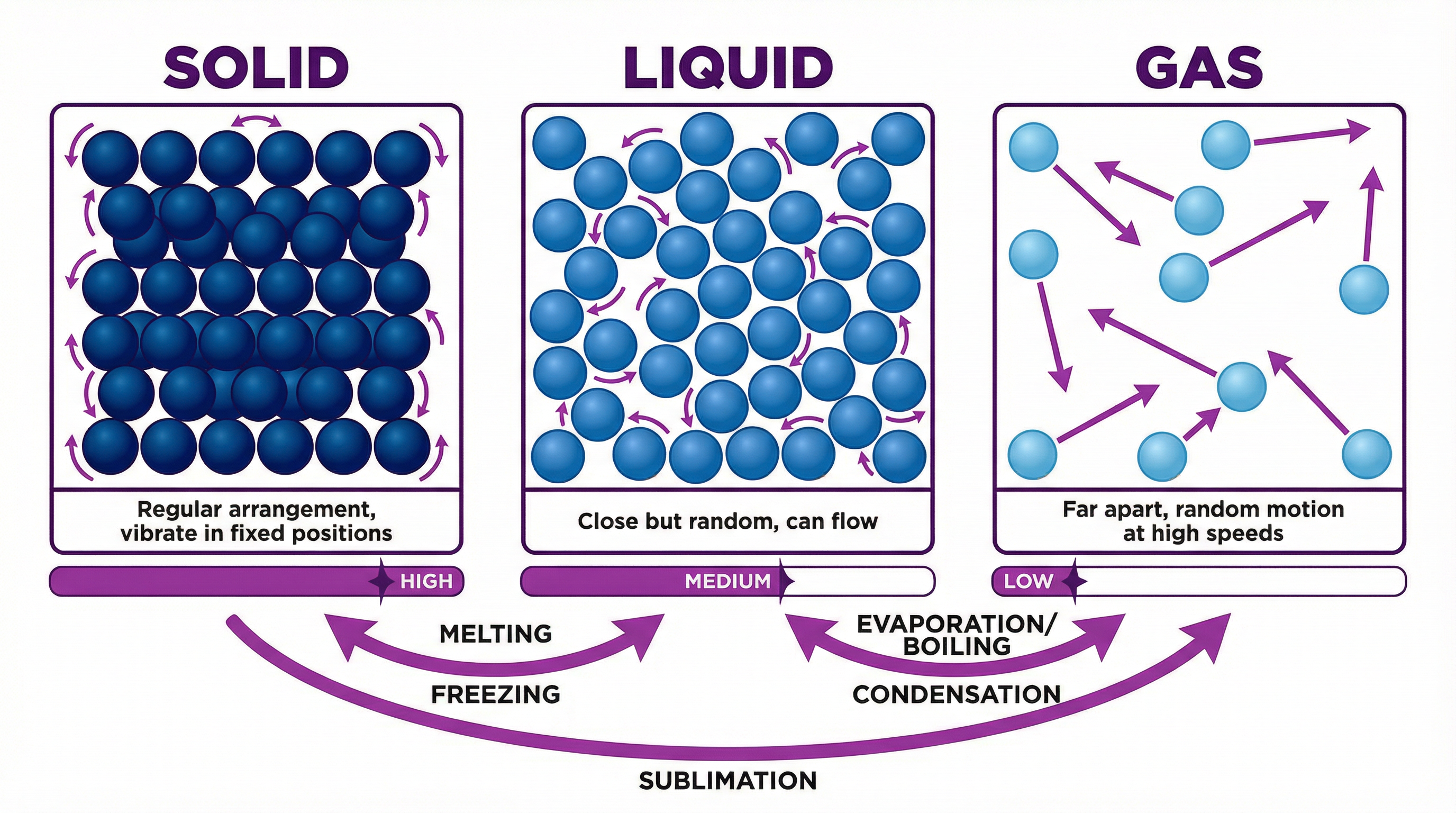
The particle model is the central idea that all matter is made of tiny, constantly moving particles. The arrangement and energy of these particles determine whether a substance is a solid, liquid, or gas. Examiners expect you to describe and draw these arrangements with precision.
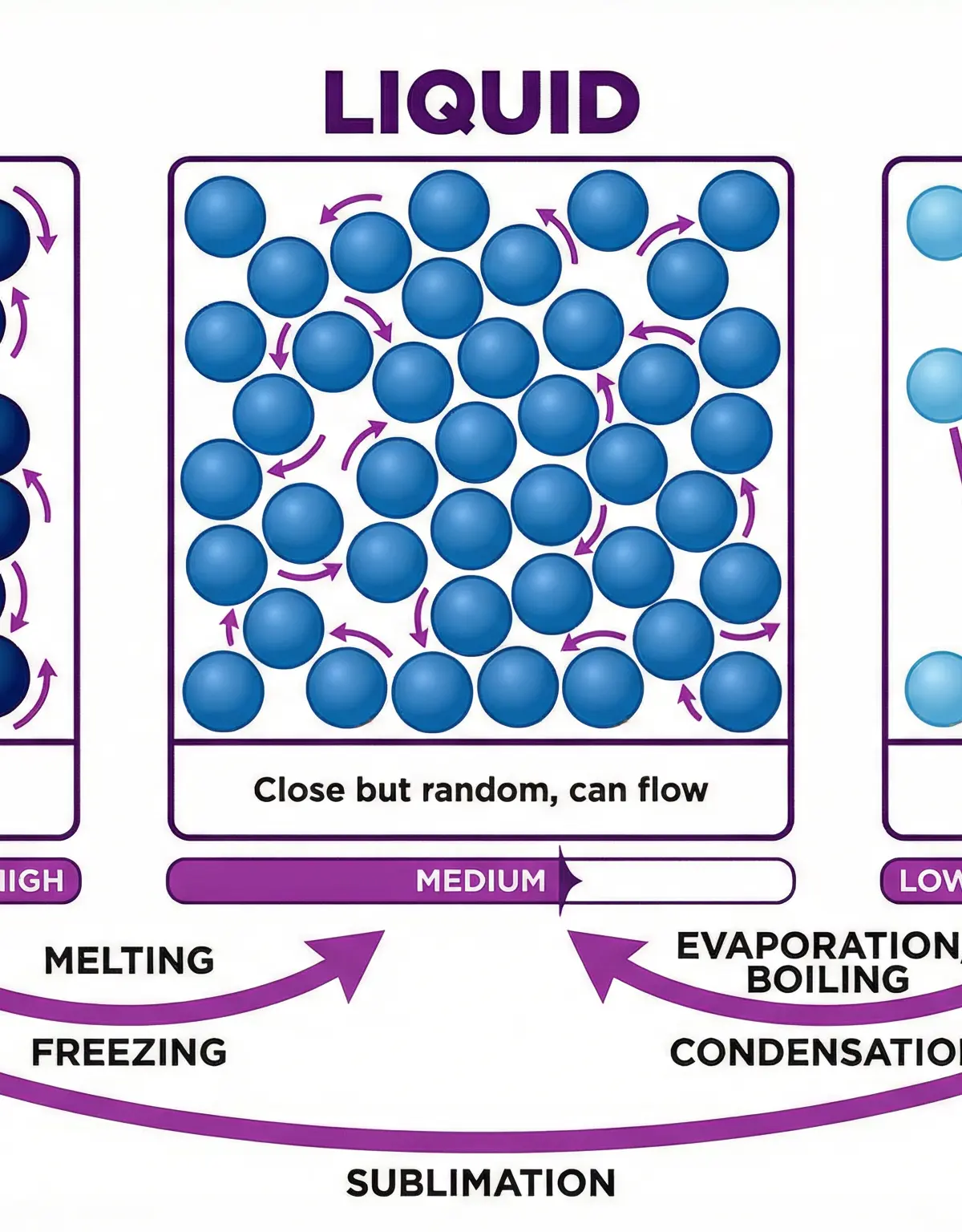
- Solids: Particles are arranged in a regular lattice structure. They are held in fixed positions by strong intermolecular forces and can only vibrate. Because the particles are packed tightly together, solids have a high density.
- Liquids: Particles are close together but randomly arranged. The forces between them are weaker than in solids, allowing them to move past each other. This is why liquids can flow. Their density is typically slightly lower than that of their solid form (a key exception being water).
- Gases: Particles are far apart with negligible forces between them. They move randomly and at high speeds. Because of the large spaces between particles, gases have a very low density and can be easily compressed.
Concept 2: Density
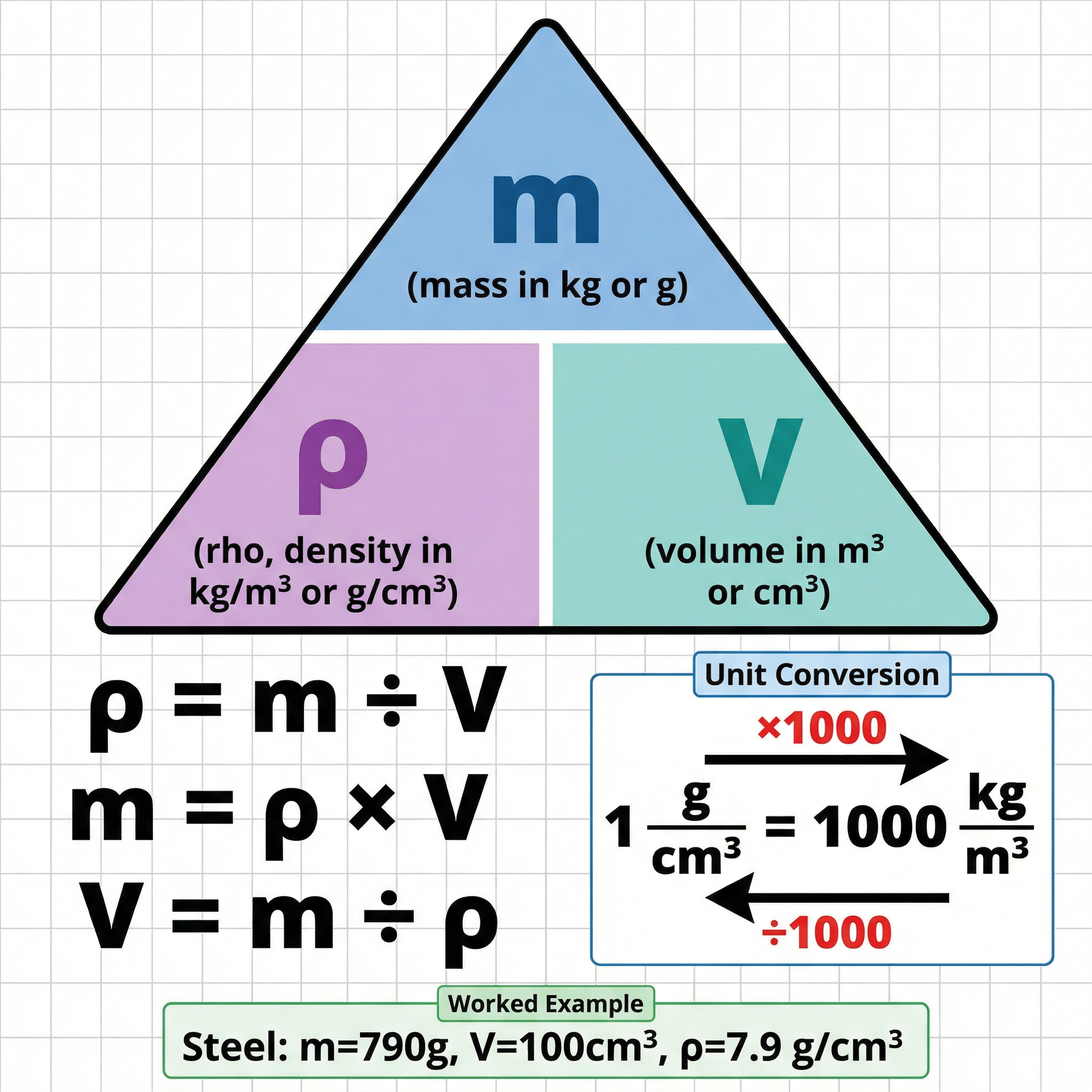
Density is a measure of how much 'stuff' (mass) is crammed into a certain amount of space (volume). It's a fundamental property of a material.
Definition: Density is defined as mass per unit volume. A substance with a high density has a lot of mass packed into a small volume.
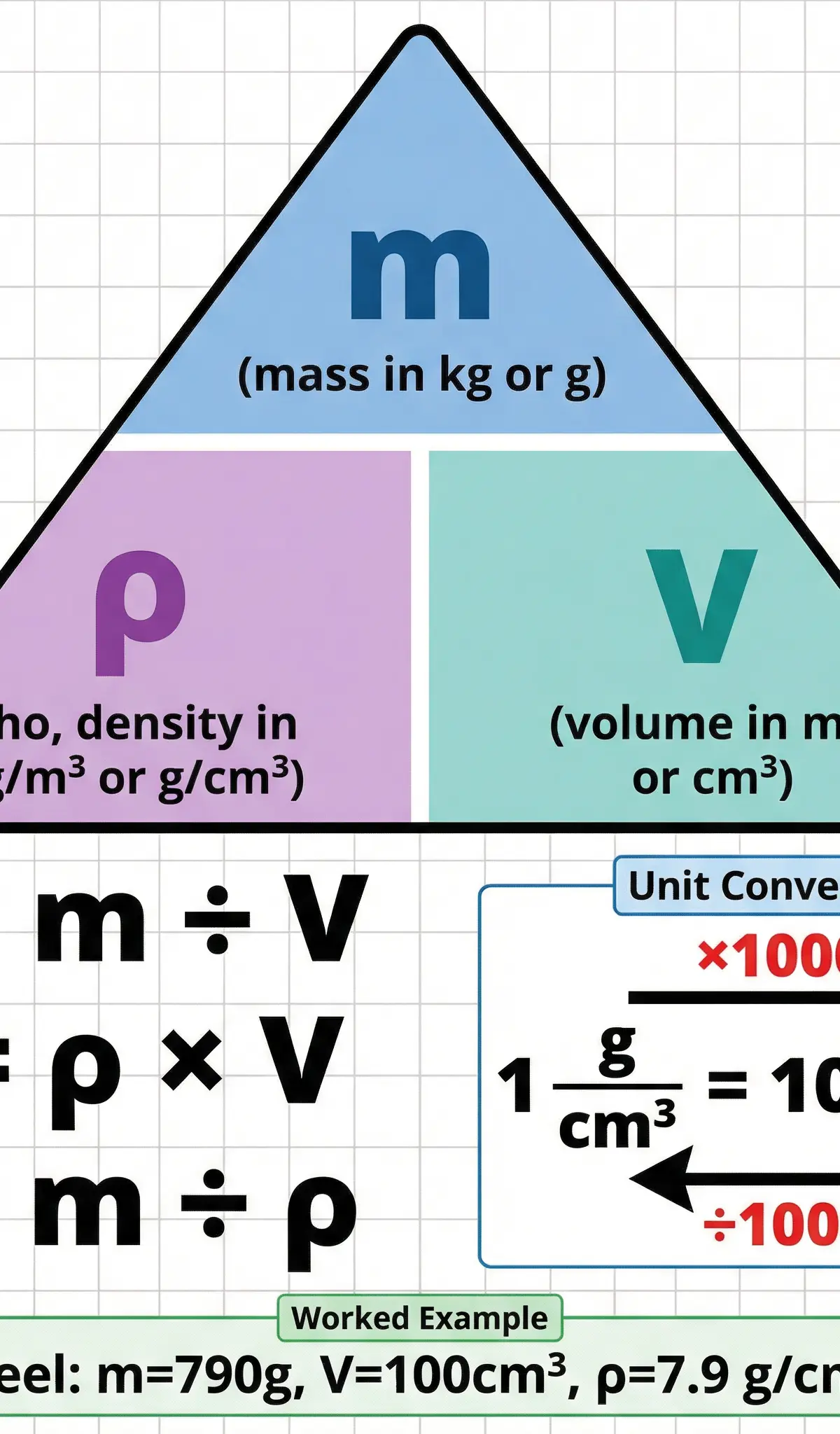
Example: A block of aluminium has a mass of 540g and a volume of 200 cm³. Its density is 540g / 200cm³ = 2.7 g/cm³.
Concept 3: Changes of State & Internal Energy
When a substance is heated, its particles gain internal energy — the total kinetic energy (from their movement) and potential energy (from the bonds between them). This can lead to a change of state.
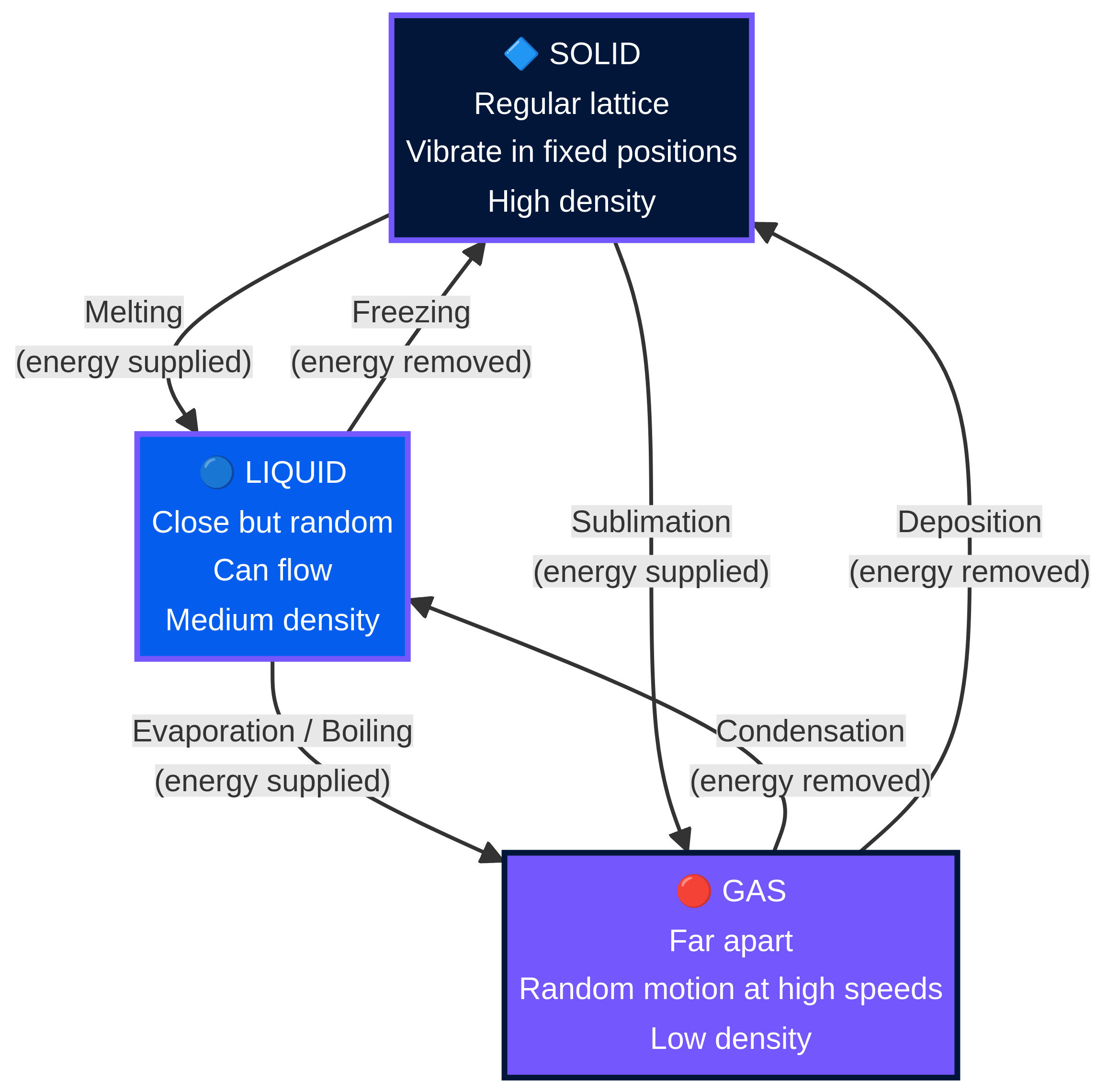
- Melting & Boiling: When energy is supplied, the potential energy of the particles increases, weakening or breaking the bonds holding them together. During a change of state, the temperature remains constant because the energy is being used to change the state (latent heat), not to increase the kinetic energy of the particles.
- Conservation of Mass: Crucially, during a physical change of state, mass is conserved. The number of particles remains the same; they just rearrange themselves. If you melt 1kg of ice, you get 1kg of water.
- Physical vs. Chemical Changes: Changes of state are physical changes because they are reversible. No new substances are formed. This is a key distinction that can be tested.
Mathematical/Scientific Relationships
Density Formula
- Formula:
ρ = m / V - ρ (rho): Density (kg/m³ or g/cm³)
- m: Mass (kg or g)
- V: Volume (m³ or cm³)
- Status: Given on formula sheet. You must be able to rearrange it.
Unit Conversions
- g/cm³ to kg/m³: Multiply by 1000. (e.g., 2 g/cm³ = 2000 kg/m³)
- kg/m³ to g/cm³: Divide by 1000. (e.g., 800 kg/m³ = 0.8 g/cm³)
- Status: Must memorise. This is a very common source of error.
Required Practical: Measuring Density (Core Practical 14.3)
This is a guaranteed area for exam questions, including potential 6-mark questions. You need to know the method for both regular and irregular solids.
Apparatus List:
- Balance (for measuring mass)
- Ruler or Vernier callipers (for regular solids)
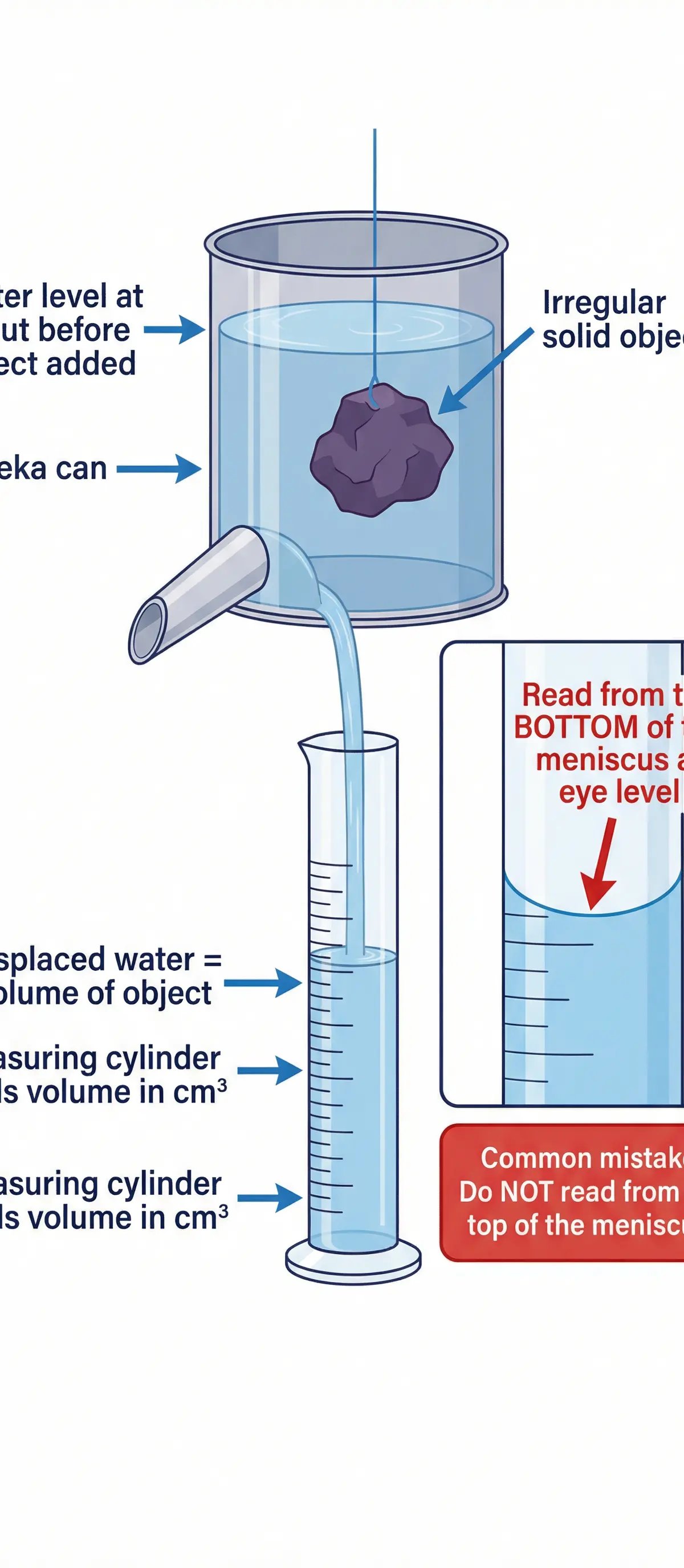
- Eureka (displacement) can
- Measuring cylinder
- String
- The objects to be measured
Method for an Irregular Solid
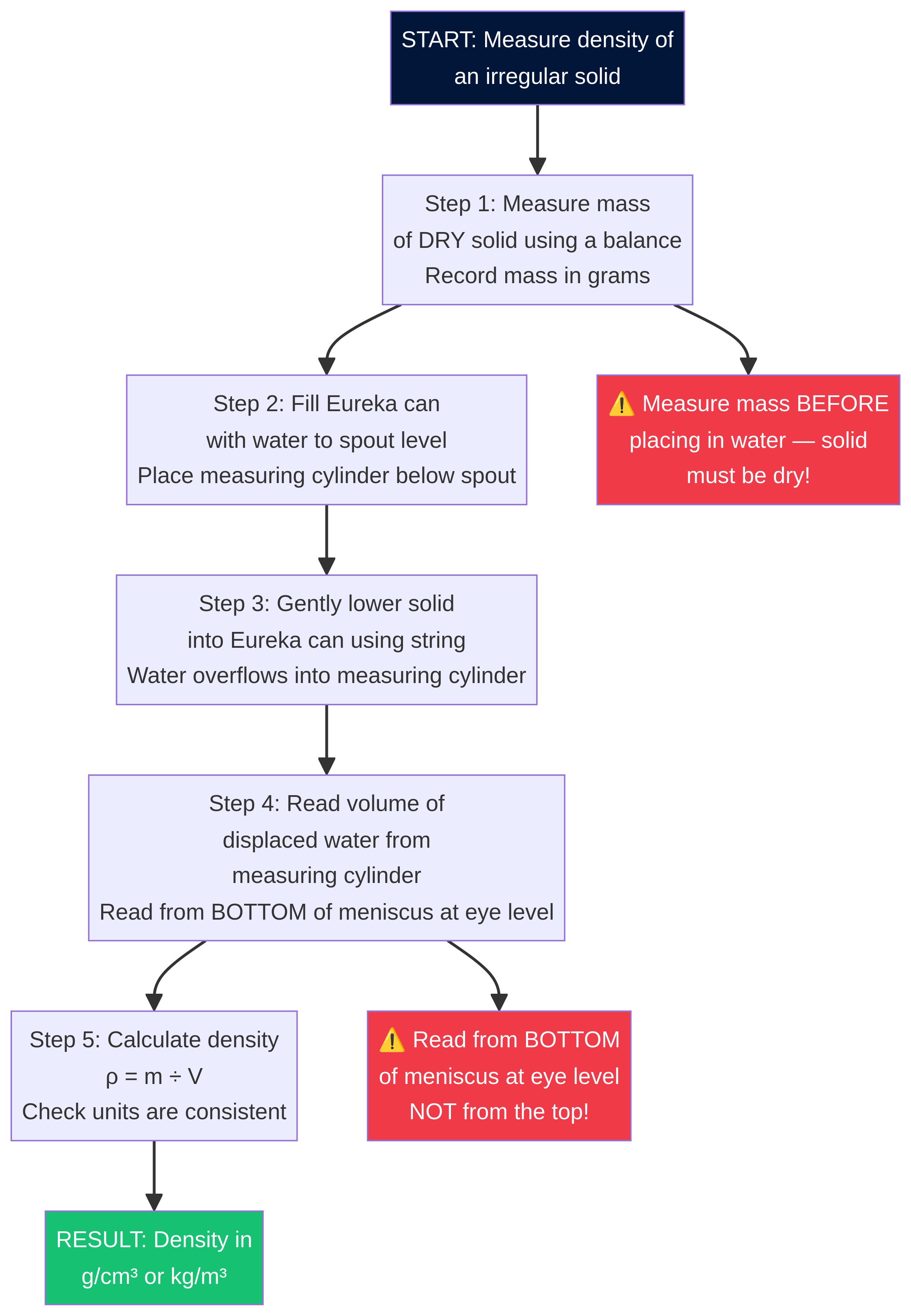
- Measure Mass: Place the dry irregular object on a balance and record its mass (m).
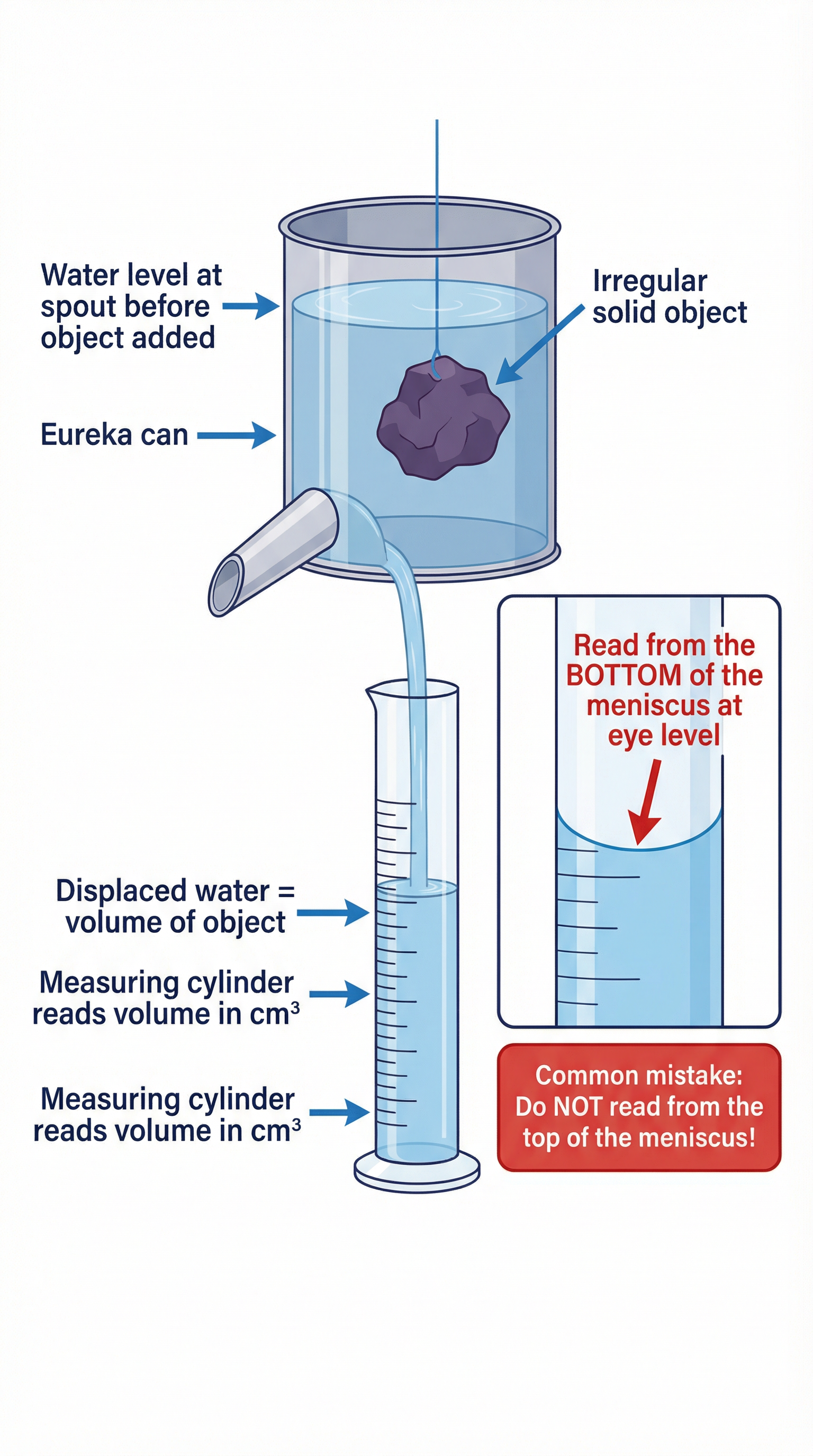
- Prepare for Displacement: Fill the Eureka can with water until it just starts to trickle out of the spout. Wait for it to stop dripping.
- Collect Displaced Water: Place an empty measuring cylinder directly under the spout.
- Measure Volume: Carefully lower the object into the Eureka can using a piece of string until it is fully submerged. The volume of water that overflows into the measuring cylinder is equal to the volume of the object (V).
- Read the Volume: Read the volume from the measuring cylinder at eye level from the bottom of the meniscus.
- Calculate Density: Use the formula
ρ = m / Vto calculate the density.
Method for a Regular Solid (e.g., a Cube)
- Measure Mass: Place the cube on a balance and record its mass (m).
- Measure Dimensions: Use a ruler to measure the length, width, and height of the cube. For greater precision, use Vernier callipers and take multiple readings to calculate an average.
- Calculate Volume: Calculate the volume using the formula
Volume = length × width × height. - Calculate Density: Use the formula
ρ = m / Vto calculate the density.
Visual Resources
5 diagrams and illustrations
Interactive Diagrams
2 interactive diagrams to visualise key concepts
Conceptual Flow Outline
This flowchart shows the transitions between the three states of matter and the energy changes involved.
Conceptual Flow Outline
A step-by-step flowchart for the Core Practical method of finding the density of an irregular solid.
Worked Examples
3 worked examples — open one to explore the question and available guidance.
Practice Questions
Test your understanding — click to reveal model answers
State the formula that links density, mass, and volume. (1 mark)
Hint: Think about the definition of density.
A student measures the mass of a 50 cm³ block of wood as 40 g. Calculate the density of the wood. (2 marks)
Hint: Use the formula from the previous question.
Describe the arrangement and motion of particles in a liquid. (2 marks)
Hint: How are the particles positioned relative to each other? Can they move?
A piece of rock has a mass of 150 g. When it is lowered into a Eureka can, it displaces 60 cm³ of water. Calculate the density of the rock in kg/m³. (4 marks)
Hint: First calculate the density in g/cm³, then convert the units.
Explain why heating a gas in a sealed container increases its pressure. (3 marks)
Hint: This is a synoptic link to the topic of Pressure. Think about what heating does to the particles' energy and movement.
Test your understanding of Density and States of Matter
Active recall beats re-reading. Take an instant quiz now to test what you’ve learned and lock it into long-term memory.
7 days Premium · Then free forever · No card, no charge