Pearson Edexcel · GCSE · Physics
Efficiency and Power
Master Edexcel GCSE Physics Topic 3.2: Efficiency and Power. This guide provides everything you need to calculate efficiency and power, explain energy dissipation, and secure top marks in your exam, complete with worked examples and examiner insights.
- 5 min read
- 3 worked examples
- 5 practice questions
- 6 key terms
Study Notes
Overview
Efficiency and Power are fundamental concepts in physics that determine how effectively energy is used in any system, from a simple light bulb to a complex power station. For your Edexcel GCSE exam, this topic is a rich source of calculation and explanation questions, carrying significant marks. Understanding the relationship between energy, power, and time, and being able to quantify and explain energy 'wastage' is crucial. Examiners frequently test your ability to apply the core formulas, convert units accurately, and use precise scientific language to describe how to improve efficiency. This guide will equip you with the knowledge and exam technique to tackle these questions with confidence, linking directly to other key areas like thermal energy, electricity, and mechanics.
Key Concepts
Concept 1: The Principle of Conservation of Energy
This is the golden rule of energy: Energy cannot be created or destroyed, only transferred from one store to another. When you use an electrical appliance, you are not 'using up' energy; you are converting it from an electrical store into other stores. Some of these are useful (like the kinetic energy of a fan's blades) and some are not (like the thermal energy dissipated to the surroundings).
Concept 2: Efficiency
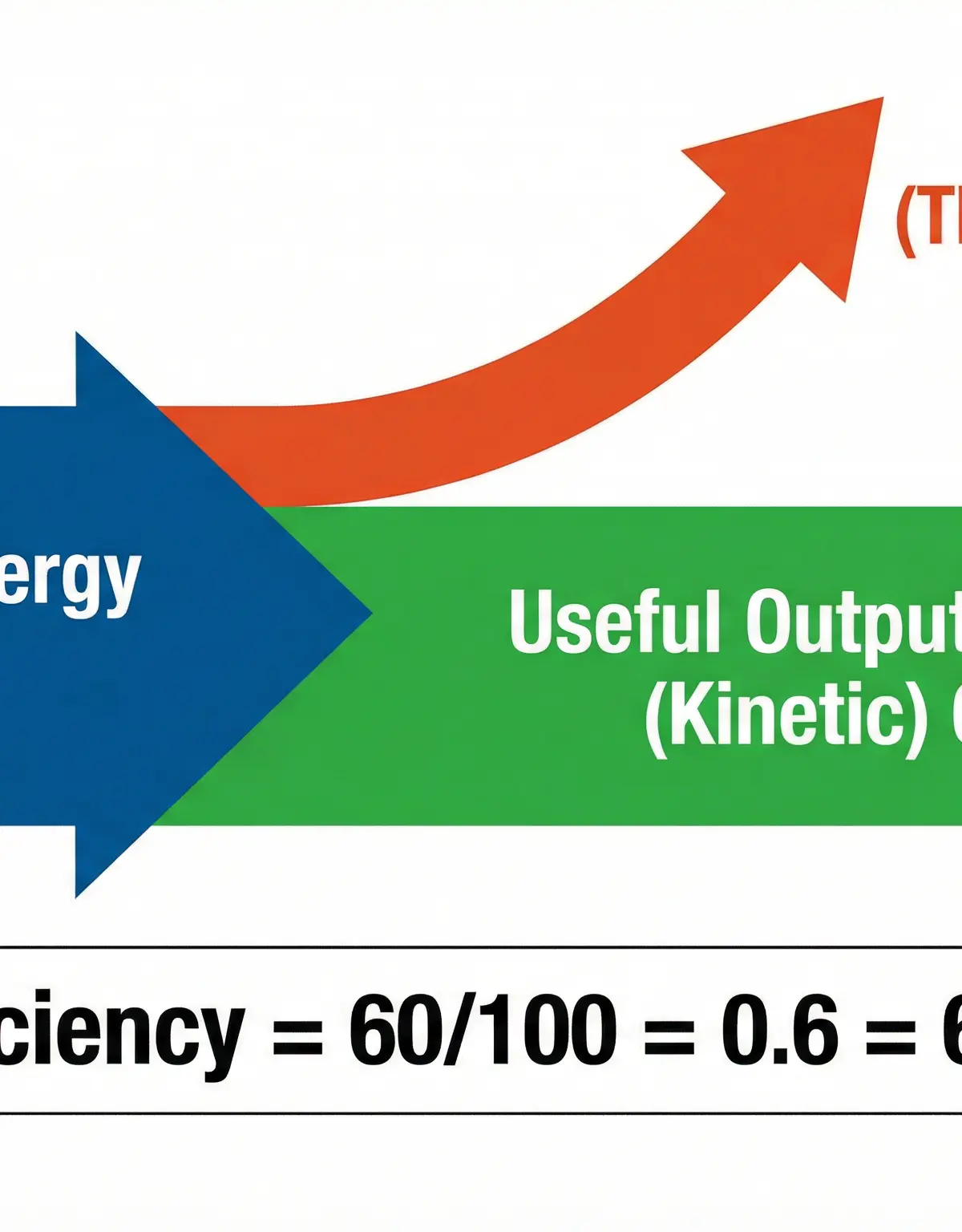
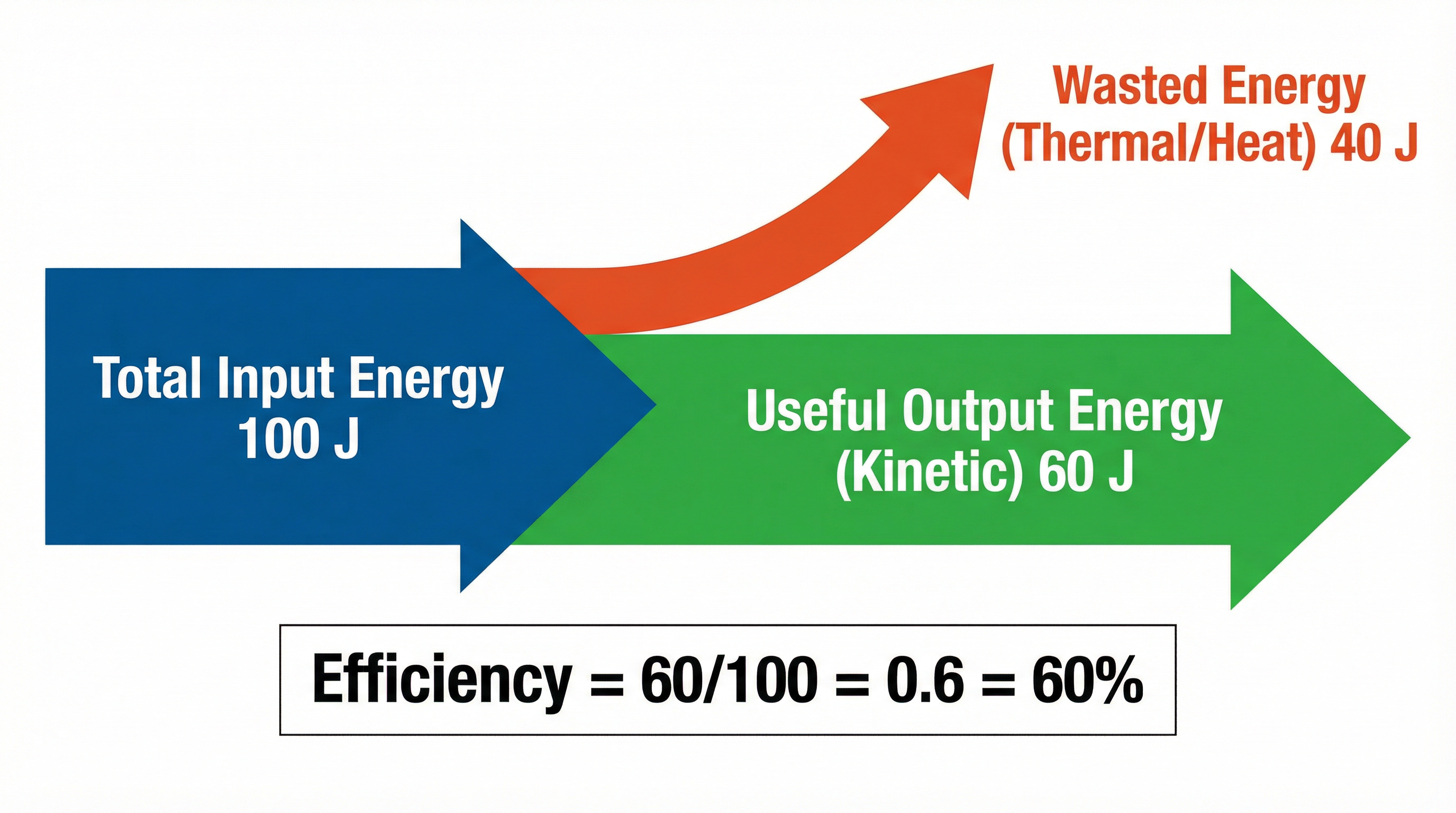
Efficiency is a measure of how good a device is at transferring energy into a useful form. No device is 100% efficient; some energy is always dissipated, usually as heat, to the thermal store of the surroundings. This dissipated energy spreads out and becomes less useful.
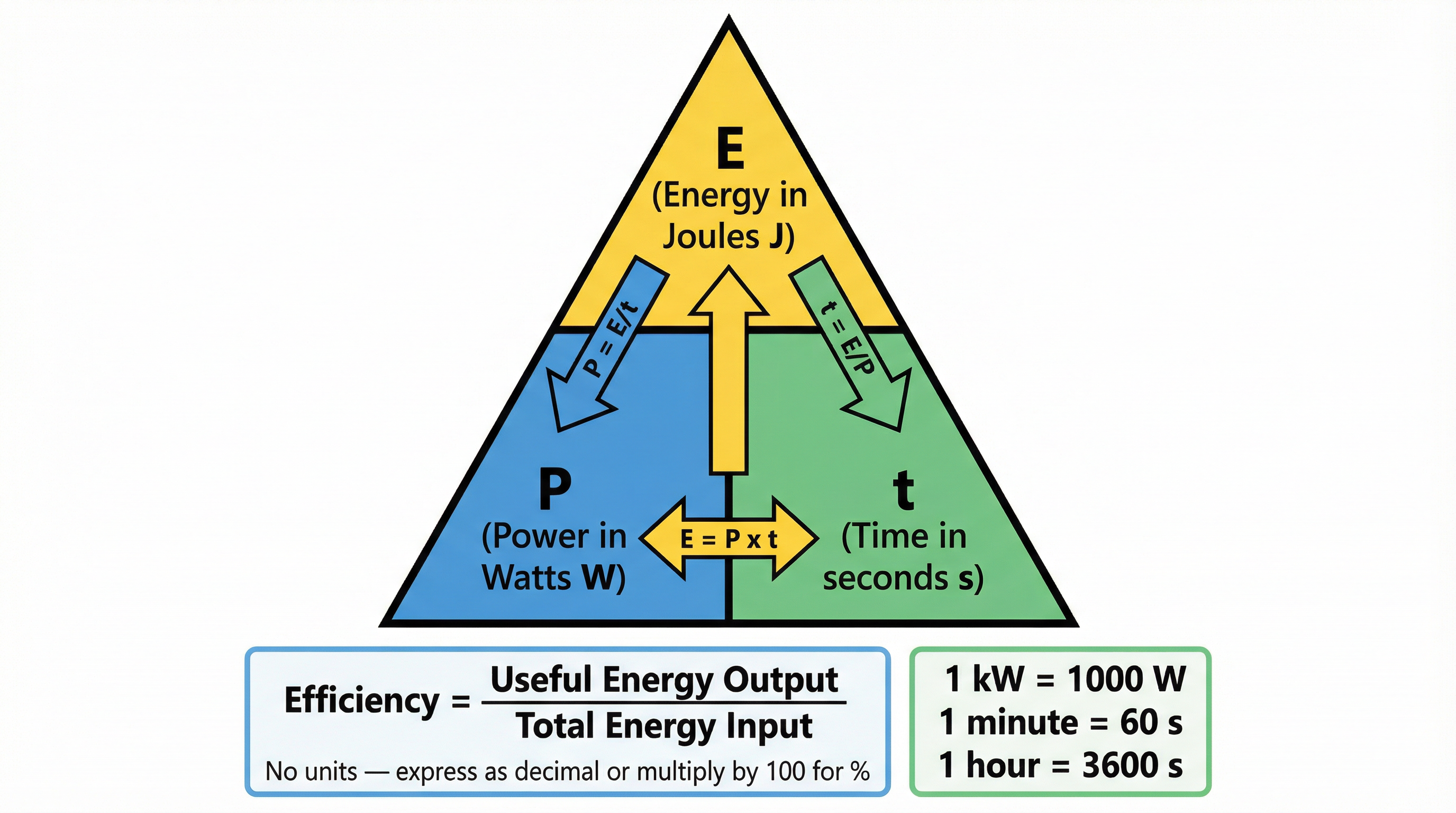
Calculation: Efficiency is calculated as a ratio. It has no units. You can leave it as a decimal or multiply by 100 to express it as a percentage. A key exam tip is to remember that efficiency can never be greater than 1 (or 100%). If you calculate a value larger than 1, you have divided the numbers the wrong way around.
Concept 3: Power
Power is the rate at which energy is transferred, or the rate at which work is done. In simple terms, it's how quickly energy is being used. A more powerful device transfers more energy every second.
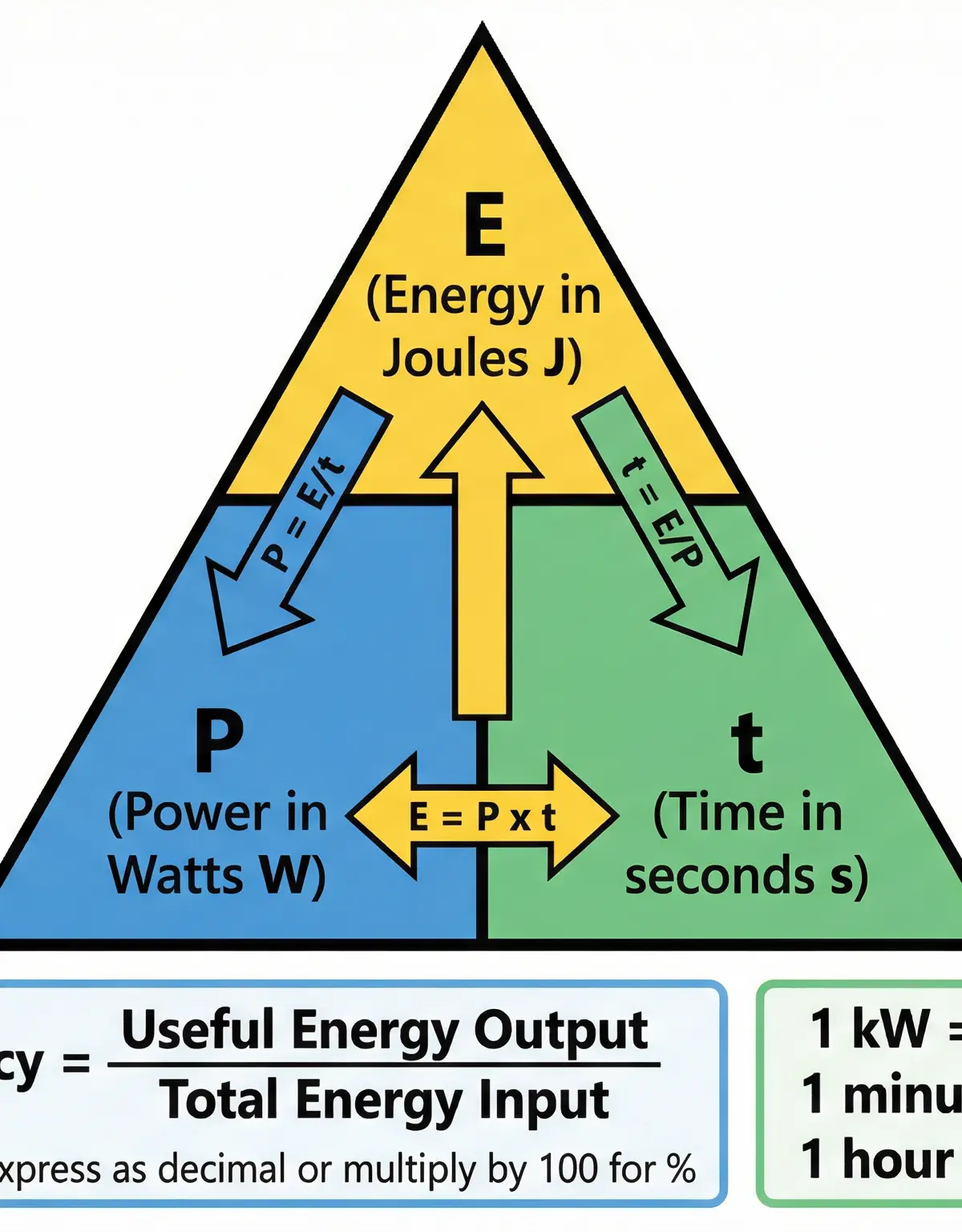
Calculation: Power is measured in Watts (W). One Watt is equivalent to one Joule of energy transferred per second (1 J/s). Examiners will often give you time in minutes or hours, or power in kilowatts (kW), so you must be confident in converting units.
Mathematical/Scientific Relationships
Here are the key formulas you need to master. Pay close attention to which ones are given on the formula sheet and which you must memorise.
| Formula | Symbol Meanings | Status |
|---|---|---|
Power = Energy transferred / time <br> P = E / t | P = Power (W) <br> E = Energy (J) <br> t = time (s) | Must memorise |
Efficiency = Useful output energy transfer / total input energy transfer | Output and Input energy must be in the same units (e.g., Joules) | Must memorise |
Efficiency = Useful power output / total power input | Output and Input power must be in the same units (e.g., Watts) | Must memorise |
Practical Applications
This topic is not just theoretical; it applies to everything from household appliances to national power generation. For example, modern LED light bulbs are much more efficient (around 80-90%) than old filament bulbs (which were only 5-10% efficient), because they dissipate far less energy to thermal stores. In a car engine, lubrication (oil) is used to reduce friction between moving parts. This increases the engine's efficiency because less of the chemical energy from the fuel is wasted as heat, and more is converted into useful kinetic energy.
Required Practicals
While there isn't a specific named required practical solely for 'Efficiency and Power', the principles are tested in other practicals. For instance, when investigating circuits or thermal insulation, you will be expected to take measurements that allow you to calculate energy transfers and efficiency. For example, in an experiment to determine the specific heat capacity of a material, you would calculate the electrical energy supplied to the heater (E = P x t) and compare it to the energy gained by the material. The difference is the energy dissipated to the surroundings, and you could be asked to suggest improvements to the insulation to increase the efficiency of the energy transfer.
Visual Resources
2 diagrams and illustrations
Interactive Diagrams
2 interactive diagrams to visualise key concepts
Conceptual Flow Outline
A flowchart illustrating the path of energy from input to either useful or wasted outputs, and methods to increase efficiency.
Conceptual Flow Outline
A flowchart detailing a systematic approach to answering exam questions on this topic, including command word strategies and sanity checks.
Worked Examples
3 worked examples — open one to explore the question and available guidance.
Practice Questions
Test your understanding — click to reveal model answers
State the principle of conservation of energy.
A 100 W filament bulb is 5% efficient. Calculate the useful light energy it produces in 30 seconds.
Hint: First, calculate the total energy input in 30 seconds. Then, find 5% of that value.
Describe two ways to increase the efficiency of a mechanical system, such as a bicycle.
A 900 W microwave is used to heat 200g of water from 20°C to 100°C. This takes 80 seconds. Calculate the efficiency of the microwave. (Specific heat capacity of water = 4200 J/kg°C)
Hint: This is a Higher Tier question linking to thermal physics. First, calculate the useful energy absorbed by the water using the specific heat capacity formula.
Explain why a device can never be more than 100% efficient.
Test your understanding of Efficiency and Power
Active recall beats re-reading. Take an instant quiz now to test what you’ve learned and lock it into long-term memory.
7 days Premium · Then free forever · No card, no charge