Pearson Edexcel · GCSE · Physics
Magnets and Magnetic Fields
Master Edexcel GCSE Physics Topic 12.1 on Magnets and Magnetic Fields. This guide provides everything you need to draw perfect field diagrams, distinguish between permanent and induced magnetism, and tackle exam questions with confidence, securing top marks.
- 6 min read
- 3 worked examples
- 5 practice questions
- 6 key terms
Study Notes

Overview
Welcome to the fascinating world of magnetism, a fundamental force that shapes our universe, from the compass in your hand to the protective magnetic field around our planet. For your Edexcel GCSE Physics exam, mastering Topic 12.1 is crucial. This topic explores the invisible forces of magnetic fields, how they are represented, and the key differences between permanent and induced magnetism. Examiners frequently test candidates' ability to construct precise field diagrams and apply their knowledge to scenarios involving attraction, repulsion, and uniform fields. A solid understanding here not only secures marks on dedicated questions but also provides a foundation for understanding electromagnetism later in the course. Expect questions that require you to draw, describe, and explain magnetic phenomena, often with specific mark allocations for accuracy and use of correct terminology.
Key Concepts
Concept 1: Magnetic Poles and Fields
Every magnet has two poles: a North pole (N) and a South pole (S). The fundamental rule, which you must remember, is that opposite poles attract and like poles repel. This force is exerted through a magnetic field, which is the region around a magnet where a magnetic force can be detected. We can't see this field, so we use an invaluable tool to visualise it: magnetic field lines.
These lines are not just a random drawing; they follow strict rules that examiners expect you to know and apply:
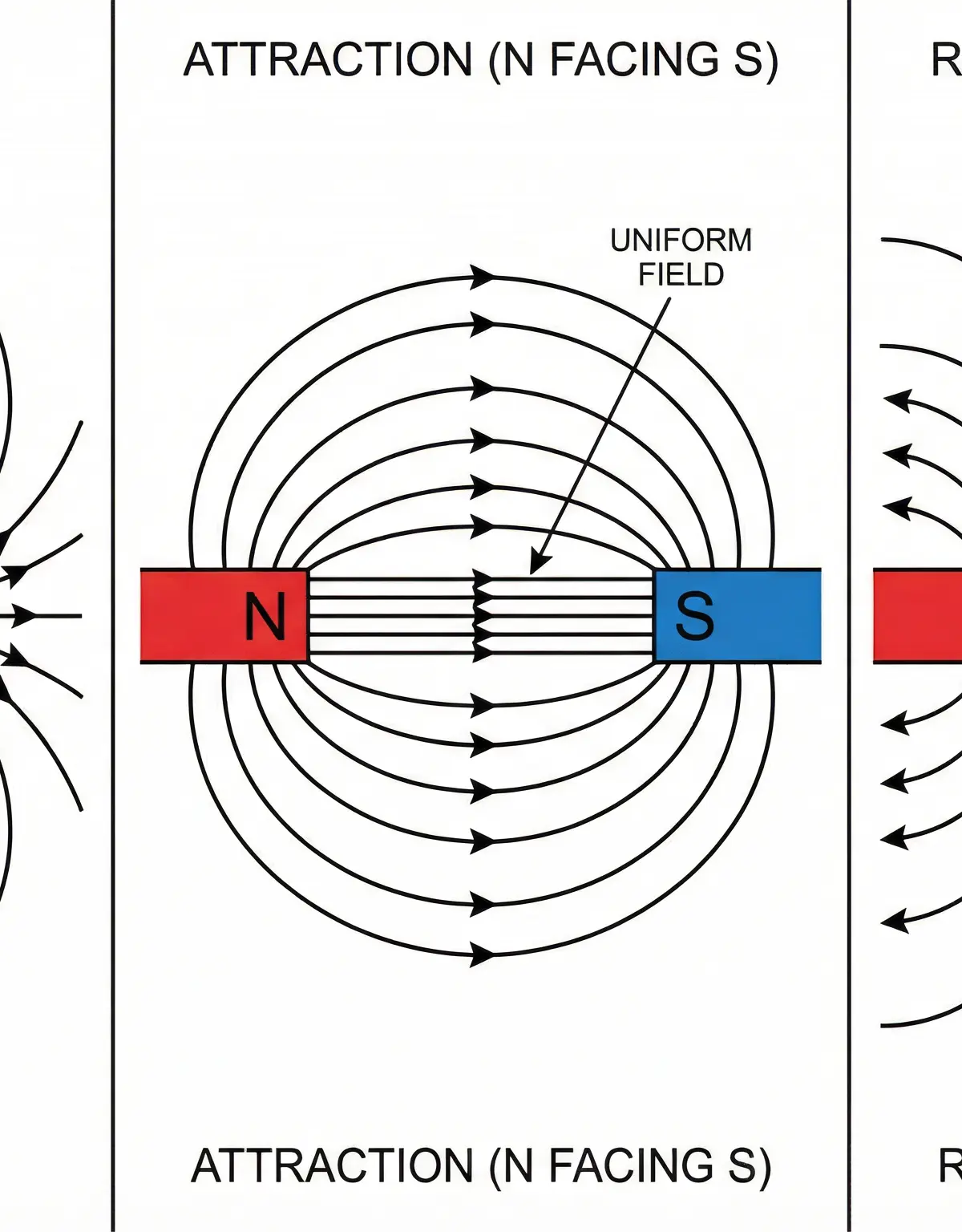
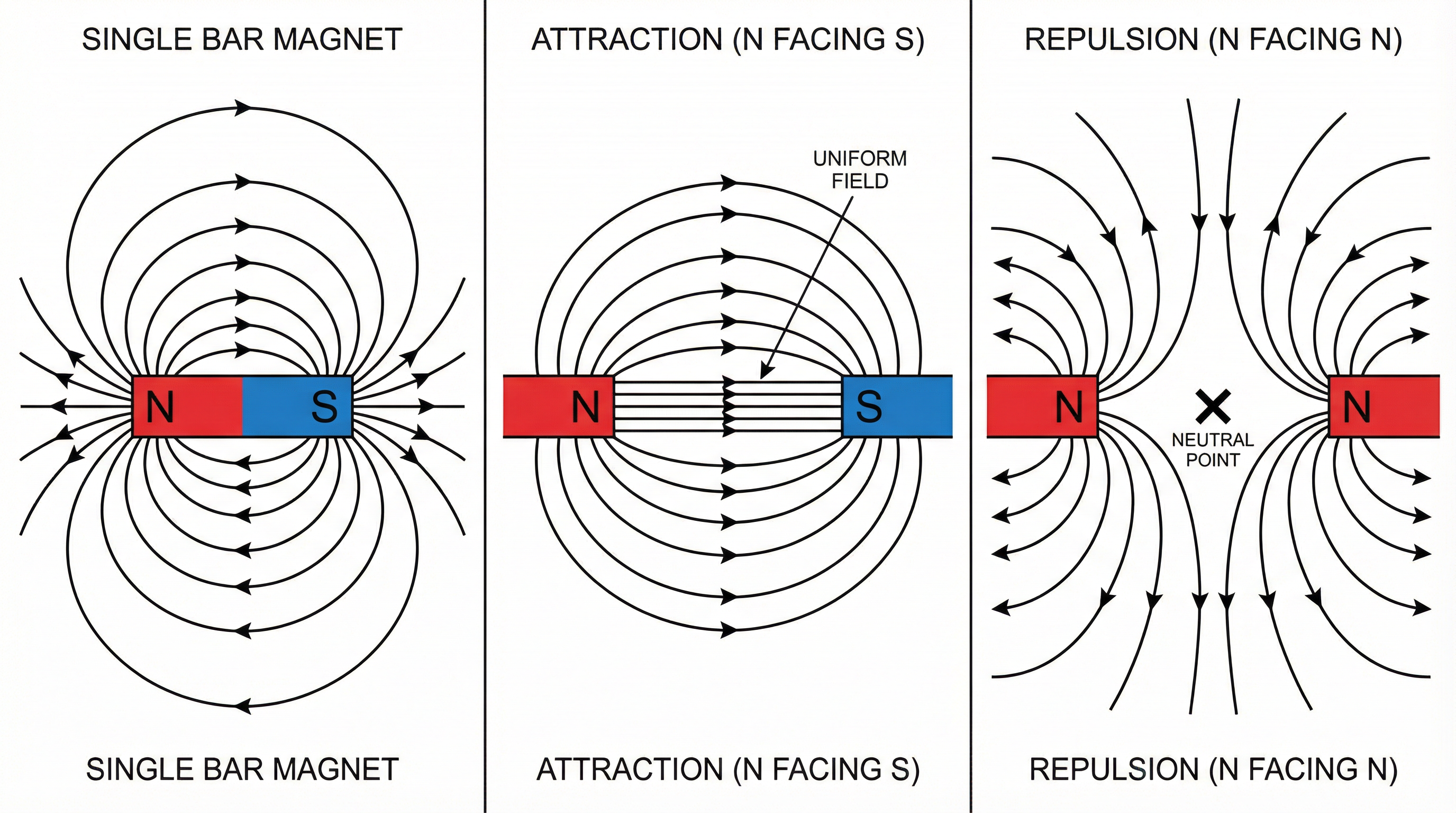
- Direction: Field lines always travel from the North pole to the South pole outside the magnet. You MUST draw arrows on your lines to show this direction.
- No Crossing: Field lines never cross or touch. This is physically impossible, as it would imply the field points in two directions at once. Any diagram with crossing lines will lose marks.
- Strength: The density of the field lines indicates the strength of the field. Where the lines are closest together, the field is strongest. This is always at the poles.
Concept 2: Permanent vs. Induced Magnetism
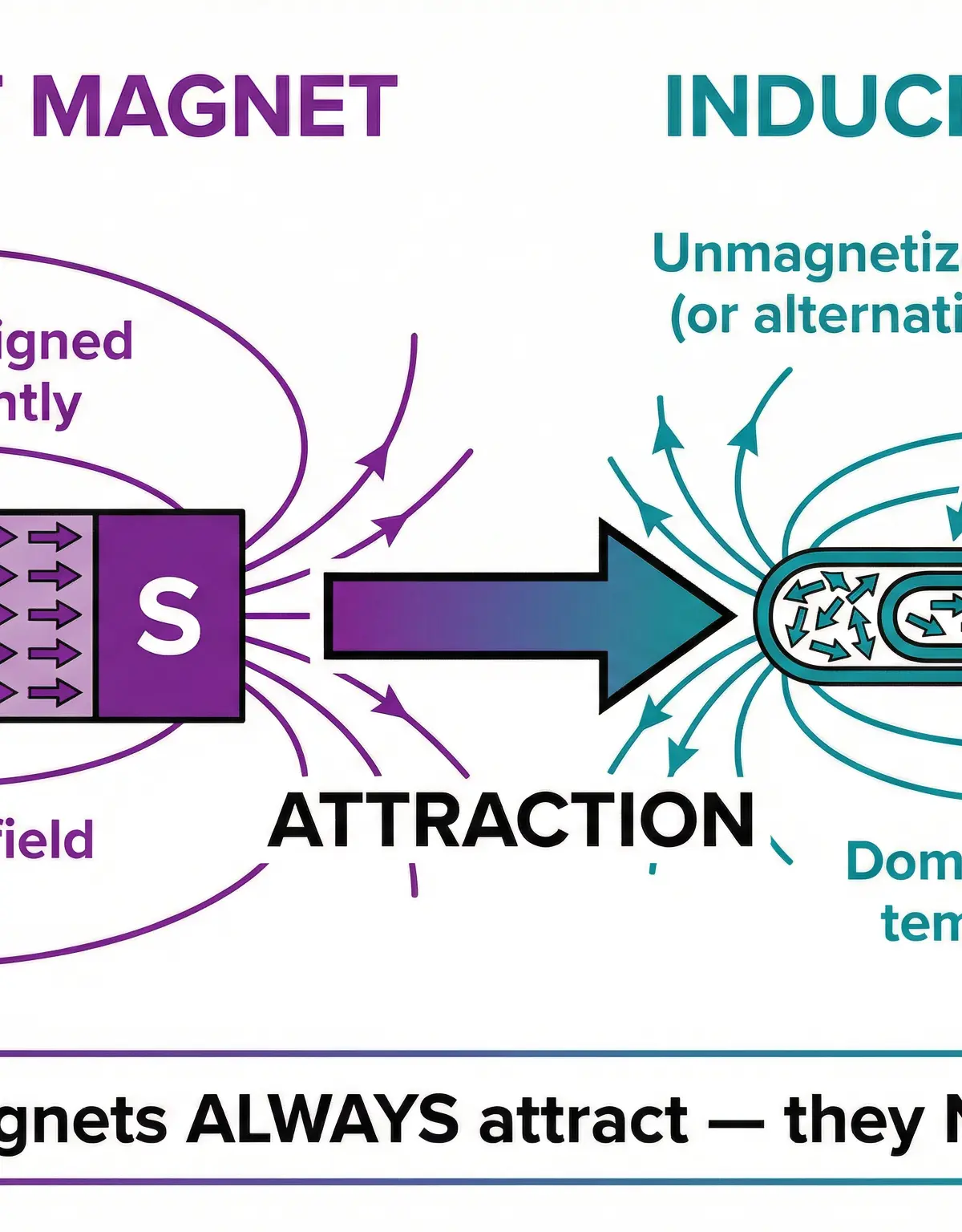
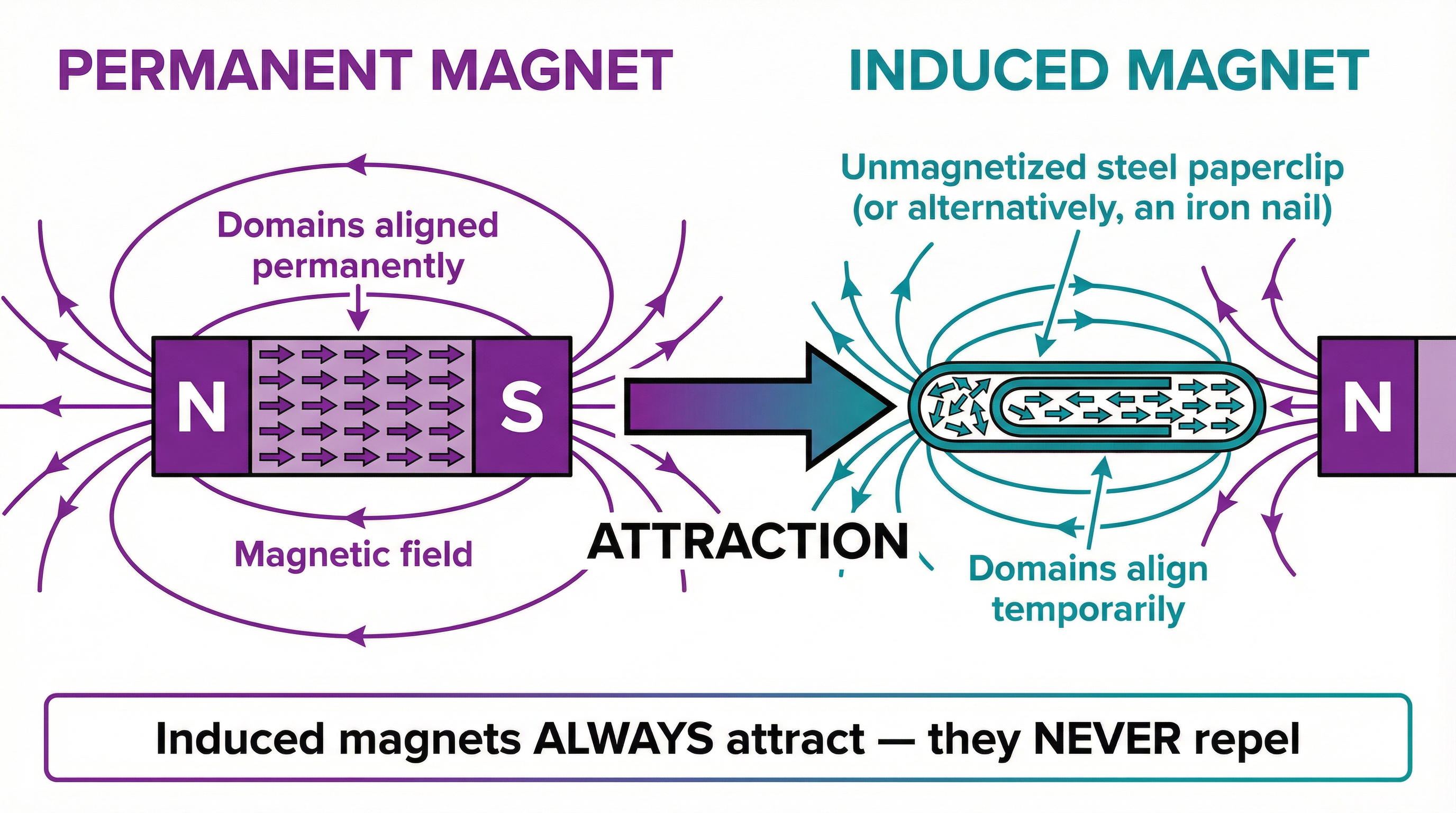
This is a critical distinction. A permanent magnet (e.g., a bar magnet or fridge magnet) produces its own magnetic field all the time. It's made from a 'magnetically hard' material like steel, where the internal magnetic domains are permanently aligned.
An induced magnet, however, is a material that becomes a magnet only when it is placed within an external magnetic field. Materials like iron, nickel, and cobalt are 'magnetically soft' and can be induced to become magnets. When you bring a permanent magnet near an iron paperclip, the paperclip becomes an induced magnet.
Crucial Exam Point: Induced magnetism always results in a force of attraction. It never causes repulsion. This is because the end of the induced magnet closest to the permanent magnet always takes on the opposite polarity. For example, if you bring a North pole near the paperclip, the end of the paperclip closest to the magnet becomes a South pole, and they attract. This is a non-negotiable fact that frequently appears in multiple-choice and short-answer questions.
Concept 3: Uniform Magnetic Fields
A uniform magnetic field is a field where the strength and direction are the same at every point. In your exam, the only place you need to draw a uniform field is in the gap between two opposite magnetic poles (a North pole facing a South pole). To gain full marks for drawing a uniform field, you must:
- Use a ruler.
- Draw at least three parallel straight lines.
- Ensure the lines are equally spaced.
- Draw arrows on the lines pointing from North to South.
Freehand sketches will not be awarded credit here; precision is key.
Concept 4: The Earth's Magnetic Field
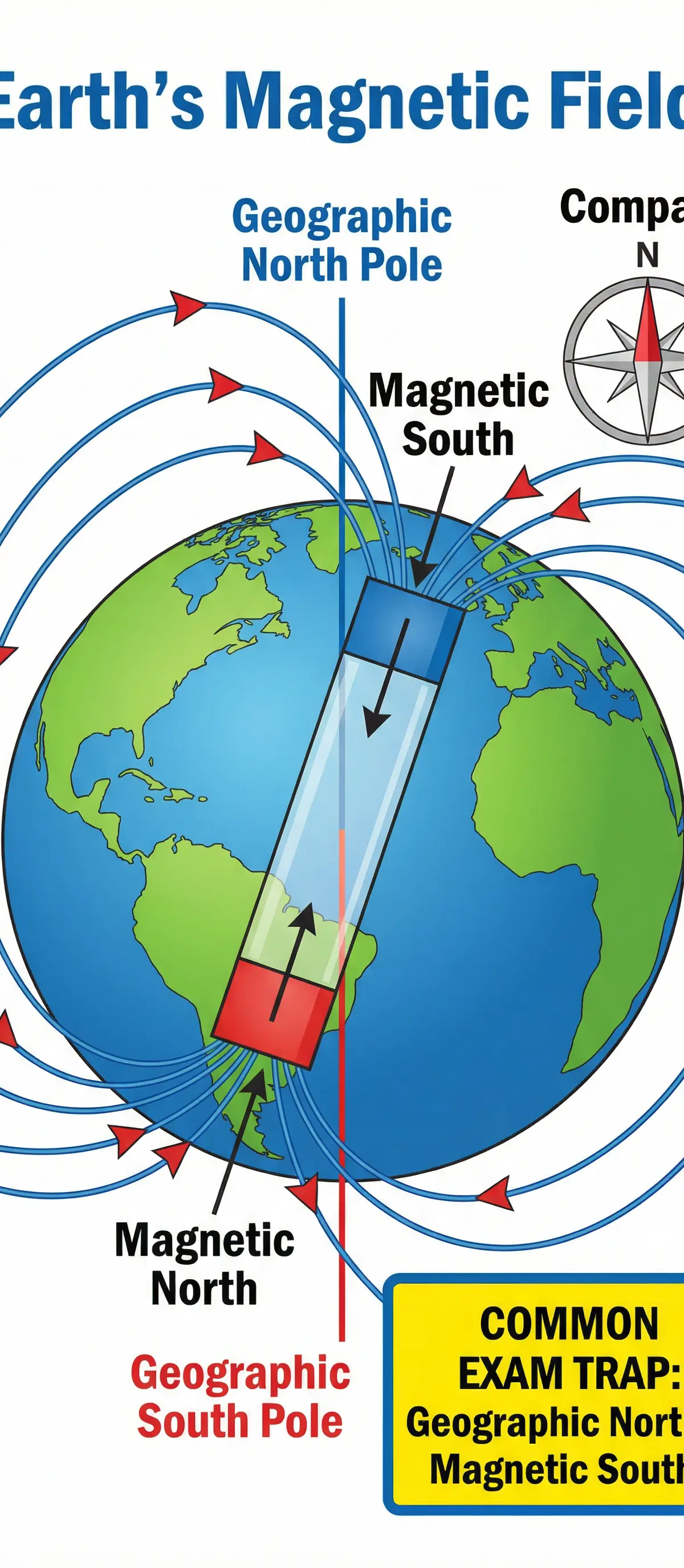
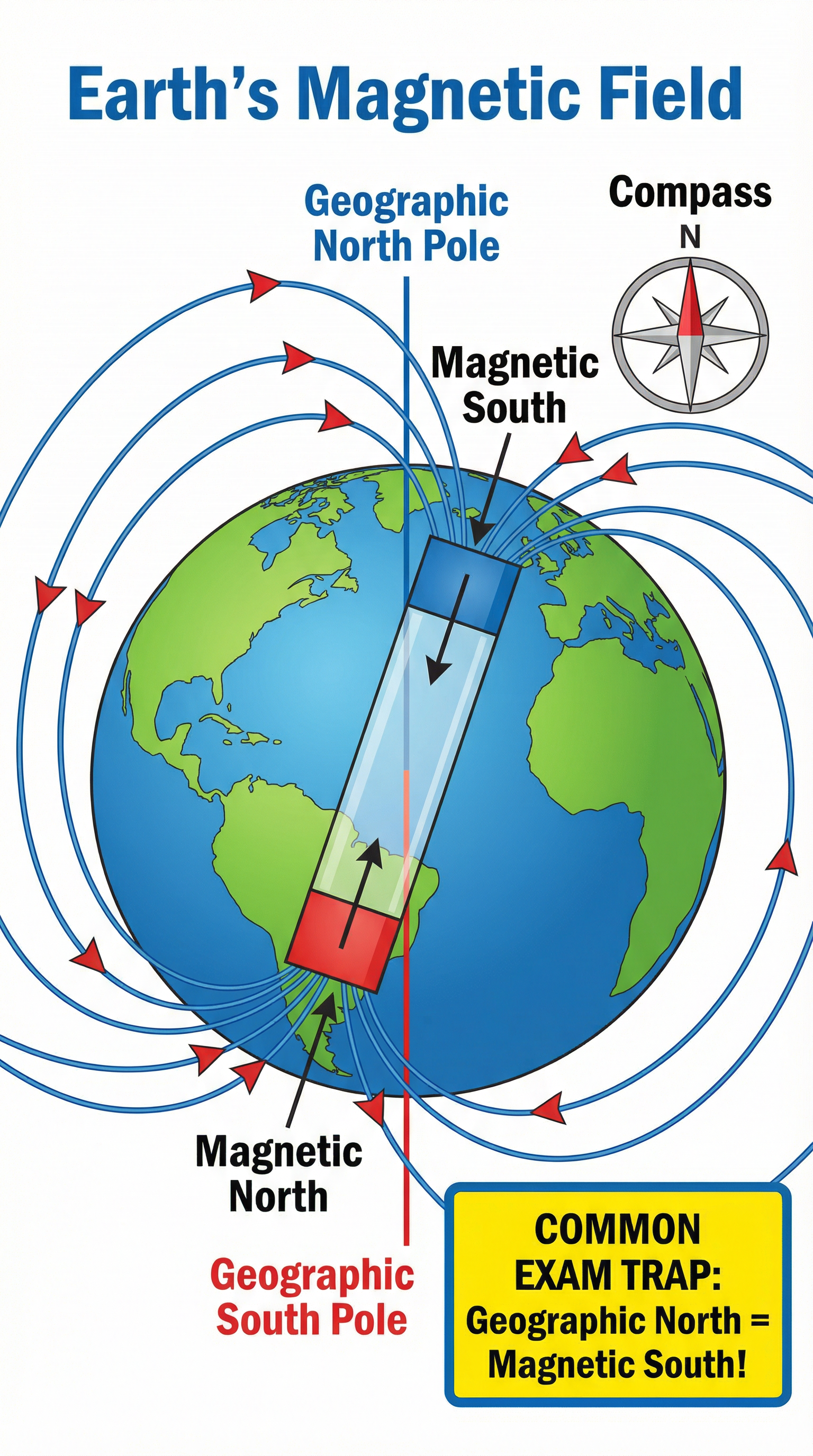
The Earth itself acts like a giant bar magnet, generating a magnetic field that protects us from solar radiation. A plotting compass works because its needle (a tiny magnet) aligns with the Earth's field lines. The North-seeking end of the compass points towards the Earth's geographic North Pole.
The Classic Exam Trap: Since the North pole of a magnet is attracted to a South pole, this means the Earth's geographic North Pole is actually a magnetic South pole. Conversely, the geographic South Pole is a magnetic North pole. This is a common high-level question designed to test deep understanding. Remember: a compass points North, so the thing it's pointing to must be a magnetic South.
Mathematical/Scientific Relationships
This topic is primarily conceptual, with no mathematical formulas to memorise for the exam. The relationships are based on the rules of attraction/repulsion and the properties of field lines. The key relationship to understand is the link between field line density and field strength: Field Strength ∝ 1 / (distance between lines). While not a formula you'll calculate with, it's the principle behind interpreting diagrams.
Practical Applications
- Compasses: Used for navigation for centuries, relying on the Earth's magnetic field.
- Scrap-yard Cranes: Use powerful electromagnets (a related topic) which can be switched on and off to pick up and drop scrap metal (induced magnetism).
- Fridge Magnets: Simple permanent magnets holding up your notes.
- MRI Scanners: In hospitals, powerful superconducting magnets are used to create detailed images of inside the body, a synoptic link to medical physics applications.
Visual Resources
3 diagrams and illustrations
Interactive Diagrams
2 interactive diagrams to visualise key concepts
Conceptual Flow Outline
Flowchart showing the process of induced magnetism. This clarifies that magnetism is temporary and only occurs when the material is in an external field.
Conceptual Flow Outline
Concept map explaining the common exam trap of the Earth's magnetic poles. It links the geographic pole, magnetic pole, and compass behaviour via the rule of attraction.
Worked Examples
3 worked examples — open one to explore the question and available guidance.
Practice Questions
Test your understanding — click to reveal model answers
State two ways in which the magnetic field lines in a uniform field differ from the field lines around a single bar magnet. [2 marks]
Hint: Think about the shape and spacing of the lines.
A student claims that a paperclip is repelled when they bring the South pole of a magnet towards it. Explain whether the student's claim is correct. [3 marks]
Hint: What type of magnetism is at play in the paperclip?
Draw a diagram to show the magnetic field pattern for two bar magnets arranged with their North poles facing each other. [4 marks]
Explain why steel is a suitable material for making a permanent magnet, but soft iron is more suitable for the core of a scrap-yard crane electromagnet. [4 marks]
Hint: Think about how easily each material is magnetised and demagnetised.
A compass is placed at a point near a wire carrying an electric current. The compass needle is deflected. What can be concluded from this observation? [1 mark]
Test your understanding of Magnets and Magnetic Fields
Active recall beats re-reading. Take an instant quiz now to test what you’ve learned and lock it into long-term memory.
7 days Premium · Then free forever · No card, no charge