Pearson Edexcel · GCSE · Physics
Newton's Laws
This guide covers Newton's Three Laws of Motion, a cornerstone of GCSE Physics. It breaks down inertia, the F=ma equation, and interaction pairs, providing exam-focused advice to help you secure top marks on this frequently tested topic.
- 6 min read
- 3 worked examples
- 5 practice questions
- 6 key terms
Study Notes
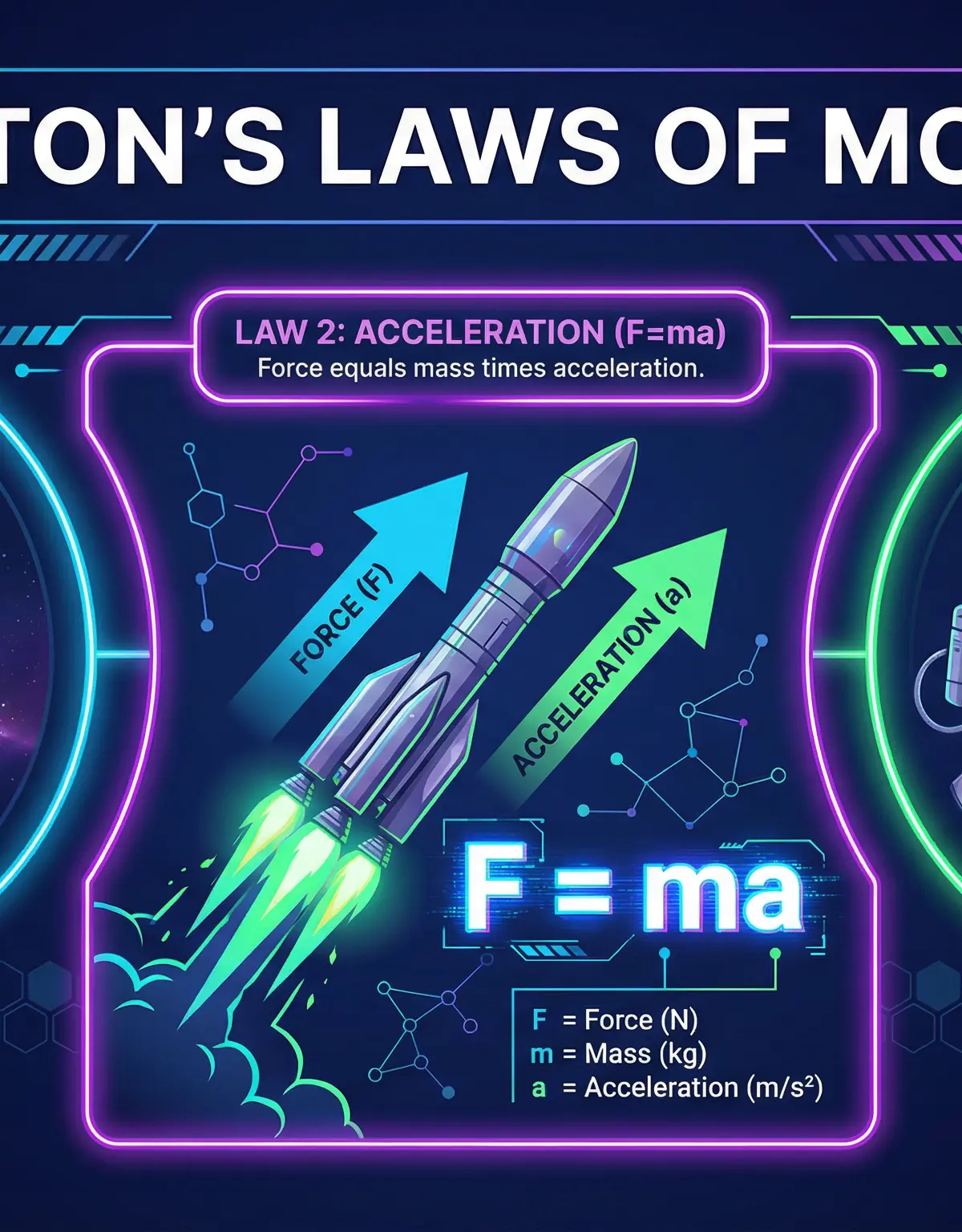
Overview
Newton's Laws of Motion are the bedrock of classical mechanics, explaining how forces affect the movement of objects. For your Edexcel GCSE Physics exam, this topic (Specification 2.2) is absolutely crucial. It not only appears in standalone questions but also forms the foundation for understanding more complex topics like momentum, circular motion, and astrophysics. Examiners frequently test candidates' ability to perform calculations using Newton's Second Law (F=ma) and, more subtly, their deep understanding of the difference between balanced forces and Newton's Third Law interaction pairs. Expect to see a mix of calculation questions, definition-based questions, and longer-answer questions requiring you to apply the laws to real-world scenarios, including the mandatory Core Practical.
Key Concepts
Concept 1: Newton's First Law (The Law of Inertia)
Newton's First Law states that an object will remain at rest or continue to move at a constant velocity unless acted upon by a resultant force. This property of resisting a change in motion is called inertia.
A common mistake is to think that zero resultant force means an object must be stationary. This is incorrect. If the forces acting on an object are balanced (meaning the resultant force is zero), the object can either be stationary OR it can be moving at a constant velocity. Think of a satellite in deep space, far from any gravitational fields. If it's moving, it will continue moving in a straight line at the same speed forever because there are no forces to slow it down or speed it up.
Example: A car travelling at a steady 70 mph on a motorway has a driving force from its engine that is exactly balanced by the forces of air resistance and friction. The resultant force is zero, so its velocity is constant.
Concept 2: Newton's Second Law (F = ma)
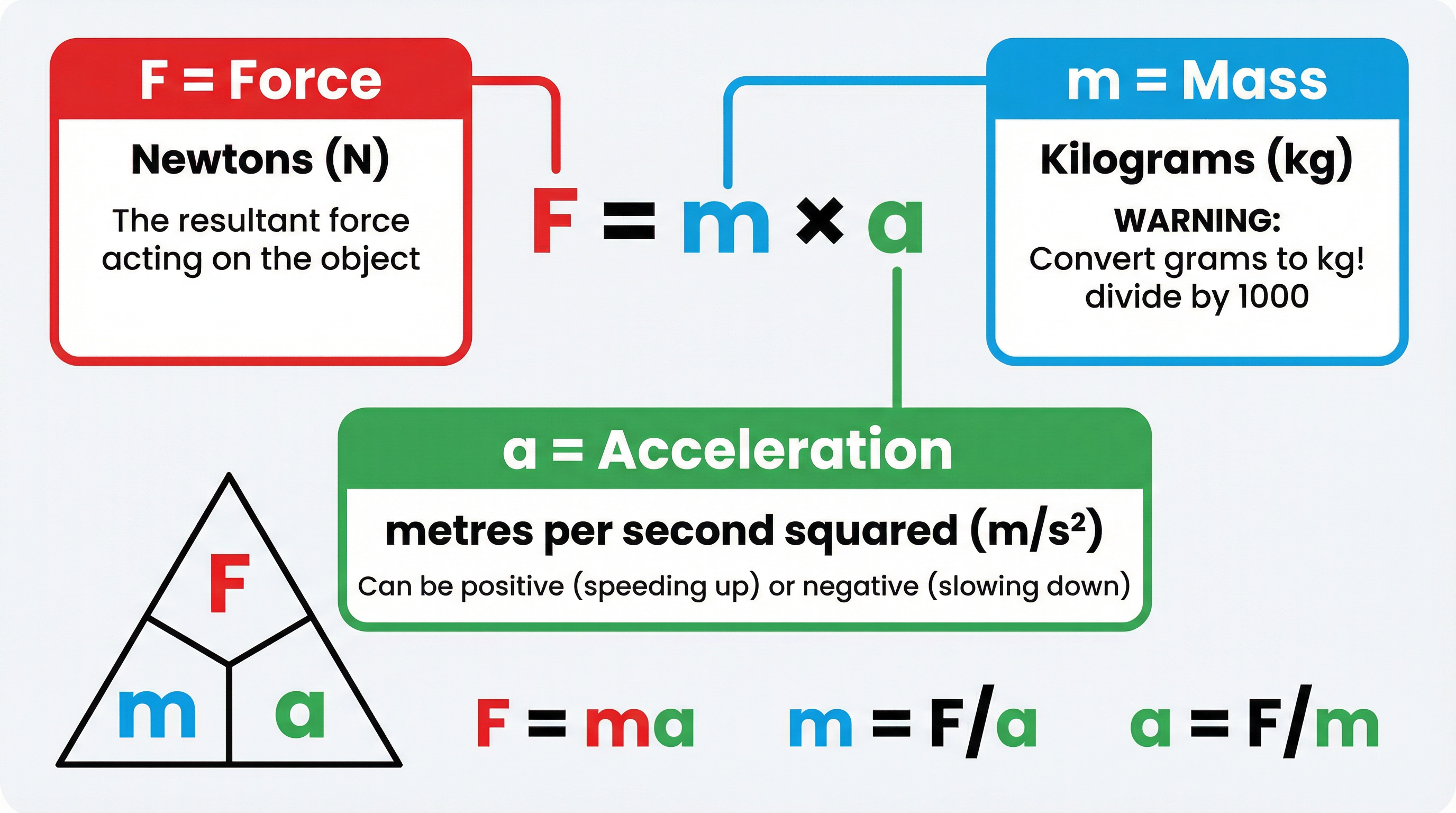
This is the law you'll use for most calculations. It states that the acceleration of an object is directly proportional to the resultant force acting on it and inversely proportional to its mass. The equation that defines this relationship is one you must know and love.
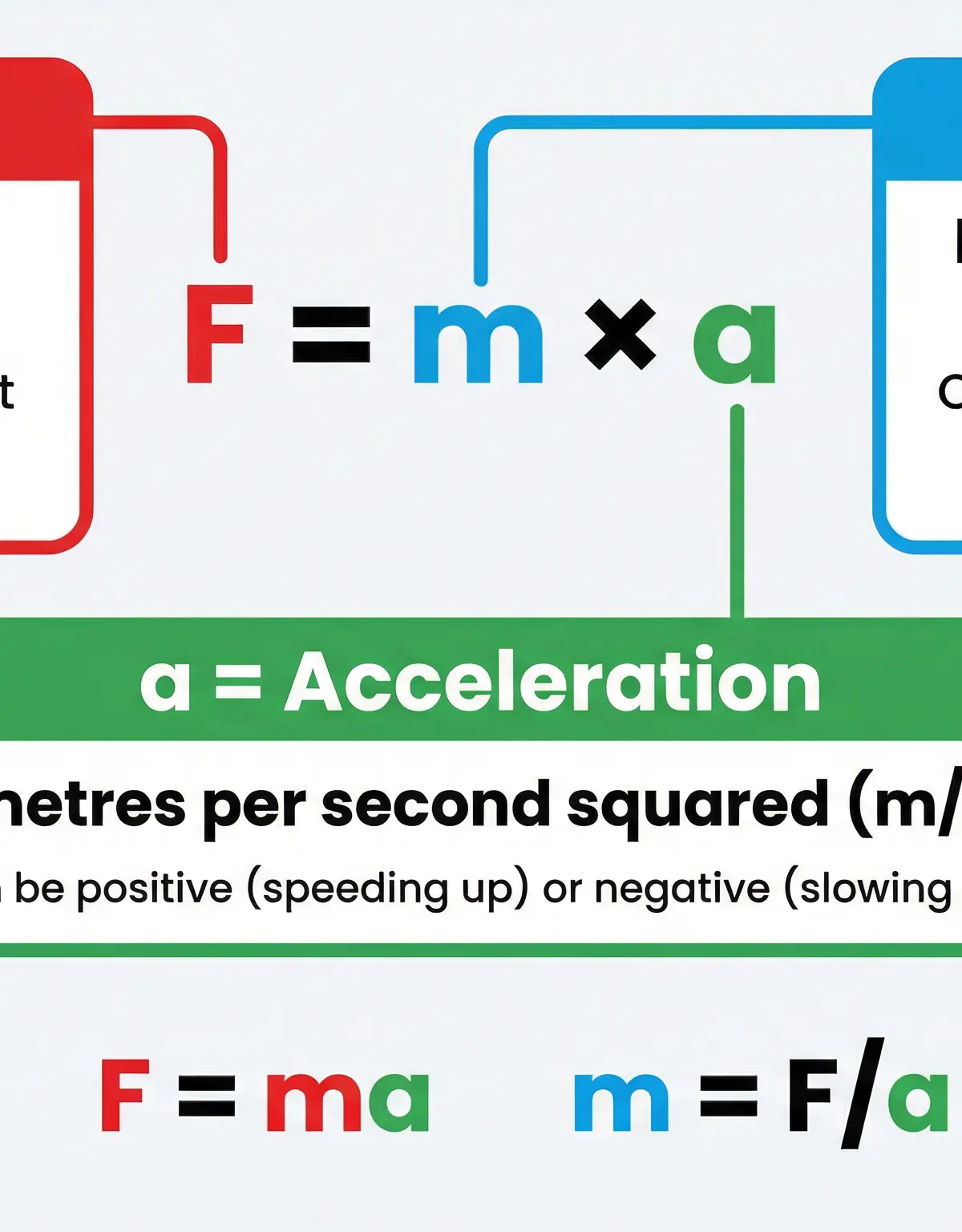
This law connects force, mass, and acceleration. A larger force produces a larger acceleration, while a larger mass results in a smaller acceleration for the same force. The most critical exam skill here is ensuring your units are correct before you calculate. Mass must be in kilograms (kg).
Example: A force of 20 N is applied to a shopping trolley of mass 10 kg. The acceleration is a = F/m = 20 N / 10 kg = 2 m/s².
Concept 3: Newton's Third Law (Interaction Pairs)
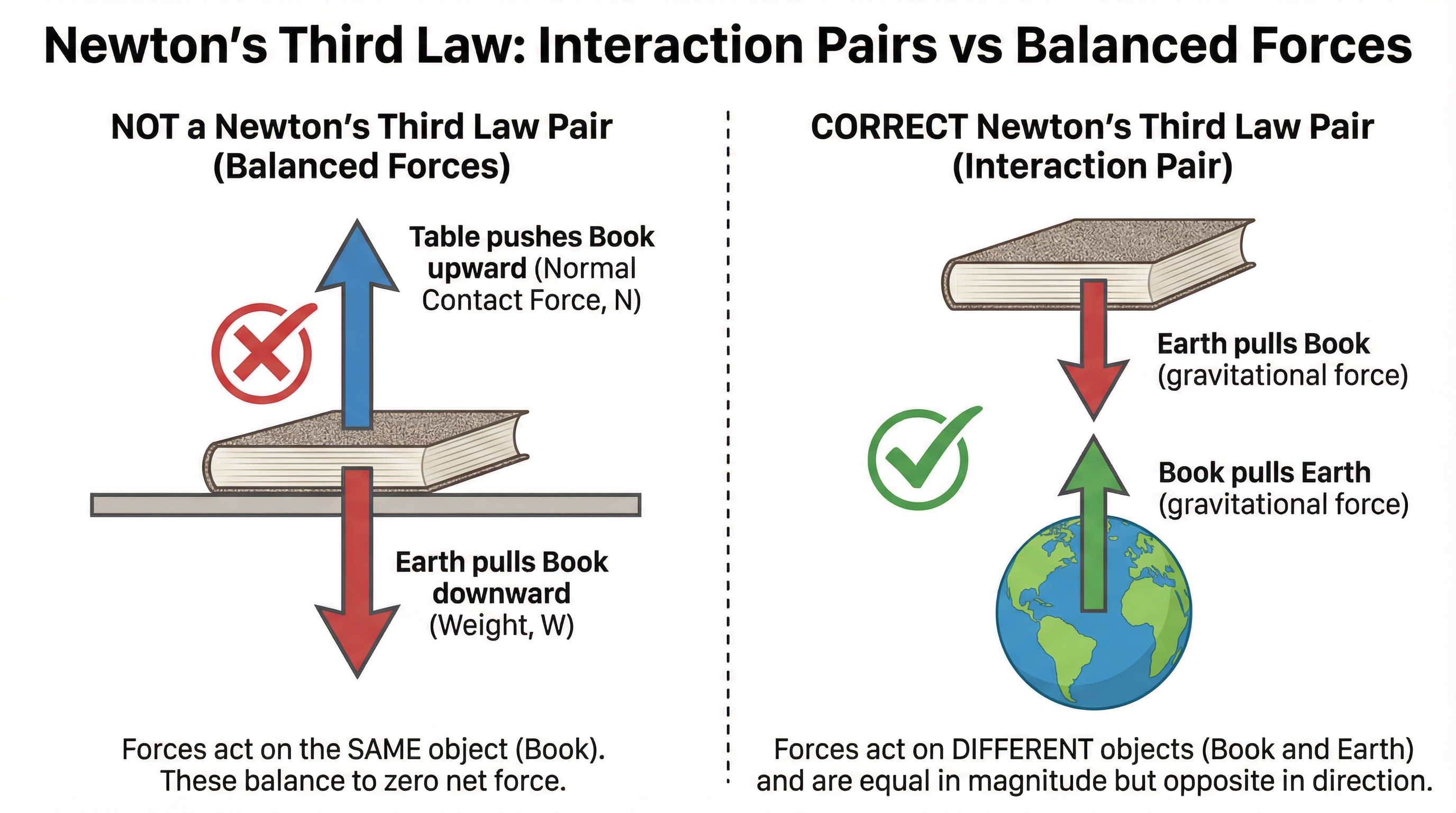
This law is often stated as "for every action, there is an equal and opposite reaction". A more precise, mark-scoring definition is: Whenever two objects interact, they exert equal and opposite forces on each other. These pairs of forces are called interaction pairs.
To be a true Newton's Third Law pair, the forces must be:
- Equal in magnitude.
- Opposite in direction.
- Acting on different objects.
- Of the same type (e.g., both gravitational or both contact forces).
This is where many candidates lose marks. They confuse interaction pairs with balanced forces.
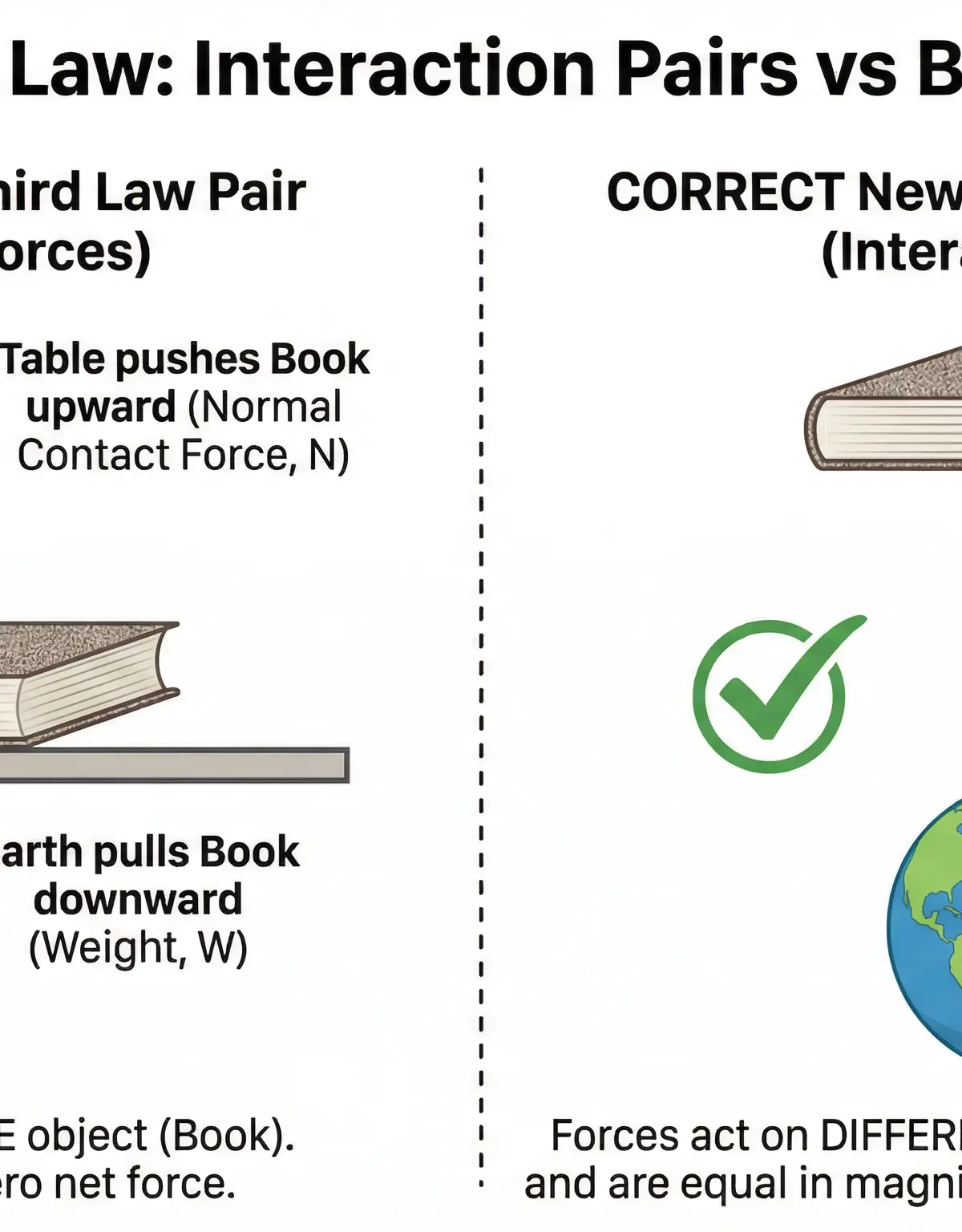
Example: When you stand on the floor, the Earth pulls you down with a gravitational force (your weight). The Newton's Third Law pair to this is you pulling the Earth up with an equal and opposite gravitational force. The upward contact force from the floor on your feet is NOT the interaction pair to your weight; it is the force that balances your weight, preventing you from accelerating through the floor.
Mathematical/Scientific Relationships
-
Newton's Second Law:
F = m × a(Must memorise)F: Resultant Force, in Newtons (N)m: Mass, in kilograms (kg)a: Acceleration, in metres per second squared (m/s²)
-
Weight:
W = m × g(Given on formula sheet)W: Weight, in Newtons (N)m: Mass, in kilograms (kg)g: Gravitational field strength, in N/kg (on Earth, g ≈ 9.8 N/kg)
Unit Conversions: The most common error is forgetting to convert mass from grams (g) to kilograms (kg). To convert from grams to kilograms, divide by 1000. For example, 500 g = 0.5 kg.
Practical Applications
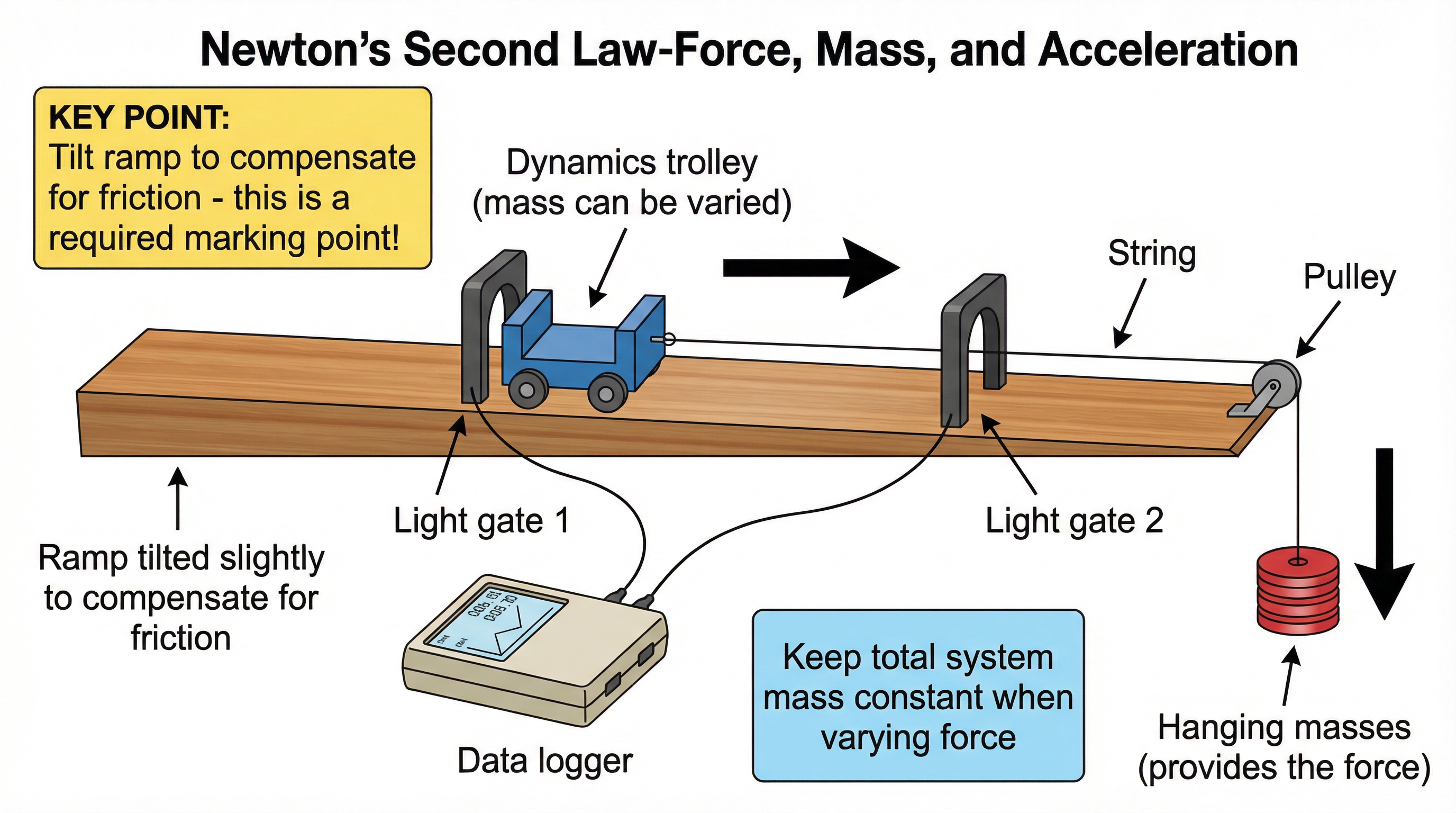
Core Practical: Investigating Force, Mass, and Acceleration
This is a mandatory practical that examiners love to ask questions about. The goal is to verify the relationships in F=ma.
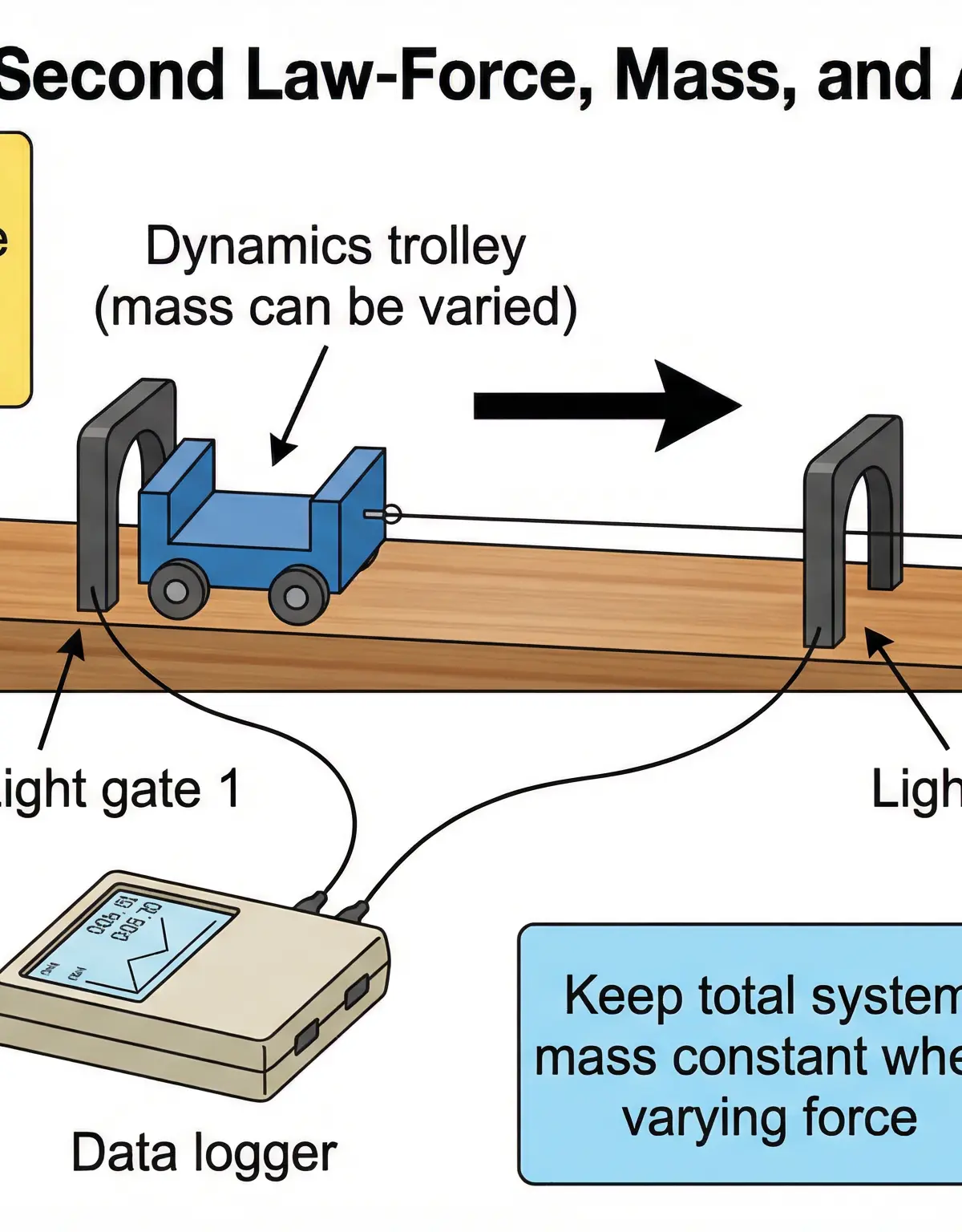
Apparatus:
- Dynamics trolley
- Metre ruler
- Light gates and data logger (or a stopwatch and ruler)
- String and pulley
- Set of masses (for the trolley) and hanging masses
- Ramp or track
Method to investigate F and a (mass constant):
- Set up the apparatus as shown in the diagram. The total mass of the system is the mass of the trolley plus the mass of the hanging weights.
- Crucially, tilt the ramp slightly until the trolley, when given a gentle push, rolls at a constant velocity. This compensates for friction.
- Start with a small hanging mass (e.g., 10g = 0.1N). Release the trolley and record the acceleration using the light gates.
- Move a mass from the trolley to the hanging mass holder. This increases the accelerating force (F) but keeps the total mass of the system (m) constant.
- Repeat for a range of forces.
- Plot a graph of Force (y-axis) against Acceleration (x-axis). It should be a straight line through the origin, confirming F is proportional to a.
Common Examiner Questions:
- "Why is the ramp tilted?" - To compensate for friction, ensuring the resultant force is equal to the weight of the hanging masses.
- "How is the mass of the system kept constant?" - By moving masses from the trolley to the hanger, rather than adding new masses.
- "Why are light gates better than a stopwatch?" - They reduce human reaction time error, leading to more accurate and repeatable measurements of time, and therefore acceleration.
Visual Resources
3 diagrams and illustrations
Interactive Diagrams
2 interactive diagrams to visualise key concepts
Conceptual Flow Outline
Flowchart illustrating Newton's First Law. If there is no resultant force, the object's motion does not change.
Conceptual Flow Outline
Concept map showing the key difference: Newton's Third Law pairs act on two different objects, whereas balanced forces act on a single object.
Worked Examples
3 worked examples — open one to explore the question and available guidance.
Practice Questions
Test your understanding — click to reveal model answers
State Newton's First Law of Motion.
Hint: Think about what happens when forces are balanced, and what happens when they are not.
A ball of mass 250 g is kicked with a resultant force of 50 N. Calculate the initial acceleration of the ball.
Hint: Check the units of mass before you calculate!
A skydiver of mass 80 kg is falling at a constant terminal velocity. Explain, in terms of forces, why their velocity is constant.
Hint: If velocity is constant, what does Newton's First Law tell you about the forces?
A gun fires a bullet. Identify the Newton's Third Law interaction pair of forces for this event.
Hint: The forces must act on two different objects.
Explain how the method for the Core Practical investigating F=ma is designed to ensure the resultant force on the trolley is only due to the hanging masses.
Hint: What other horizontal force might be acting?
Test your understanding of Newton's Laws
Active recall beats re-reading. Take an instant quiz now to test what you’ve learned and lock it into long-term memory.
7 days Premium · Then free forever · No card, no charge