Pearson Edexcel · GCSE · Physics
Static Electricity
This guide covers Edexcel GCSE Physics Topic 10.3, Static Electricity. It explains how objects become charged through friction, the forces they exert, and the concept of electric fields. Crucially, it details how to secure top marks by explaining real-world applications and avoiding common pitfalls, making it essential for exam success.
- 8 min read
- 3 worked examples
- 5 practice questions
- 7 key terms
Study Notes
Overview
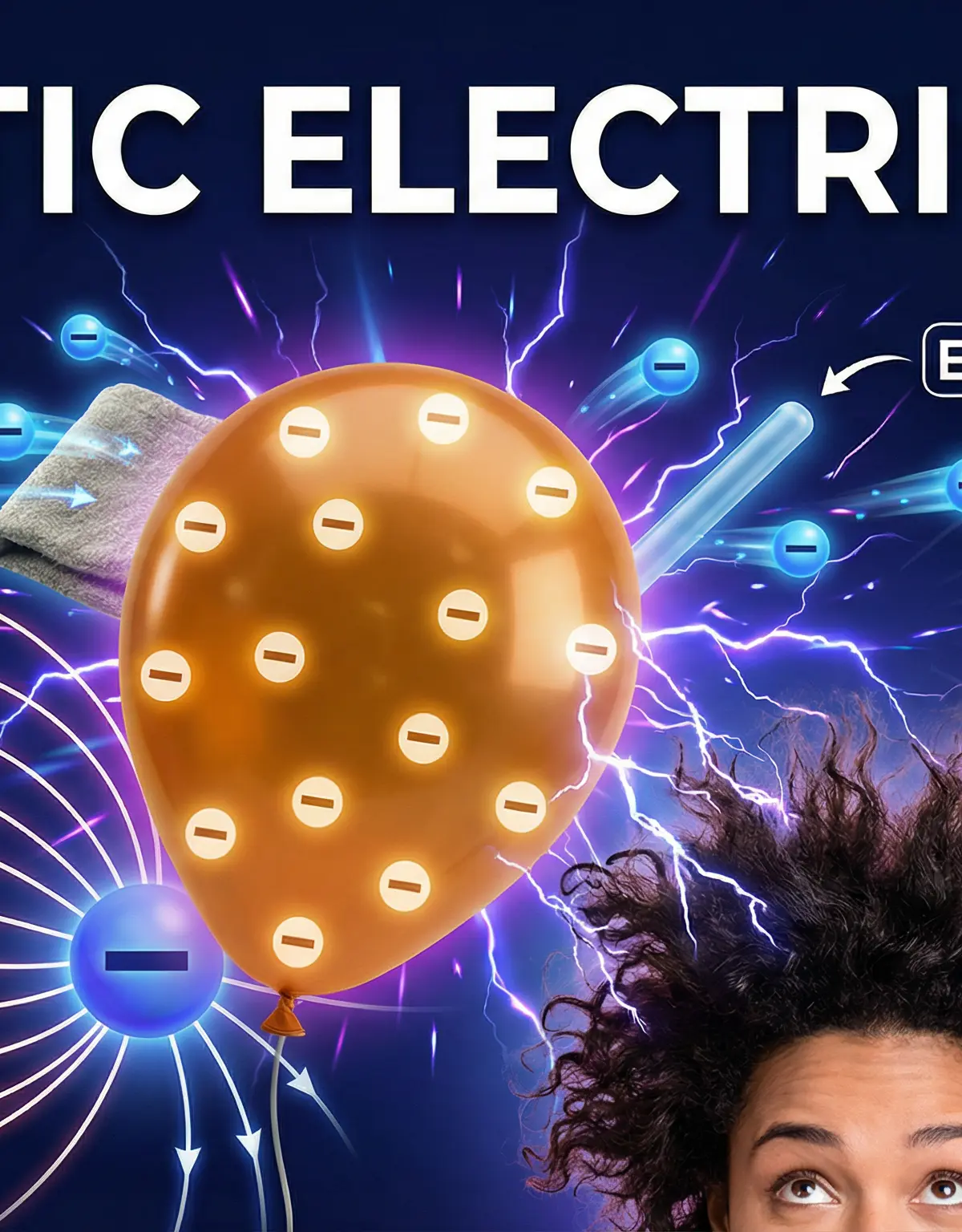
Welcome to the study of Static Electricity, a fundamental topic in physics that explains everything from the crackle of a jumper to the awesome power of a lightning strike. This area of the Edexcel specification (Topic 10) focuses on the nature of electric charge when it is stationary. You will explore how insulating materials can be charged by friction, the forces that exist between charged objects, and how we can visualise these forces using electric field lines. Understanding this topic is not just about memorising facts; it is about building a clear model of how unseen electrons dictate visible phenomena. Examiners frequently test this topic through a combination of definition-based questions, diagram drawing, and longer, structured explanations of applications, so a solid grasp of the core principles is vital for achieving a high grade.
Key Concepts
Concept 1: Charging by Friction
Static electricity begins when two insulating materials are rubbed together. The key to understanding this is to focus on the subatomic particles within the materials. All matter is made of atoms, which contain positive protons, neutral neutrons, and negative electrons. In insulators, the electrons are not free to move around as they are in conductors, but they can be transferred from one material to another through friction.
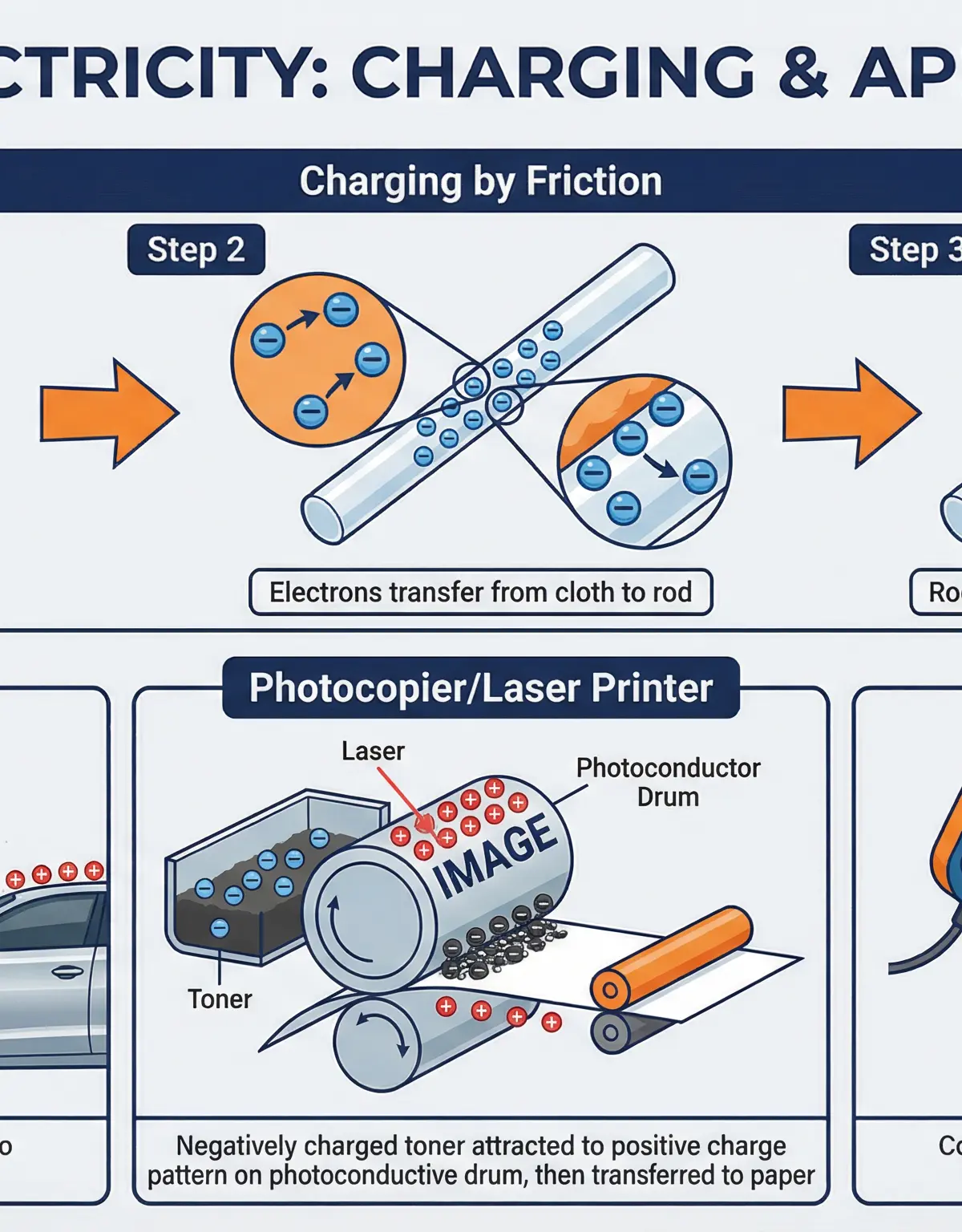
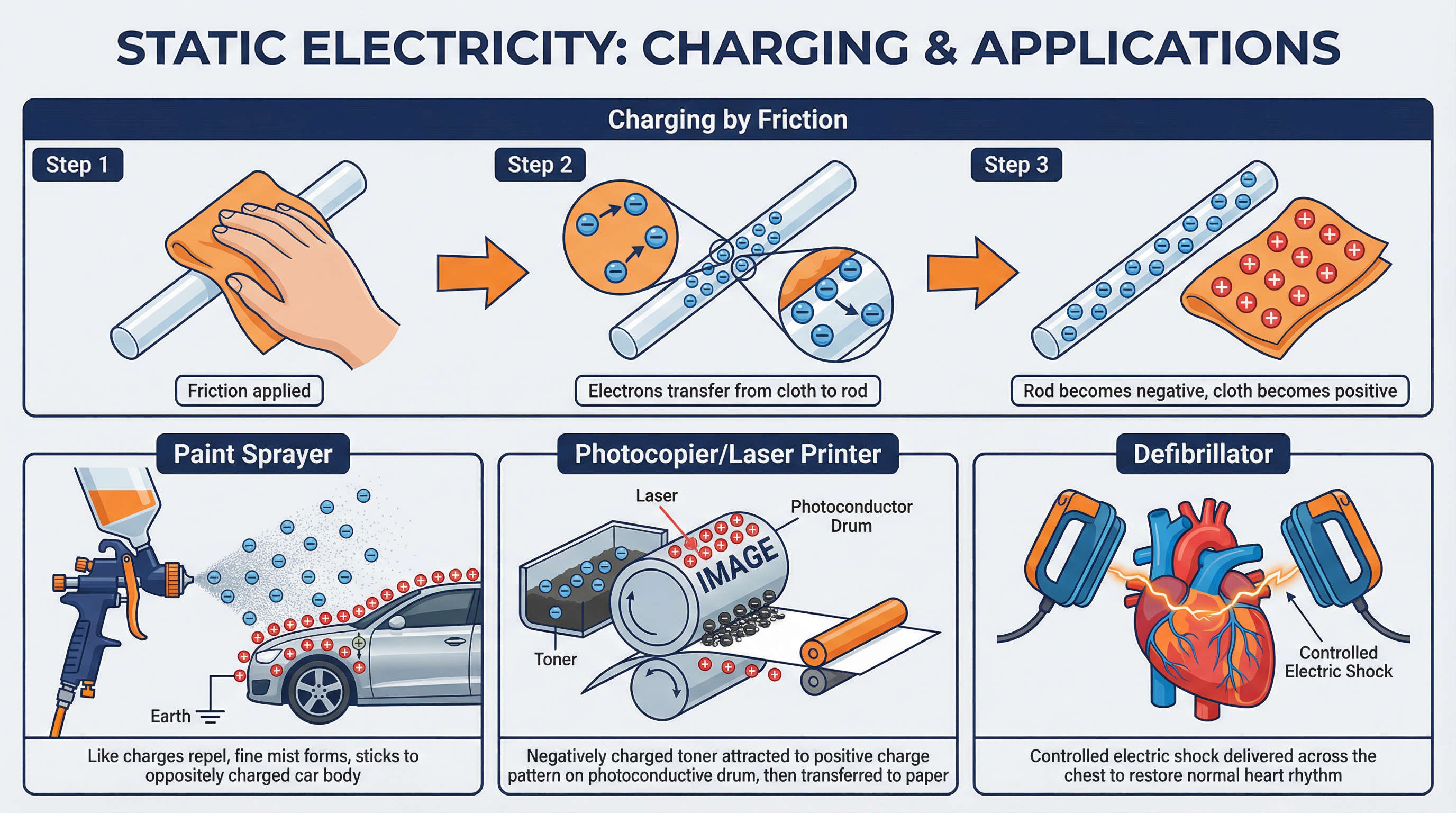
When you rub a polythene rod with a dry cloth, the friction provides energy for electrons to move from the surface of the cloth to the surface of the rod.
- The rod gains electrons, so it gains an overall negative charge.
- The cloth loses electrons, so it is left with an excess of positive charges and has an overall positive charge.
Crucial Examiner Point: Charge is created by the transfer of electrons. Protons are fixed in the nucleus and do not move. Stating that positive charge moves is a common mistake that will lose you marks.
Concept 2: Electrostatic Forces
Once an object is charged, it can exert a non-contact force on other objects. This is known as the electrostatic force. The rules are simple and fundamental:
- Like charges repel: Two positively charged objects will push each other away. Two negatively charged objects will also push each other away.
- Unlike (or opposite) charges attract: A positively charged object and a negatively charged object will pull towards each other.
This explains why a charged balloon can stick to a neutral wall. The charged balloon induces a charge in the wall by attracting opposite charges and repelling like charges within the wall's surface, creating a net attractive force.
Concept 3: Electric Fields
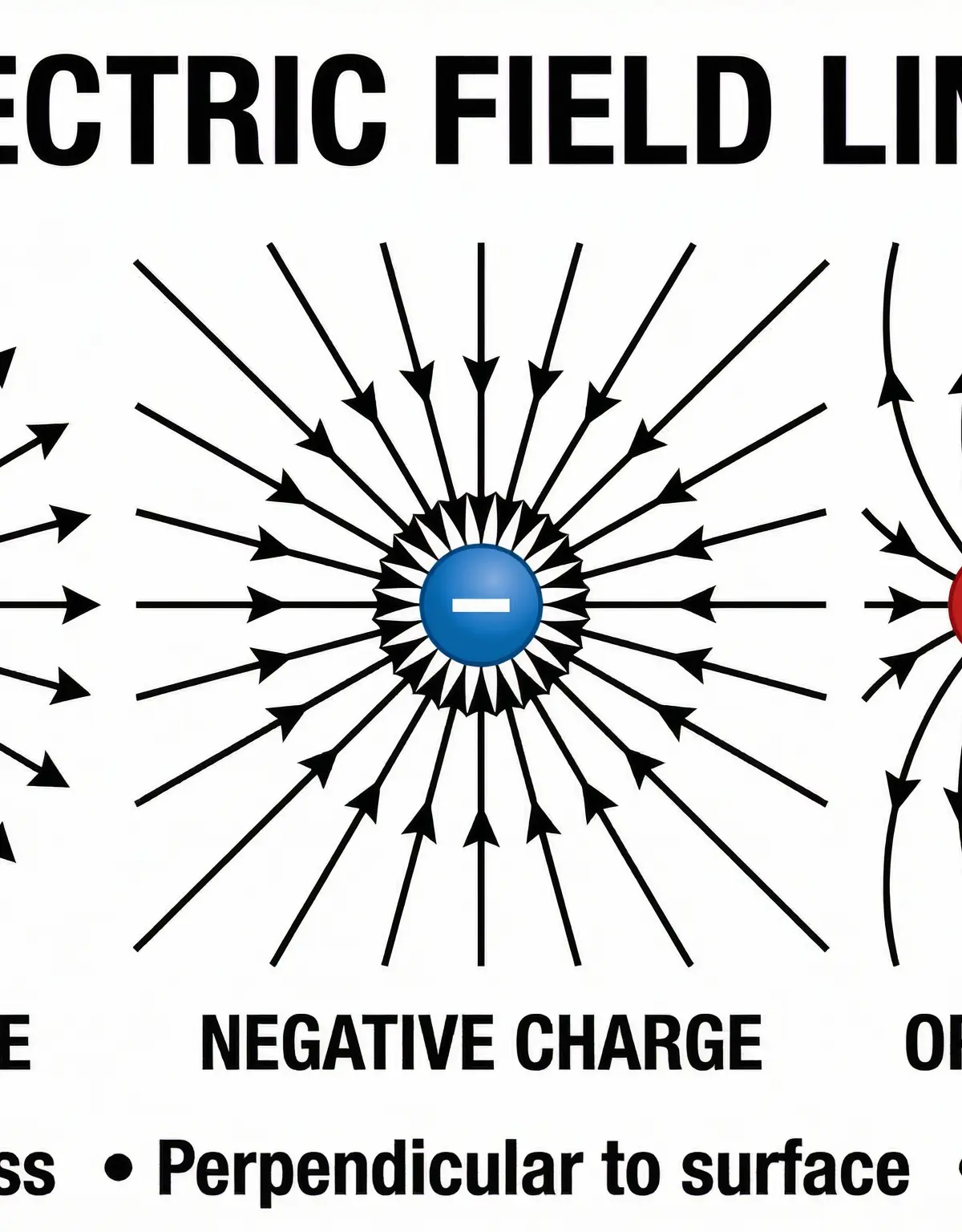
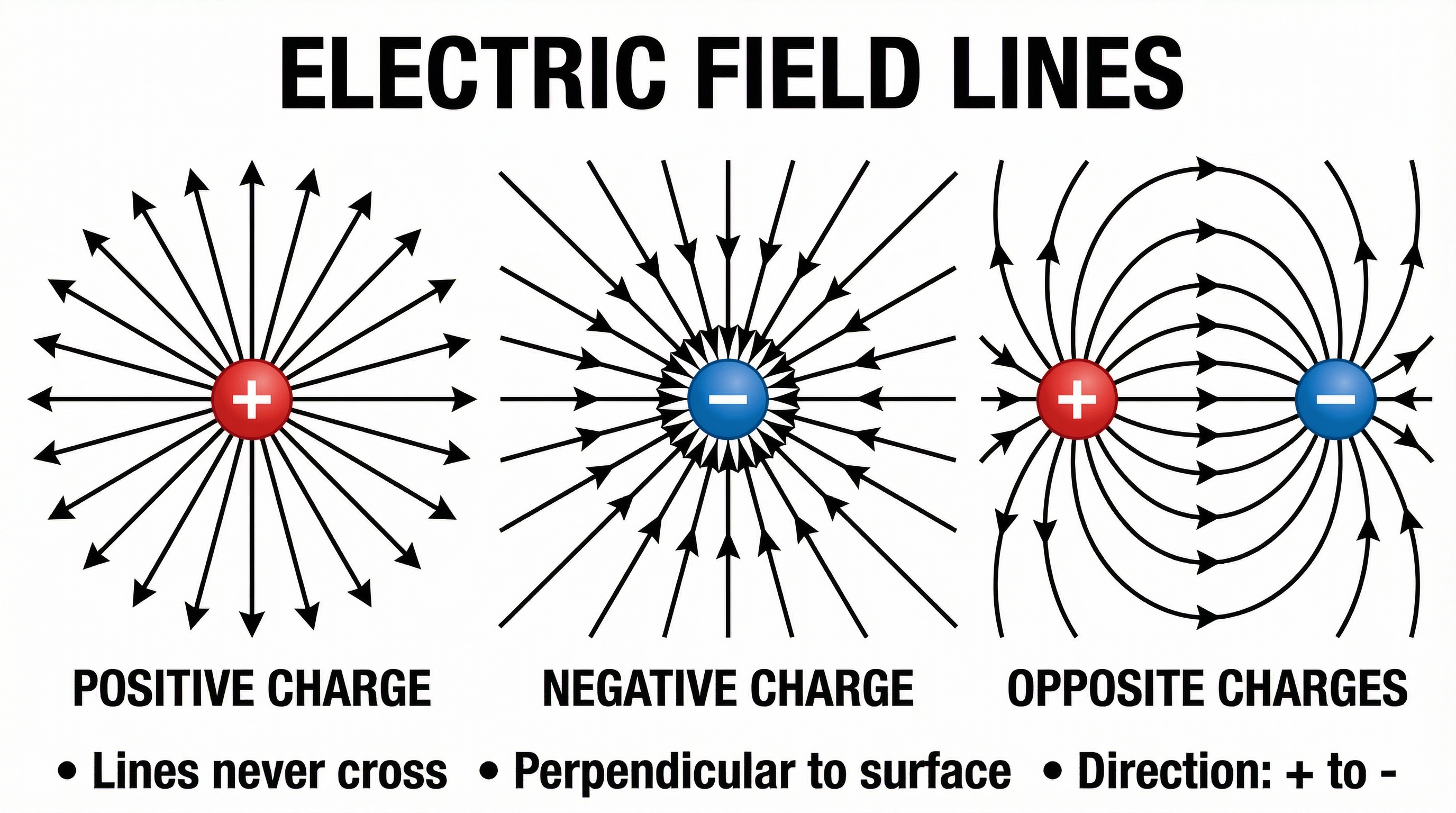
An electric field is a region of space around a charged object where another charged object will experience an electrostatic force. We cannot see electric fields, so we represent them using electric field lines. These diagrams are a common feature in exams.
Rules for Drawing Electric Field Lines:
- Direction: Field lines always show the direction of the force on a positive charge. Therefore, they point away from positive charges and towards negative charges.
- Spacing: The closer the field lines are together, the stronger the electric field.
- No Crossing: Field lines can never cross each other.
- Perpendicular Surface: Field lines must always meet a charged surface at a right angle (90 degrees).
Concept 4: Sparking and Discharge (Higher Tier)
If the build-up of static charge on an object becomes large enough, the potential difference between the object and its surroundings (e.g., the earth) can become very high. This creates a very strong electric field in the air between them.
Air is normally an insulator, but a sufficiently strong electric field can ionise the air molecules. This means the field is so strong it rips electrons from the air molecules, creating positive ions and free electrons. This mixture of ions and electrons makes the air a conductor for a brief moment. A large number of electrons can then rush across this conducting path, creating a visible spark. Lightning is a dramatic, large-scale example of this process.
Concept 5: Earthing
Earthing (or grounding) is the process of removing excess static charge from an object by providing a safe path for electrons to flow to or from the Earth. The Earth is a vast reservoir of charge and can accept or donate a large number of electrons without becoming significantly charged itself. By connecting a charged object to the ground with a conductor (like a copper wire), the charge is neutralised.
- If an object is negatively charged, excess electrons flow from the object to the Earth.
- If an object is positively charged, electrons flow from the Earth to the object.
This is a crucial safety feature used to prevent the build-up of static charge in situations where a spark could be dangerous, such as when refuelling aircraft.
Mathematical/Scientific Relationships
There are no specific formulas to memorise for the Static Electricity topic at GCSE level. However, for Higher Tier students, the concept of an electric field is linked to potential difference and distance. The electric field strength (E) is related to the potential difference (V) and the distance (d) between two points.
- Relationship: E = V / d
- Meaning: The electric field is stronger when the potential difference is larger or when the distance is smaller. This is why sparking is more likely with a very high voltage over a small air gap. This formula is not on the specification for calculation but underpins the principles of sparking.
Practical Applications
Examiners love to ask about the real-world uses of static electricity. You need to be able to explain how they work using the principles of charge transfer and electrostatic forces.
-
Photocopiers and Laser Printers: A rotating drum is given a positive charge. A laser (or light) is used to discharge parts of the drum, leaving a positively charged 'image' of the page. Negatively charged toner particles are then attracted to this positive image on the drum. The toner is then transferred to a sheet of paper and heated to fuse it permanently.
-
Electrostatic Paint Sprayers: The spray gun gives the paint droplets a positive charge. As the droplets leave the nozzle, they repel each other, forming a very fine, even mist. The object to be painted (e.g., a car body) is connected to the negative terminal of a power supply, giving it a negative charge. The positively charged paint droplets are then attracted to the negatively charged object, resulting in an even coat with very little waste paint.
-
Defibrillators: In a cardiac arrest, the heart's rhythm is chaotic. A defibrillator uses two paddles with a very high potential difference between them. When placed on the patient's chest, a large electric charge is passed through the heart. This causes the heart muscle to contract and can reset it into a normal rhythm.
-
Chimney Flue Precipitators: Smoke and dust particles are passed through a high-voltage metal grid, giving them a negative charge. These charged particles are then attracted to positively charged metal plates on the inside of the chimney. The particles stick to the plates and can be removed, preventing them from being released into the atmosphere.
Required Practicals
While there is not a single 'required practical' for static electricity in the same way as other topics, investigating static charges is a common classroom activity. You should be familiar with the following:
- Apparatus: Polythene rod, acetate rod, dry cloth (duster), small pieces of paper, gold-leaf electroscope.
- Method:
- Rub the polythene rod with the cloth. This makes the rod negative.
- Bring the rod close to (but not touching) the small pieces of paper. Observe that they are attracted.
- Bring the charged rod close to the cap of a gold-leaf electroscope. The gold leaf will rise as it becomes charged by induction.
- Expected Results: Insulating materials can be charged by friction. Charged objects attract uncharged objects. Like charges repel (e.g., bringing a negatively charged rod near an electroscope already charged negative will make the leaf rise further).
- Common Errors: Using a damp cloth or conducting rods will prevent charge from building up. Not earthing the electroscope between experiments can lead to residual charge affecting results.
Visual Resources
2 diagrams and illustrations
Interactive Diagrams
2 interactive diagrams to visualise key concepts
Conceptual Flow Outline
Flowchart showing the process of charging two insulators by friction.
Conceptual Flow Outline
Sequence of events leading to a spark (Higher Tier content).
Worked Examples
3 worked examples — open one to explore the question and available guidance.
Practice Questions
Test your understanding — click to reveal model answers
State the type of particle that is transferred when a polythene rod is charged by friction.
A charged rod is brought near a pile of small paper pieces. The paper pieces are attracted to the rod. Explain why this happens. (3 marks)
Hint: Think about what happens to the charges within the neutral paper pieces.
Draw the electric field pattern between two parallel plates, one positively charged and one negatively charged. (3 marks)
Explain, in terms of electrons, how a cloth becomes positively charged when it is used to rub an acetate rod. (2 marks)
Explain why a person might get an electric shock when touching a metal tap after walking on a nylon carpet. (4 marks) [Higher Tier]
Hint: Think about the steps: charging, potential difference, and discharge.
Test your understanding of Static Electricity
Active recall beats re-reading. Take an instant quiz now to test what you’ve learned and lock it into long-term memory.
7 days Premium · Then free forever · No card, no charge