Pearson Edexcel · GCSE · Physics
The Motor Effect
The Motor Effect explains how a current-carrying conductor placed in a magnetic field experiences a force — the fundamental principle behind every electric motor on the planet. Edexcel tests this topic at both tiers through Fleming's Left-Hand Rule, the mechanism of the DC electric motor, and (Higher only) the quantitative equation F = BIl. Master this topic and you unlock marks across qualitative explanation questions, diagram interpretation, and multi-step calculations.
- 9 min read
- 5 worked examples
- 6 practice questions
- 8 key terms
Study Notes

Overview
The Motor Effect is one of the most practically significant topics in GCSE Physics, underpinning the operation of electric motors found in everything from household appliances to electric vehicles. At its core, the topic asks: what happens when a current-carrying wire is placed inside a magnetic field? The answer — it experiences a force — seems simple, but Edexcel builds considerable complexity around this idea, testing candidates on the direction of that force, the mechanism that sustains continuous rotation in a DC motor, and the mathematical relationship between force, field strength, current, and wire length.
This topic sits within the broader theme of electromagnetism (Topic 12), connecting directly to magnetic fields (12.1) and electromagnetic induction (12.3). Examiners frequently set synoptic questions that bridge the motor effect with energy transfers, electrical circuits, and even wave properties. Typical question styles include: short 'state' and 'describe' questions (1–2 marks) testing Fleming's Left-Hand Rule; extended 'explain' questions (4–6 marks) requiring a step-by-step account of DC motor operation; and Higher-tier calculation questions (3–4 marks) using F = BIl with deliberate unit conversion traps.
AO1 questions (recall and knowledge) account for 30% of marks on this topic; AO2 (application) for 40%; and AO3 (analysis and evaluation) for 30%. This means simply memorising facts is not enough — you must be able to apply and evaluate.
Key Concepts
Concept 1: The Motor Effect — Why Does the Force Occur?
When an electric current flows through a wire, it generates a circular magnetic field around that wire (this is Oersted's discovery, linked to Topic 12.1). When this wire is placed between the poles of a permanent magnet, two magnetic fields now exist in the same region of space: the field of the permanent magnet and the field produced by the current. These two fields interact — in some regions they reinforce each other (the combined field is stronger) and in other regions they oppose each other (the combined field is weaker). The result of this uneven field is a net force on the wire, pushing it from the region of stronger combined field toward the region of weaker combined field.
This interaction is the key marking point. Candidates who simply write 'the magnet attracts the wire' will not receive credit. The examiner's mark scheme specifically awards marks for identifying that it is the interaction between the permanent magnetic field and the magnetic field due to the current that produces the force.
Real-world analogy: Think of two people pushing on a revolving door from opposite sides — the door moves because of the interaction of both forces, not just one. Similarly, the wire moves because of the interaction of both fields.
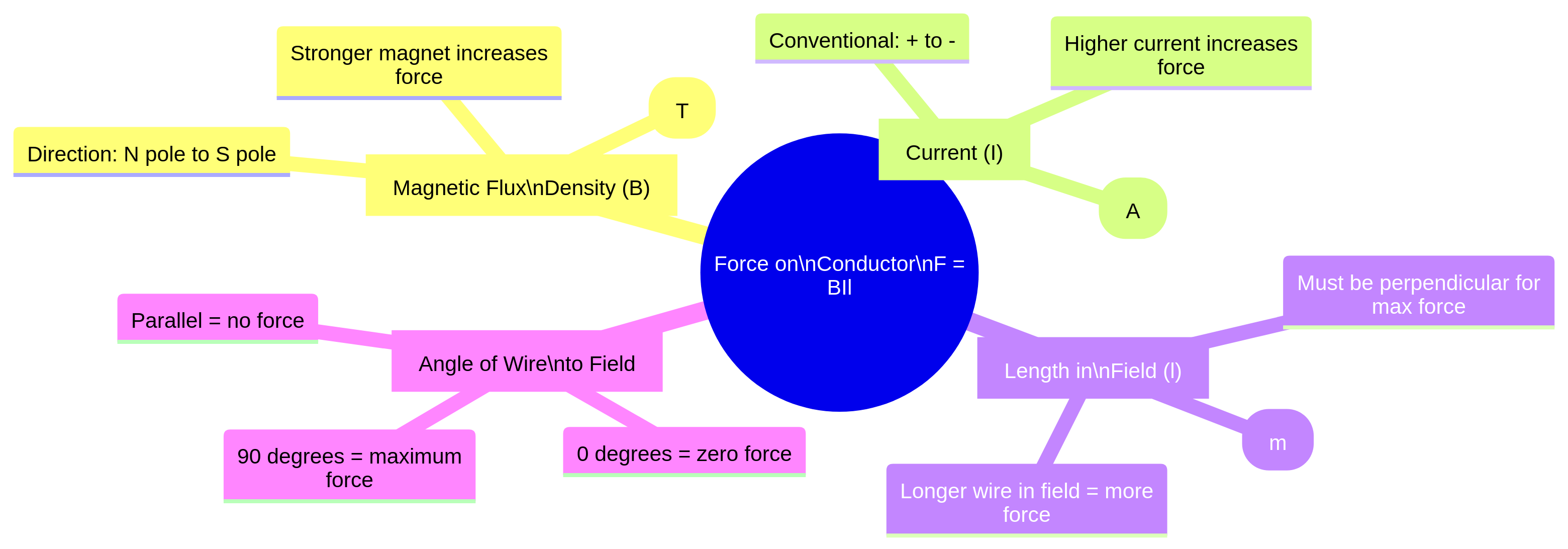
The force is maximised when the wire is perpendicular (at 90°) to the magnetic field. The force is zero when the wire is parallel to the magnetic field. This is a frequently tested one-mark point.
Concept 2: Fleming's Left-Hand Rule
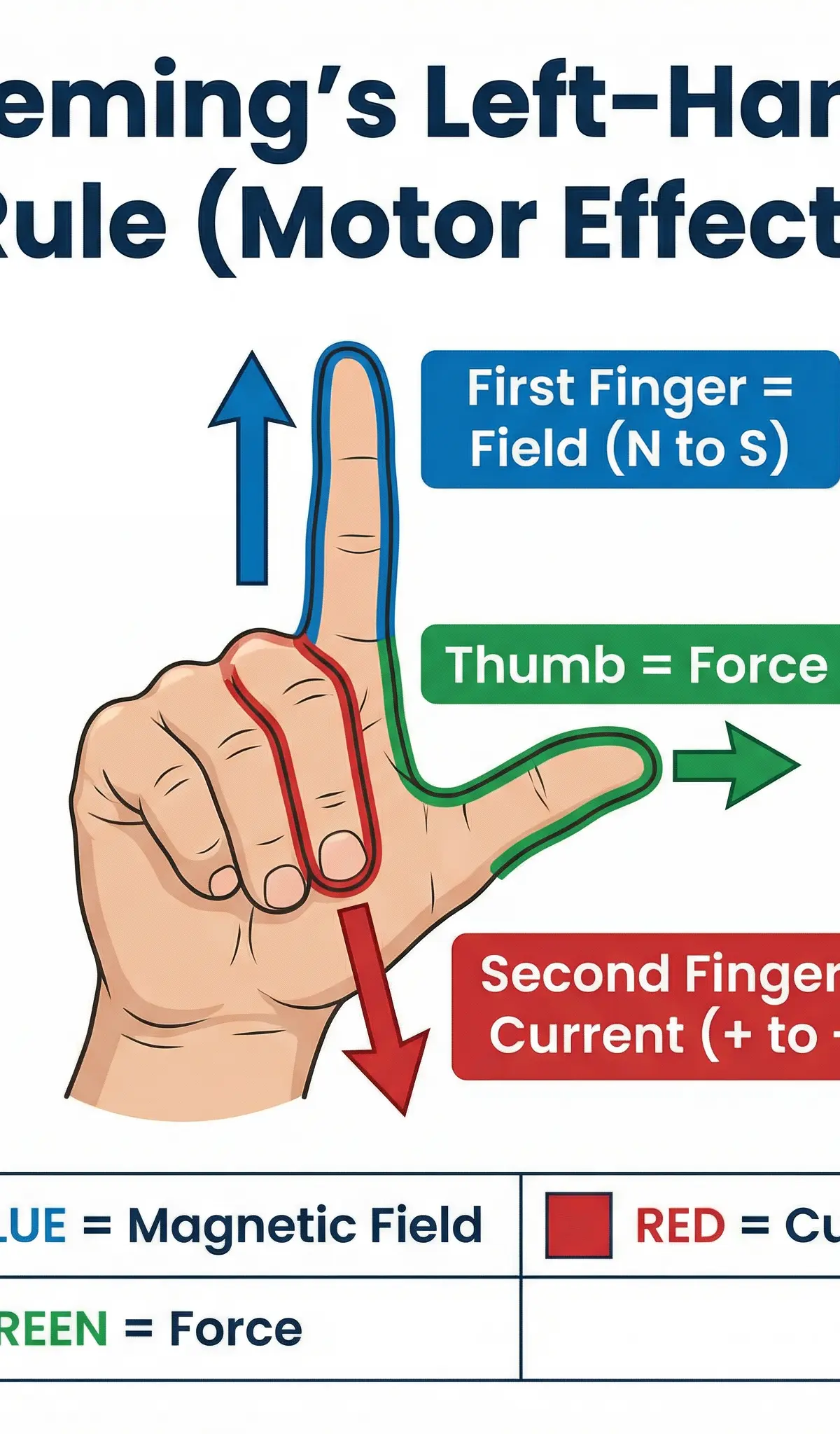
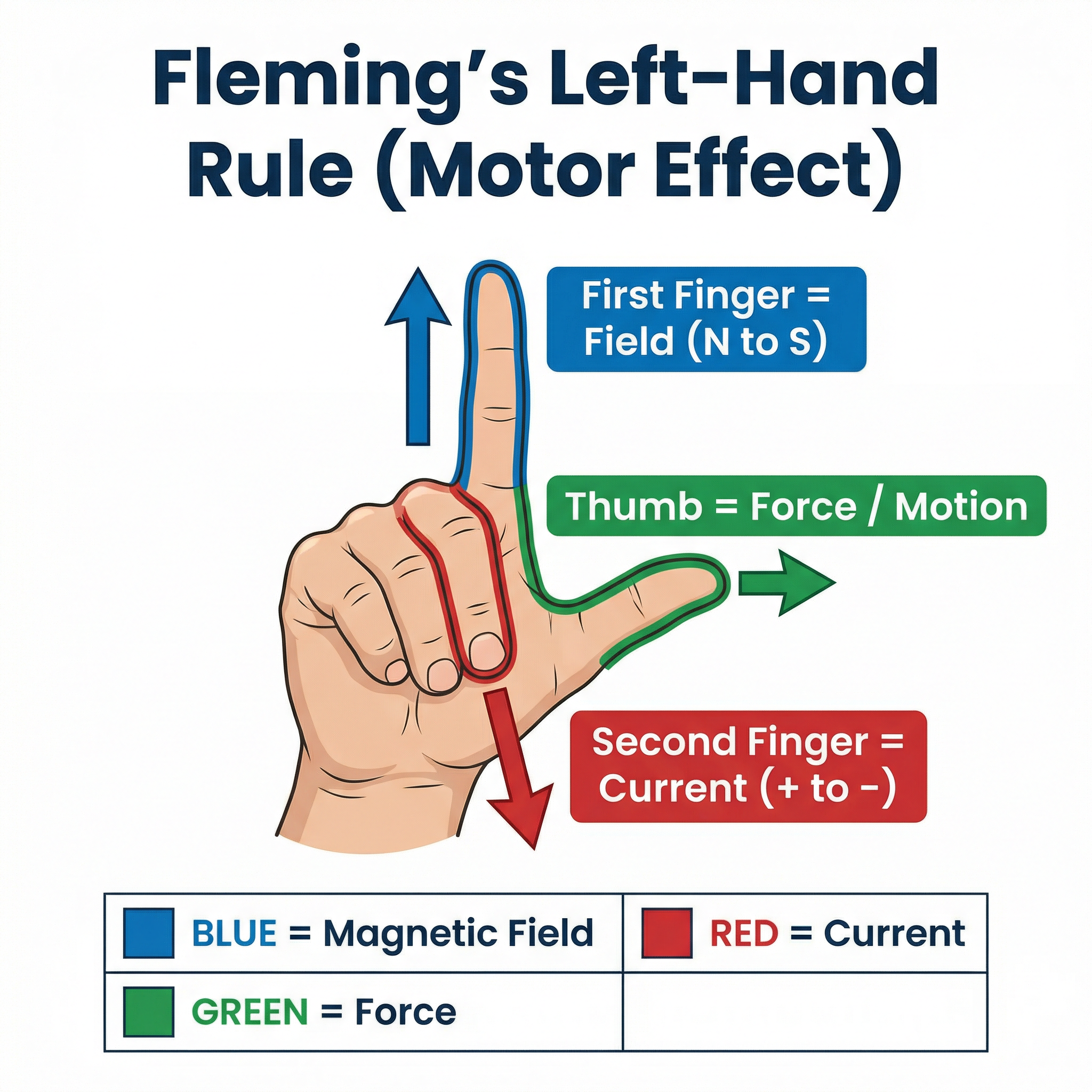
Fleming's Left-Hand Rule is the tool used to determine the direction of the force on a current-carrying conductor in a magnetic field. It applies to the motor effect (the Left-Hand Rule is for motors; the Right-Hand Rule is for generators — confusing these is one of the most common errors in this topic).
**How to apply it:**Hold your left hand with your first finger, second finger, and thumb all pointing at right angles to each other (like a 3D coordinate system).
| Finger | Represents | Direction |
|---|---|---|
| First finger | Magnetic Field | North pole to South pole |
| Second finger | Current (conventional) | Positive terminal to negative terminal |
| Thumb | Motion / Force | Direction the wire moves |
Critical warning: Always use conventional current (positive to negative), not electron flow (negative to positive). If a question states that electrons flow in a particular direction, you must reverse that direction to get conventional current before applying the rule. This is one of the most common errors in the exam.
Memory hook: Freddie Can Move — First finger = Field, seCond finger = Current, thuMb = Motion.
Concept 3: The DC Electric Motor
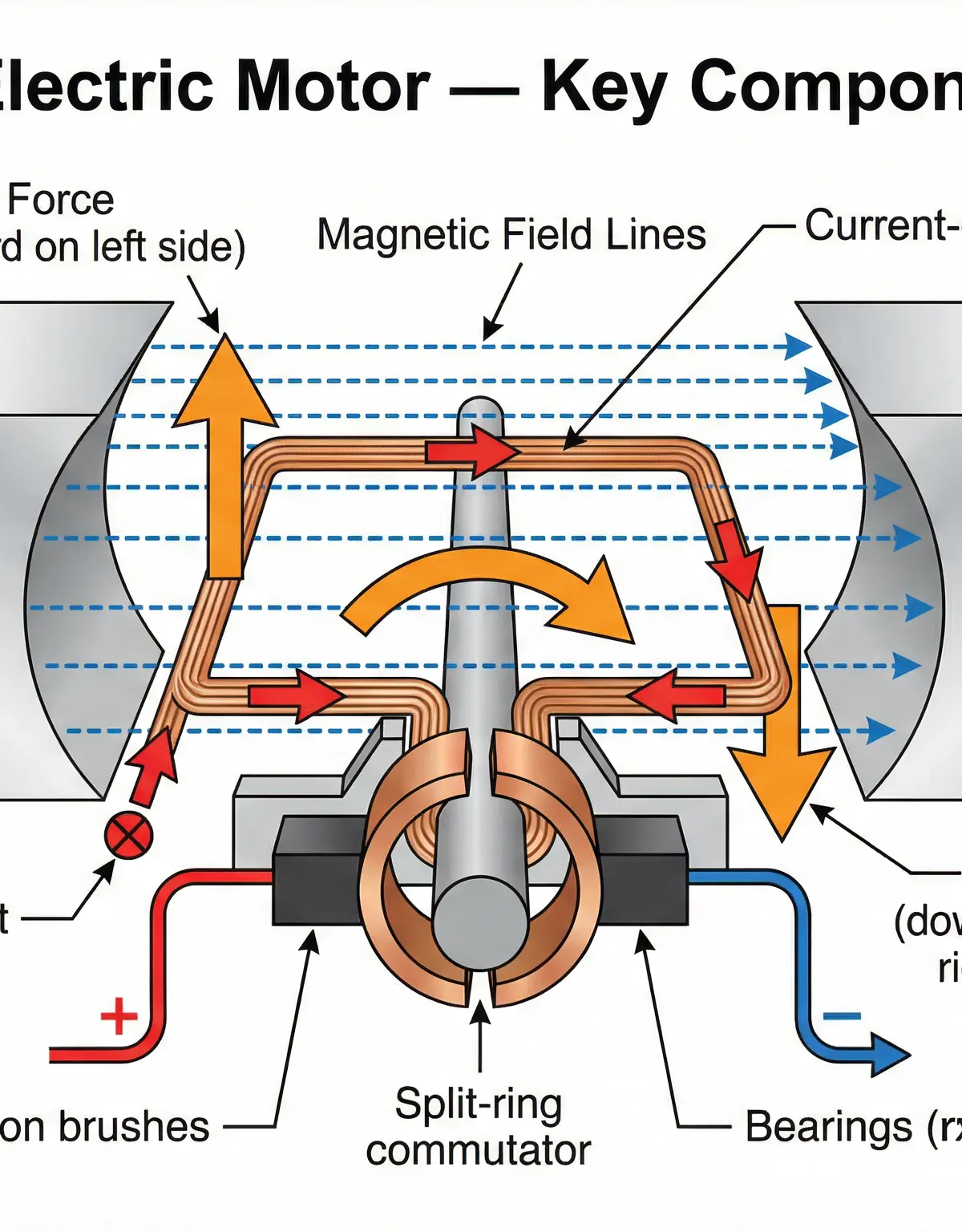
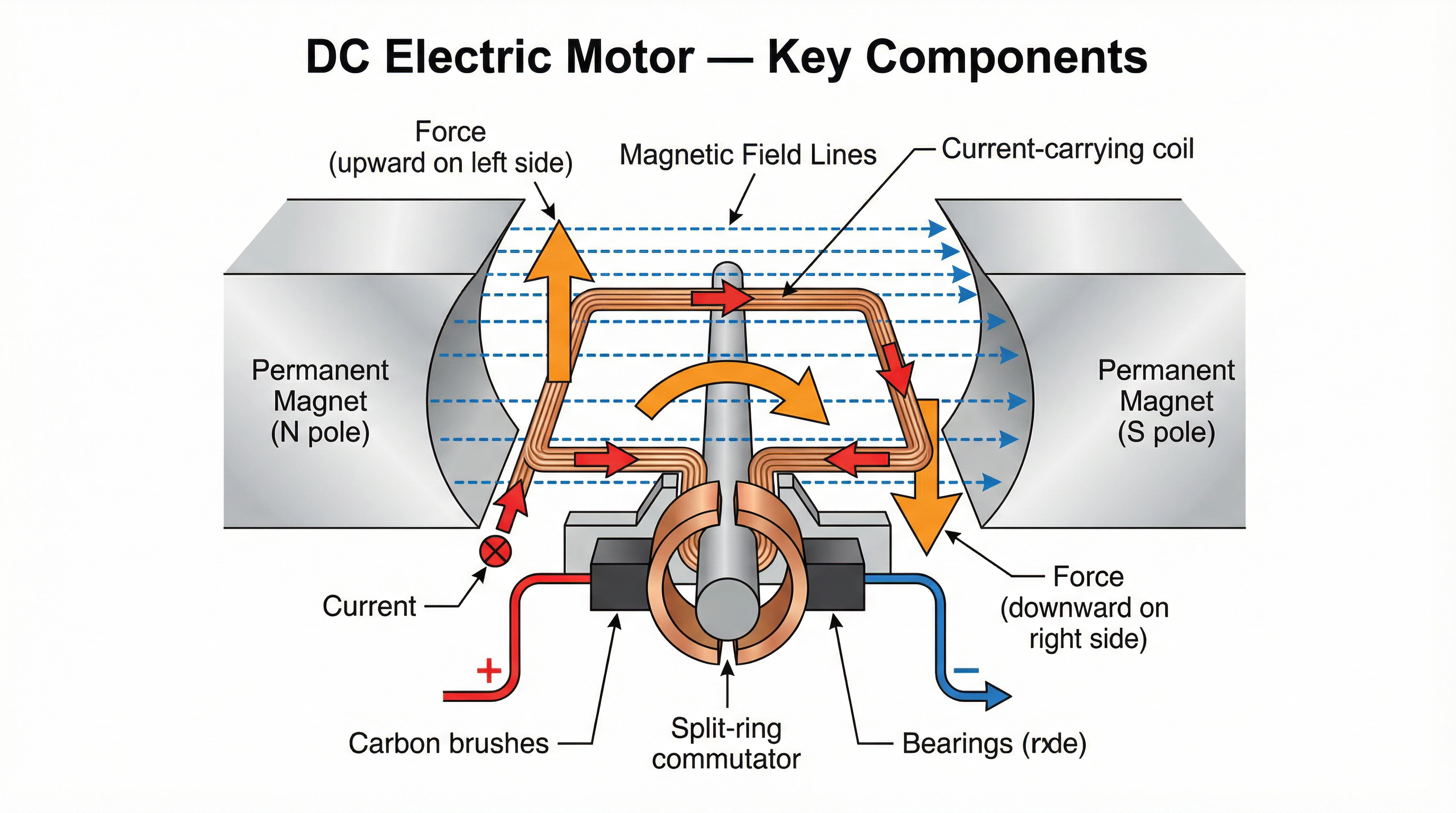
The DC electric motor converts electrical energy into kinetic (rotational) energy. Understanding its mechanism in detail is essential for the longer-mark questions on this topic.
Components of a DC Motor:
| Component | Function |
|---|---|
| Rectangular coil (armature) | Carries the current; experiences the force |
| Permanent magnet | Provides the external magnetic field |
| Carbon brushes | Maintain electrical contact with the rotating commutator |
| Split-ring commutator | Reverses current direction every half-turn to maintain continuous rotation |
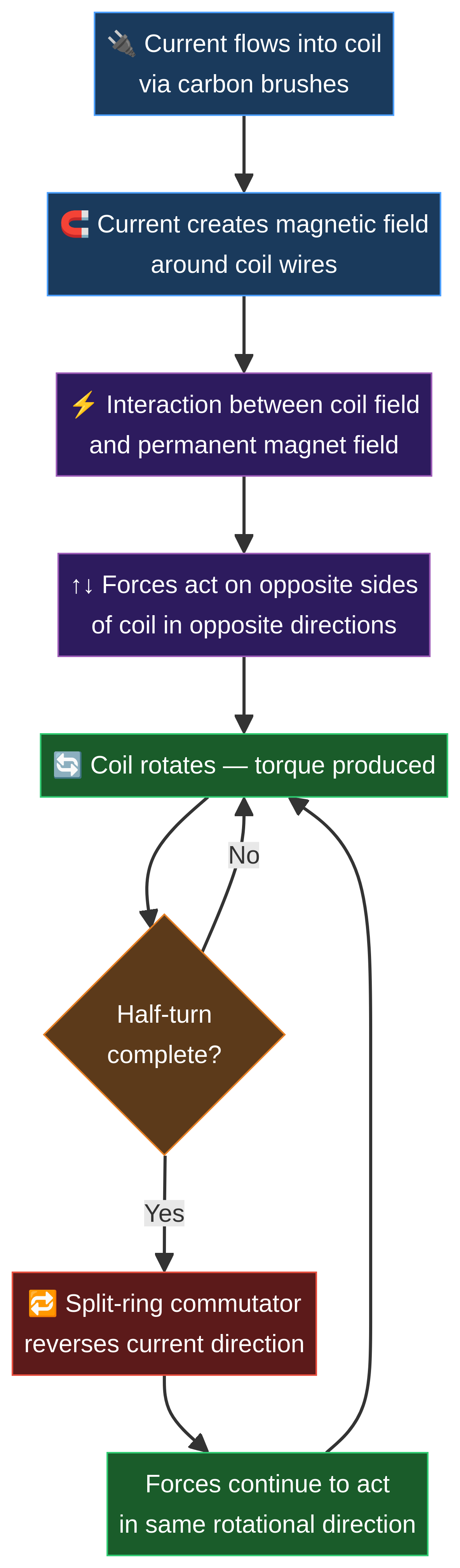
Step-by-step mechanism (learn this sequence for 5–6 mark questions):
- Current flows into the coil via the carbon brushes and split-ring commutator.
- The current-carrying sides of the coil sit within the magnetic field of the permanent magnet.
- By the motor effect, each side of the coil experiences a force. Using Fleming's Left-Hand Rule, the forces on opposite sides act in opposite directions (one side is pushed up, the other down).
- These opposing forces create a torque (turning effect), causing the coil to rotate.
- After half a turn, the sides of the coil have swapped positions. Without intervention, the forces would now reverse the rotation — the coil would oscillate rather than spin continuously.
- The split-ring commutator reverses the direction of current through the coil at this exact moment. This ensures the force on each side continues to act in the same rotational direction.
- The coil continues to rotate in the same direction indefinitely.
The split-ring commutator's function is the most commonly misunderstood point. Candidates frequently write that it 'stops the wires tangling' or 'maintains electrical contact' — neither of these earns the mark. The correct answer: it reverses the current direction every half-turn to maintain continuous rotation in the same direction.
Increasing motor speed/force: Increase the current, increase the magnetic field strength (stronger magnet), or increase the number of turns on the coil.
Concept 4: The Force Equation — F = BIl (Higher Tier)
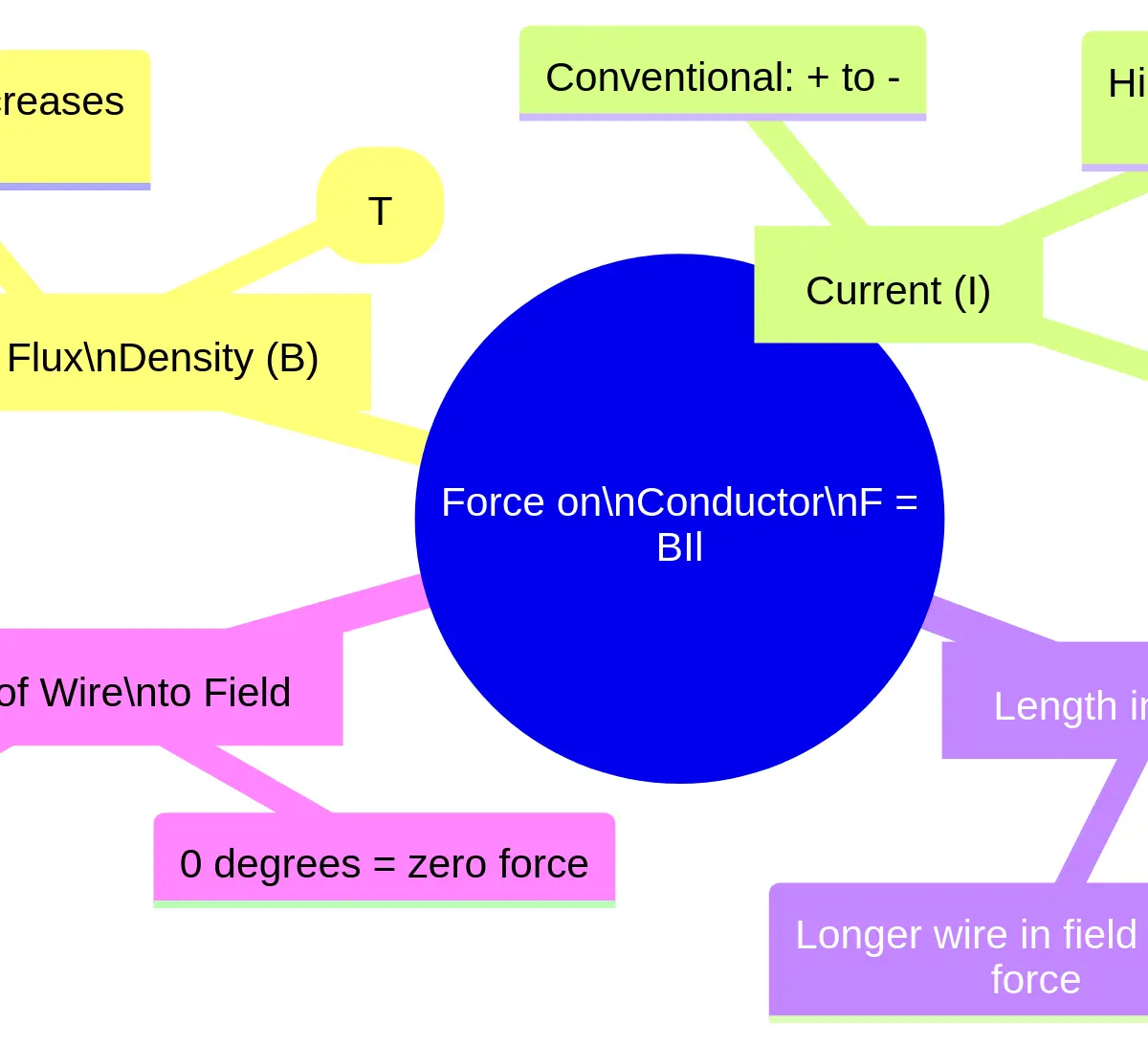
For Higher tier candidates, the relationship between force, magnetic flux density, current, and wire length is expressed as:
F = BIlWhere:
- F = force on the conductor (Newtons, N)
- B = magnetic flux density (Tesla, T) — a measure of the strength of the magnetic field
- I = current (Amperes, A)
- l = length of the conductor within the magnetic field (metres, m)
Formula sheet status: This equation is provided on the Edexcel formula sheet. You do not need to memorise it, but you must be able to use and rearrange it.
Unit conversions — the most common trap:
| Given unit | Convert to | Divide by |
|---|---|---|
| centimetres (cm) | metres (m) | 100 |
| millimetres (mm) | metres (m) | 1000 |
| milliamperes (mA) | amperes (A) | 1000 |
| millitesla (mT) | tesla (T) | 1000 |
Always write out your known values with units before substituting — this forces you to identify any conversions needed and earns a substitution mark even if your final answer is wrong.
Mathematical Relationships
F = BIl (Higher Tier — given on formula sheet)
Rearrangements:
- B = F ÷ (I × l)
- I = F ÷ (B × l)
- l = F ÷ (B × I)
Key relationships to remember:
- Doubling B doubles F (directly proportional)
- Doubling I doubles F (directly proportional)
- Doubling l doubles F (directly proportional)
- Force is zero when the wire is parallel to the field (angle = 0°)
- Force is maximum when the wire is perpendicular to the field (angle = 90°)
Practical Applications
The motor effect is not merely an abstract concept — it is the operating principle of:
- Electric vehicles (motors in Tesla cars, electric buses)
- Industrial machinery (conveyor belts, lathes, pumps)
- Household appliances (washing machines, fans, food mixers)
- Medical equipment (MRI machines use related electromagnetic principles)
Edexcel does not specify a required practical for this topic, but candidates may be asked to interpret data from investigations into how force varies with current or field strength, or to describe how they would investigate the factors affecting the force on a current-carrying conductor.
Listen to the 10-minute revision podcast above for a full walkthrough of all key concepts, exam tips, and a quick-fire recall quiz.
Visual Resources
4 diagrams and illustrations
Interactive Diagrams
2 interactive diagrams to visualise key concepts
Conceptual Flow Outline
DC Electric Motor Operation — Step-by-step flowchart showing how continuous rotation is achieved, with the split-ring commutator as the key mechanism for maintaining unidirectional rotation.
Conceptual Flow Outline
F = BIl Concept Map — Shows the three variables that determine the force on a current-carrying conductor and the effect of the angle between the wire and the magnetic field.
Worked Examples
5 worked examples — open one to explore the question and available guidance.
Practice Questions
Test your understanding — click to reveal model answers
State what is meant by the 'motor effect'. (1 mark)
Hint: Think about what two things must be present, and what happens as a result.
A wire is placed horizontally between the poles of a magnet. The magnetic field points from north to south (left to right). The conventional current flows from front to back (into the page). Using Fleming's Left-Hand Rule, determine the direction of the force on the wire. (2 marks)
Hint: Hold up your left hand. Point your first finger in the direction of the field (left to right). Point your second finger into the page. Your thumb will show the force direction.
A wire of length 8 cm carries a current of 1.5 A in a magnetic field of magnetic flux density 0.25 T. The wire is perpendicular to the field. Calculate the force on the wire. (3 marks)
Hint: Use F = BIl. Don't forget to convert the length from centimetres to metres before substituting.
Explain the role of the split-ring commutator in a DC electric motor. (3 marks)
Hint: Think about what would happen to the rotation after the coil has turned half a revolution, and how the commutator solves this problem.
A student investigates the motor effect using a wire connected to a power supply and placed between the poles of a magnet. The student reverses the direction of the current. Predict and explain what happens to the wire. (3 marks)
Hint: Apply Fleming's Left-Hand Rule with the current direction reversed. What happens to the second finger?
A DC motor has a coil of wire with a magnetic flux density of 0.15 T acting on it. The coil carries a current of 2 A and the length of wire in the field is 0.1 m. (a) Calculate the force on one side of the coil. (2 marks) (b) The student wants to double the force. Suggest two changes they could make to the motor. (2 marks) [Higher Tier]
Hint: For part (a), use F = BIl directly — no unit conversion needed here. For part (b), look at the equation: what variables could you change to double F?
Test your understanding of The Motor Effect
Active recall beats re-reading. Take an instant quiz now to test what you’ve learned and lock it into long-term memory.
7 days Premium · Then free forever · No card, no charge