Pearson Edexcel · GCSE · Physics
The Universe (Big Bang and Red-Shift)
This guide covers the Edexcel GCSE Physics topic of The Universe, focusing on the two key pieces of evidence for the Big Bang theory: the red-shift of distant galaxies and the discovery of Cosmic Microwave Background Radiation (CMBR). Mastering this topic is crucial for explaining the origins of our universe and tackling high-mark comparison questions in your exam.
- 7 min read
- 3 worked examples
- 5 practice questions
- 6 key terms
Study Notes

Overview
Welcome to one of the most fascinating topics in physics: the study of the Universe itself. This section of your Edexcel GCSE course (7.2) explores the evidence for the Big Bang, our current best model for the origin and evolution of the cosmos. You will learn how observations of distant galaxies (red-shift) and faint background radiation (CMBR) support the idea that the Universe began from an incredibly hot, dense point around 13.8 billion years ago. This topic frequently appears in exams, often in the form of longer-answer questions that require you to explain concepts or compare competing theories. It provides a crucial synoptic link to the study of waves (the Doppler effect) and the electromagnetic spectrum, showing how different parts of physics connect to tell a single, epic story.
Key Concepts
Concept 1: The Doppler Effect and Red-Shift
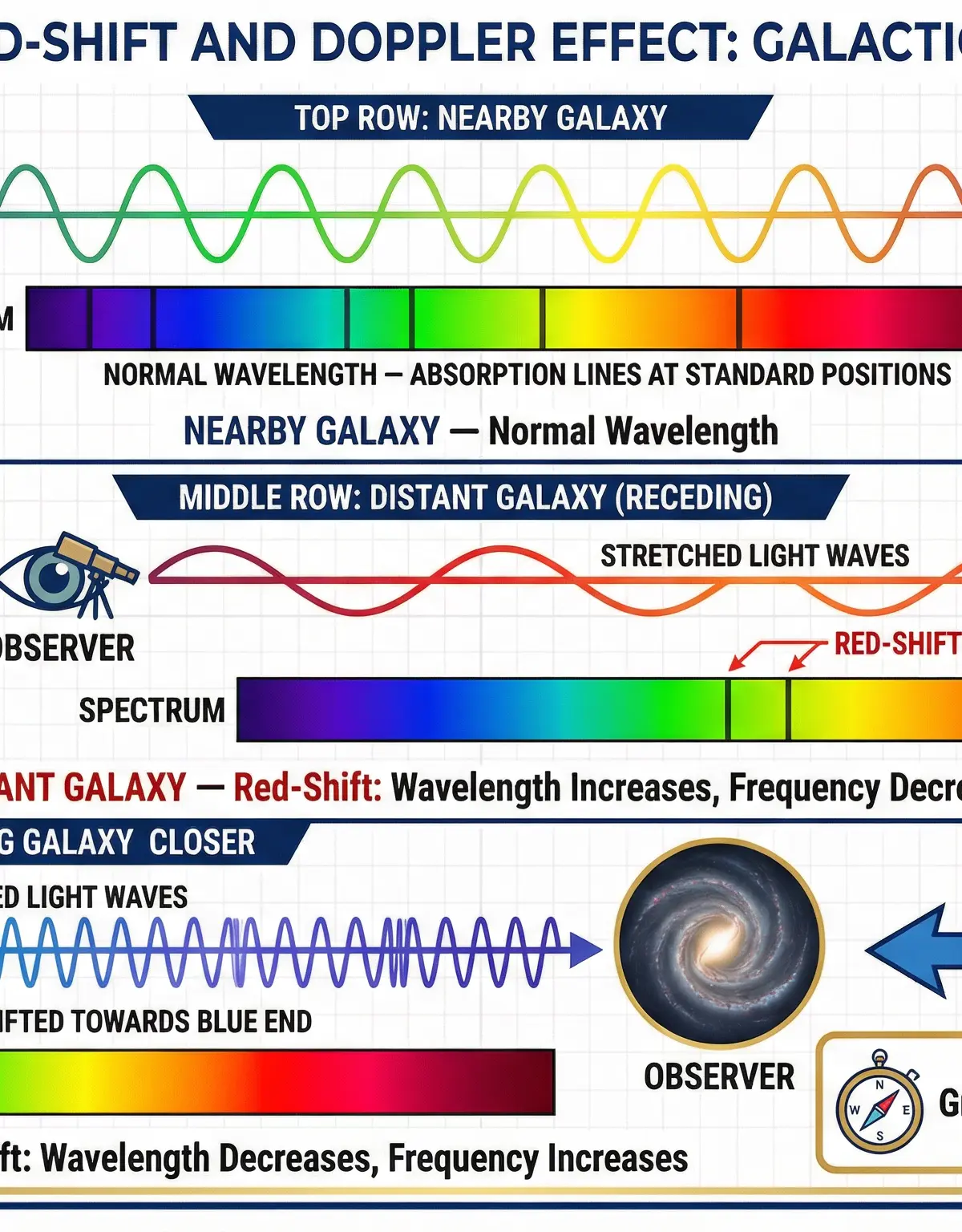
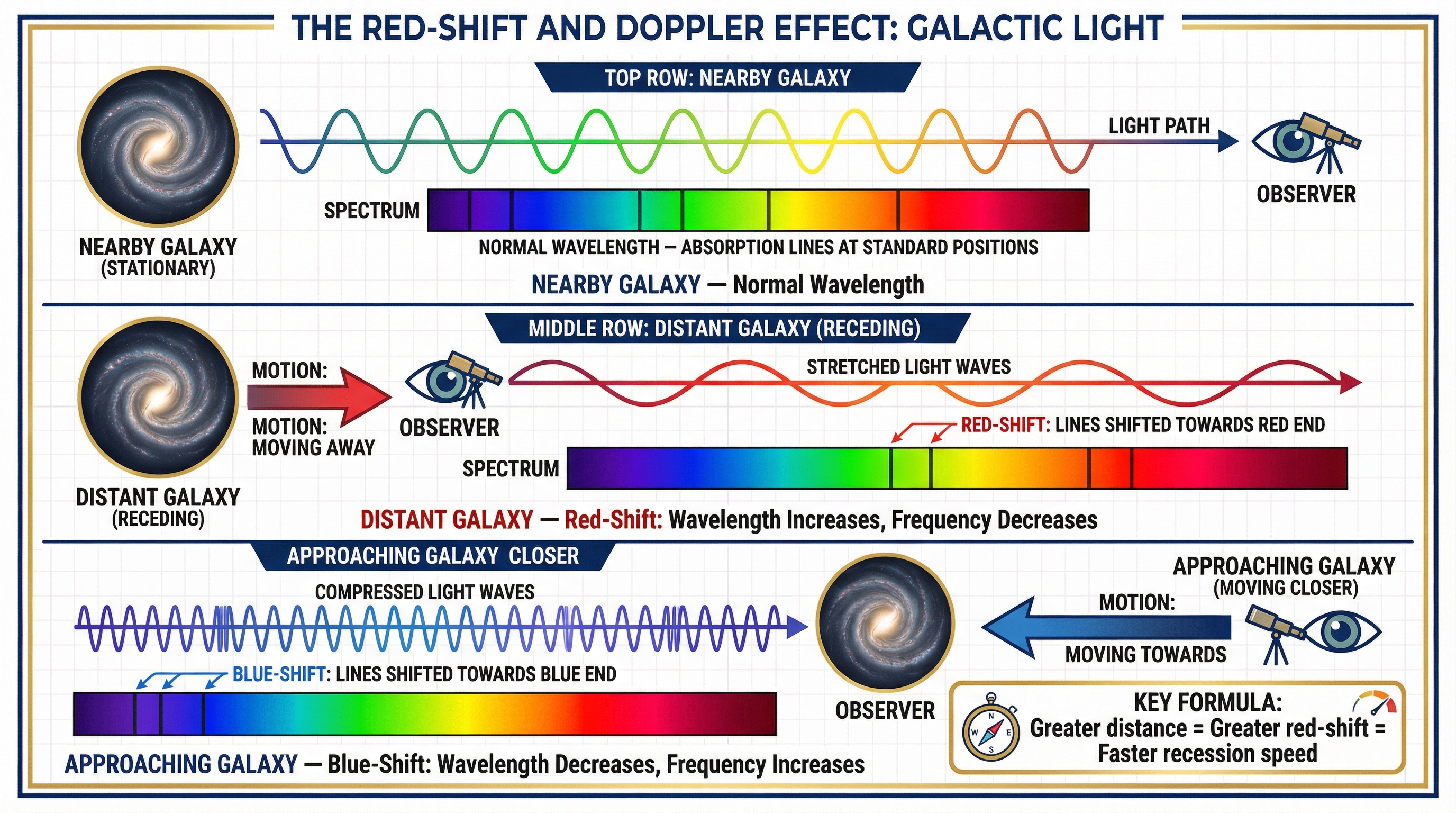
The Doppler effect is the change in the observed frequency and wavelength of a wave when its source is moving relative to an observer. You experience this with sound all the time: the pitch of an ambulance siren sounds higher as it approaches you and lower as it moves away. The exact same principle applies to light.
When a light source, like a galaxy, moves away from us, the light waves it emits are 'stretched out'. This means their wavelength increases and their frequency decreases. In the visible spectrum, the longest wavelength of light is red. Therefore, we say the light has been red-shifted. Conversely, if a galaxy were moving towards us, its light waves would be compressed, decreasing their wavelength and shifting them towards the blue end of the spectrum (blue-shift). Observations show that almost all distant galaxies are red-shifted, meaning they are moving away from us.
Crucial Exam Point: Red-shift does not mean the galaxy appears red. It means that when we analyse the spectrum of light from that galaxy, the characteristic dark absorption lines (which act like atomic fingerprints) are all shifted towards the red end of the spectrum compared to where they would be if the galaxy were stationary.
Concept 2: Hubble's Law and the Expanding Universe
In the 1920s, astronomer Edwin Hubble made a groundbreaking discovery. He found a direct relationship between the distance to a galaxy and the size of its red-shift. The further away a galaxy is, the greater its red-shift, and therefore the faster it is moving away from us. This is known as Hubble's Law.
This observation is the cornerstone of our understanding of an expanding universe. It implies that the universe as a whole is expanding, carrying galaxies along with it. It is not that galaxies are flying through a static space; rather, the fabric of space itself is stretching. This is a critical distinction that examiners look for. Avoid saying 'galaxies are expanding'; instead, state that 'the space between galaxies is expanding' or 'galaxies are moving apart'.
Concept 3: The Big Bang Theory
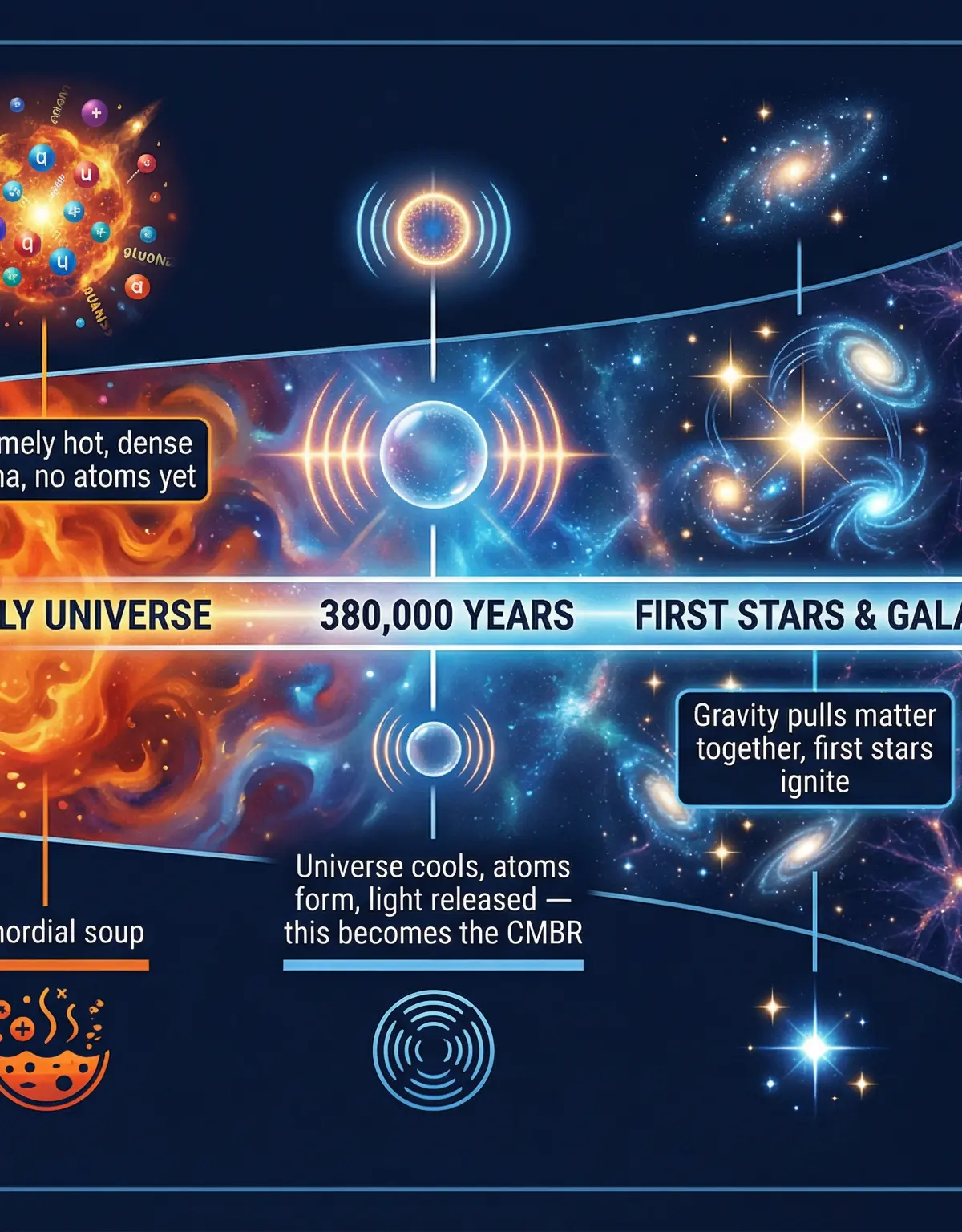
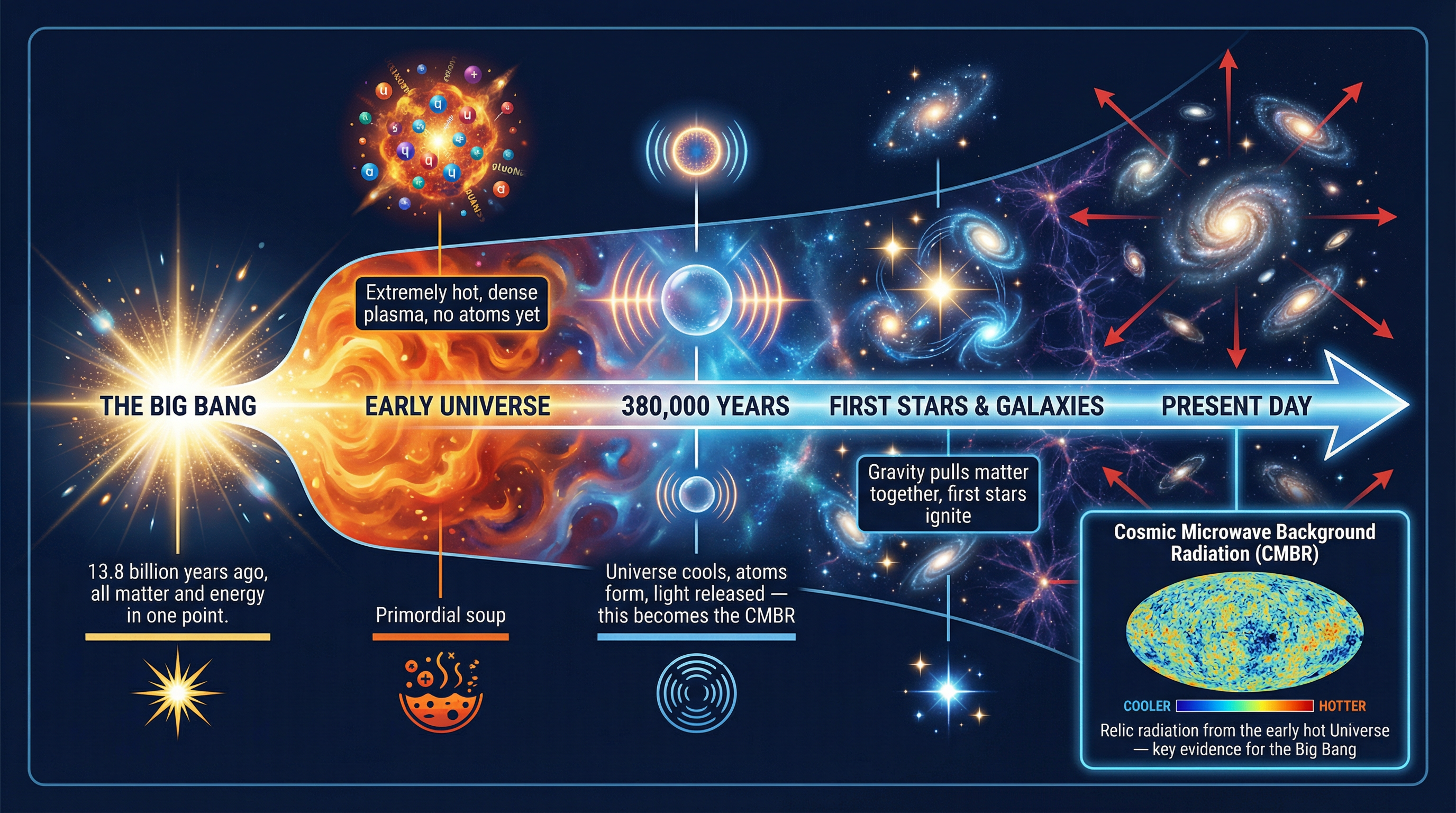
If the universe is expanding now, it logically follows that in the past, it must have been smaller, denser, and hotter. The Big Bang theory is the model that describes this evolution. It states that approximately 13.8 billion years ago, all the matter and energy in the observable universe was concentrated into a single, infinitely hot and dense point (a singularity). This point began to expand rapidly in an event we call the Big Bang.
This was not an explosion in space, but an expansion of space itself. As the universe expanded, it cooled down, allowing energy to convert into matter, and eventually for atoms, stars, and galaxies to form. The expansion observed today via red-shift is the ongoing legacy of that initial event.
Concept 4: Cosmic Microwave Background Radiation (CMBR)
CMBR is the second major piece of evidence for the Big Bang. For the first ~380,000 years after the Big Bang, the universe was so hot that atoms couldn't form. It was an opaque, glowing 'soup' of plasma. As the universe expanded and cooled to a temperature of about 3000 Kelvin, electrons and protons could finally combine to form neutral hydrogen atoms. At this moment, the universe became transparent, and the light that was present could travel freely through space for the first time.
This ancient light, released from everywhere in the universe at once, is still detectable today. Due to the continued expansion of the universe, its wavelength has been stretched all the way from visible/infrared light into the microwave part of the electromagnetic spectrum. This is the Cosmic Microwave Background Radiation. It is a faint, uniform glow of radiation with a temperature of just 2.7 Kelvin, and it is observed in all directions. It is often called the 'afterglow' or 'echo' of the Big Bang and provides a snapshot of the universe in its infancy.
Concept 5: The Steady State Theory (Higher Tier Only)
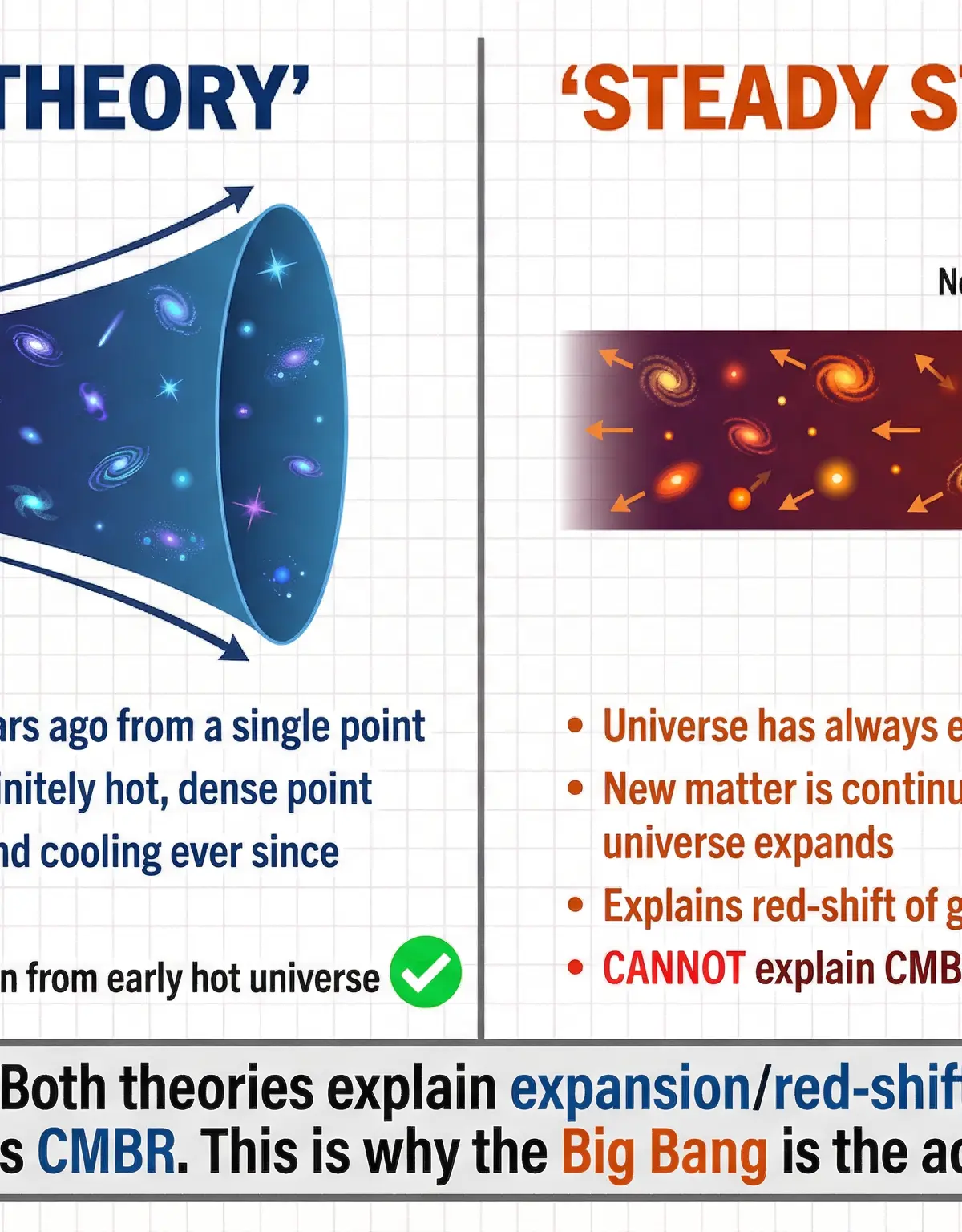
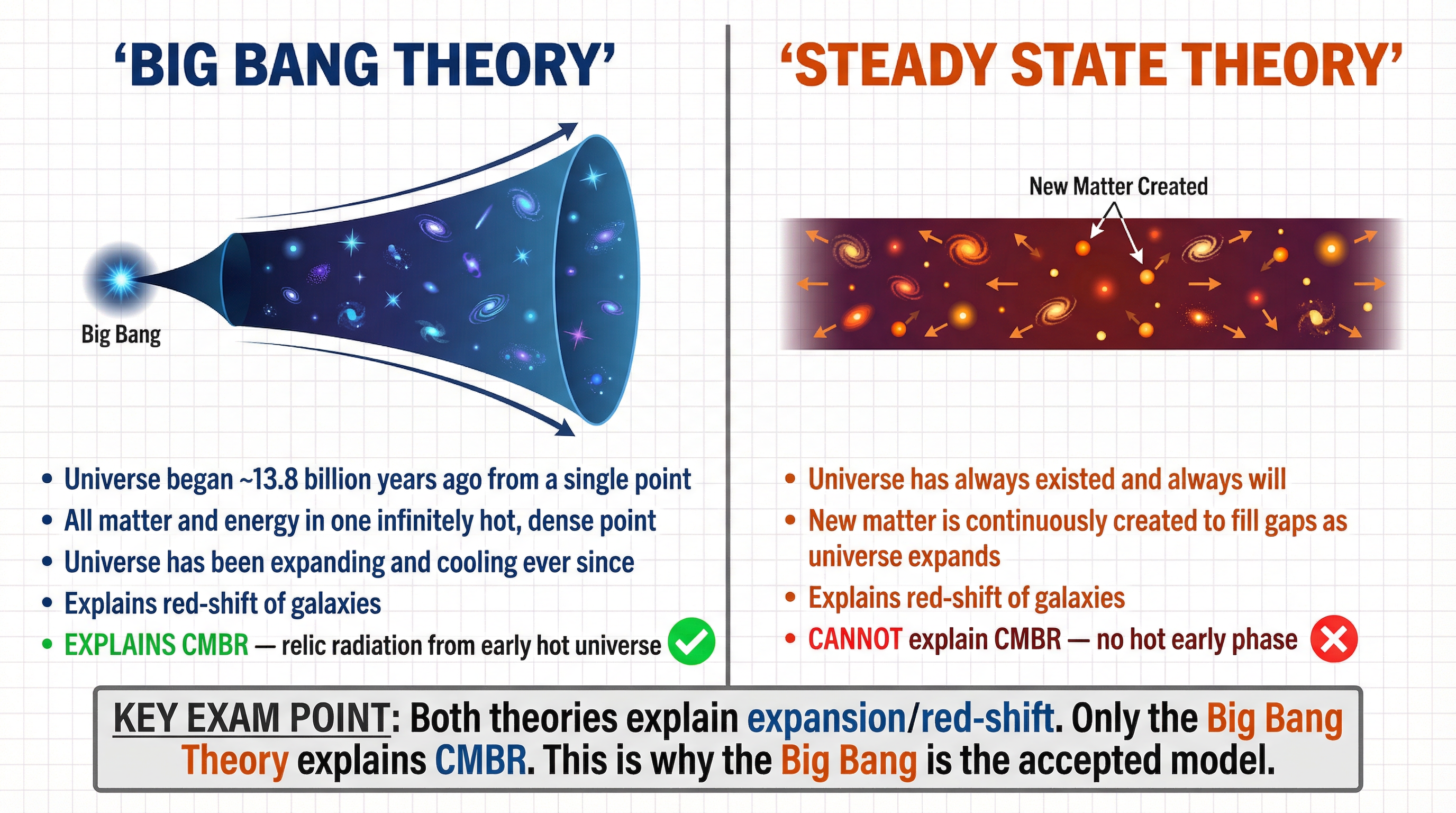
Before CMBR was discovered in 1965, a competing theory was popular: the Steady State theory. This model proposed that the universe has always existed and is eternal. It accepted that the universe is expanding, but suggested that new matter is continuously being created in the gaps between receding galaxies. This would keep the overall density of the universe constant over time, meaning the universe would look roughly the same at all points in history.
The Decisive Evidence: While both the Big Bang and Steady State theories could explain the red-shift of galaxies, only the Big Bang theory provides a natural explanation for the existence of CMBR. The Steady State model has no mechanism to produce a hot, dense early phase, and therefore cannot account for the faint microwave glow we see everywhere. The discovery of CMBR was the key piece of evidence that led to the Big Bang becoming the universally accepted scientific model.
Mathematical/Scientific Relationships
While you are not required to perform complex calculations with red-shift at GCSE, you must understand the qualitative relationship:
Change in wavelength / reference wavelength = velocity of a galaxy / speed of lightThis formula is for information only and is NOT on the Edexcel GCSE specification for you to use in calculations. What you must know is the conceptual relationship it implies:
- **Greater red-shift (a larger change in wavelength) implies a greater recession velocity (the galaxy is moving away faster).**This is a direct application of Hubble's Law, which states that a galaxy's recession velocity is directly proportional to its distance from us. So, the chain of logic is:
Greater Distance → Greater Recession Velocity → Greater Red-Shift
Practical Applications
While there isn't a specific required practical for this topic, the methods used are a practical application of spectroscopy. Astronomers use powerful telescopes linked to spectrographs. These devices split the light from a distant star or galaxy into its constituent wavelengths, producing a spectrum. By comparing the position of the absorption lines in this spectrum to the known positions of those lines from laboratory experiments on Earth, astronomers can measure the red-shift and thereby calculate the galaxy's speed and distance. This is a fundamental technique in modern astrophysics.
Visual Resources
3 diagrams and illustrations
Interactive Diagrams
2 interactive diagrams to visualise key concepts
Conceptual Flow Outline
Flowchart showing how the two main lines of evidence, Red-Shift and CMBR, both originate from the initial conditions of the Big Bang and the subsequent expansion of the universe.
Conceptual Flow Outline
Concept map comparing the key features and explanatory power of the Big Bang and Steady State theories. The crucial difference is the explanation for CMBR.
Worked Examples
3 worked examples — open one to explore the question and available guidance.
Practice Questions
Test your understanding — click to reveal model answers
State two pieces of evidence that support the Big Bang theory. (2 marks)
Hint: Think about what we observe from distant galaxies and what we detect from all over the sky.
A student writes: 'Red-shift proves the Big Bang theory because it shows that all the galaxies are expanding.' Explain two mistakes in the student's statement. (4 marks)
Hint: Consider the precise language needed. What is expanding? And does red-shift alone *prove* the theory?
Explain why the discovery of Cosmic Microwave Background Radiation (CMBR) was so important for the Big Bang theory. (3 marks)
Hint: Think about what CMBR is and how it relates to the conditions of the early universe.
Galaxy A is 100 million light-years away and has a red-shift value of Z. Galaxy B is 500 million light-years away. Compare the expected red-shift of Galaxy B to Galaxy A. (2 marks)
Hint: Remember Hubble's Law: what is the relationship between distance and recession speed (and therefore red-shift)?
Evaluate the statement: 'The Big Bang theory is the only possible explanation for the origin of the universe.' (5 marks) (Higher Tier only)
Hint: An 'evaluate' question requires a balanced argument. Consider the strengths of the Big Bang theory but also acknowledge the existence of other ideas and the limits of our knowledge.
Test your understanding of The Universe (Big Bang and Red-Shift)
Active recall beats re-reading. Take an instant quiz now to test what you’ve learned and lock it into long-term memory.
7 days Premium · Then free forever · No card, no charge