Pearson Edexcel · GCSE · Physics
Weight vs Mass
Weight and Mass are two of the most frequently confused concepts in GCSE Physics, yet the distinction is straightforward once you understand it — and examiners reward candidates who can articulate it precisely. This topic covers the definitions of mass (quantity of matter, measured in kg) and weight (force due to gravity, measured in N), the formula W = mg, and why weight varies across planets while mass remains constant. Mastering this topic unlocks marks across AO1 definitions, AO2 calculations, and AO3 evaluation questions throughout the specification.
- 6 min read
- 4 worked examples
- 6 practice questions
- 8 key terms
Study Notes

Overview
Weight versus Mass is one of the most reliably tested topics in Edexcel GCSE Physics, appearing in virtually every series of the 1PH0 paper. Despite being conceptually straightforward, it is also one of the most common sources of lost marks — because everyday language uses 'weight' and 'mass' interchangeably, while physics demands a precise distinction. Candidates who can define both terms accurately, apply the formula W = mg correctly, and explain why weight changes with location while mass does not, are consistently rewarded across AO1, AO2, and AO3 question types.
This topic sits within Topic 2 (Forces and Motion) and connects directly to Newton's Laws, gravitational fields, and space physics. Typical exam question styles include: 1-mark 'State' questions asking for definitions or units; 2-3 mark 'Calculate' questions requiring substitution into W = mg (often with a unit conversion trap); 4-mark 'Explain' questions asking why weight varies on different planets; and 6-mark extended writing questions comparing mass and weight across all four key properties. Both Foundation and Higher Tier candidates are expected to know this content, with Higher Tier additionally requiring the scalar/vector distinction.
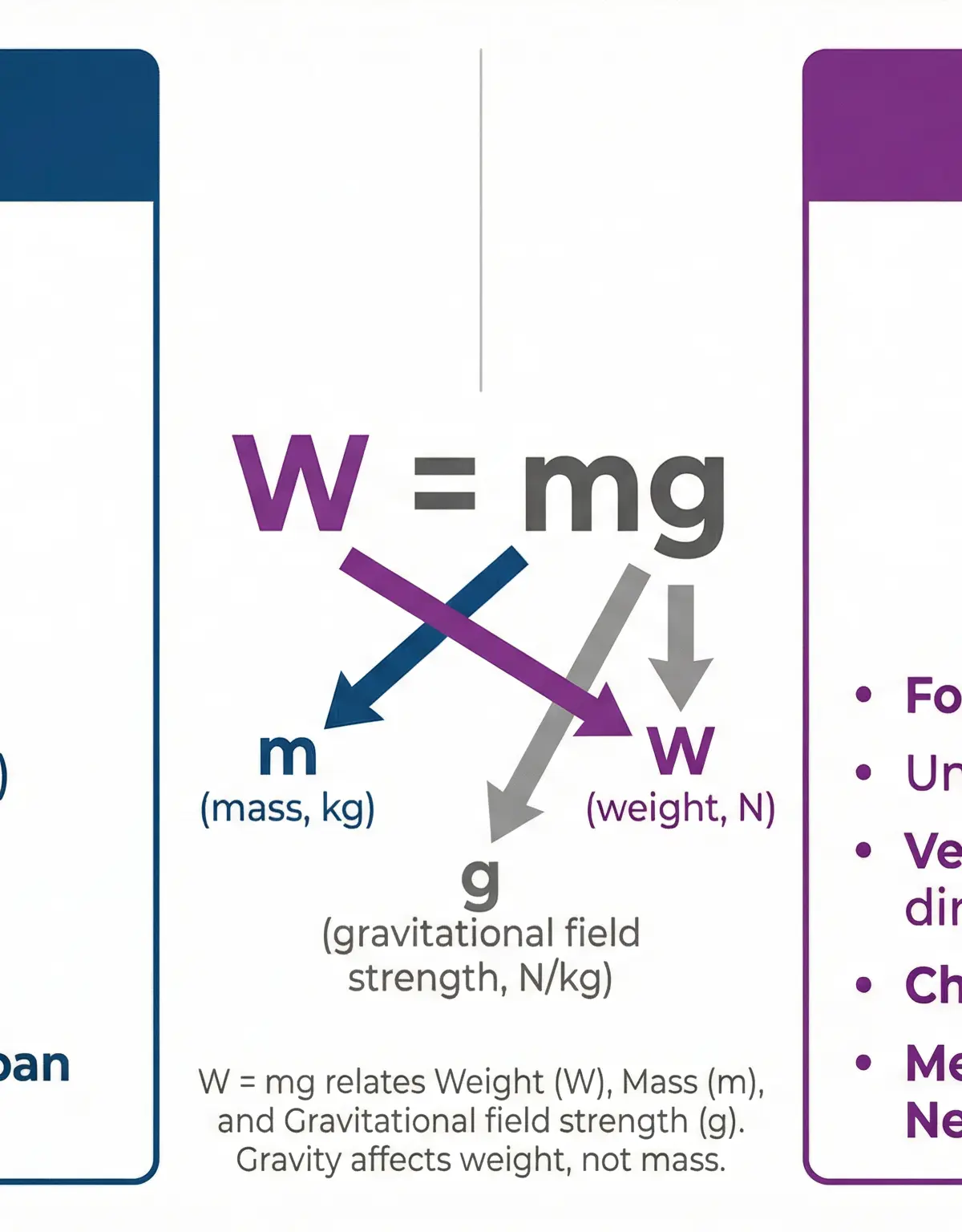
Key Concepts
Concept 1: Mass
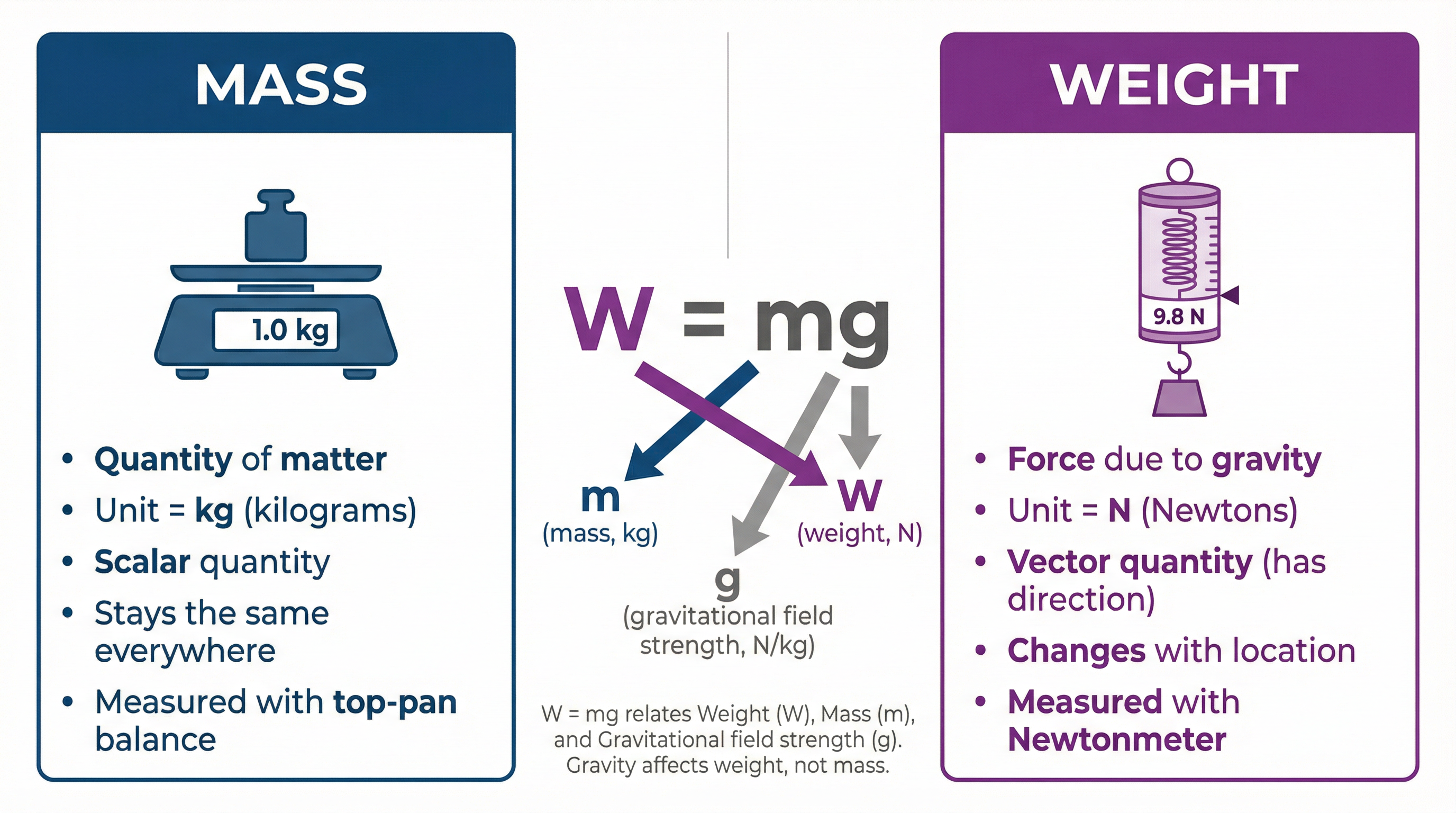
Mass is defined as the quantity of matter in an object. It represents the total amount of material — atoms, molecules, particles — that makes up that object. Mass is measured in kilograms (kg) using a top-pan balance (also called a beam balance or electronic balance). The critical property of mass is that it is invariant: it does not change regardless of where in the universe the object is located. An astronaut with a mass of 80 kg on Earth has exactly the same mass of 80 kg on the Moon, on Mars, or floating in deep space.
Mass is a scalar quantity, meaning it has magnitude (size) only — no direction is associated with it. This is a Higher Tier distinction, but it is worth understanding at all levels because it explains why mass cannot be 'pulled' in any direction by gravity.
Analogy: Think of mass like the number of pages in a book. Whether you read that book in London, on the Moon, or on Jupiter, it still has the same number of pages. The pages don't disappear just because you've changed location.
Concept 2: Weight
Weight is defined as the force acting on an object due to gravity. Because it is a force, weight is measured in Newtons (N) — never in kilograms. Weight is measured using a calibrated spring balance, commonly known as a Newtonmeter. The spring inside the Newtonmeter stretches in proportion to the gravitational force acting on the object; a stronger gravitational field causes more stretching and a higher reading.
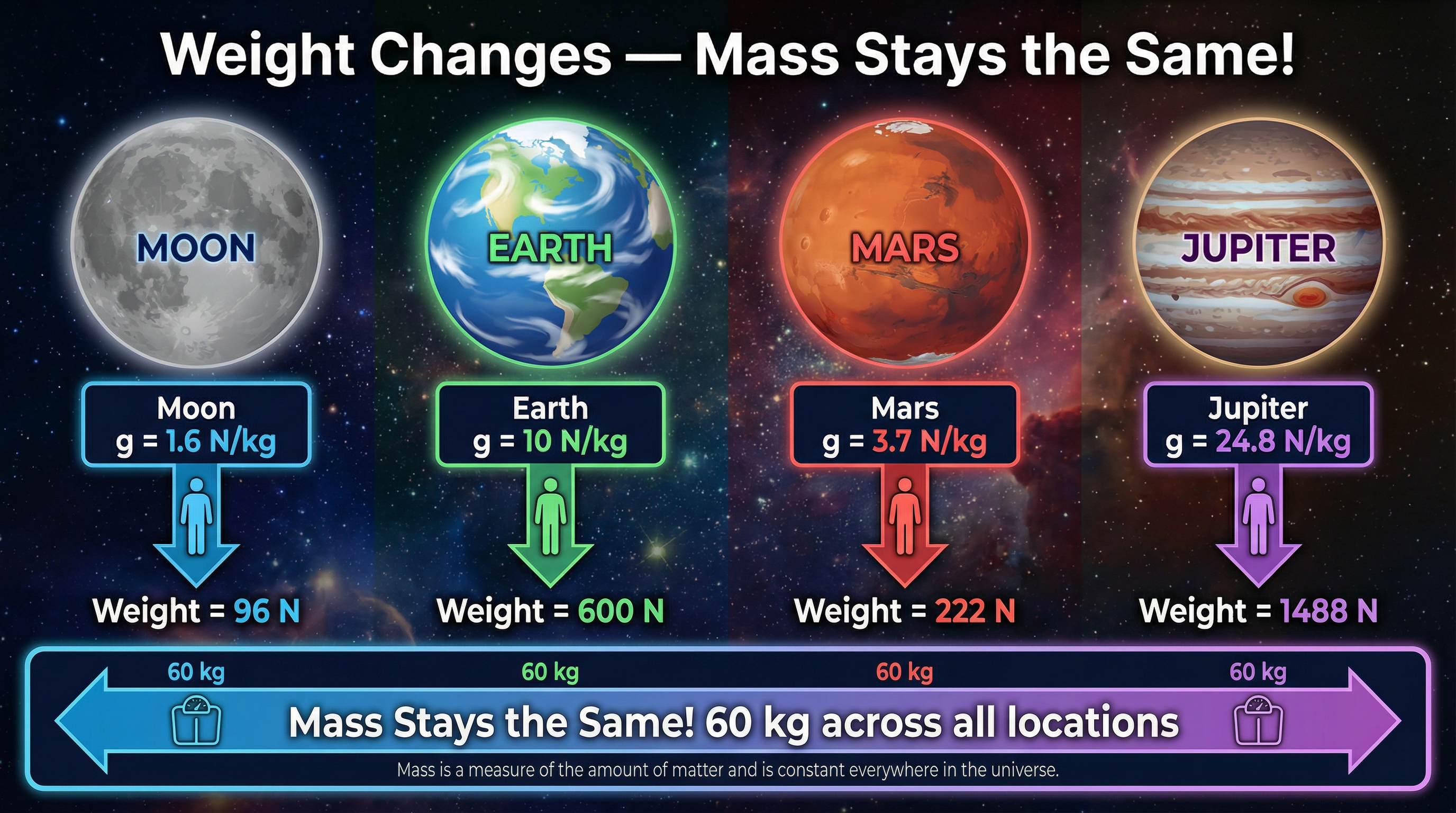
Unlike mass, weight is not constant — it depends on the gravitational field strength at the object's location. On Earth (g = 10 N/kg), a 60 kg person weighs 600 N. On the Moon (g = 1.6 N/kg), the same person weighs only 96 N. On Jupiter (g = 24.8 N/kg), they would weigh 1,488 N. In each case, their mass remains 60 kg.
Weight is a vector quantity (Higher Tier), meaning it has both magnitude and direction. Weight always acts downwards, towards the centre of the gravitational body (e.g., towards the centre of the Earth).
Analogy: Think of weight like the force of a hand pushing down on those pages. On Earth, the hand pushes hard. On the Moon, the hand barely pushes at all. The number of pages (mass) hasn't changed — only the push (weight) has.
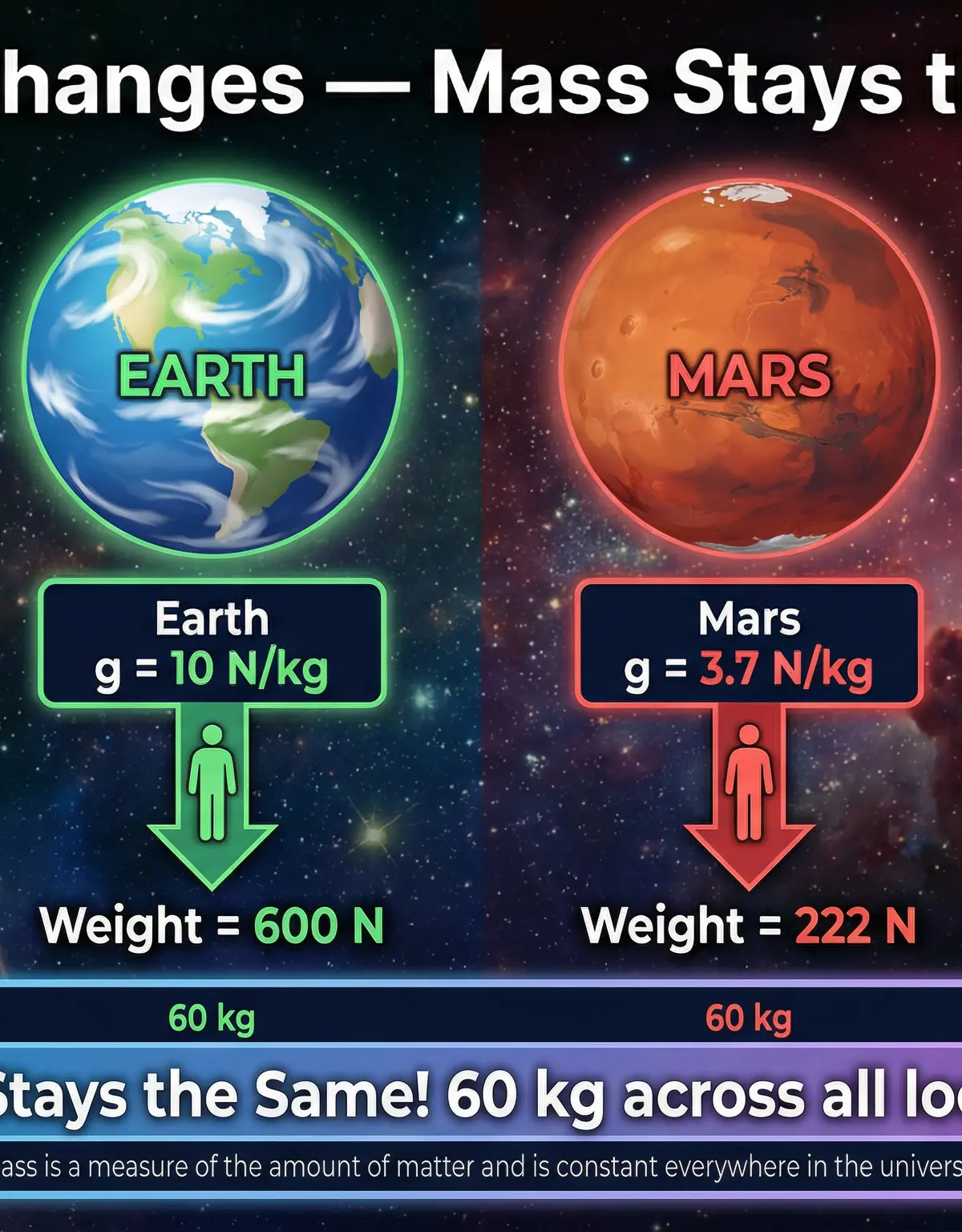
Concept 3: Gravitational Field Strength (g)
Gravitational field strength, symbol g, is the force per unit mass experienced by an object in a gravitational field. It is measured in Newtons per kilogram (N/kg). For Edexcel GCSE calculations, candidates must use g = 10 N/kg on Earth unless the question specifies a different value. This is the standard Edexcel approximation and will be used in all mark schemes.
Different celestial bodies have different values of g because they have different masses and radii. A larger, denser body exerts a stronger gravitational pull, giving a higher value of g and therefore greater weight for any given mass.
| Celestial Body | Gravitational Field Strength (g) |
|---|---|
| Moon | 1.6 N/kg |
| Mars | 3.7 N/kg |
| Earth | 10 N/kg |
| Jupiter | 24.8 N/kg |
Concept 4: The Formula W = mg
The relationship between weight, mass, and gravitational field strength is expressed by the equation:
W = m × g
W = weight (N), m = mass (kg), g = gravitational field strength (N/kg)
This formula is provided on the Edexcel equation sheet, but candidates must know how to apply it correctly, including rearranging it to find mass or g when weight is given. The formula tells us that weight is directly proportional to gravitational field strength: if g doubles, weight doubles; if g halves, weight halves (assuming mass stays constant).
Critical unit conversion: If mass is given in grams (g), divide by 1000 to convert to kilograms (kg) before substituting into the formula. Failing to do so is the single most common calculation error on this topic and results in an answer 1000 times too large.
Mathematical/Scientific Relationships
W = mg — Must memorise (also given on formula sheet)
- W = weight in Newtons (N)
- m = mass in kilograms (kg)
- g = gravitational field strength in Newtons per kilogram (N/kg)
Rearrangements:
- To find mass: m = W ÷ g
- To find gravitational field strength: g = W ÷ m
Proportional relationship: W ∝ g (when mass is constant)
Unit conversion: 1 kg = 1000 g, so to convert grams to kilograms: divide by 1000
Practical Applications
While there is no Edexcel required practical specifically for this topic, the concepts appear in practical contexts throughout the course. Candidates should be able to describe how to measure weight using a Newtonmeter (hang the object, read the scale in Newtons) and how to measure mass using a top-pan balance (place the object on the pan, read the display in kg or g). In the context of space exploration, this topic is frequently applied to questions about astronauts on the Moon or Mars, satellite orbits, and the design of spacecraft. The distinction between mass and weight is also fundamental to understanding Newton's Second Law (F = ma), where the 'F' in a gravitational context is the weight force.
Visual Resources
2 diagrams and illustrations
Interactive Diagrams
3 interactive diagrams to visualise key concepts
Conceptual Flow Outline
How weight changes with location while mass remains constant. The object's mass (m kg) is fixed, but the weight force (W = mg) varies depending on the gravitational field strength at each location.
Conceptual Flow Outline
Decision flowchart for identifying whether a question is asking about weight or mass, and the key properties of each.
Conceptual Flow Outline
Unit conversion and formula flowchart for W = mg calculations. Always convert grams to kilograms (÷ 1000) BEFORE multiplying by g.
Worked Examples
4 worked examples — open one to explore the question and available guidance.
Practice Questions
Test your understanding — click to reveal model answers
State what is meant by the term 'weight'. (1 mark)
Hint: Think about what type of quantity weight is — is it a force, a mass, or something else?
A ball has a mass of 400 g. Calculate the weight of the ball on Earth. Use g = 10 N/kg. (3 marks)
Hint: Check the unit of mass in the question — is it in kilograms or grams? You may need to convert before using the formula.
Explain why an astronaut's weight is less on the Moon than on Earth, but their mass remains the same. (4 marks)
Hint: Use the formula W = mg in your explanation. Think about what changes between Earth and the Moon, and what stays the same.
A Newtonmeter reads 37 N when an object is suspended from it on Mars, where g = 3.7 N/kg. Calculate the mass of the object. (3 marks)
Hint: You need to rearrange W = mg to find mass. Remember: m = W ÷ g.
Compare the mass and weight of a 10 kg object on Earth (g = 10 N/kg) and on Jupiter (g = 24.8 N/kg). Your answer should include calculations and a comparison of the scalar/vector nature of each quantity. (6 marks) [Higher Tier]
Hint: Use the DUVM structure: Definition, Unit, Vector/Scalar, Measurement. Calculate weight on both planets and compare. Remember to address both mass AND weight.
A student uses a top-pan balance and a Newtonmeter to investigate the mass and weight of objects. Explain why the top-pan balance would give the same reading on the Moon as on Earth, but the Newtonmeter would give a different reading. (4 marks)
Hint: Think about what each instrument actually measures and how each one works. One compares against known masses; the other measures a force directly.
Test your understanding of Weight vs Mass
Active recall beats re-reading. Take an instant quiz now to test what you’ve learned and lock it into long-term memory.
7 days Premium · Then free forever · No card, no charge