Weight vs Mass — Edexcel GCSE Study Guide
Exam Board: Edexcel | Level: GCSE
Master the fundamental principles of motion and forces that underpin all of GCSE Physics. This guide breaks down how to calculate speed, velocity, and acceleration, interpret motion graphs, and apply Newton's Laws to predict how objects move — essential skills for securing top marks in your exam.
## Overview
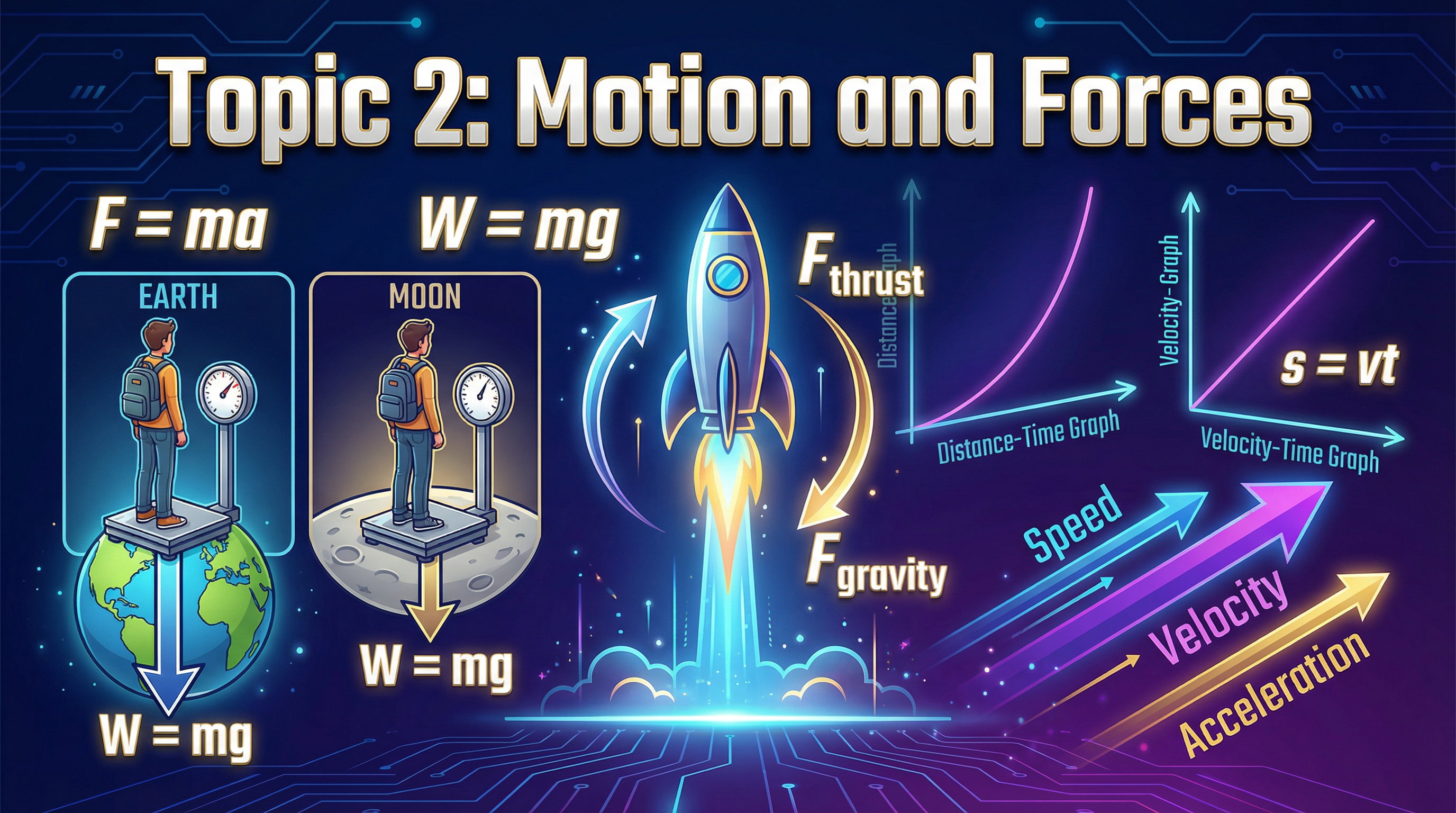
Topic 2: Motion and Forces is the engine room of GCSE Physics. It connects the abstract concepts of energy and the practical world of machinery and transport. In this topic, you will learn to describe motion mathematically and graphically, and understand the invisible forces that cause changes in motion. This is not just about memorising formulas; it's about understanding *why* things move the way they do.
This topic is heavily assessed through calculation questions and graph analysis. Examiners frequently link it to Energy (Topic 3) and Space Physics (Topic 8), so mastering these concepts is crucial for a high grade. You can expect questions ranging from simple 1-mark recall of units to complex 6-mark calculations involving multiple steps and unit conversions. A solid grasp of vector and scalar quantities is your foundation here — get that right, and the rest follows.
## Key Concepts
### Concept 1: Vectors and Scalars
In Physics, not all numbers are created equal. Some just tell you "how much" (magnitude), while others tell you "how much AND which way" (magnitude and direction).
* **Scalar quantities** have magnitude only. Examples: distance, speed, mass, energy, time.
* **Vector quantities** have magnitude and direction. Examples: displacement, velocity, force, acceleration, momentum.
Think of it this way: If you tell someone to walk 50 metres (distance/scalar), they could end up anywhere in a circle around you. If you tell them to walk 50 metres *North* (displacement/vector), they end up at a precise location.
### Concept 2: Speed vs. Velocity
Speed is how fast you're going. Velocity is how fast you're going *in a specific direction*.
* **Speed** = Distance / Time ($s = d/t$)
* **Velocity** = Displacement / Time ($v = s/t$)
**Crucial Distinction**: An object moving in a circle at a constant speed has a *changing velocity*. Why? Because its direction is constantly changing. This means it is accelerating, even though its speed hasn't changed! This is a classic exam trap.
### Concept 3: Acceleration
Acceleration is the rate at which velocity changes. It's not just "speeding up" — it's slowing down (deceleration) or changing direction too.
Formula: $a = (v - u) / t$
* $a$ = acceleration ($m/s^2$)
* $v$ = final velocity ($m/s$)
* $u$ = initial velocity ($m/s$)
* $t$ = time ($s$)
If you don't know the time, use the equation of motion: $v^2 - u^2 = 2 \times a \times x$
### Concept 4: Distance-Time Graphs
A distance-time graph tells a story of a journey.
* **Gradient (slope)** = Speed.
* **Straight diagonal line** = Constant speed.
* **Horizontal line** = Stationary (stopped).
* **Curved line** = Acceleration (gradient is changing).
To find the speed at a specific time on a curve, draw a tangent to the curve and calculate its gradient.
### Concept 5: Velocity-Time Graphs
These are more powerful and appear frequently in higher-tier questions.
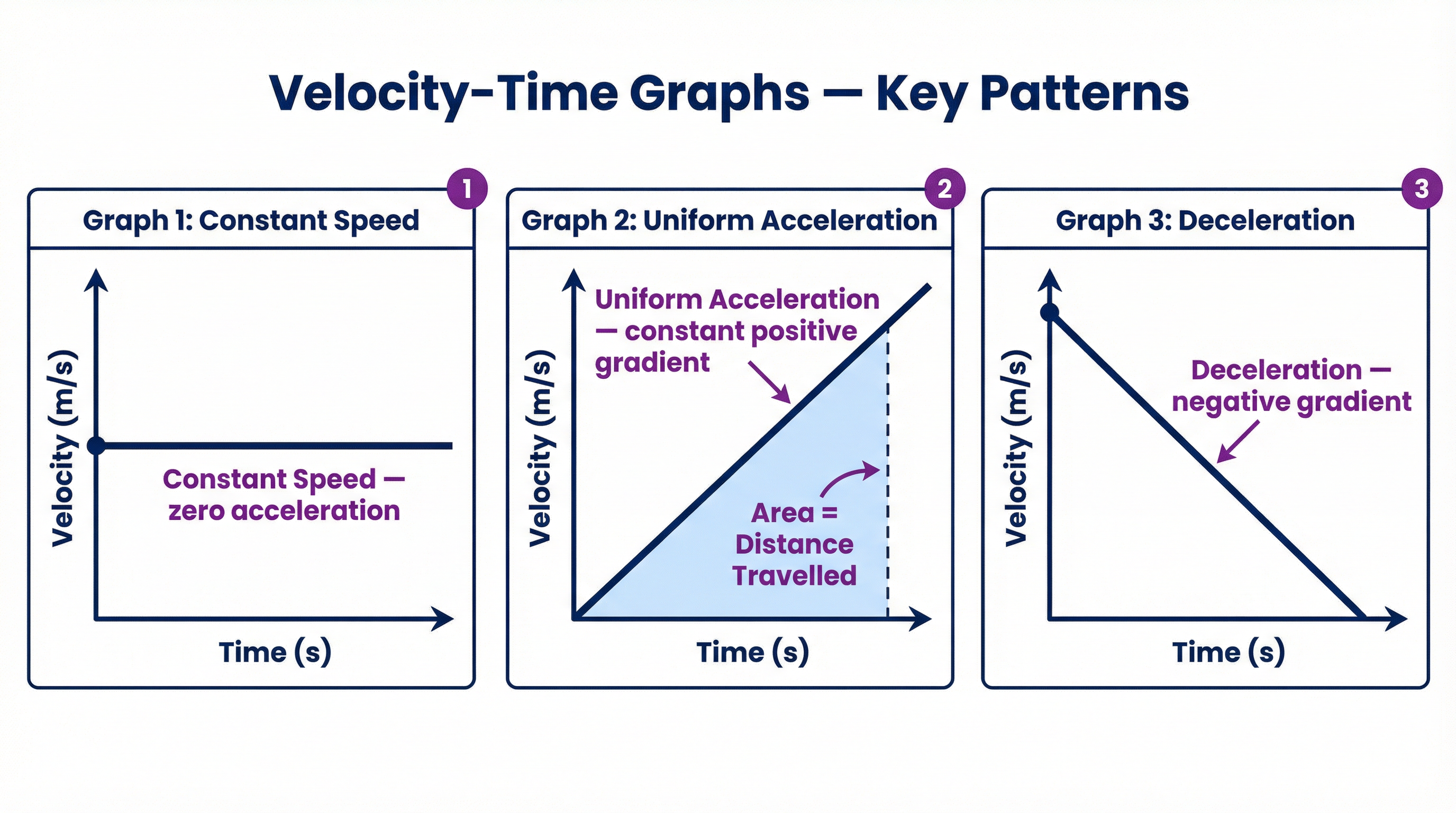
* **Gradient (slope)** = Acceleration.
* **Horizontal line** = Constant velocity (zero acceleration).
* **Area under the graph** = Distance travelled (or displacement).
### Concept 6: Mass, Weight, and Gravity
This is the most common misconception in Physics.
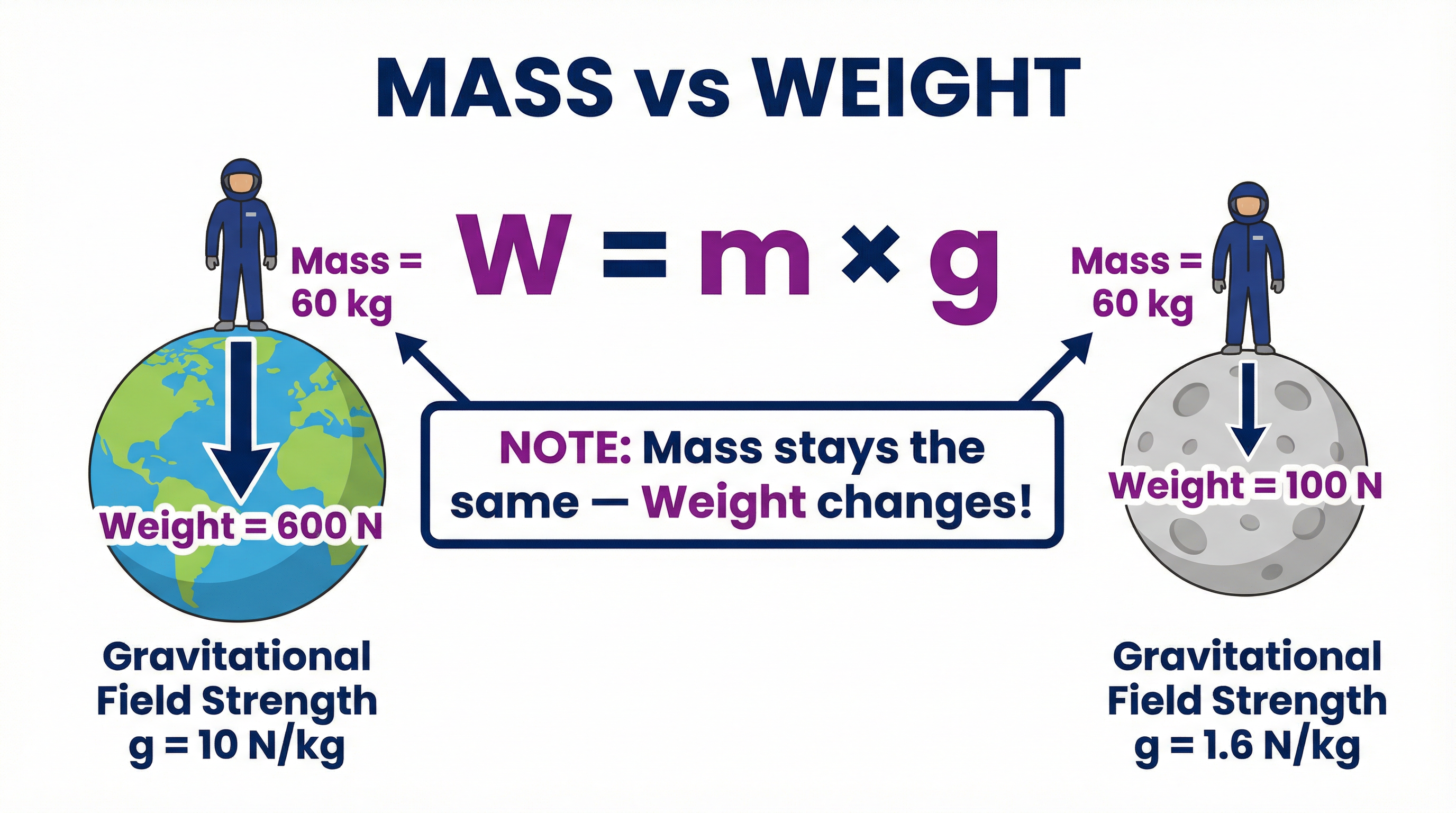
* **Mass** (kg) is the amount of "stuff" (matter) in an object. It is intrinsic — it doesn't change whether you are on Earth, Mars, or floating in space.
* **Weight** (N) is the force of gravity acting on that mass. It depends on the gravitational field strength ($g$) of where you are.
Formula: $W = m \times g$
* $W$ = Weight (Newtons, N)
* $m$ = Mass (Kilograms, kg)
* $g$ = Gravitational Field Strength (Newtons per kilogram, N/kg)
On Earth, $g \approx 10 N/kg$. On the Moon, $g \approx 1.6 N/kg$. Your mass is the same on both, but your weight is much less on the Moon.
### Concept 7: Newton's Laws of Motion
1. **First Law (Inertia)**: An object remains at rest or moves at a constant velocity unless acted on by a resultant force. (No resultant force = no acceleration).
2. **Second Law (F=ma)**: The acceleration of an object is proportional to the resultant force and inversely proportional to its mass. ($F = m \times a$).
3. **Third Law (Action-Reaction)**: Whenever two objects interact, they exert equal and opposite forces on each other. (Note: These forces act on *different* objects).
## Mathematical/Scientific Relationships
| Equation | Meaning | Units |
| :--- | :--- | :--- |
| $s = v \times t$ | Distance = Speed × Time | m, m/s, s |
| $a = (v - u) / t$ | Acceleration = Change in Velocity / Time | m/s², m/s, s |
| $v^2 - u^2 = 2ax$ | Final v² - Initial v² = 2 × Accel × Distance | m/s, m/s², m |
| $W = m \times g$ | Weight = Mass × Gravitational Field Strength | N, kg, N/kg |
| $F = m \times a$ | Resultant Force = Mass × Acceleration | N, kg, m/s² |
| $p = m \times v$ | Momentum = Mass × Velocity | kg m/s, kg, m/s |
## Practical Applications
* **Road Safety**: Stopping distance = Thinking distance + Braking distance. Factors affecting thinking distance (tiredness, drugs, alcohol) vs. braking distance (road conditions, tyre quality, mass of car).
* **Space Travel**: Rockets use Newton's Third Law (gas pushed down, rocket pushed up). Weight changes on different planets affect design requirements.
* **Sports**: Crumple zones in cars or cushioned soles in running shoes increase the time taken to stop, which reduces acceleration and therefore reduces the force on the body ($F = ma$).
