OCR · A-Level · Physics
Forces in Action
Master the core principles of OCR A-Level Physics Topic 3.2: Forces in Action. This guide breaks down complex vector analysis, equilibrium, and fluid dynamics into exam-focused, mark-scoring techniques. Prepare to tackle any question on moments, inclined planes, or upthrust with confidence.
- 6 min read
- 3 worked examples
- 5 practice questions
- 6 key terms
Study Notes

Overview
Forces in Action is a cornerstone of mechanics, exploring how forces interact to produce equilibrium or motion. For OCR A-Level candidates, this topic is crucial as it integrates vector mathematics with physical principles, a skill tested frequently in exams. You will learn to deconstruct complex scenarios into manageable components using free-body diagrams, resolve forces on inclined planes, and apply the principle of moments to solve for unknown forces in static systems. This topic also introduces fluid dynamics through density, pressure, and Archimedes' principle, providing a foundation for further study in thermal physics and engineering. Examiners often set multi-step problems that require candidates to synthesise these concepts, for example, by calculating the stability of an object in a fluid, which requires a firm grasp of both moments and upthrust. Mastering this section is not just about learning formulas; it's about developing a systematic, analytical approach to problem-solving that will be rewarded with high marks across multiple papers.
Key Concepts
Concept 1: Resolving Forces and Free-Body Diagrams
A free-body diagram (FBD) is the starting point for nearly all mechanics problems. It is a simplified diagram showing a single object isolated from its surroundings, with all the forces acting on it represented by arrows. These arrows must originate from the centre of the object and point in the correct direction. For example, weight always acts vertically downwards, while the normal reaction force is always perpendicular to the surface.
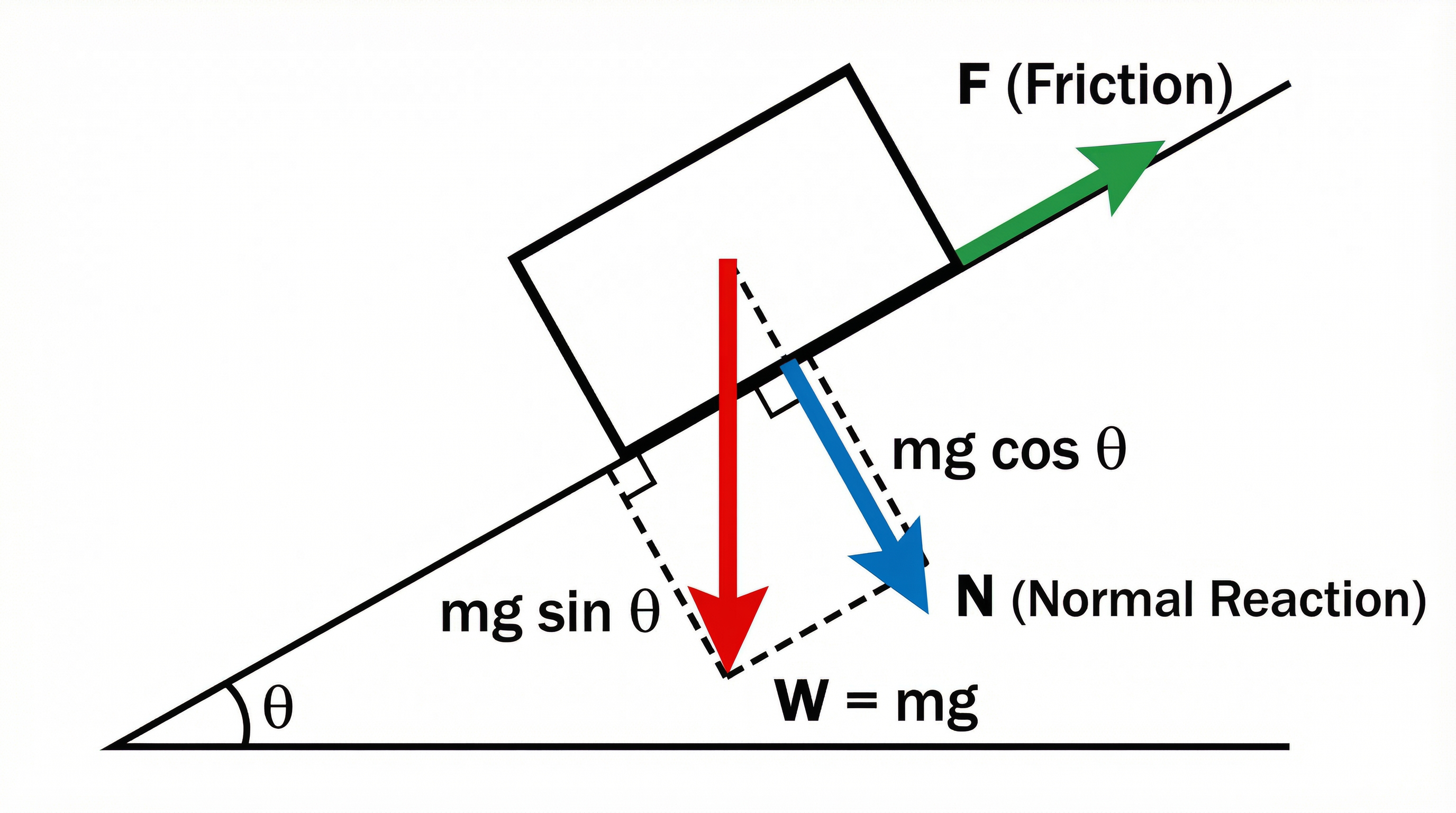
Once you have your FBD, the next step is often to resolve forces. This means splitting a force vector into two perpendicular components. The most common application is on an inclined plane. For an object on a slope at an angle θ to the horizontal, its weight (W = mg) can be resolved into two components:
- A component acting parallel to the slope: mg sin(θ)
- A component acting perpendicular to the slope: **mg cos(θ)**This is fundamental. Credit is consistently given for correctly identifying these components. A common mistake is to swap sin and cos, so use the memory hook: 'it's a sin to slide down the slope'.

Concept 2: The Principle of Moments and Equilibrium
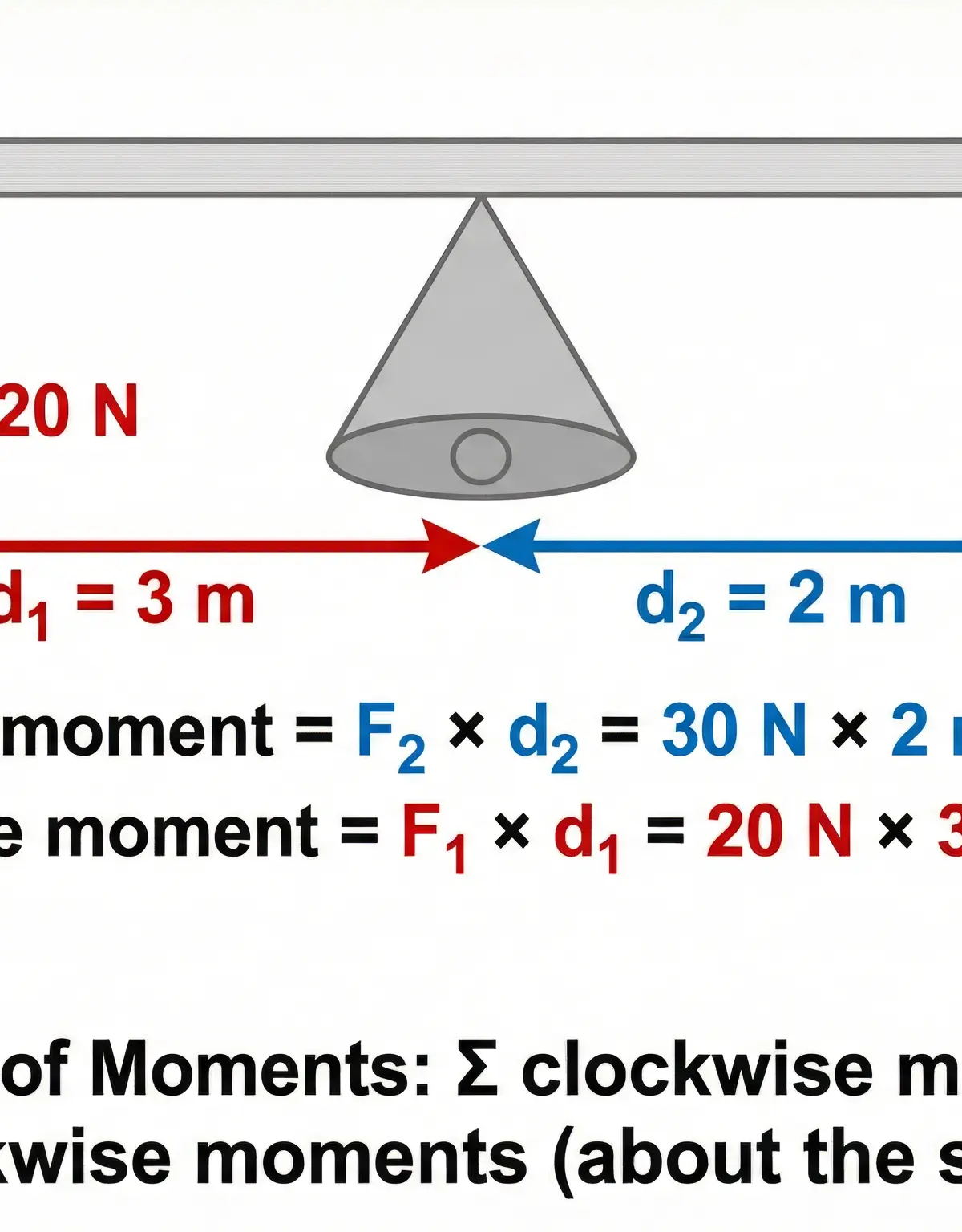
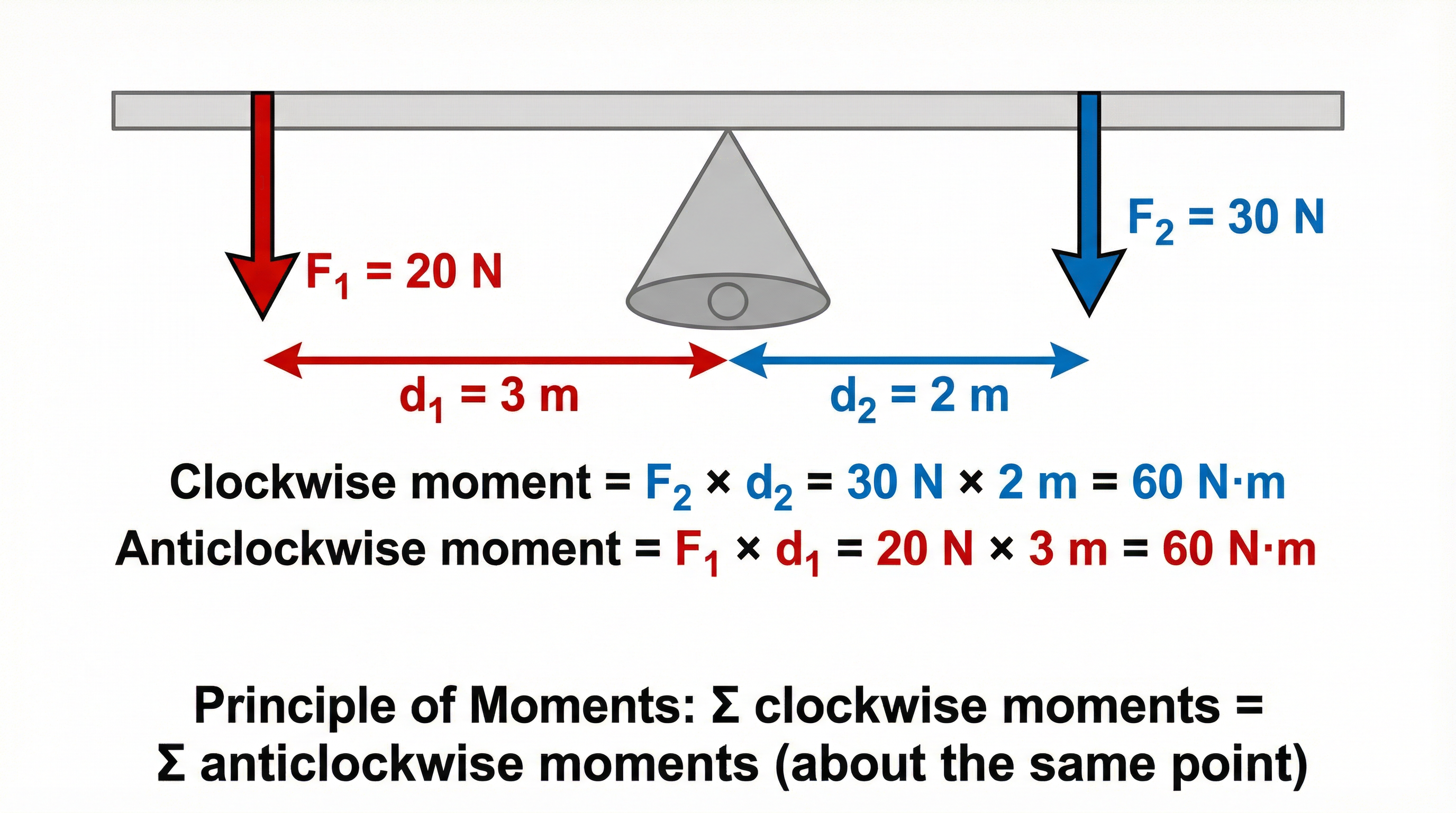
A moment is the turning effect of a force about a pivot. It is calculated as:
**Moment (N m) = Force (N) × Perpendicular distance from the pivot (m)**The Principle of Moments is a condition for rotational equilibrium. It states that for an object to be balanced (not rotating), the sum of the clockwise moments about any point must be equal to the sum of the anticlockwise moments about the same point.
Σ Clockwise Moments = Σ Anticlockwise MomentsCandidates frequently lose marks by omitting the phrase 'about the same point' when stating this principle. For an object to be in static equilibrium, two conditions must be met:
- The net force acting on it is zero (no translational acceleration).
- The net moment acting on it is zero (no rotational acceleration).
Concept 3: Couples
A couple is a pair of equal, parallel, but opposite forces that act on an object through different lines of action. A couple produces a pure rotation without any translation. The turning effect of a couple is called its torque (τ), calculated as:
Torque (N m) = One of the forces (F) × Perpendicular distance between the forces (d)
Concept 4: Density, Pressure, and Upthrust
Density (ρ) is the mass per unit volume of a substance (ρ = m/V). It's a measure of how 'compact' a material is. In fluids, pressure increases with depth due to the weight of the fluid above. The pressure difference (Δp) at a certain depth (h) in a fluid of constant density (ρ) is given by:
Δp = ρghThis pressure difference gives rise to an upward force on any object submerged in the fluid, known as upthrust. Archimedes' Principle provides the key insight: the upthrust on a submerged object is equal to the weight of the fluid it displaces.
Upthrust (U) = Weight of displaced fluid = ρ_fluid × V_submerged × gA common error is to use the object's density or total volume. Remember, it's the fluid's density and the volume of the submerged part of the object that matter.
Mathematical/Scientific Relationships
| Formula | Symbol Meanings | Status |
|---|---|---|
| W = mg | W: Weight (N), m: mass (kg), g: gravitational field strength (N kg⁻¹) | Must memorise |
| Moment = Fd | F: Force (N), d: perpendicular distance (m) | Must memorise |
| τ = Fd | τ: Torque of a couple (N m), F: one of the forces (N), d: perpendicular distance between forces (m) | Must memorise |
| ρ = m/V | ρ: density (kg m⁻³), m: mass (kg), V: volume (m³) | Must memorise |
| p = F/A | p: pressure (Pa), F: normal force (N), A: area (m²) | Given on formula sheet |
| Δp = ρgh | Δp: pressure change (Pa), ρ: fluid density (kg m⁻³), g: gravitational field strength (N kg⁻¹), h: depth change (m) | Given on formula sheet |
| U = ρ_f V_s g | U: Upthrust (N), ρ_f: fluid density (kg m⁻³), V_s: submerged volume (m³), g: gravitational field strength (N kg⁻¹) | Must memorise |
Practical Applications
This topic is directly assessed in the Required Practical involving the determination of the centre of gravity of an object. A common method involves suspending an irregular lamina from different points and using a plumb line to mark vertical lines. The centre of gravity is the point where these lines intersect. Examiners may ask about sources of error (e.g., parallax error in marking the line, the lamina swinging) or improvements (e.g., using a sharp pencil, waiting for the plumb line to be stationary). Other applications include crane stability, bridge design, and the buoyancy of ships and submarines.
Visual Resources
2 diagrams and illustrations
Interactive Diagrams
2 interactive diagrams to visualise key concepts
Conceptual Flow Outline
A flowchart showing the decision-making process for solving inclined plane problems.
Conceptual Flow Outline
Concept map illustrating the conditions for an object sinking or floating based on density.
Worked Examples
3 worked examples — open one to explore the question and available guidance.
Practice Questions
Test your understanding — click to reveal model answers
State the two conditions necessary for an object to be in static equilibrium.
Hint: Think about both linear motion and rotational motion.
A non-uniform rod AB of length 4.0 m and weight 120 N is pivoted at its midpoint. It is kept in equilibrium by a downward force of 50 N at end A and a vertical string attached to the rod at a point C. If the centre of mass of the rod is 1.5 m from end A, calculate the tension in the string and the distance AC.
Hint: This is a two-part problem. First, use force equilibrium to find the tension. Then, use moment equilibrium to find the distance.
Explain why a ship made of steel (density ~8000 kg m⁻³) can float in water (density ~1000 kg m⁻³).
Hint: Think about the ship's shape and Archimedes' Principle.
A force of (3i + 4j) N acts on a body, moving it from a point with position vector (i + j) m to a point with position vector (5i + 8j) m. Calculate the work done by the force.
Hint: Work done is the dot product of the force vector and the displacement vector.
Describe an experiment to find the centre of gravity of an irregular plane lamina.
Hint: Think about plumb lines and suspension.
Test your understanding of Forces in Action
Active recall beats re-reading. Take an instant quiz now to test what you’ve learned and lock it into long-term memory.
7 days Premium · Then free forever · No card, no charge