OCR · A-Level · Physics
Gravitational Fields
This module bridges the gap between everyday mechanics and the cosmos, covering everything from circular motion and simple harmonic motion to gravitational fields and stellar evolution. Mastering these concepts is essential for understanding both the clockwork precision of orbits and the life cycles of the stars.
- 6 min read
- 3 worked examples
- 5 practice questions
- 6 key terms
Study Notes
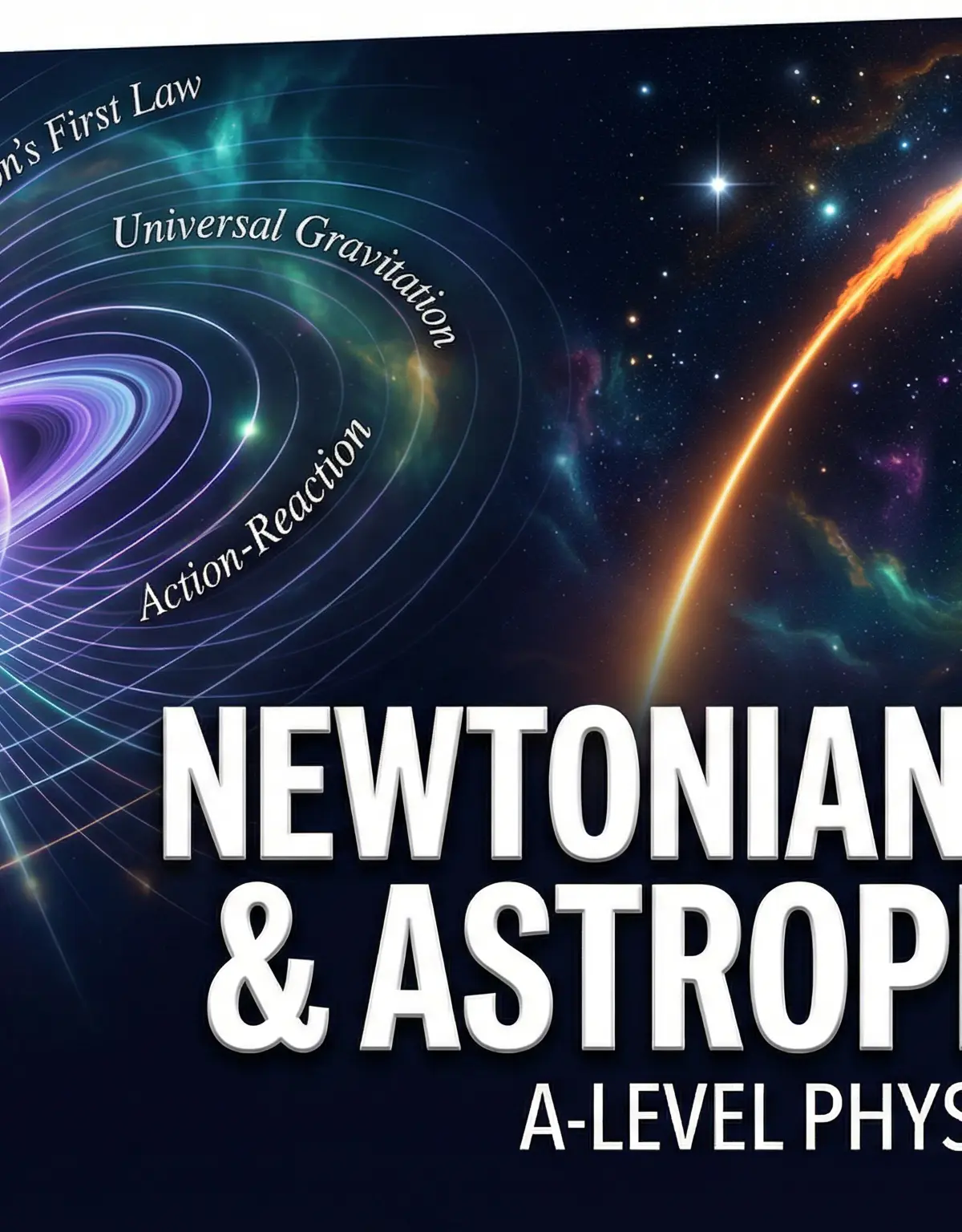
Overview
Module 5: Newtonian World and Astrophysics is the grand unifier of the A-Level Physics course. It takes the fundamental laws of motion you learned in Year 12 and applies them to systems on a vast scale. You will transition from linear motion to circular motion, explore the rhythmic mathematics of simple harmonic motion (SHM), and then apply these principles to the gravitational fields that govern the universe. Finally, you will study astrophysics, learning how we determine the properties of distant stars and how the universe itself began.
This topic is heavily mathematical but also requires precise descriptive language. Exam questions often combine multiple concepts—for example, asking you to use gravitational field theory to explain satellite motion, or using thermal physics to calculate the luminosity of a star. Examiners reward candidates who can seamlessly link equations to physical principles.
Key Concepts
Concept 1: Circular Motion
Circular motion occurs when an object moves at a constant speed but changing direction. Because velocity is a vector, this change in direction means the object is accelerating, even if its speed is constant. This acceleration is always directed toward the centre of the circle and is called centripetal acceleration.
By Newton's Second Law (F=ma), this acceleration requires a resultant force acting toward the centre: the centripetal force. It is crucial to understand that centripetal force is not a new type of force; it is simply the name we give to the net force causing the circular motion. It could be tension in a string, friction on a road, or gravity in orbit.
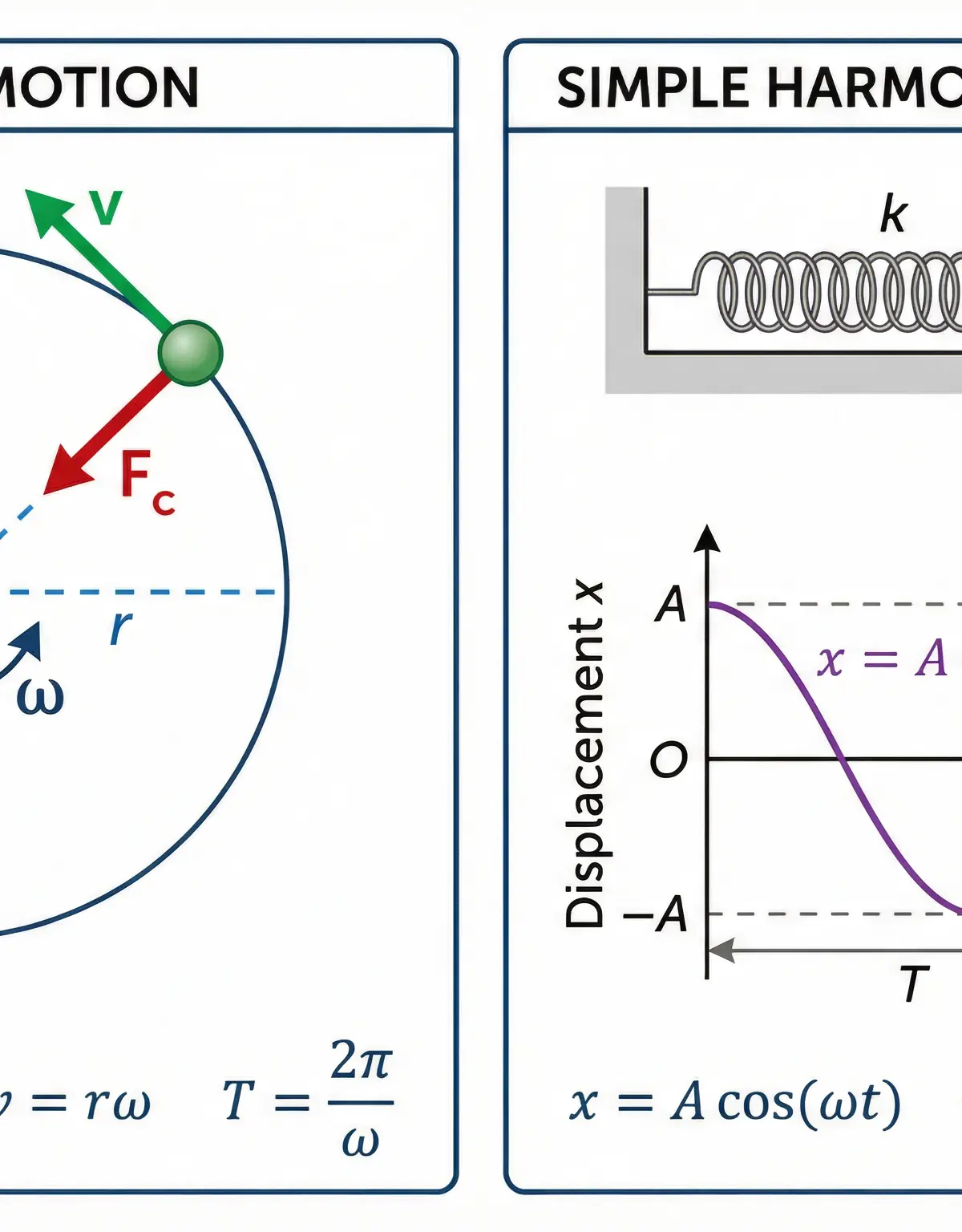
Example: A car turning a corner on a flat road relies on friction to provide the centripetal force. If the road is icy (friction is low) or the car is too fast (required force mv^2/r is too high), the friction will be insufficient, and the car will skid in a straight line (Newton's First Law).
Concept 2: Simple Harmonic Motion (SHM)
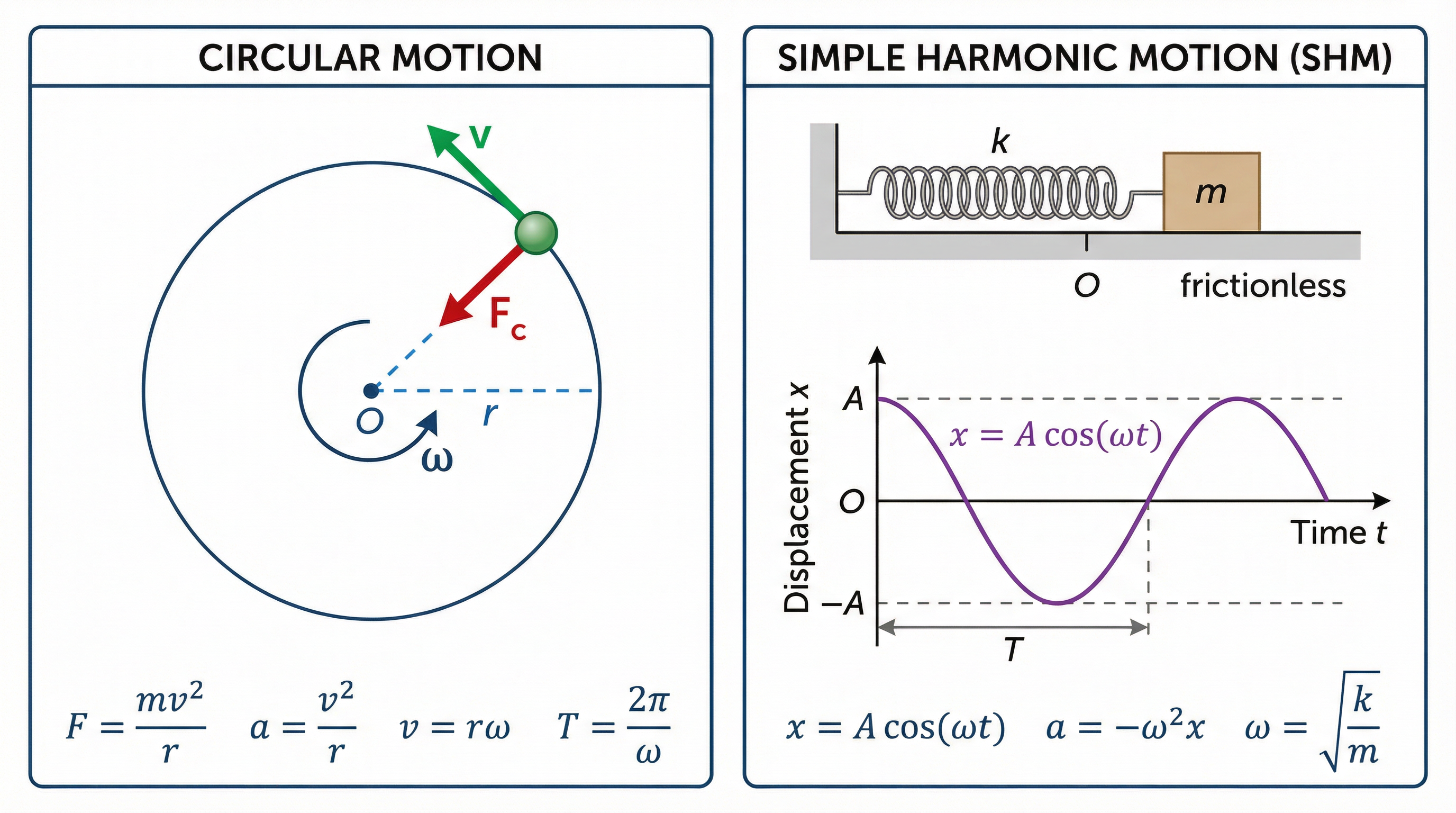
SHM is a special type of oscillation where the acceleration is directly proportional to the displacement from the equilibrium position and is directed towards that equilibrium position. The defining equation is:
a = -\omega^2 x
The minus sign is the most important part—it signifies that the acceleration is a "restoring" acceleration, always opposing the displacement. If you displace a pendulum to the right (+x), gravity pulls it back to the left (-a).
Energy in SHM is a constant interplay between kinetic and potential energy. At the equilibrium position, kinetic energy is maximum and potential energy is zero. At maximum displacement (amplitude), potential energy is maximum and kinetic energy is zero. The total energy remains constant (assuming no damping).
Concept 3: Gravitational Fields
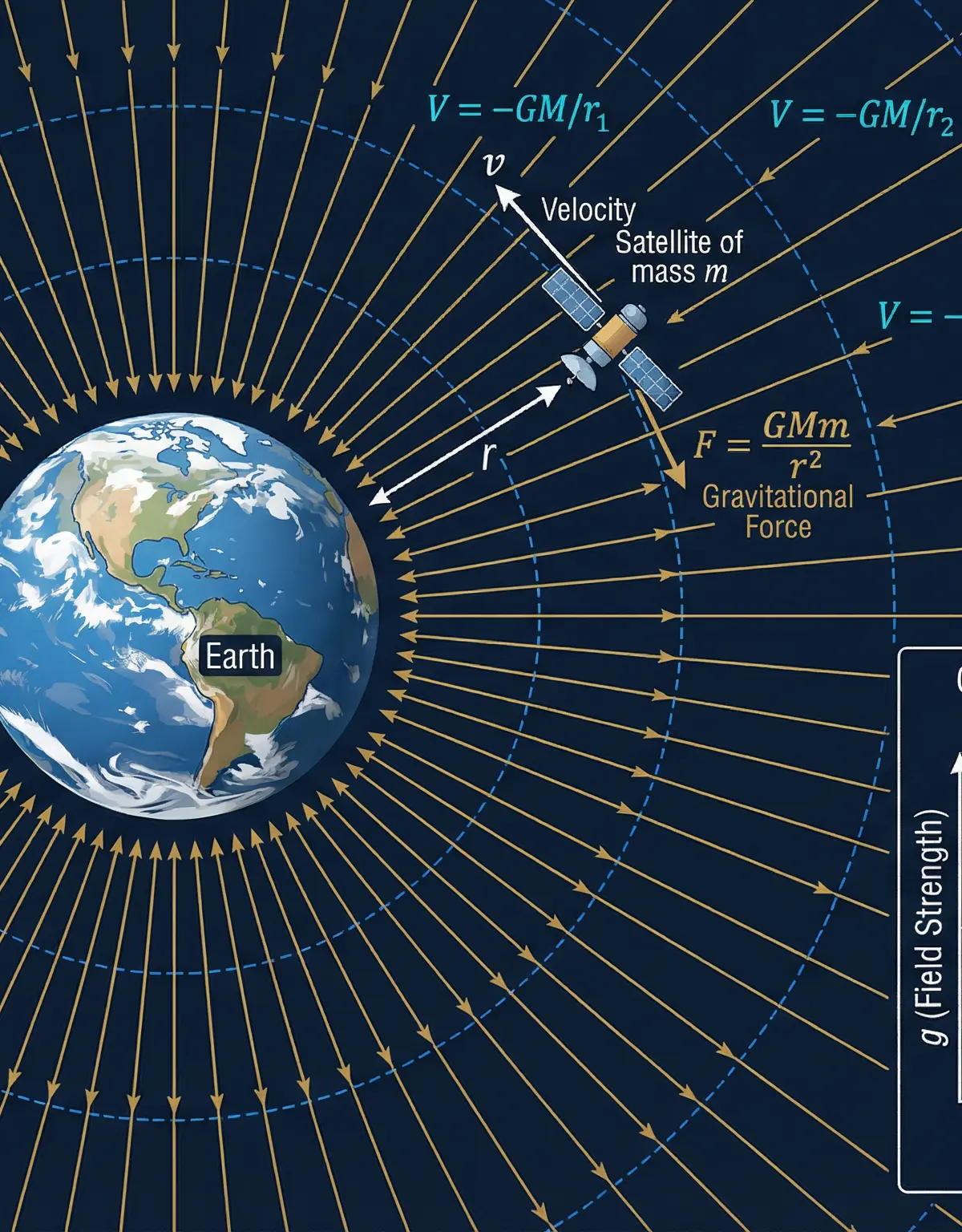
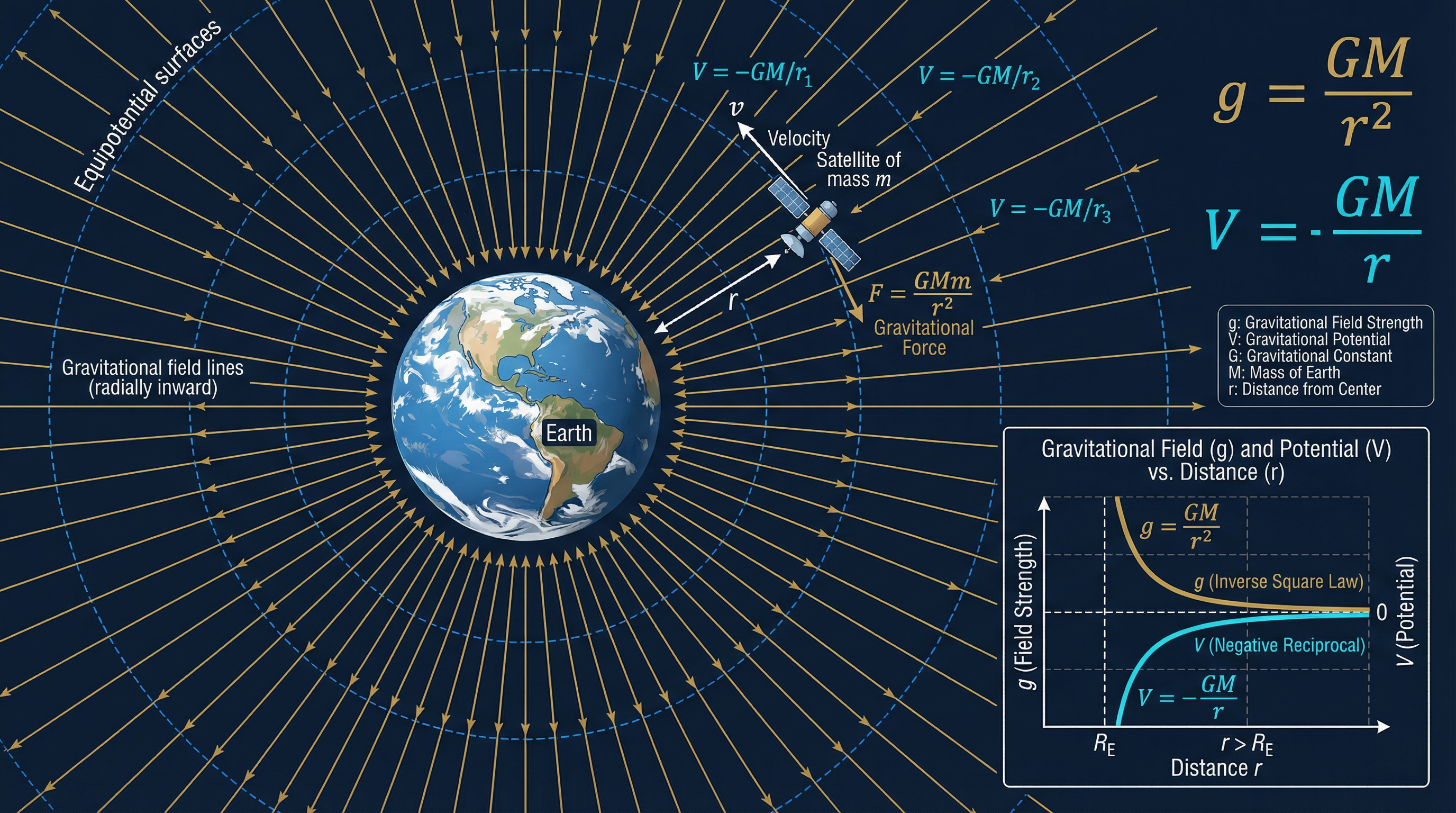
A gravitational field is a region where a mass experiences a force. Newton's Law of Universal Gravitation states that every particle of matter attracts every other particle with a force directly proportional to the product of their masses and inversely proportional to the square of the distance between them.
F = -\frac{GMm}{r^2}
This inverse square law means that if you double the distance from a planet's centre, the gravitational force drops to one-quarter of its original value. Gravitational potential (V) is defined as the work done per unit mass to bring an object from infinity to a point in the field. It is always negative because gravity is an attractive force—you have to do work to move a mass away.
Concept 4: Stellar Evolution and Astrophysics
Stars are powered by nuclear fusion. The stability of a star depends on the balance between the inward pull of gravity and the outward pressure from radiation and hot gas. When a star runs out of fuel, this balance is broken, leading to spectacular deaths ranging from planetary nebulae to supernovae.
The Hertzsprung-Russell (H-R) diagram is the most important graph in astrophysics. It plots luminosity against temperature (note: temperature increases to the left). It allows us to classify stars into the Main Sequence, Red Giants, and White Dwarfs, and to trace their evolutionary paths.
Mathematical/Scientific Relationships
Circular Motion
- \omega = \frac{2\pi}{T} = 2\pi f (Angular velocity)
- v = r\omega (Linear velocity)
- a = \frac{v^2}{r} = r\omega^2 (Centripetal acceleration)
- F = \frac{mv^2}{r} = mr\omega^2 (Centripetal force)
Simple Harmonic Motion
- a = -\omega^2 x (Defining equation)
- x = A \cos(\omega t) (Displacement starting from amplitude)
- v = \pm \omega \sqrt{A^2 - x^2} (Velocity at displacement x)
- T = 2\pi \sqrt{\frac{m}{k}} (Period of mass-spring system)
- T = 2\pi \sqrt{\frac{l}{g}} (Period of simple pendulum)
Gravitation
- F = -\frac{GMm}{r^2} (Newton's Law of Gravitation)
- g = -\frac{GM}{r^2} (Field strength)
- V = -\frac{GM}{r} (Gravitational potential)
- T^2 = \left(\frac{4\pi$^2}{GM}
ight) r^3$ (Kepler's Third Law)
Astrophysics
- L = 4\pi r^2 \sigma T^4 (Stefan-Boltzmann Law)
- \lambda_{max} T = 2.9 \times 10^{-3} \text{ m K} (Wien's Displacement Law)
- \frac{\Delta \lambda}{\lambda} = \frac{v}{c} (Doppler shift for v \ll c)
- v = H_0 d (Hubble's Law)
Practical Applications
- Geostationary Satellites: Used for telecommunications, these must orbit with a period of exactly 24 hours to remain above the same point on Earth. Using Kepler's Third Law, we can calculate the precise altitude required (approx 36,000 km).
- Car Suspension: Shock absorbers use critical damping to return the car to equilibrium as quickly as possible without oscillating after hitting a bump.
- Forensic Astronomy: Using Wien's Law and the Stefan-Boltzmann Law, astronomers can determine the size, temperature, and lifespan of stars trillions of kilometres away without ever visiting them.
Visual Resources
2 diagrams and illustrations
Interactive Diagrams
2 interactive diagrams to visualise key concepts
Conceptual Flow Outline
Stellar Evolution Pathways: The life cycle of a star depends entirely on its initial mass.
Conceptual Flow Outline
Calculus relationships in Simple Harmonic Motion.
Worked Examples
3 worked examples — open one to explore the question and available guidance.
Practice Questions
Test your understanding — click to reveal model answers
A body executes simple harmonic motion with an amplitude of 0.05 m and a frequency of 2.0 Hz. Calculate the maximum acceleration of the body.
Hint: Remember the formula for maximum acceleration involves amplitude and angular frequency.
Describe the evolution of a star much more massive than the Sun, from the main sequence to its final state.
Hint: Focus on the changes in the core and the resulting external changes.
Define the term 'gravitational potential' at a point.
Hint: Think about work done and where the test mass comes from.
Two stars are separated by a distance d. Explain why there is a point between them where the resultant gravitational field strength is zero.
Hint: Consider the direction of the forces from each star.
Using the Doppler effect, explain how astronomers know the universe is expanding.
Hint: Relate colour change to velocity and distance.
Test your understanding of Gravitational Fields
Active recall beats re-reading. Take an instant quiz now to test what you’ve learned and lock it into long-term memory.
7 days Premium · Then free forever · No card, no charge