OCR · A-Level · Physics
Motion
Master the fundamental principles of forces and motion, from Newton's Laws to complex stopping distance calculations. This essential module connects mathematical precision with real-world physics, forming the backbone of your exam success.
- 4 min read
- 3 worked examples
- 5 practice questions
- 6 key terms
Study Notes
Overview
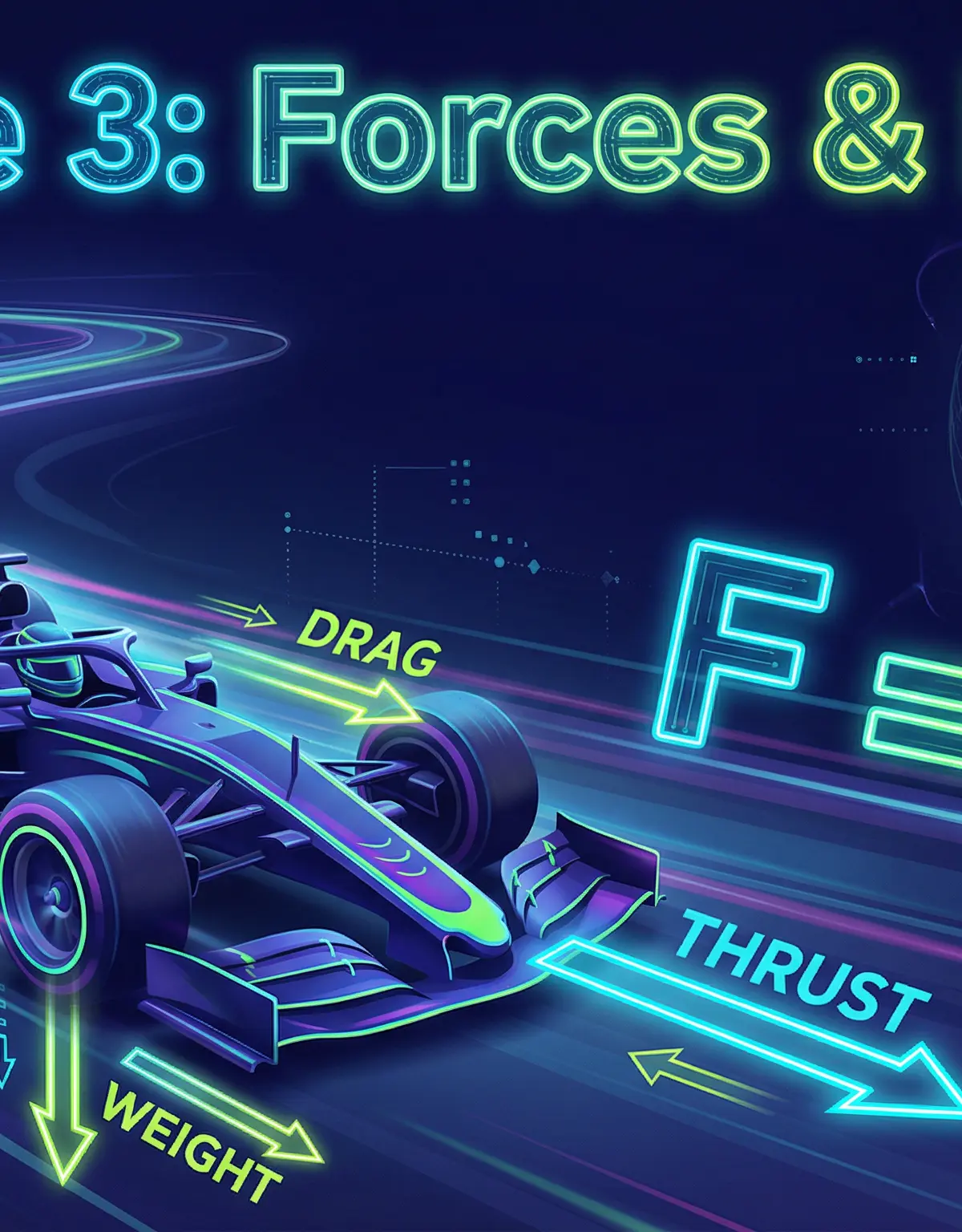
Forces and Motion is the engine room of Physics. It explains everything from why you don't float off your chair to how Formula 1 cars corner at high speeds. In your exam, this topic is a heavy hitter—expect it to appear in multiple questions, ranging from simple 1-mark recall definitions to complex 6-mark calculations that test your ability to link concepts.
This module connects deeply with Energy (work done) and Space Physics (orbital motion), making it a synoptic powerhouse. Examiners are looking for precision: correct vector diagrams, accurate use of terminology like "resultant force" and "deceleration", and flawless unit handling. Master this, and you unlock a significant portion of the paper.
Key Concepts
Concept 1: Scalar vs Vector Quantities
Physics distinguishes between quantities that just have size (magnitude) and those that have both size and direction.
- Scalars: Magnitude only. Examples: Speed, Distance, Mass, Energy, Time.
- Vectors: Magnitude AND Direction. Examples: Velocity, Displacement, Weight, Force, Acceleration.
Examiner Tip: If a question asks for a vector quantity, you MUST specify the direction to get the mark. For example, "5 m/s North" is a velocity; "5 m/s" is just a speed.
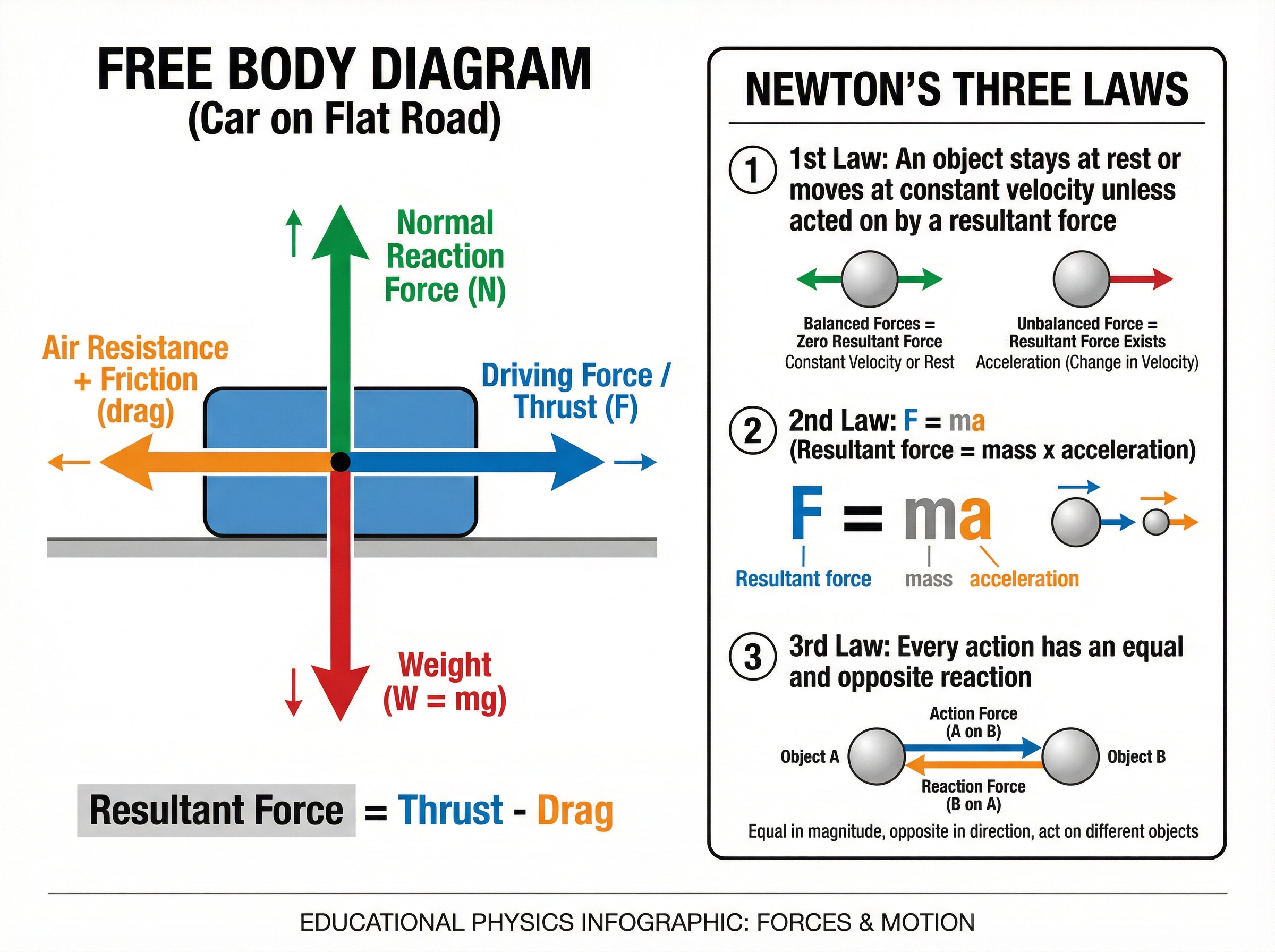
Concept 2: Newton's Laws of Motion
These three laws govern how everything moves.
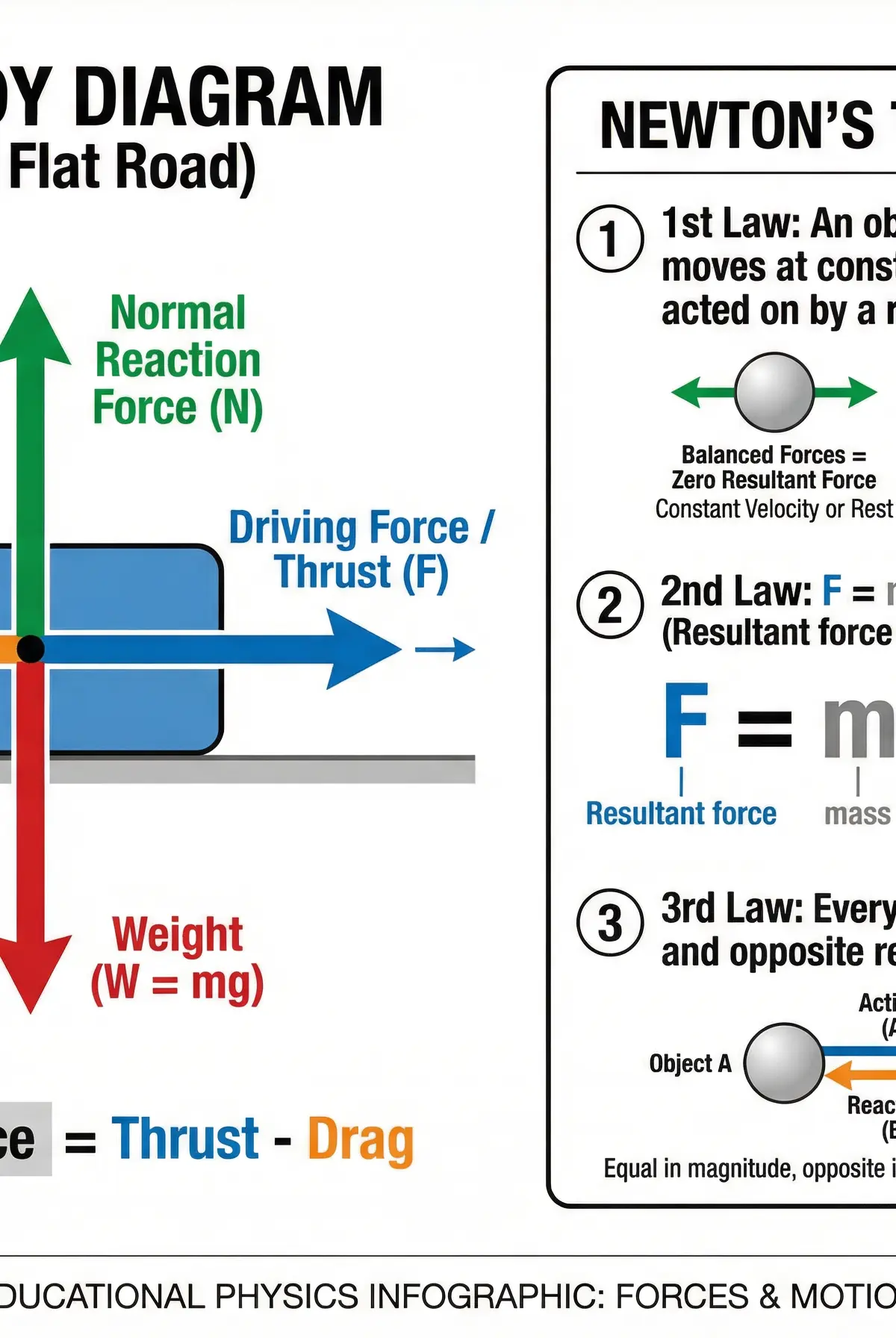
- Newton's First Law (Inertia): An object remains at rest or moves at a constant velocity unless acted on by a resultant force. If forces are balanced, motion doesn't change.
- Newton's Second Law (F = ma): The acceleration of an object is proportional to the resultant force acting on it and inversely proportional to its mass. This is the most important equation in the module.
- Newton's Third Law: Whenever two objects interact, they exert equal and opposite forces on each other. These forces are always of the same type and act on different objects.
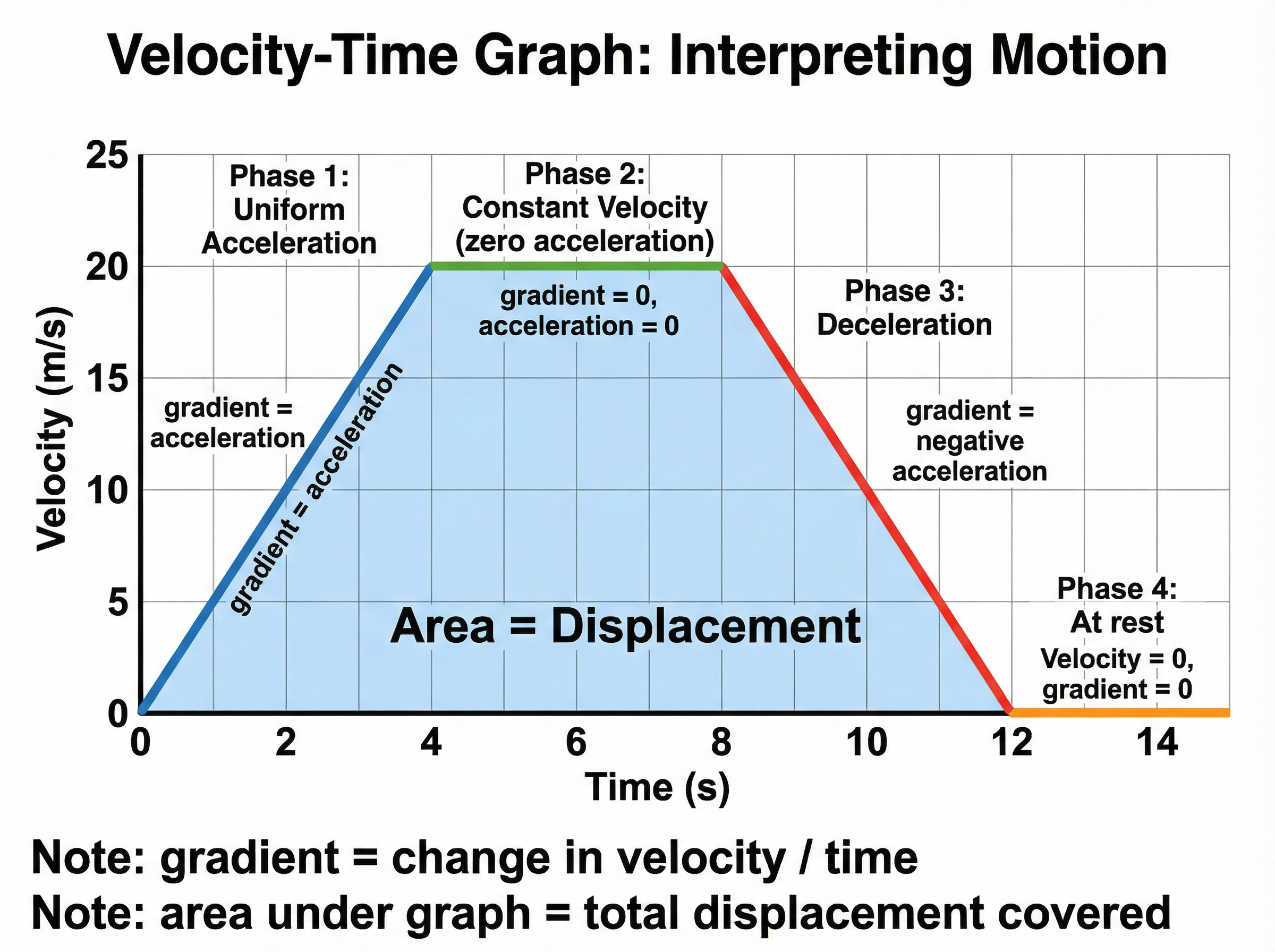
Concept 3: Velocity-Time Graphs
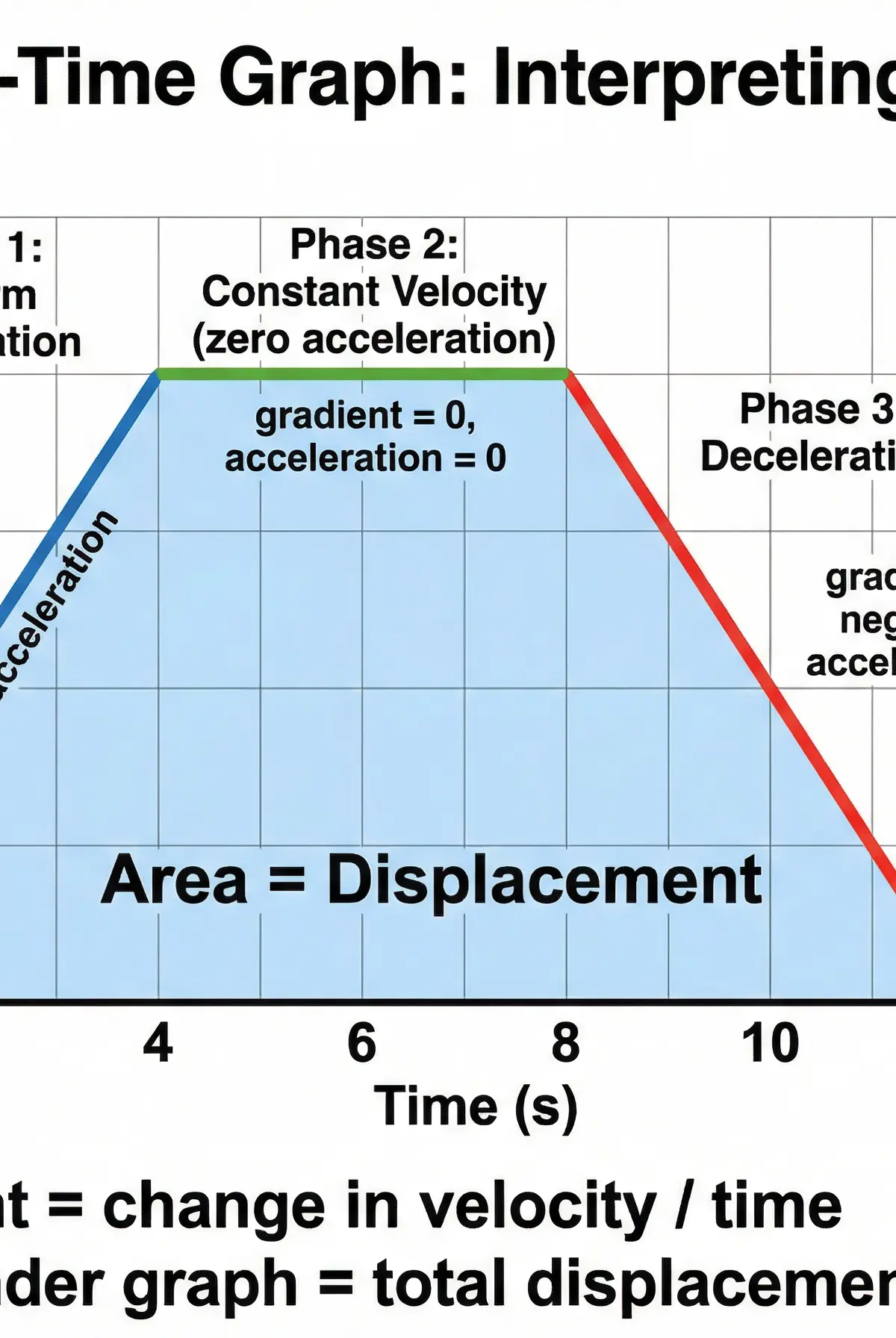
These graphs tell the story of a journey. The key features you must interpret are:
- Gradient (Slope) = Acceleration. A steeper line means greater acceleration. A flat horizontal line means zero acceleration (constant velocity).
- Area Under the Graph = Distance Travelled (Displacement). You calculate this by splitting the area into rectangles and triangles.
Mathematical/Scientific Relationships
1. Newton's Second Law
F = m \times a
- F = Resultant Force (Newtons, N)
- m = Mass (Kilograms, kg)
- a = Acceleration (Metres per second squared, m/s²)
2. Weight Equation
W = m \times g
- W = Weight (Newtons, N)
- m = Mass (kg)
- g = Gravitational Field Strength (N/kg) — usually 9.8 or 10 on Earth.
3. Acceleration
a = \frac{v - u}{t}
- v = Final velocity (m/s)
- u = Initial velocity (m/s)
- t = Time taken (s)
4. The Equations of Motion (SUVAT)
For constant acceleration:
v^2 - u^2 = 2 \times a \times s
- s = Distance/Displacement (m)
Practical Applications
Stopping Distances
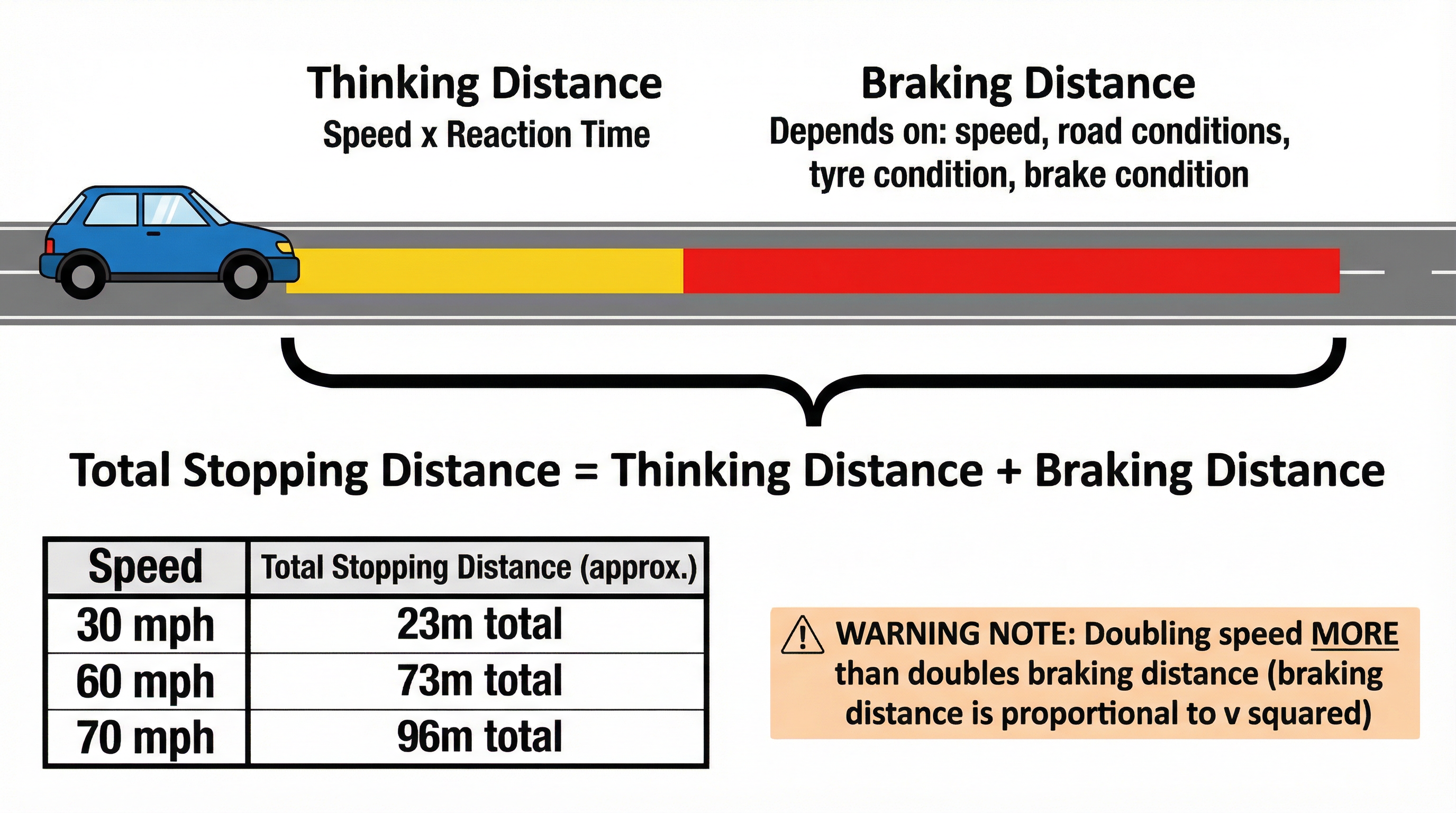
Stopping distance is a critical real-world application of these physics principles. It is the sum of two parts:
\text{Stopping Distance} = \text{Thinking Distance} + \text{Braking Distance}
- Thinking Distance: Distance travelled while the driver reacts. Affected by tiredness, drugs, alcohol, and distractions (mobile phones).
- Braking Distance: Distance travelled while the brakes are working. Affected by speed, road conditions (ice/rain), tyre condition, and brake quality.
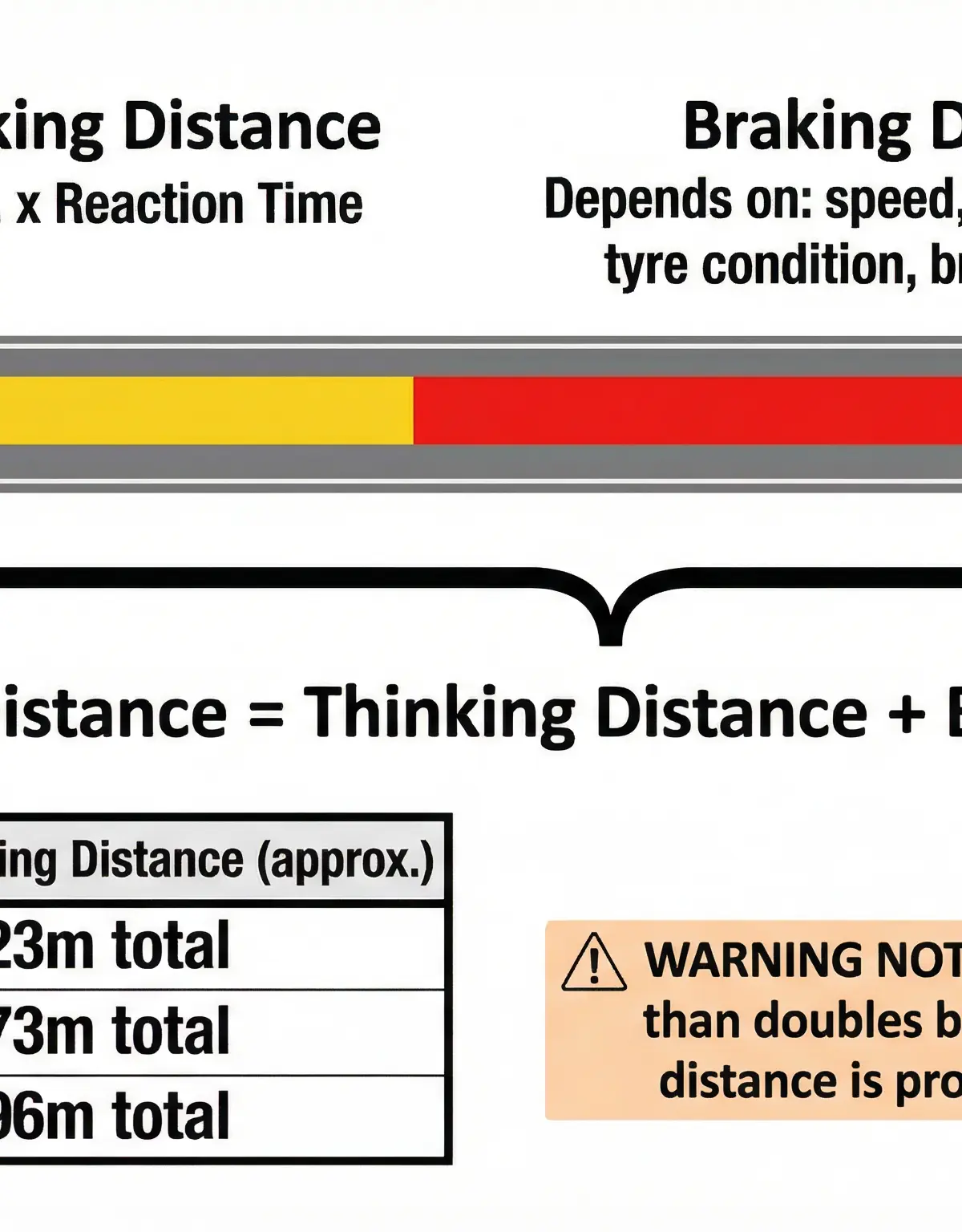
Crucial Physics: Braking distance is proportional to the square of the speed (v^2). If you double your speed (x2), your braking distance quadruples (x4). This is why speed limits are so strictly enforced.
Visual Resources
3 diagrams and illustrations
Interactive Diagrams
2 interactive diagrams to visualise key concepts
Conceptual Flow Outline
Components of Stopping Distance
Conceptual Flow Outline
Newton's First and Second Laws Logic Flow
Worked Examples
3 worked examples — open one to explore the question and available guidance.
Practice Questions
Test your understanding — click to reveal model answers
A sprinter runs a 100m race. She accelerates from rest at 4 m/s² for 3 seconds. Calculate her final velocity after 3 seconds.
Hint: Use the equation v = u + at. Remember she starts from rest so u = 0.
Describe the relationship between the speed of a vehicle and its braking distance.
Hint: Think about kinetic energy (1/2 mv²).
A skydiver jumps from a plane. Explain, in terms of forces, why she eventually reaches a terminal velocity.
Hint: Consider weight and air resistance at the start, middle, and end of the fall.
A car travels 45m while braking to a stop. The braking force is 6000N. Calculate the work done by the brakes.
Hint: Work Done = Force x Distance
Using a velocity-time graph, determine the total distance travelled by an object that accelerates from 0 to 10 m/s in 5 seconds, then travels at constant speed for 10 seconds.
Hint: Split the area under the graph into a triangle and a rectangle.
Test your understanding of Motion
Active recall beats re-reading. Take an instant quiz now to test what you’ve learned and lock it into long-term memory.
7 days Premium · Then free forever · No card, no charge