OCR · A-Level · Physics
Nuclear and Particle Physics
Master OCR A-Level Physics Module 6.4: Nuclear and Particle Physics. This guide deconstructs the Standard Model, radioactive decay, and binding energy, providing examiner insights and multi-modal resources to help you secure top marks on complex quantitative and qualitative questions.
- 7 min read
- 3 worked examples
- 5 practice questions
- 6 key terms
Study Notes
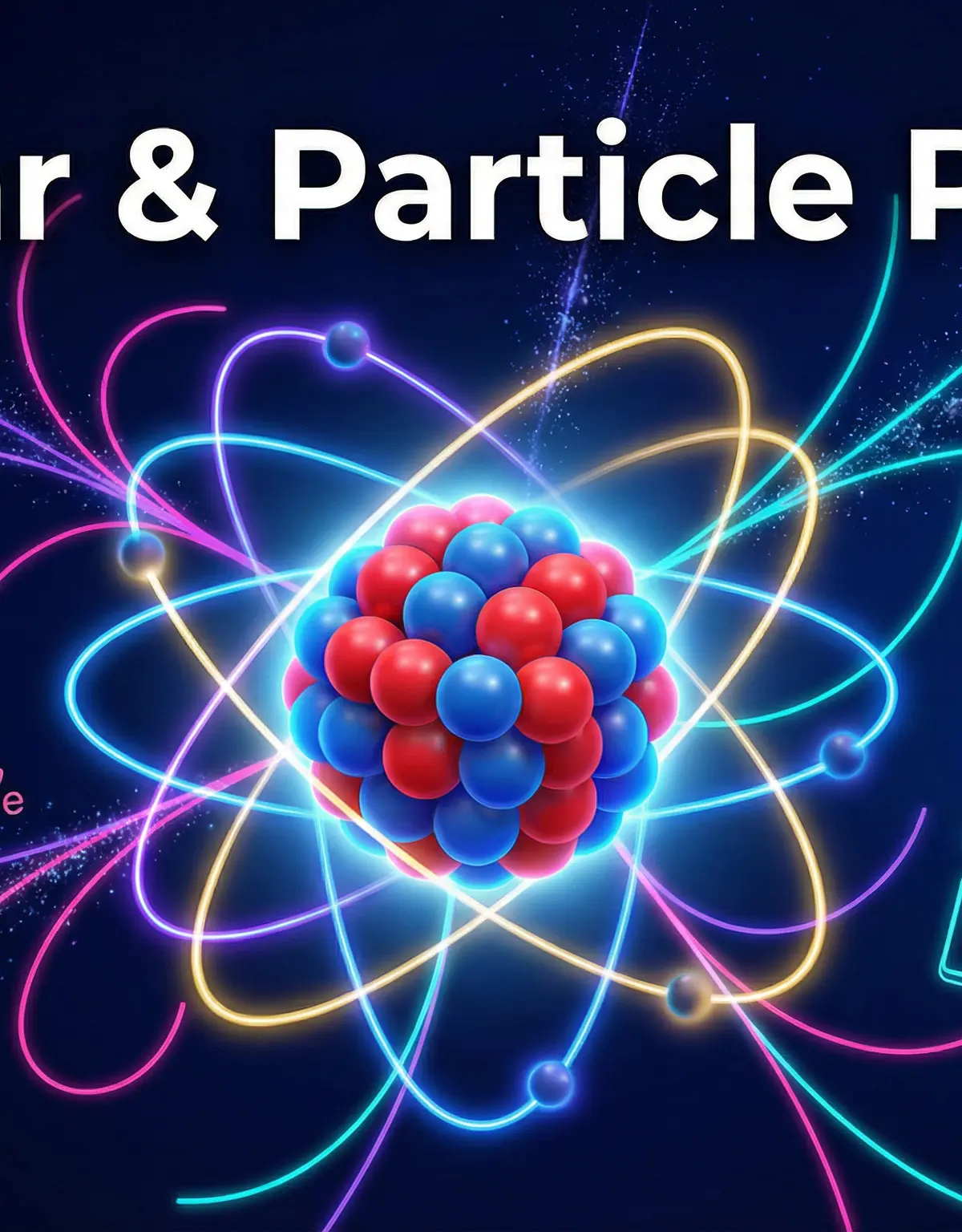
Overview
Welcome to one of the most fundamental and revealing areas of modern physics. OCR A-Level Physics Module 6.4, Nuclear and Particle Physics, takes us on a journey from the familiar atomic nucleus into the strange and wonderful subatomic world of quarks, leptons, and bosons. This topic is crucial because it underpins our understanding of matter itself, the forces that govern it, and the processes that power stars and nuclear reactors. In the exam, you will face a mix of challenging quantitative problems (like decay modelling and binding energy calculations) and qualitative questions that test your precise understanding of the Standard Model and conservation laws. Candidates who can navigate these concepts with fluency, applying conservation laws rigorously and handling mass-energy conversions with precision, are consistently rewarded with high marks. This guide will equip you with the conceptual framework and exam technique to do just that.
Key Concepts
Concept 1: The Nucleus & Radioactive Decay
The atomic nucleus is comprised of protons and neutrons, collectively known as nucleons. An atom's identity is its proton number (Z), while its mass number (A) is the total count of nucleons. Nuclei of the same element with different numbers of neutrons are called isotopes.
Many nuclei are unstable. They possess an imbalance of neutrons and protons or are simply too large to be held together by the strong nuclear force. To achieve a more stable, lower-energy state, they undergo radioactive decay. It's crucial to understand that this process is both spontaneous (unaffected by external factors like temperature or pressure) and random (it's impossible to predict when a specific nucleus will decay, but there is a constant probability of decay per unit time). Examiners frequently test the distinction between these two terms.
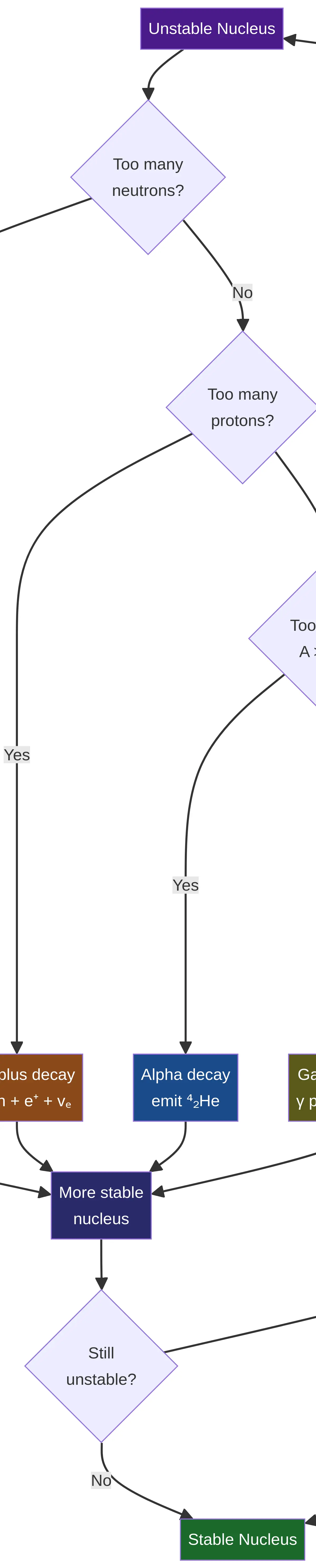
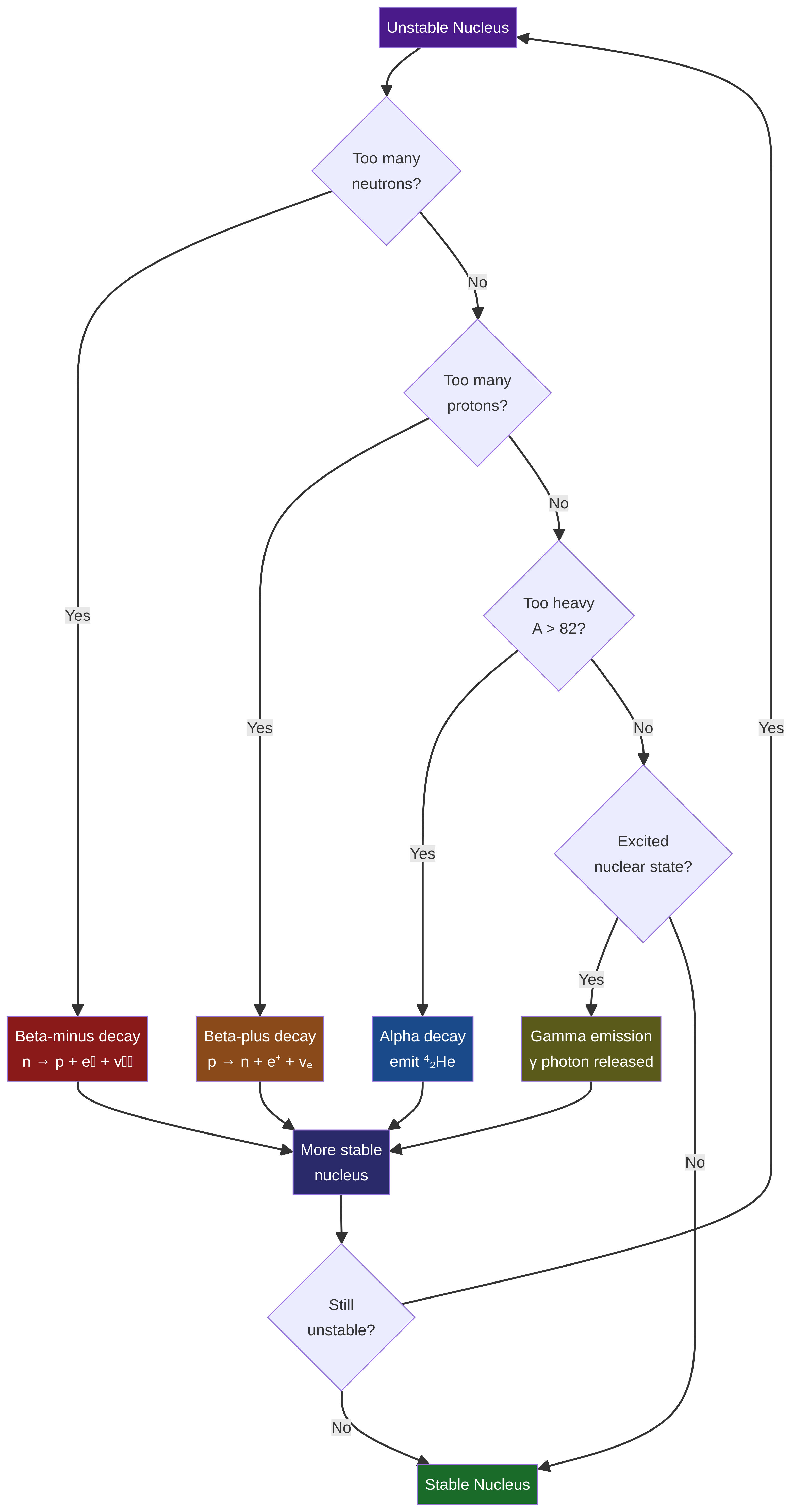
- Alpha (α) Decay: Occurs in very heavy nuclei. An alpha particle (a Helium nucleus, ⁴₂He) is emitted. The result is that A decreases by 4 and Z decreases by 2.
- Beta-minus (β⁻) Decay: Occurs in neutron-rich nuclei. A neutron transforms into a proton, emitting a high-energy electron (the β⁻ particle) and an electron antineutrino (v̄ₑ). The antineutrino is essential for conserving lepton number and is a common omission in exam answers, leading to lost marks. A increases by 1, Z increases by 1.
- Beta-plus (β⁺) Decay: Occurs in proton-rich nuclei. A proton transforms into a neutron, emitting a positron (the electron's antiparticle, e⁺) and an electron neutrino (vₑ). A decreases by 1, Z decreases by 1.
- Gamma (γ) Emission: An excited nucleus releases surplus energy as a high-frequency photon (gamma ray). There is no change in A or Z; the nucleus simply moves to a lower energy state.
Concept 2: The Mathematics of Decay
Radioactive decay is governed by a key exponential relationship. The number of undecayed nuclei, N, at time t is given by:
N = N₀ * e^(-λt)
Where N₀ is the initial number of undecayed nuclei and λ is the decay constant. The decay constant represents the probability that an individual nucleus will decay per unit time. The activity (A) of a sample, measured in Becquerels (Bq), is the rate of decay:
A = λN
This means activity also follows the same exponential decay pattern: A = A₀ * e^(-λt).
A related and more intuitive concept is half-life (T₁/₂), the time taken for half of the undecayed nuclei in a sample to decay (or for the activity to halve). It is related to the decay constant by:
T₁/₂ = ln(2) / λ ≈ 0.693 / λ
Exam Skill: A common high-mark question involves determining the decay constant from data. Plotting ln(A) against t produces a straight line with a gradient of -λ. Candidates must explicitly state this relationship to gain full credit.
Concept 3: The Standard Model of Particle Physics
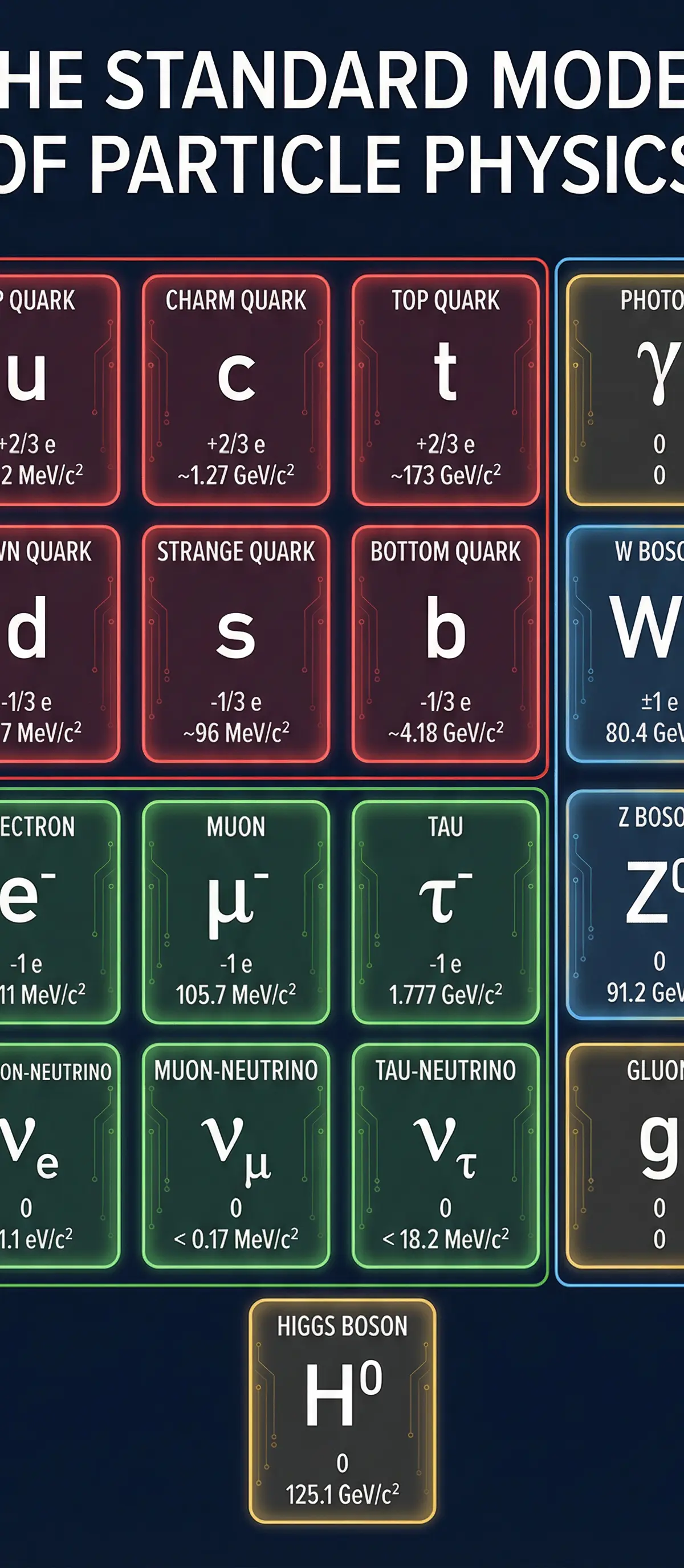
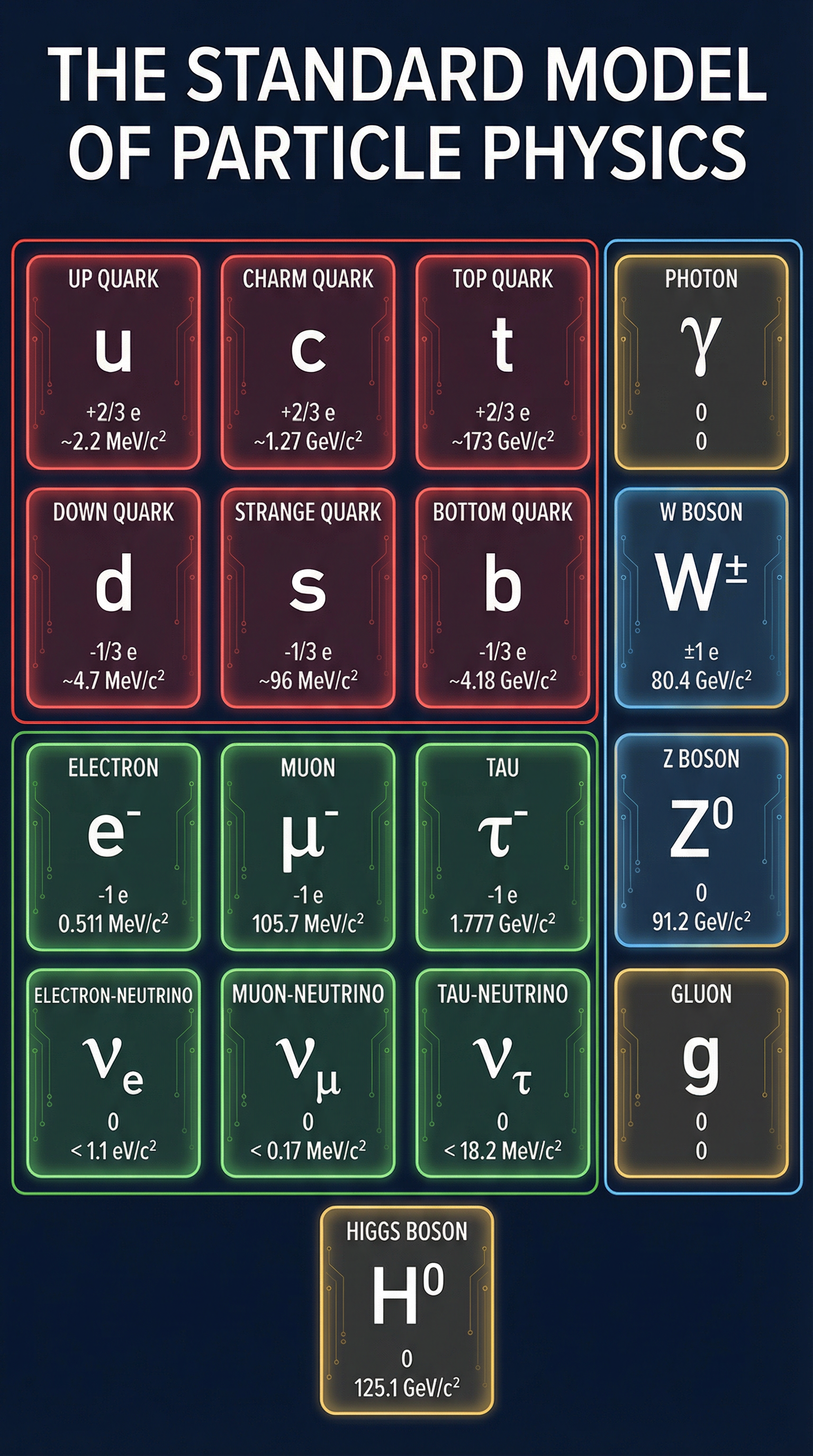
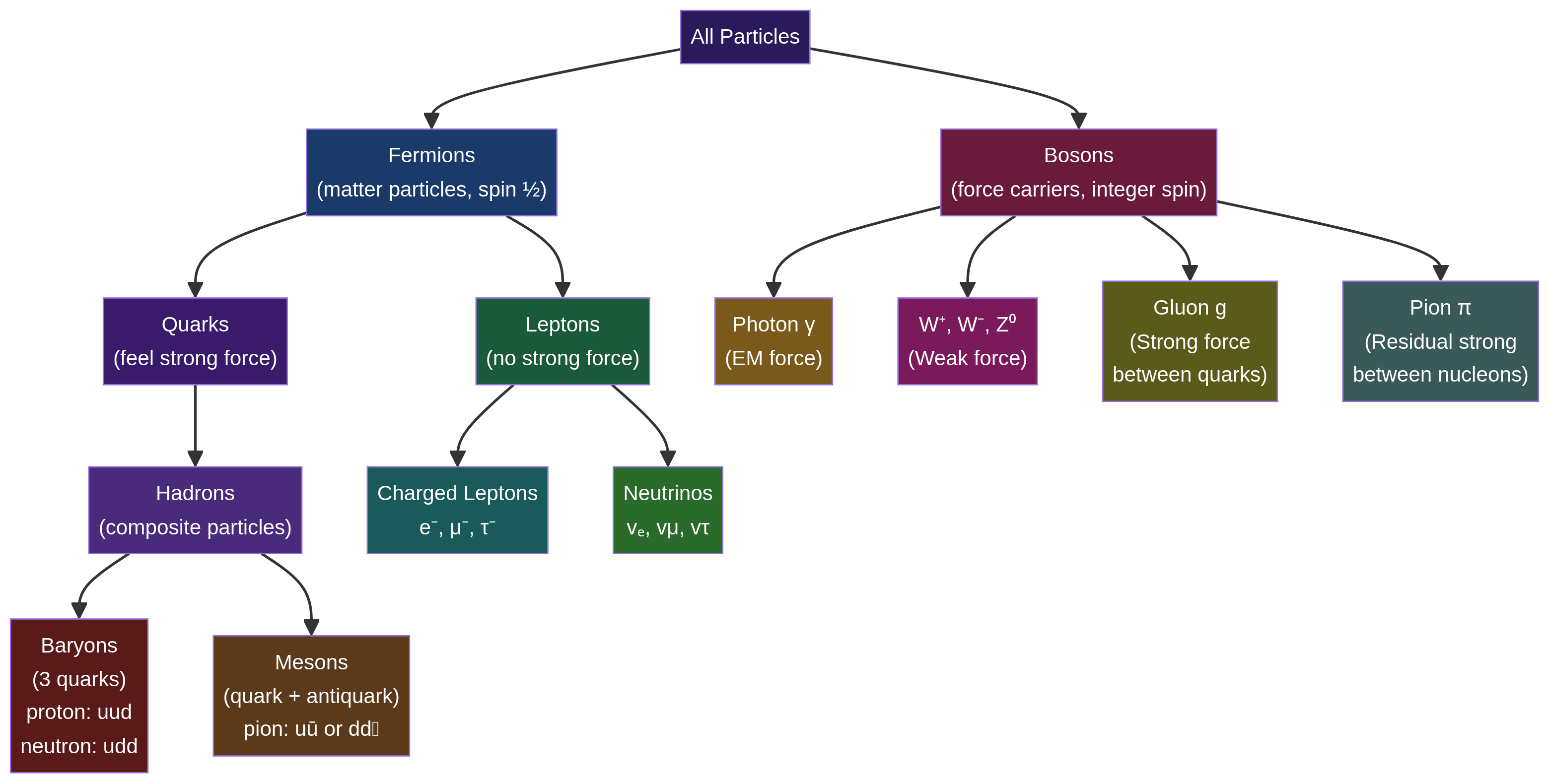
The Standard Model is the physicist's periodic table, classifying all known fundamental particles. It is a cornerstone of the specification.
Particles are divided into two main families:
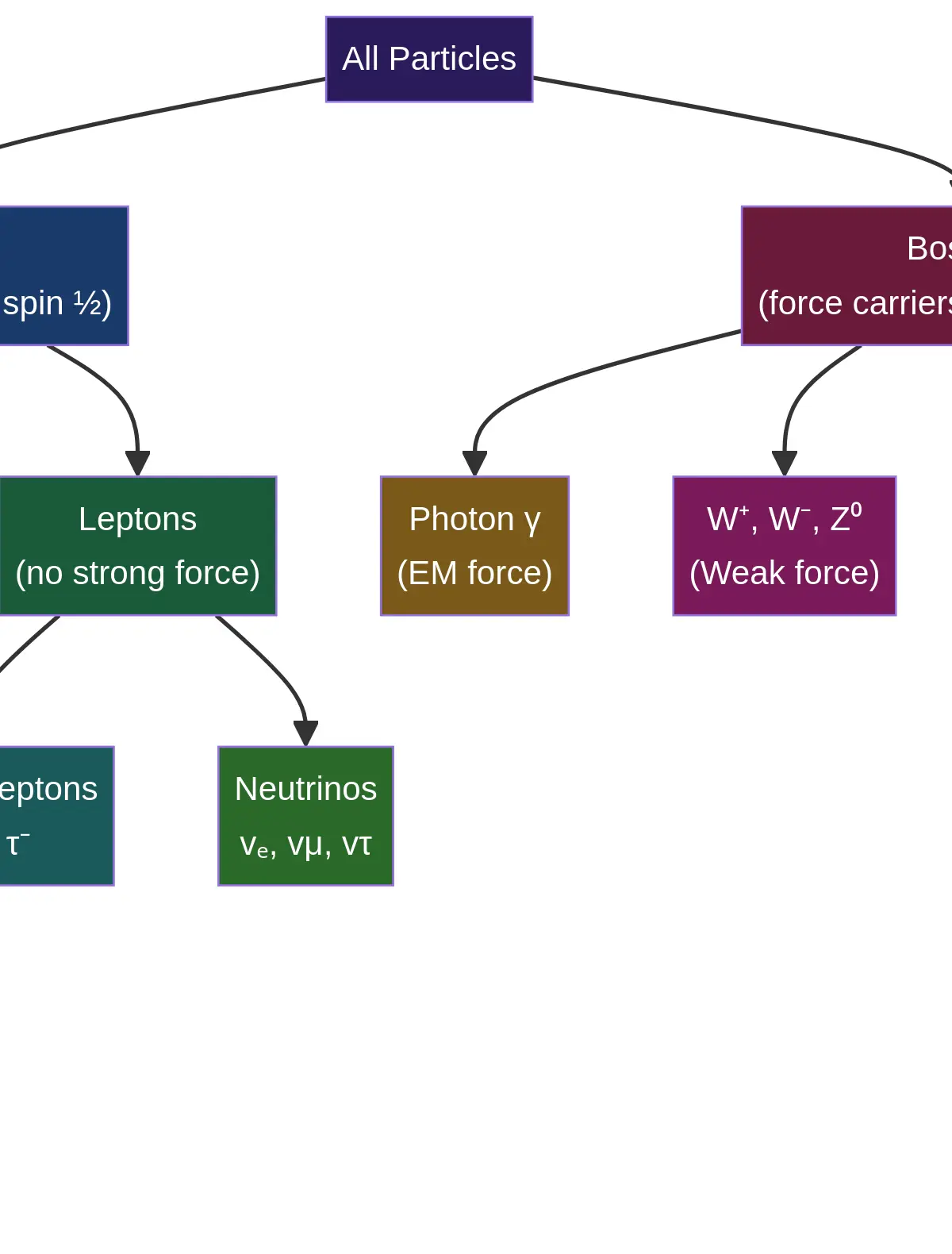
- Fermions: The 'matter' particles. They have half-integer spin and are subdivided into quarks and leptons.
- Quarks: Experience the strong nuclear force. They come in six 'flavours': up (u), down (d), charm (c), strange (s), top (t), and bottom (b). They always exist in composite particles called hadrons.
- Baryons: Made of three quarks (e.g., Proton: uud, Neutron: udd). Baryon Number = +1.
- Mesons: Made of one quark and one antiquark (e.g., Pion: uđ). Baryon Number = 0.
- Leptons: Do not experience the strong force. They include the electron (e⁻), muon (μ⁻), tau (τ⁻), and their corresponding neutrinos (vₑ, vμ, vτ). Each has a Lepton Number of +1.
- Quarks: Experience the strong nuclear force. They come in six 'flavours': up (u), down (d), charm (c), strange (s), top (t), and bottom (b). They always exist in composite particles called hadrons.
- Bosons: The 'force-carrying' particles. They have integer spin.
- Photon (γ): Mediates the electromagnetic force.
- W⁺, W⁻, Z⁰ Bosons: Mediate the weak nuclear force (responsible for beta decay).
- Gluon (g): Mediates the strong nuclear force that binds quarks together inside hadrons.
- Higgs Boson: Responsible for giving particles mass.
Concept 4: Conservation Laws
In any particle interaction, certain properties must be conserved. To validate a proposed interaction, you must check for the conservation of:
- Charge (Q)
- Baryon Number (B)
- Lepton Number (L) (This is conserved separately for each family: Lₑ, Lμ, Lτ)
If any of these laws are violated, the interaction cannot happen. This is a standard template for many exam questions.
Concept 5: Binding Energy and Mass Defect
The mass of a nucleus is always less than the sum of the masses of its individual, separate protons and neutrons. This difference in mass is called the mass defect (Δm). The 'missing' mass has been converted into energy, known as the binding energy (BE), which holds the nucleus together. This is a direct consequence of Einstein's mass-energy equivalence principle:
BE = Δm * c²
- Mass Defect (Δm) = (Total mass of separate nucleons) - (Mass of the nucleus)
For calculations, you can either convert the mass defect from atomic mass units (u) to kg and use c², or more directly, use the conversion factor 1 u = 931.5 MeV.
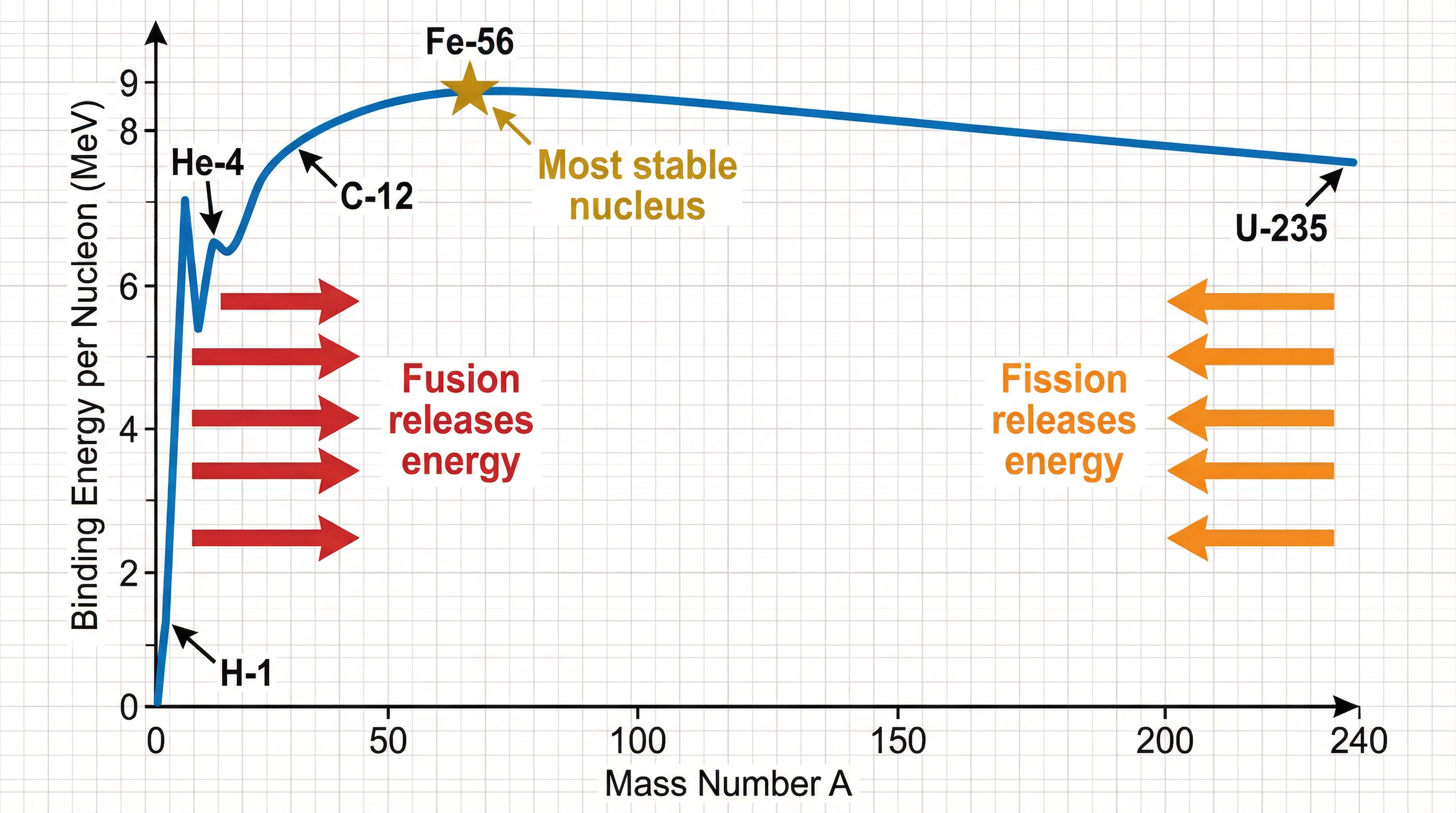
The binding energy per nucleon (BE/A) is a measure of a nucleus's stability. The higher this value, the more stable the nucleus.
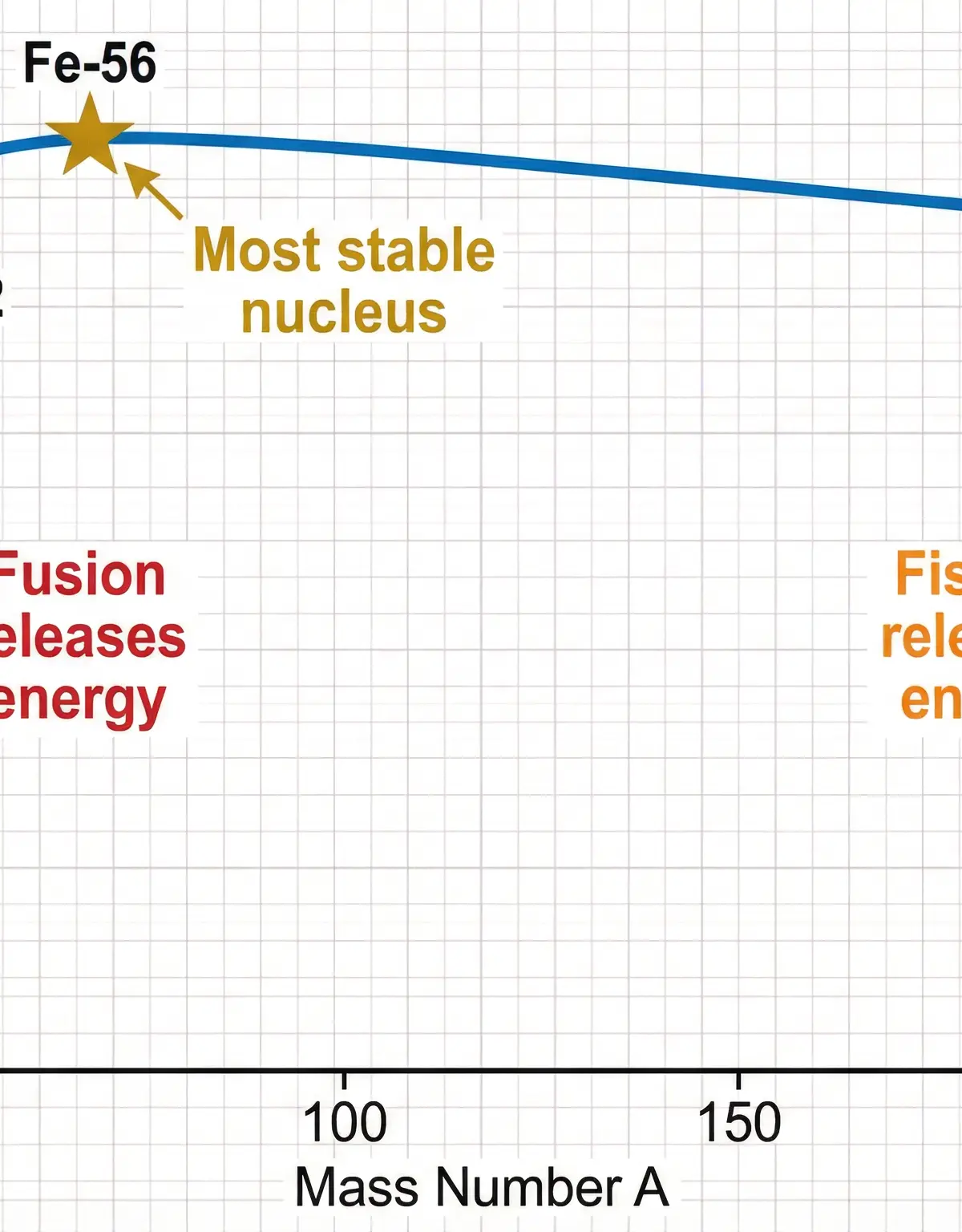
The binding energy curve shows that Iron-56 (Fe-56) has the highest binding energy per nucleon, making it the most stable nucleus. Energy is released when nuclei move towards this peak:
- Fusion: Light nuclei combine, increasing their binding energy per nucleon.
- Fission: A heavy nucleus splits, increasing the binding energy per nucleon of the fragments.
Exam Skill: In 'Show that' questions involving energy release, it is vital to carry intermediate mass values to at least 5 decimal places to avoid rounding errors that will cause your final answer to differ from the given value, resulting in a lost mark.
Visual Resources
4 diagrams and illustrations
Interactive Diagrams
2 interactive diagrams to visualise key concepts
Conceptual Flow Outline
A flowchart showing the decision process for which type of radioactive decay an unstable nucleus is likely to undergo based on its properties.
Conceptual Flow Outline
A concept map illustrating the classification of particles within the Standard Model, from the main families of Fermions and Bosons down to specific examples like protons and photons.
Worked Examples
3 worked examples — open one to explore the question and available guidance.
Practice Questions
Test your understanding — click to reveal model answers
State the quark composition of a neutron and show how it changes during beta-minus decay.
Hint: Remember that a neutron changes into a proton. What are the quark compositions of each?
A sample of a radioactive isotope has an initial activity of 640 Bq. After 48 hours, its activity drops to 80 Bq. Calculate the half-life of the isotope.
Hint: How many times has the activity halved to get from 640 to 80?
Explain why the mass of a carbon-12 nucleus is less than the mass of 6 protons and 6 neutrons.
Hint: Think about mass-energy equivalence and what holds the nucleus together.
The decay of a lambda particle is shown: Λ⁰ → p + π⁻. The lambda particle is a baryon with strangeness -1. Justify whether strangeness is conserved in this decay and state the fundamental force responsible.
Hint: Pions and protons have a strangeness of 0. What does this imply about the interaction?
A radioactive source is monitored over time. Describe a graphical method to determine its decay constant, λ, and state the precautions needed for an accurate result.
Hint: Think about how to turn the exponential decay equation into a straight line graph (y=mx+c).
Test your understanding of Nuclear and Particle Physics
Active recall beats re-reading. Take an instant quiz now to test what you’ve learned and lock it into long-term memory.
7 days Premium · Then free forever · No card, no charge