OCR · A-Level · Physics
Thermal Physics
This module bridges the gap between terrestrial mechanics and the cosmos, explaining how the same laws that govern a falling apple also govern the orbits of planets and the life cycles of stars. Mastering these concepts is essential for understanding the fundamental forces of the universe and securing high marks in synoptic questions.
- 5 min read
- 3 worked examples
- 3 practice questions
- 6 key terms
Study Notes
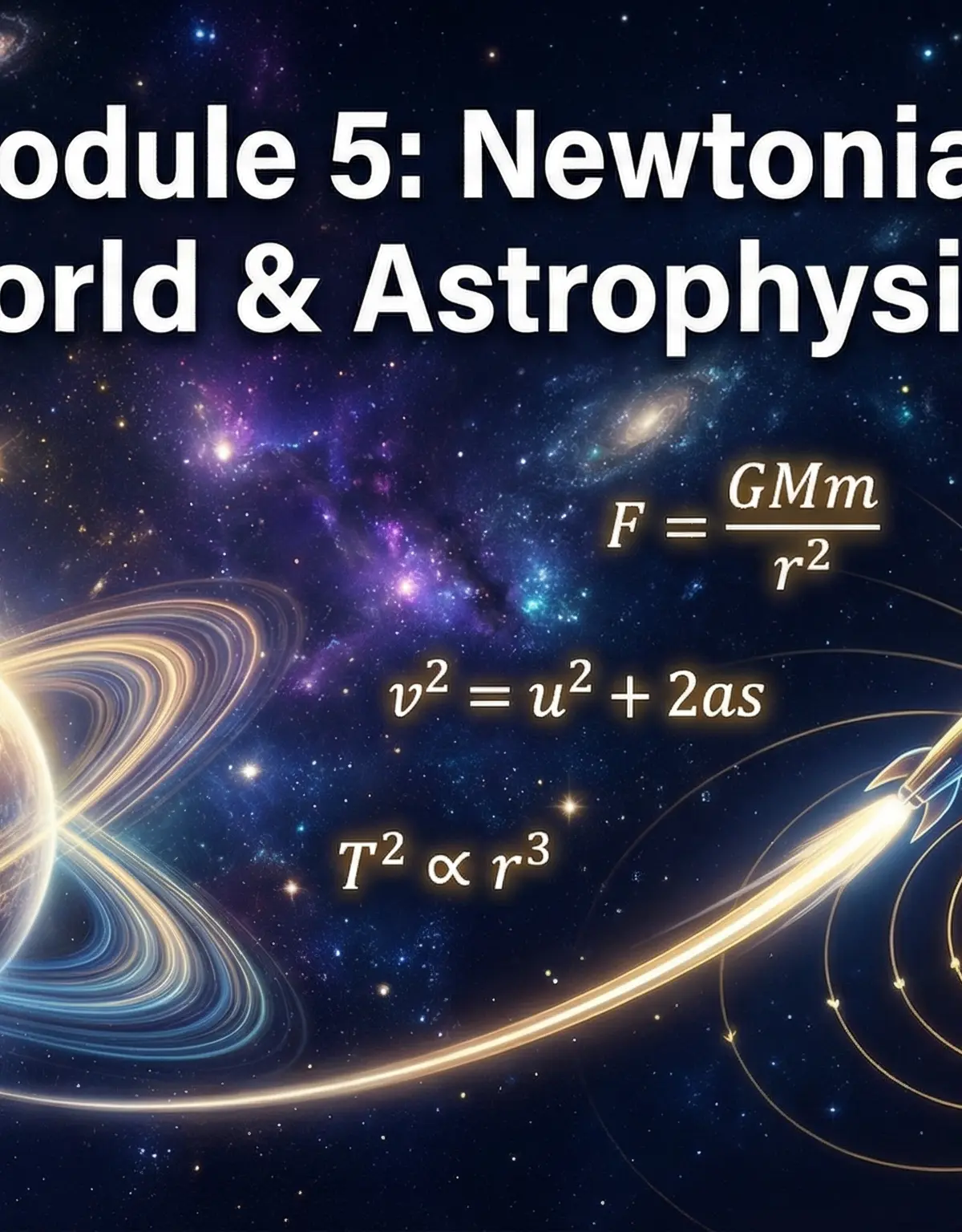
Overview
Module 5: Newtonian World and Astrophysics is a cornerstone of the A-Level Physics specification. It unifies the microscopic and macroscopic worlds, demonstrating how simple mathematical laws apply universally. You will journey from the mechanics of circular motion and oscillations to the vast scales of gravitational fields and the evolution of the universe itself.
This topic is critical because it tests your ability to model the physical world mathematically. Examiners love this module for its potential to combine calculation with deep conceptual explanation. You can expect multi-stage calculation questions involving orbital mechanics, as well as extended response questions requiring you to explain stellar evolution or the evidence for the Big Bang.
Success here requires fluency in switching between algebraic derivations and qualitative descriptions. You must be comfortable explaining why a satellite stays in orbit just as well as you can calculate its period.
Key Concepts
Concept 1: Circular Motion
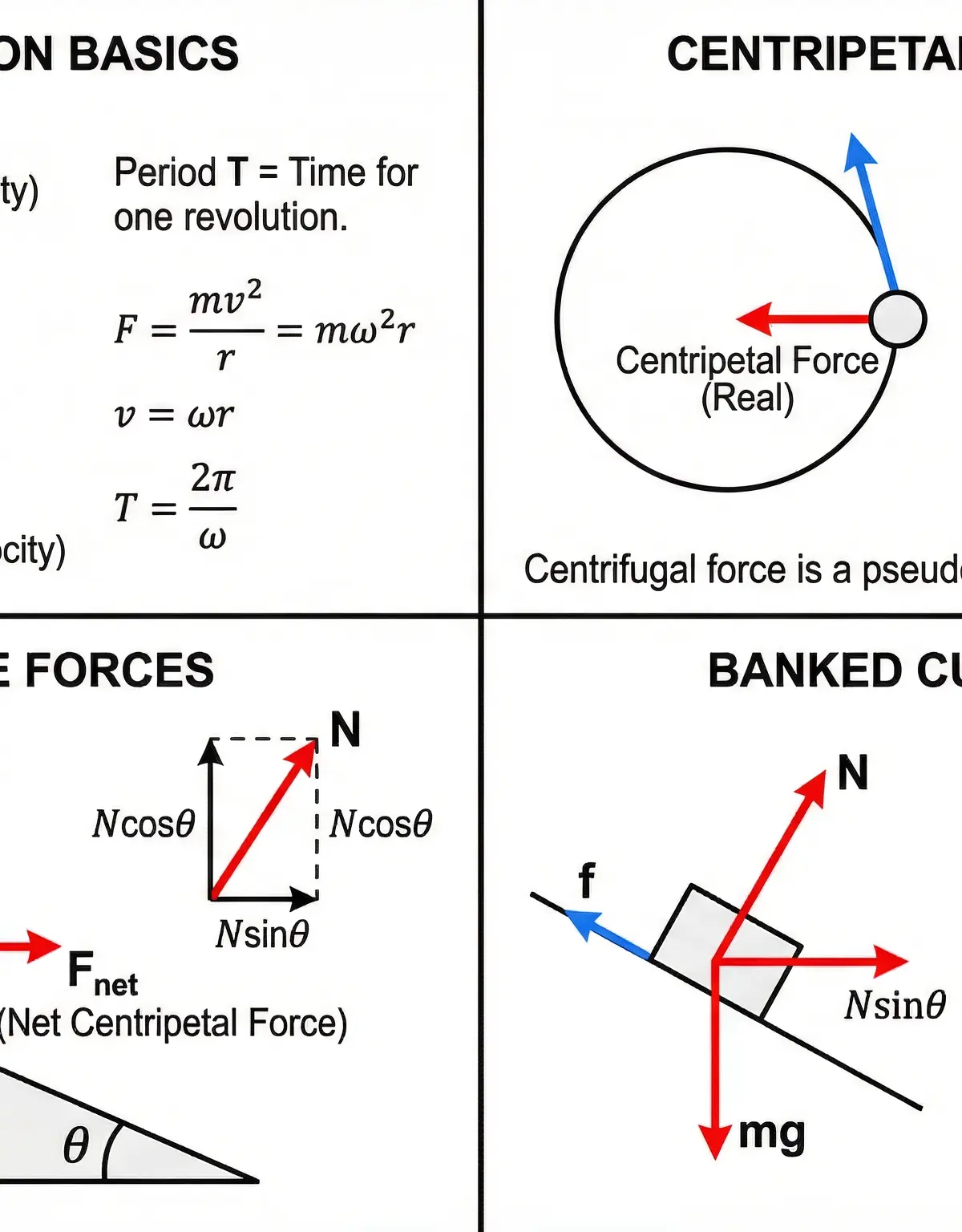
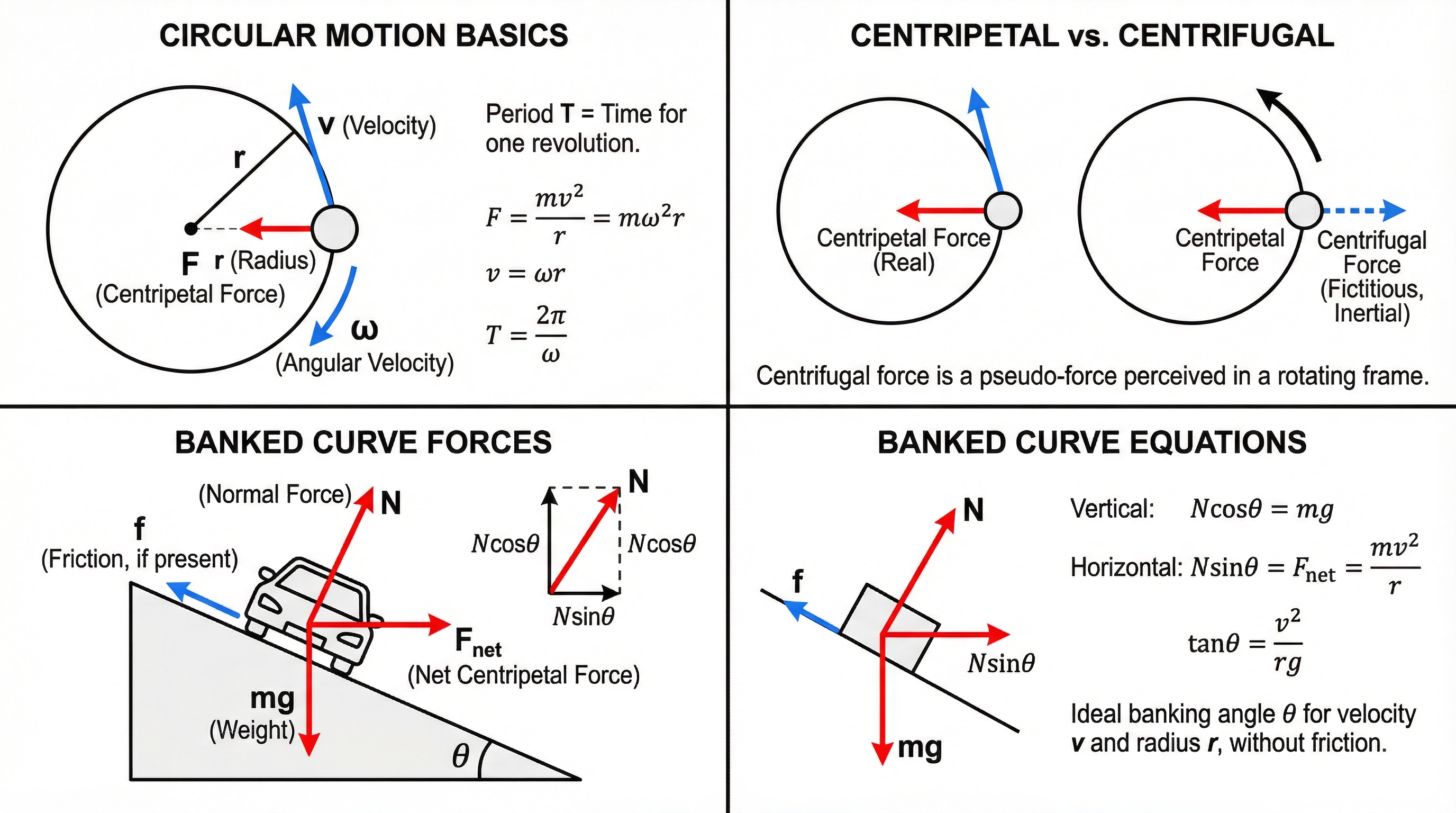
Circular motion occurs when an object moves at a constant speed but changing velocity. Because velocity is a vector (speed + direction), a change in direction means a change in velocity, which implies an acceleration. This acceleration is always directed toward the centre of the circle and is called centripetal acceleration.
To produce this acceleration, a resultant force must act toward the centre: the centripetal force.
Crucial Point: Centripetal force is NOT a new physical force. It is simply the name we give to the resultant of other forces (gravity, tension, friction) that causes the circular path. Never label a diagram with "centripetal force" — label the actual force (e.g., Tension) and state that it provides the centripetal force.
Concept 2: Gravitational Fields
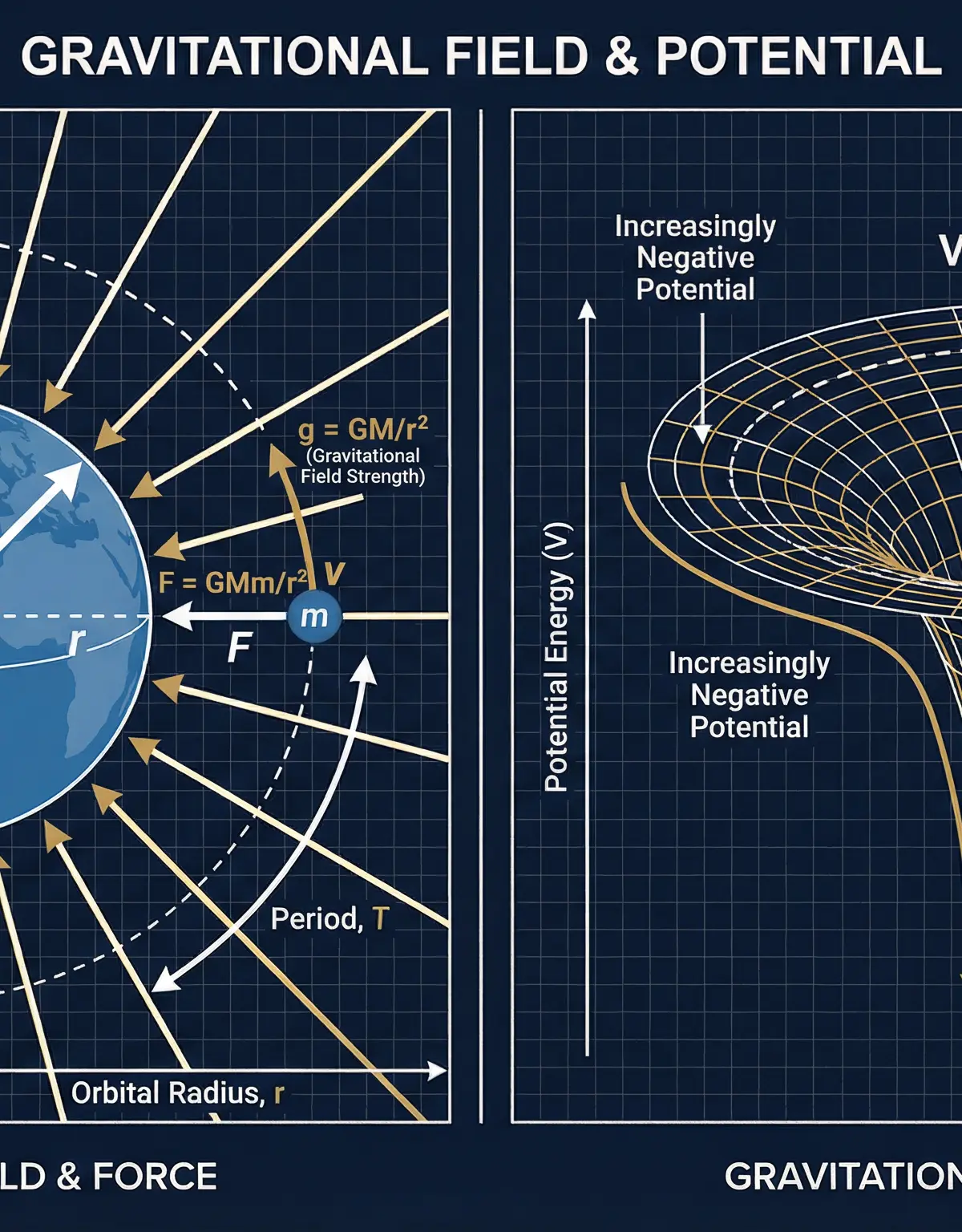
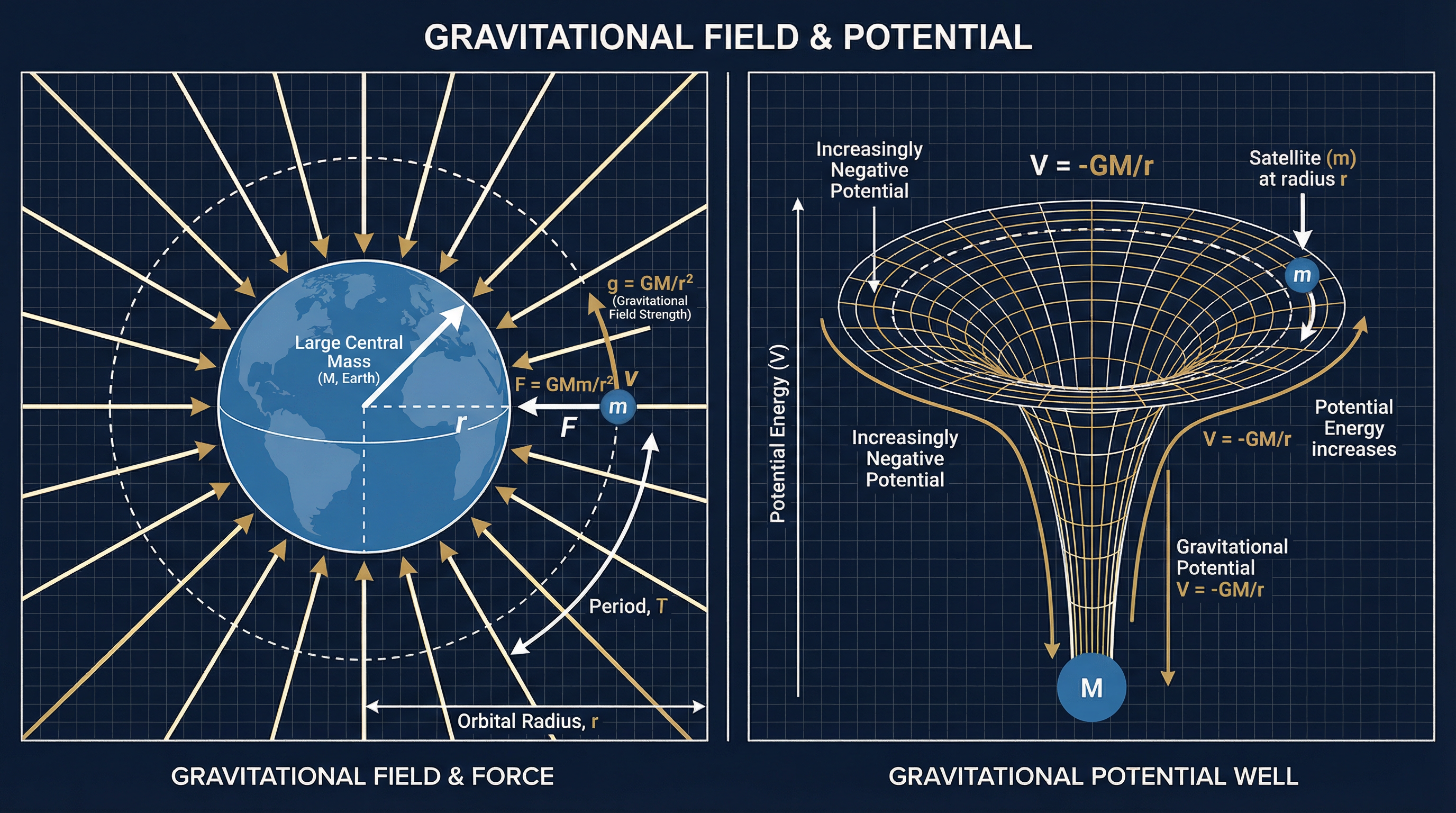
A gravitational field is a region where a mass experiences a force. We model these fields using field lines (showing direction of force) and equipotential surfaces (lines of constant potential).
Newton's Law of Universal Gravitation states that the force between two point masses is proportional to the product of their masses and inversely proportional to the square of their separation. This inverse square law is a recurring theme in physics.
Gravitational Potential (V) is defined as the work done per unit mass to move a small test mass from infinity to that point. It is always negative because gravity is an attractive force — you would have to do work against the field to move a mass away to infinity (where potential is zero).
Concept 3: Stellar Evolution
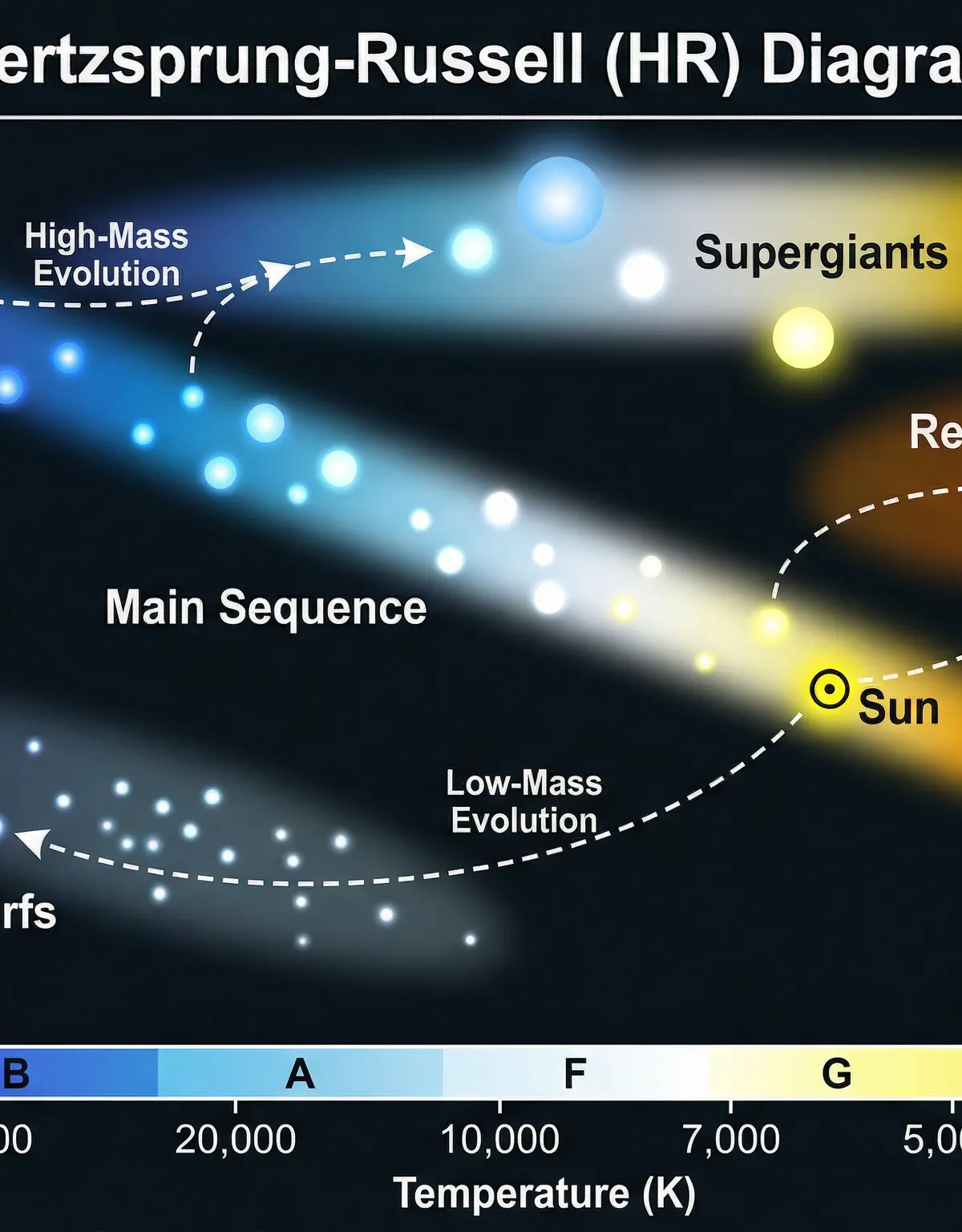
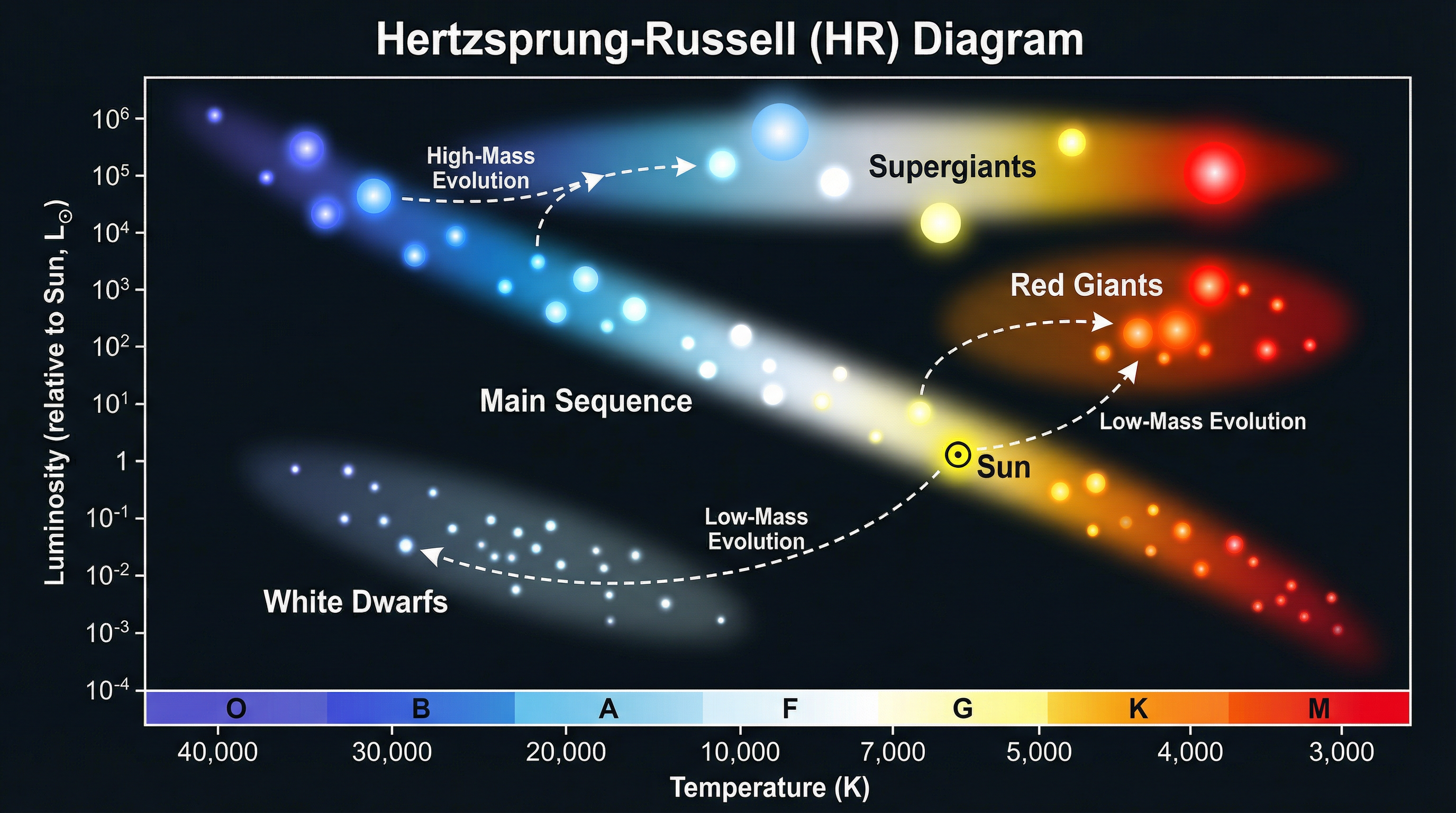
Stars are dynamic objects balanced between two opposing forces: gravity trying to collapse the star inward, and radiation pressure (from fusion) pushing outward. The life cycle of a star is determined almost entirely by its initial mass.
- Low-mass stars (like our Sun): Main Sequence \rightarrow Red Giant \rightarrow Planetary Nebula \rightarrow White Dwarf.
- High-mass stars: Main Sequence \rightarrow Red Supergiant \rightarrow Supernova \rightarrow Neutron Star or Black Hole.
The Hertzsprung-Russell (HR) Diagram is the most important plot in astrophysics, organizing stars by luminosity and temperature. You must be able to sketch this and draw evolutionary tracks.
Mathematical/Scientific Relationships
Circular Motion
- \omega = \frac{2\pi}{T} : Angular velocity (rad s^{-1})
- v = r\omega : Linear velocity (m s^{-1})
- a = \frac{v^2}{r} = \omega^2r : Centripetal acceleration (m s^{-2})
- F = \frac{mv^2}{r} = m\omega^2r : Centripetal force (N)
Gravitational Fields
- F = -\frac{GMm}{r^2} : Newton's Law of Gravitation (N)
- g = -\frac{GM}{r^2} : Gravitational field strength (N kg^{-1})
- V = -\frac{GM}{r} : Gravitational potential (J kg^{-1})
- E_p = mV = -\frac{GMm}{r} : Gravitational potential energy (J)
- T^2 = \left(\frac{4\pi^2}{GM}\right)r^3 : Kepler's Third Law
Astrophysics
- \lambda_{max} T = 2.9 \times 10^{-3} m K : Wien's Displacement Law
- L = 4\pi r^2 \sigma T^4 : Stefan's Law
- v \approx H_0 d : Hubble's Law
- \frac{\Delta \lambda}{\lambda} \approx \frac{v}{c} : Doppler shift (for v \ll c)
Practical Applications
Geostationary Satellites: These orbit above the equator with a period of exactly 24 hours, matching Earth's rotation. They appear stationary from the ground, making them essential for telecommunications and satellite TV. To achieve this, they must be at a specific altitude (approx. 36,000 km).
GPS Systems: These rely on precise orbital mechanics. Interestingly, they must also account for relativistic time dilation (both special and general relativity) to maintain accuracy — a real-world application of advanced gravitational theory.
Visual Resources
3 diagrams and illustrations
Interactive Diagrams
2 interactive diagrams to visualise key concepts
Conceptual Flow Outline
Stellar Evolution Pathways: The fate of a star depends on its initial mass.
Conceptual Flow Outline
Graphical Analysis of Orbital Mechanics
Worked Examples
3 worked examples — open one to explore the question and available guidance.
Practice Questions
Test your understanding — click to reveal model answers
Calculate the gravitational field strength at the surface of Mars. (Mass of Mars = 6.4 \times 10^{23} kg, Radius of Mars = 3.4 \times 10^6 m).
Hint: Use the formula $g = GM/r^2$.
Describe and explain the evolution of a star much more massive than the Sun, starting from the Main Sequence.
Hint: Focus on the balance between gravity and radiation pressure.
Binary stars A and B orbit a common centre of mass. Star A is twice the mass of Star B. Compare the orbital period and orbital radius of Star A relative to Star B.
Hint: Think about the angular velocity of a rigid system.
Test your understanding of Thermal Physics
Active recall beats re-reading. Take an instant quiz now to test what you’ve learned and lock it into long-term memory.
7 days Premium · Then free forever · No card, no charge