Momentum — OCR GCSE Study Guide
Exam Board: OCR | Level: GCSE
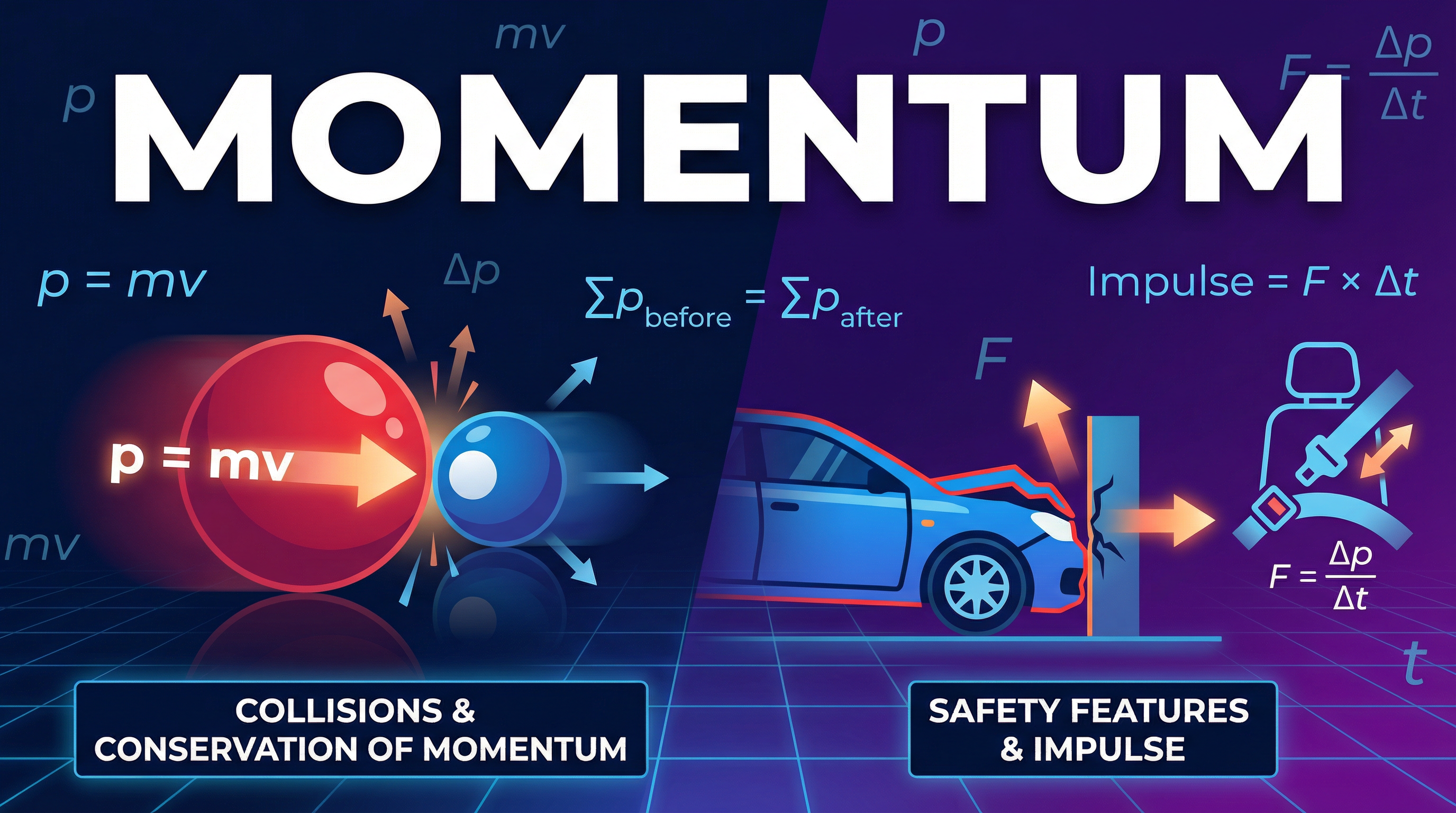
This comprehensive study guide for OCR GCSE Physics (P2.4) delves into the crucial concept of momentum. It covers everything from the fundamental equation p=mv to the principles of conservation in collisions and the application of momentum change in real-world safety features, equipping you with the knowledge to secure top marks.
## Overview
Momentum is a fundamental concept in physics that describes an object's quantity of motion. In essence, it's a measure of how difficult it is to stop a moving object. For your OCR GCSE Physics exam, a thorough understanding of momentum is essential, not just for calculation questions but for longer, explanatory answers. This topic, specification reference **P2.4**, is a cornerstone of mechanics and has direct links to forces (Newton's Laws), energy, and practical applications like vehicle safety. Examiners frequently test momentum through a variety of question styles, from straightforward calculations to more demanding problems involving the conservation of momentum in collisions and explosions. Higher Tier candidates will also be expected to relate force to the rate of change of momentum. Mastering the vector nature of momentum and the principle of conservation is the key to unlocking the highest marks in this area.

## Key Concepts
### Concept 1: Defining and Calculating Momentum
Momentum is a property of all moving objects. It is defined as the product of an object's mass and its velocity. This relationship is captured in a simple but powerful equation that you must be able to recall and apply.
**Mathematical Relationship:**
- **Formula**: `p = m × v` (Must memorise)
- **p**: momentum, measured in **kilogram metres per second (kg m/s)** or **Newton seconds (N s)**.
- **m**: mass, measured in **kilograms (kg)**. A common exam trap is to provide mass in grams; you must convert it by dividing by 1000.
- **v**: velocity, measured in **metres per second (m/s)**.
Crucially, momentum is a **vector quantity**. This means it has both magnitude (size) and direction. In one-dimensional problems, we represent direction using positive and negative signs. For example, if we define movement to the right as positive, then any object moving to the left will have a negative velocity and therefore a negative momentum. Neglecting this is one of the most frequent errors made by candidates.
**Example**:
A trolley with a mass of 2.5 kg moves to the right at 4 m/s. Its momentum is:
`p = 2.5 kg × 4 m/s = 10 kg m/s`
If the same trolley were moving to the left, its momentum would be:
`p = 2.5 kg × (-4 m/s) = -10 kg m/s`
### Concept 2: The Principle of Conservation of Momentum
This is one of the most important laws in physics. It states that: **In a closed system, the total momentum before an event is equal to the total momentum after the event.**
A 'closed system' is one where no external forces (like friction or air resistance) are acting. For your exams, you can assume you are dealing with a closed system unless told otherwise. This principle is applied to two main types of events: collisions and explosions.
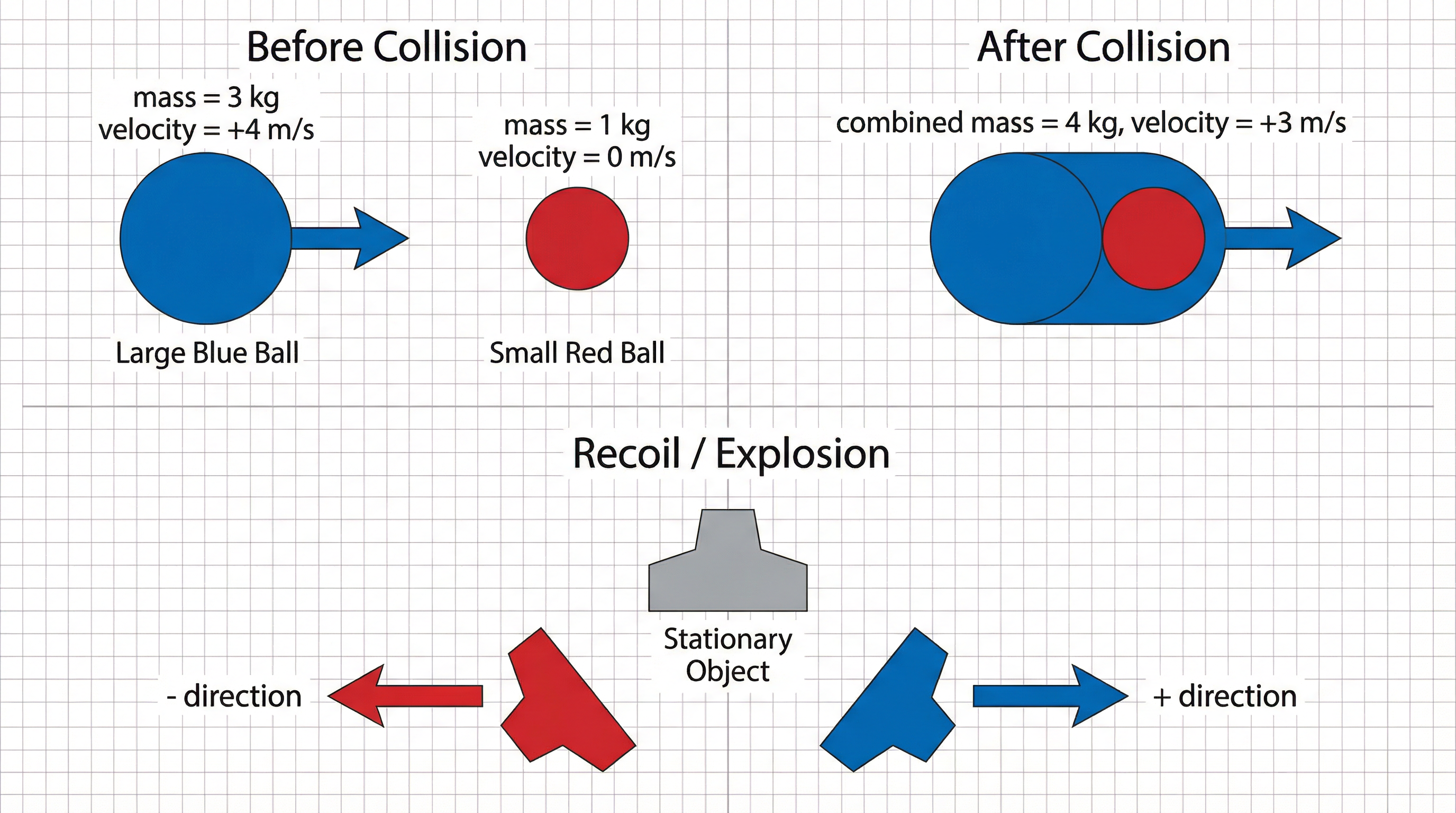
**Collisions**: When objects collide, their individual momenta may change, but the total momentum of the system remains constant. To solve these problems, you calculate the total momentum of all objects before the collision and set it equal to the total momentum of all objects after.
`Total momentum before = Total momentum after`
`m₁u₁ + m₂u₂ = m₁v₁ + m₂v₂` (where u is initial velocity and v is final velocity)
**Explosions/Recoil**: This is where one object breaks apart, or two objects push away from each other (like a gun firing a bullet). Often, the system starts from rest, meaning the total initial momentum is zero. Because momentum is conserved, the total momentum afterwards must also be zero. This can only happen if the parts move in opposite directions, with equal and opposite momentum.
**Example (Recoil)**:
A 5 kg rifle fires a 0.02 kg bullet. The bullet moves forward with a velocity of 300 m/s. What is the recoil velocity of the rifle?
1. **Total momentum before = 0** (everything is stationary).
2. **Total momentum after must also = 0**.
3. Momentum of bullet = `0.02 kg × (+300 m/s) = +6 kg m/s`
4. Therefore, momentum of rifle must be `-6 kg m/s` to keep the total at zero.
5. Recoil velocity of rifle = `p / m = -6 kg m/s / 5 kg = -1.2 m/s`. The negative sign indicates it moves in the opposite direction to the bullet.
### Concept 3: Force and the Rate of Change of Momentum (Higher Tier Only)
Newton's Second Law of Motion can be expressed in a way that is incredibly useful for explaining real-world phenomena. It states that the resultant force acting on an object is equal to the rate of change of its momentum.
**Mathematical Relationship:**
- **Formula**: `Force = Change in momentum / time taken` or `F = Δp / t` (Given on formula sheet)
- **F**: Resultant force, in **Newtons (N)**.
- **Δp**: Change in momentum (`final momentum - initial momentum`), in **kg m/s**.
- **t**: time taken for the change, in **seconds (s)**.
This equation is the key to understanding how safety features in cars work. The term `Δp` is also known as **impulse**. The impulse of a force is equal to the change in momentum it produces.
## Practical Applications
### Vehicle Safety Features
The physics of momentum is directly applied to save lives on the road. Features like seatbelts, airbags, and crumple zones all work by applying the principle `F = Δp / t`.
In a crash, a passenger's momentum must change from a large value to zero. This change in momentum (Δp) is fixed for a given crash speed. The goal of safety features is to reduce the force (F) on the passenger. According to the equation, the only way to reduce the force is to **increase the time (t)** over which the momentum change occurs.
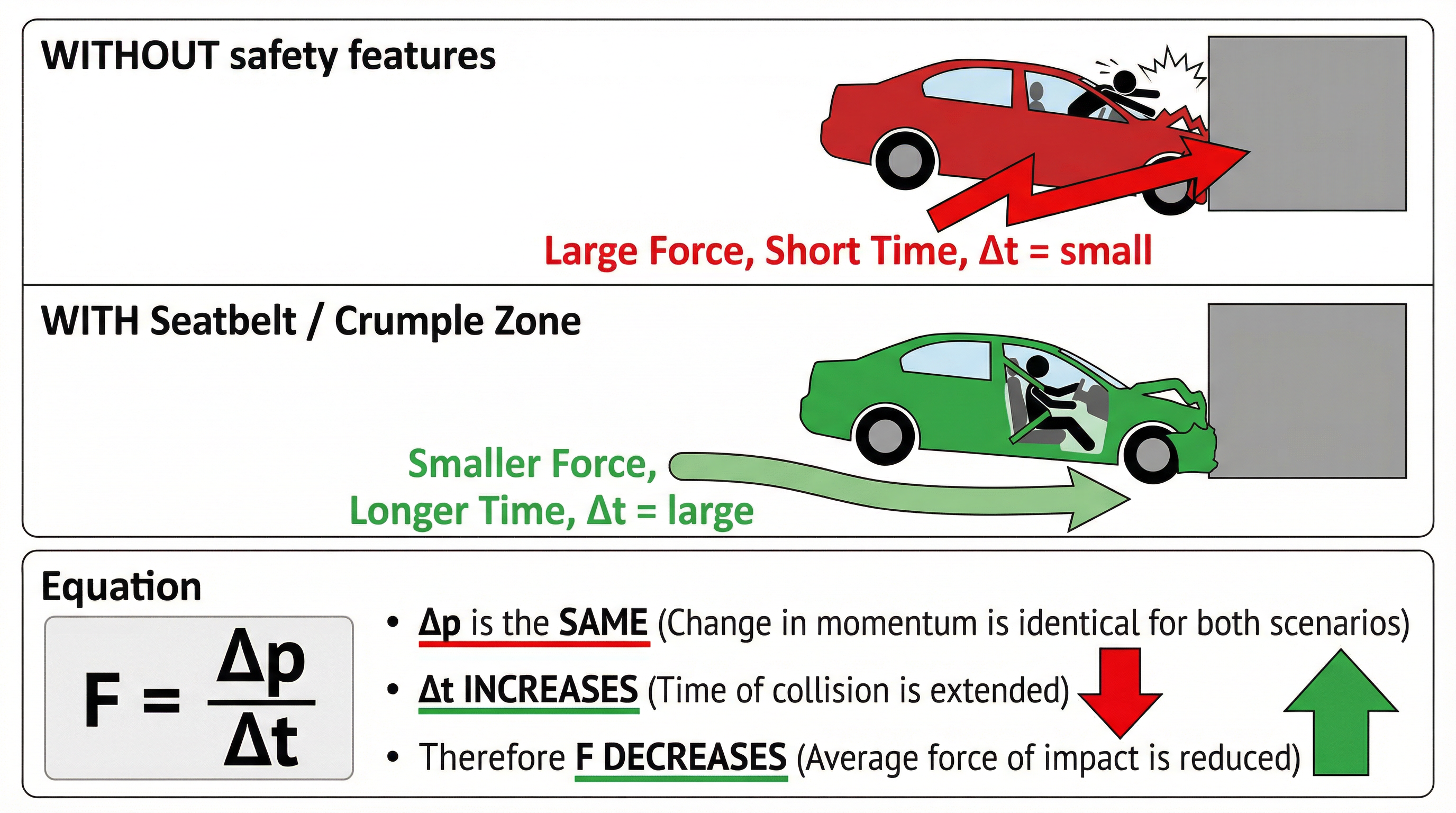
- **Seatbelts**: They stretch slightly, increasing the time it takes for the wearer to stop. This reduces the force on their chest and pelvis.
- **Airbags**: They provide a soft cushion that deflates as the person's head hits it, dramatically increasing the time taken to stop the head's motion.
- **Crumple Zones**: These are areas at the front and back of a car designed to deform and buckle in a collision. This deformation takes time, extending the duration of the impact and reducing the force transmitted to the rigid passenger cabin.
When asked to explain this in an exam, you must construct a clear, logical chain of reasoning. A high-scoring answer will always state that the feature **increases the time of impact**, which in turn **reduces the rate of change of momentum**, and therefore **reduces the resultant force** on the passenger.