OCR · GCSE · Physics
Newton's Laws
Unlock top marks in your OCR GCSE Physics exam by mastering Newton's Laws of Motion. This guide breaks down inertia, F=ma, and action-reaction pairs into easy-to-understand concepts, complete with worked examples and examiner tips to help you tackle any question with confidence.
- 6 min read
- 3 worked examples
- 5 practice questions
- 6 key terms
Study Notes

Overview
Newton's Laws of Motion form the bedrock of classical mechanics and are a cornerstone of your OCR GCSE Physics course (P2.2). This topic explains the fundamental relationship between forces and motion, answering questions like why things start or stop moving, why they speed up, and how objects interact with each other. A solid grasp of these three laws is essential, as they are applied throughout other areas of physics, including momentum, work, and energy. Examiners frequently test this topic through a mix of conceptual explanations, mathematical calculations (F=ma), and analysis of real-world scenarios like car safety features. Expect to see questions ranging from short 1-mark definitions to challenging 6-mark extended response questions, making this a high-stakes area where secure knowledge is rewarded.
Key Concepts
Concept 1: Newton's First Law - The Law of Inertia
Newton's First Law states that an object will remain at rest or continue to move at a constant velocity unless acted upon by a resultant force. The key term here is resultant force, which is the overall force on an object once all forces are combined, considering their directions. The property of an object that resists a change in its state of motion is called inertia. The more mass an object has, the greater its inertia.
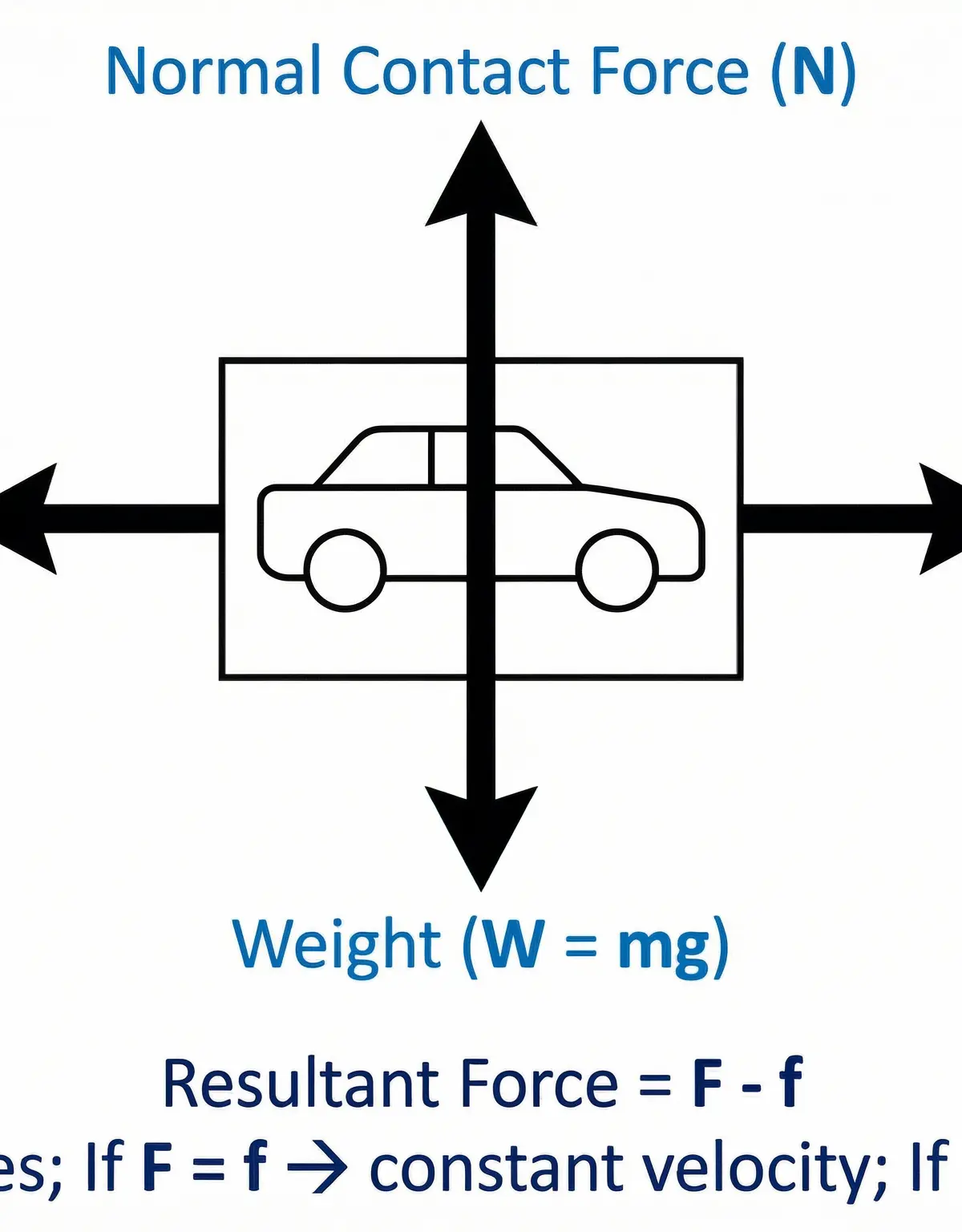
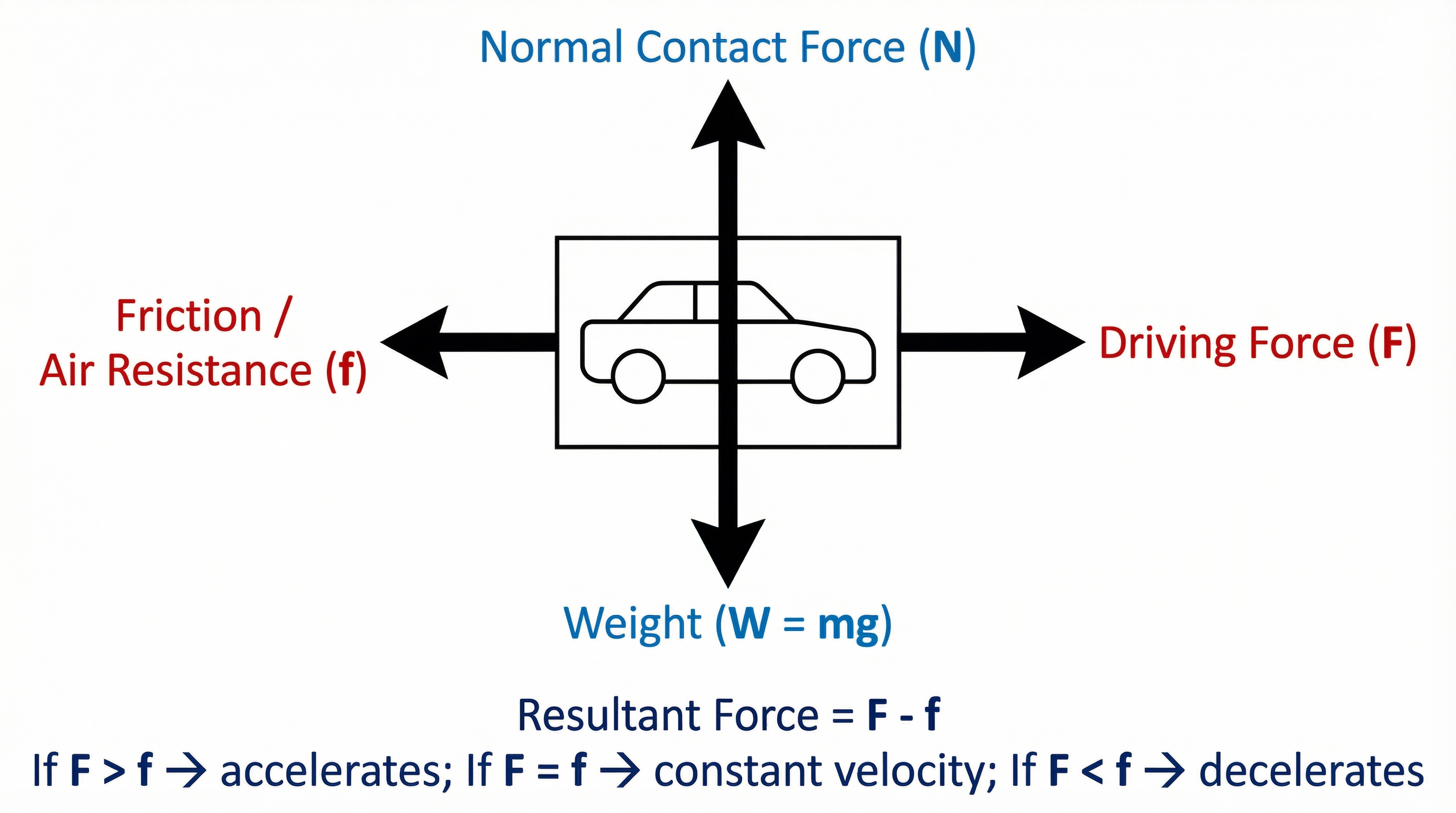
This law directly challenges the common misconception that a force is needed to keep something moving. This is incorrect. An object moving at a constant velocity has a resultant force of ZERO. The driving forces are perfectly balanced by resistive forces like friction and air resistance.
Example: A car travelling at a steady 70 mph on a motorway has a driving force from its engine pushing it forward, but this is exactly cancelled out by the forces of air resistance and friction pushing it backward. The resultant force is zero, so its velocity remains constant.
Concept 2: Newton's Second Law - F=ma
Newton's Second Law provides the mathematical link between force, mass, and acceleration. It states that the acceleration of an object is directly proportional to the resultant force acting on it and inversely proportional to its mass. The relationship is summarised by the famous equation:
F = ma
- F is the resultant force in Newtons (N)
- m is the mass in kilograms (kg)
- a is the acceleration in metres per second squared (m/s²)
This equation is your key tool for solving almost all calculation problems involving forces. It is crucial to remember to use the resultant force, not just any single force. This is why drawing a free-body diagram is so important.
Higher Tier: Inertial MassFor Higher Tier candidates, you must understand the concept of inertial mass. It is defined as the ratio of force to acceleration (m = F/a) and is a measure of how difficult it is to change an object's velocity. An object with a large inertial mass requires a large force to produce a given acceleration.
Concept 3: Newton's Third Law - Action-Reaction Pairs
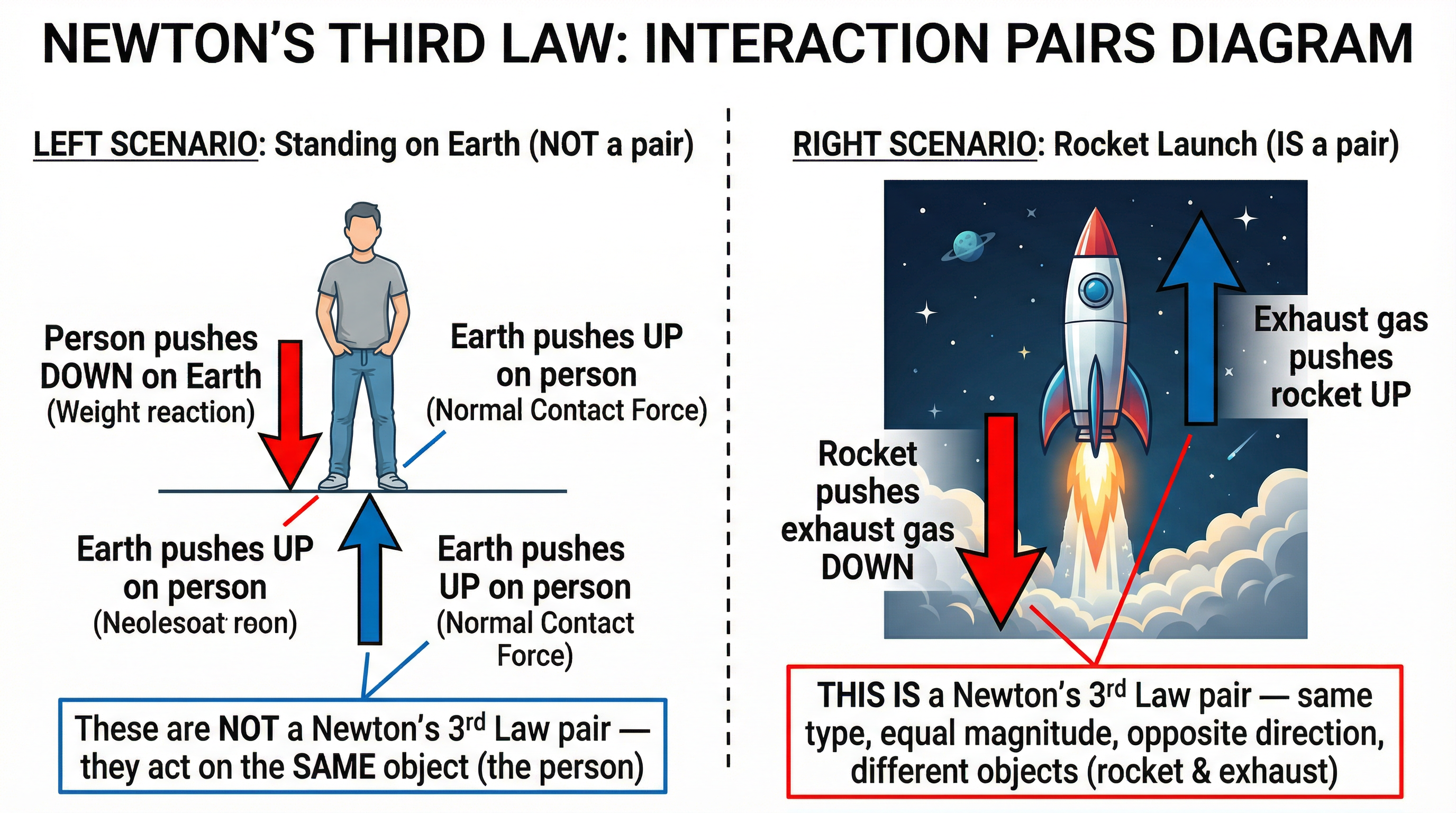
Newton's Third Law states that whenever two objects interact, they exert equal and opposite forces on each other. This is often summarised as 'for every action, there is an equal and opposite reaction'. However, to secure full marks, you must be more precise. A Newton's Third Law force pair must always be:
- Equal in magnitude
- Opposite in direction
- The same type of force (e.g., both gravitational or both contact)
- Acting on two different objectsThis last point is the most common source of confusion. The forces in a Newton's Third Law pair NEVER act on the same object, which means they can NEVER cancel each other out.
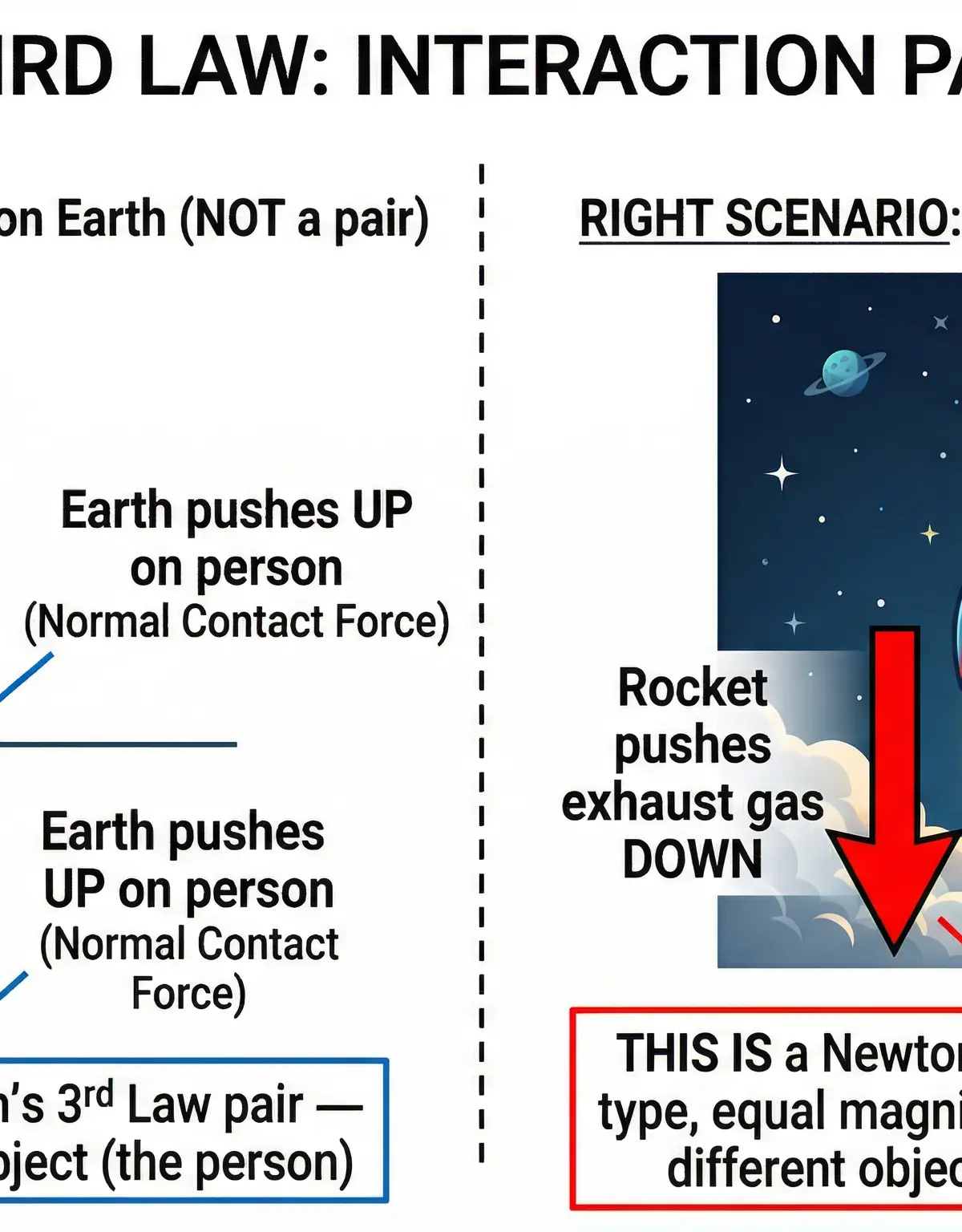
Example: When a rocket is launched, it pushes hot exhaust gases downwards. In return, the exhaust gases push the rocket upwards with an equal and opposite force. The forces act on different objects (the rocket and the gas), causing the rocket to accelerate upwards.
Mathematical/Scientific Relationships
-
Newton's Second Law:
F = ma(Given on formula sheet)- F: Resultant Force (N)
- m: Mass (kg)
- a: Acceleration (m/s²)
-
Weight:
W = mg(Given on formula sheet)- W: Weight (N)
- m: Mass (kg)
- g: Gravitational Field Strength (approx. 9.8 N/kg on Earth)
-
Inertial Mass (Higher Tier):
m = F/a(Must memorise as a definition)
Practical Applications
Newton's Laws are fundamental to understanding countless real-world phenomena. A key application assessed by OCR is vehicle safety. Features like seatbelts, airbags, and crumple zones are all designed using Newton's Second Law. They work by increasing the time it takes for a person's momentum to change to zero during a crash. Since F = (change in momentum) / time, increasing the collision time significantly reduces the resultant force on the passenger, making serious injury less likely. This is a classic 6-mark question context.
Graph/Data Skills
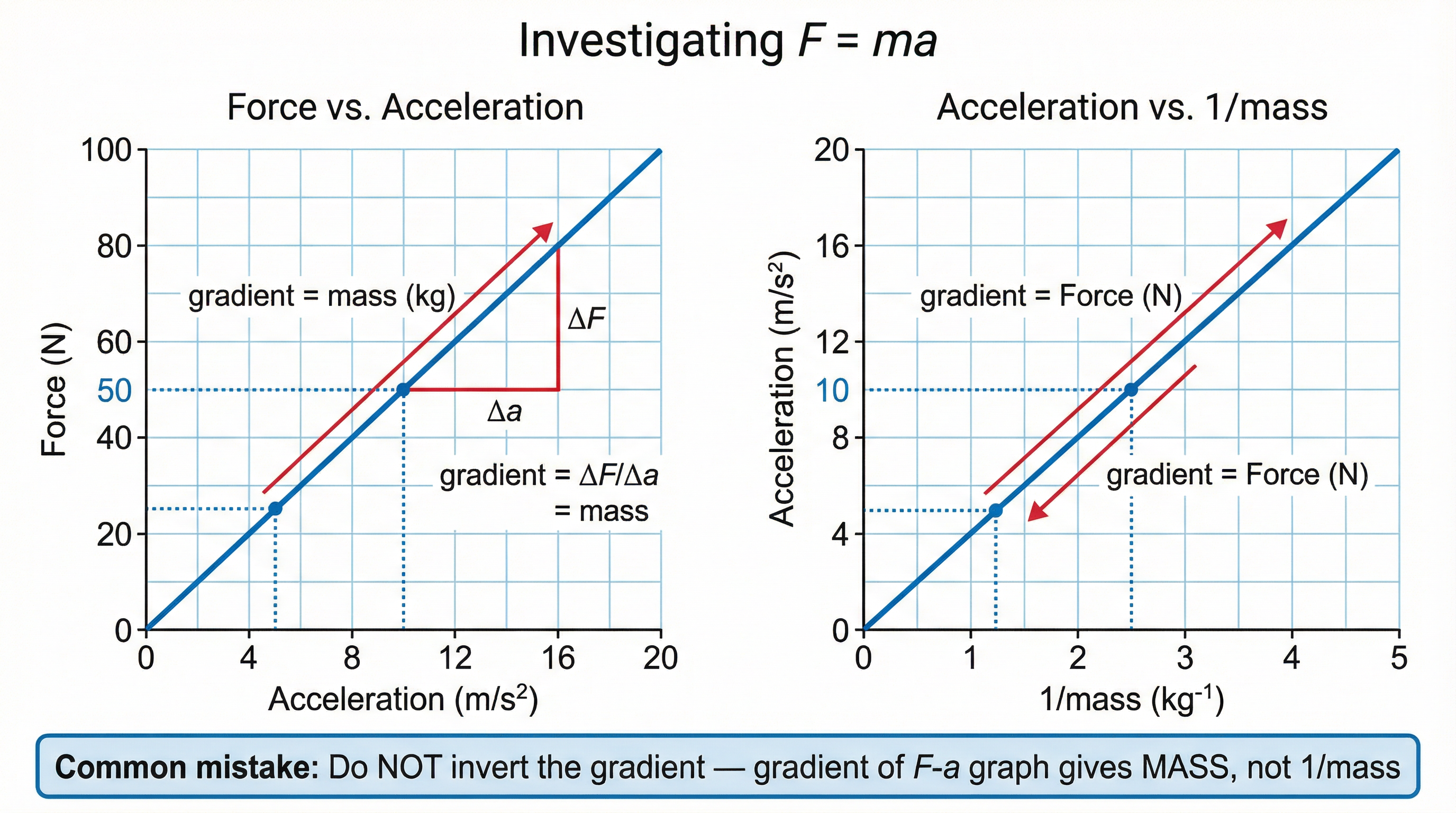
Examiners can test your understanding of F=ma using graphs. You must be able to interpret and draw conclusions from Force-Acceleration graphs.

- Force vs. Acceleration Graph: If you plot resultant force (y-axis) against acceleration (x-axis), you will get a straight line through the origin. The gradient of this line (change in F / change in a) is equal to the mass of the object.
- Acceleration vs. 1/Mass Graph: If you plot acceleration (y-axis) against 1/mass (x-axis), you will also get a straight line through the origin. The gradient of this line (change in a / change in 1/m) is equal to the constant resultant force applied.
Visual Resources
3 diagrams and illustrations
Interactive Diagrams
2 interactive diagrams to visualise key concepts
Conceptual Flow Outline
Flowchart showing the relationship between Resultant Force and motion according to Newton's First and Second Laws.
Diagram could not be rendered
Sequence diagram illustrating the action-reaction pair of forces between a cannon and a cannonball as described by Newton's Third Law.
Worked Examples
3 worked examples — open one to explore the question and available guidance.
Practice Questions
Test your understanding — click to reveal model answers
State Newton's First Law of Motion.
Hint: Think about what happens to an object if no overall force is acting on it.
A ball of mass 250 g is kicked with a resultant force of 20 N. Calculate the initial acceleration of the ball.
Hint: Don't forget to check the units of mass before you calculate!
A book is at rest on a table. Describe the Newton's Third Law force pair to the force of the Earth's gravity on the book (its weight).
Hint: Remember, the pair force must act on a different object. What is the book interacting with gravitationally?
A skydiver of mass 80 kg is accelerating downwards at 4.0 m/s². Calculate the magnitude of the air resistance acting on her. (g = 9.8 N/kg)
Hint: First, find the resultant force using F=ma. Then, consider the two forces acting on the skydiver (weight and air resistance) to find the unknown.
Explain how a seatbelt improves a passenger's safety during a car crash.
Hint: This is a Level of Response question. Structure your answer logically, linking time, momentum, and force.
Test your understanding of Newton's Laws
Active recall beats re-reading. Take an instant quiz now to test what you’ve learned and lock it into long-term memory.
7 days Premium · Then free forever · No card, no charge