OCR · GCSE · Physics
Powering Earth
This guide provides a comprehensive, exam-focused breakdown of OCR GCSE Physics Topic P8.2: Powering Earth. It covers the National Grid, transformer principles, domestic electricity safety, and energy calculations, equipping candidates with the knowledge to secure top marks."
- 8 min read
- 3 worked examples
- 5 practice questions
Study Notes
Overview
Topic P8.2, Powering Earth, is the story of electricity's journey from power station to plug socket. For your exam, this isn't just about knowing facts; it's about explaining the physics that makes the system work efficiently and safely. Candidates must master the quantitative reasons for high-voltage transmission and be able to apply principles of electromagnetism to transformers. A significant portion of marks in this topic are awarded for explaining the function of domestic safety features like fuses and earth wires. This topic has strong synoptic links to P3 (Energy) and P5 (Waves and Electromagnetism), and examiners frequently test it with a mix of calculation, description, and long-answer evaluation questions. Expect to see questions asking you to compare energy resources or explain the complete sequence of the National Grid for 6 marks.
Key Concepts
Concept 1: The National Grid & High-Voltage Transmission
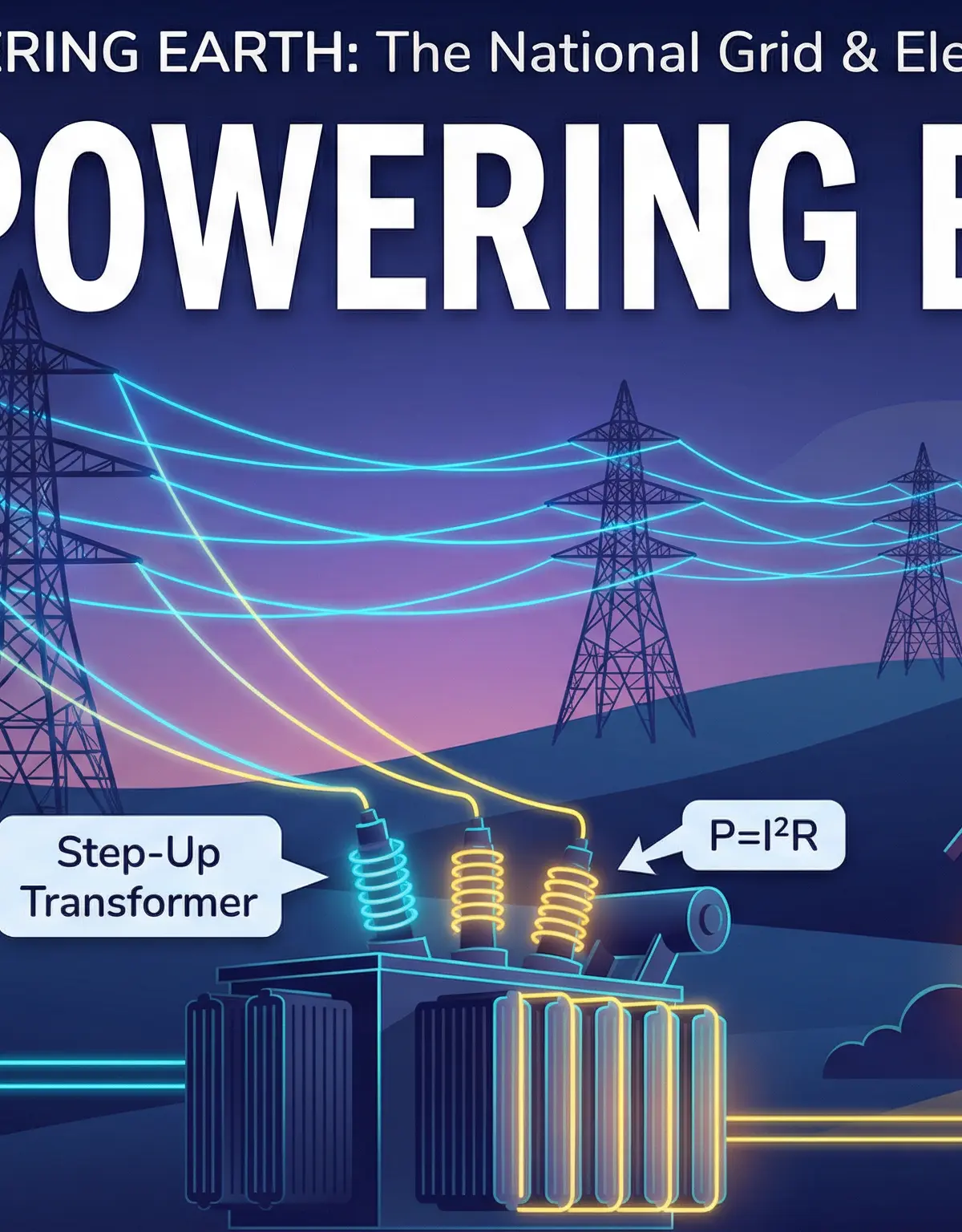
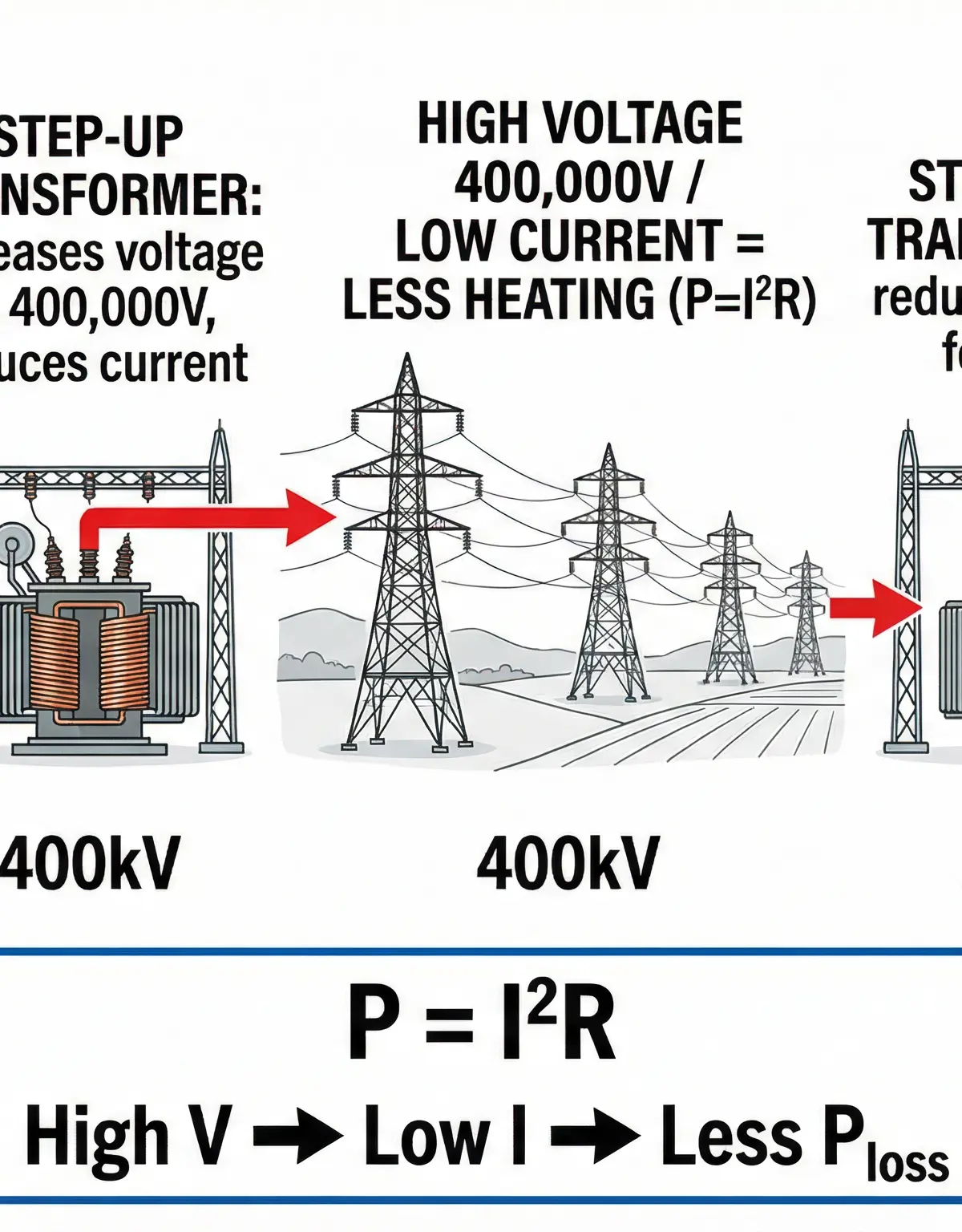
The National Grid is the UK-wide network of cables and transformers that transports electricity from power stations to consumers. Power stations generate electricity at a relatively low voltage (around 25,000 V). To transmit this power over hundreds of miles, it's essential to minimise energy losses in the cables. The primary cause of energy loss is the heating effect of the current flowing through the wires, which have resistance.
To combat this, step-up transformers are used at the power station end to increase the voltage to a very high level (typically 400,000 V). According to the relationship Power = Voltage × Current (P=VI), for the same amount of power to be transmitted, increasing the voltage must cause a corresponding decrease in the current. The crucial formula here is Power loss = Current² × Resistance (P=I²R). Because the power loss is proportional to the square of the current, even a small reduction in current leads to a very large reduction in wasted thermal energy. This makes the grid highly efficient.
Before this high-voltage electricity can be used in homes, it must be made safe. Step-down transformers are used at local substations to reduce the voltage to the UK mains level of 230 V.
Concept 2: Transformers
A transformer changes the size of an alternating voltage using the principle of electromagnetic induction. It consists of two coils of wire, a primary coil and a secondary coil, wrapped around a laminated soft iron core.
- An alternating current (AC) in the primary coil produces a continuously changing magnetic field in the iron core.
- The iron core concentrates this changing magnetic field, passing it through the secondary coil.
- The changing magnetic field induces an alternating voltage across the ends of the secondary coil.
If the secondary coil has more turns than the primary coil, the induced voltage is greater than the primary voltage (a step-up transformer). If it has fewer turns, the voltage is stepped down. For a 100% efficient transformer, the relationship is given by the formula:
**(Vp / Vs) = (Np / Ns)**Where Vp = primary voltage, Vs = secondary voltage, Np = turns on primary, and Ns = turns on secondary.
Concept 3: Domestic Wiring & Safety
UK mains electricity is an AC supply at 230 V and a frequency of 50 Hz. Appliances are connected using a three-core cable, and you must know the function and colour of each wire.
- Live Wire (Brown): Carries the high potential (230 V). It is the dangerous wire. Current flows through it from the supply.
- Neutral Wire (Blue): Completes the circuit. It is at or close to earth potential (0 V).
- Earth Wire (Green and Yellow stripes): A safety wire that is connected to the metal casing of an appliance. Under normal operation, no current flows through it. If a fault occurs where the live wire touches the metal case, the earth wire provides a low-resistance path for current to flow to the ground. This causes a large surge of current, which melts the fuse or trips the circuit breaker, disconnecting the appliance from the live supply and preventing electric shock.

Concept 4: Fuses and Circuit Breakers
Fuses and circuit breakers are safety devices designed to interrupt the circuit if the current becomes dangerously high.
- Fuse: A thin piece of wire designed to melt and break the circuit if the current exceeds a certain level. Fuses are rated in Amps (e.g., 3 A, 5 A, 13 A). The correct fuse for an appliance should have a rating just slightly higher than the normal operating current.
- Circuit Breaker: An electromagnetic switch that opens (trips) to break the circuit when the current is too high. They have the advantage of being resettable and acting faster than fuses.
Concept 5: Power, Energy, and Cost
Power is the rate at which energy is transferred. The key formulas are:
-
Power (W) = Current (A) × Potential Difference (V)
-
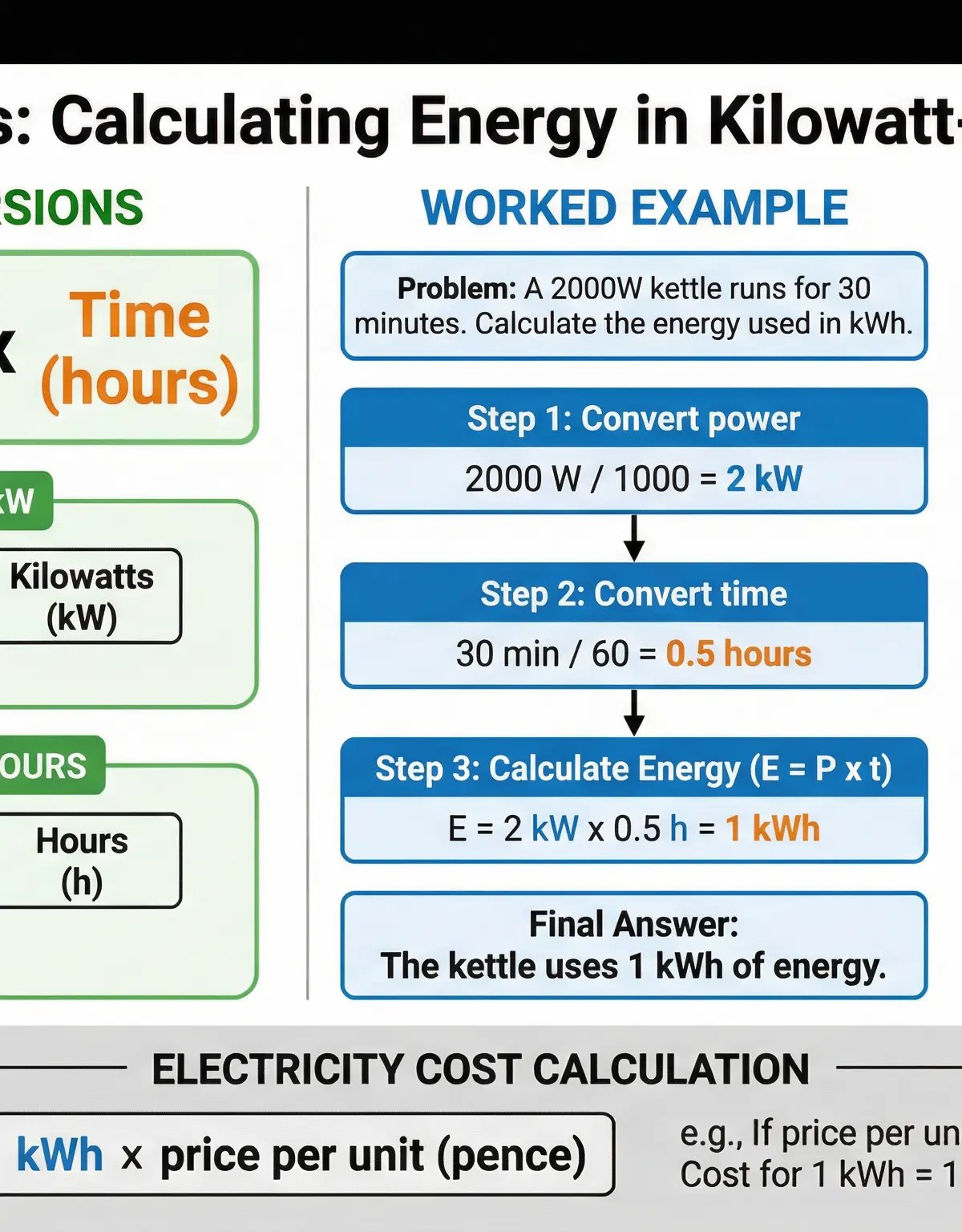
**Energy Transferred (J) = Power (W) × Time (s)**For billing purposes, electricity companies use a larger unit of energy called the kilowatt-hour (kWh). This is the energy used by a 1 kW appliance in 1 hour.
-
**Energy Transferred (kWh) = Power (kW) × Time (h)**To calculate the cost, you multiply the energy used in kWh by the price per unit:
-
Cost = Energy (kWh) × Cost per kWhCandidates frequently lose marks by failing to convert units correctly. Remember: for kWh calculations, power MUST be in kW and time MUST be in hours.
Mathematical/Scientific Relationships
| Formula | Symbol Meanings | When to Use | Given on Sheet? |
|---|---|---|---|
P = VI | P: Power (W), V: Potential Difference (V), I: Current (A) | Calculating power from current and voltage. | Yes |
P = I²R | P: Power (W), I: Current (A), R: Resistance (Ω) | Calculating power loss (heating) in cables. Crucial for explaining the National Grid. | Yes |
E = Pt (for Joules) | E: Energy (J), P: Power (W), t: time (s) | Calculating energy in the standard SI unit. Time must be in seconds. | Yes |
E = Pt (for kWh) | E: Energy (kWh), P: Power (kW), t: time (h) | Calculating energy for electricity bills. Power must be in kW, time in hours. | Yes |
Vp / Vs = Np / Ns | Vp/Vs: Primary/Secondary Voltage, Np/Ns: Turns on Primary/Secondary coil | Transformer calculations. | Yes |
Practical Applications
This topic is directly applicable to everyday life. Understanding the principles of the National Grid helps explain why power stations can be located far from cities. The concepts of domestic wiring and safety are essential for using electricity safely in the home. Required practicals for this topic often involve investigating the properties of transformers or measuring the power and energy consumption of various household appliances. For example, candidates might be asked to measure the input and output voltage of a transformer to verify the turns ratio equation, or use a joulemeter to measure the energy consumption of a kettle and compare it to the calculated value."
Worked Examples
3 worked examples — open one to explore the question and available guidance.
Practice Questions
Test your understanding — click to reveal model answers
A transformer has 200 turns on its primary coil and is connected to the 230 V mains supply. It is designed to output 11.5 V. Calculate the number of turns needed on the secondary coil. [3 marks]
Hint: Start with the transformer equation: Vp / Vs = Np / Ns. You need to rearrange it to find Ns.
Describe the differences between alternating current (AC) and direct current (DC). [2 marks]
Hint: Think about the direction of flow of the charge.
Explain how a fuse and an earth wire work together to prevent an electric shock from an appliance with a metal case. [4 marks]
Hint: Describe what happens during a fault, step-by-step.
A family watches a 600 W television for 4 hours a day and plays on a 450 W games console for 2 hours a day. Calculate the total cost of their entertainment for one week (7 days) if electricity costs 25p per kWh. [6 marks]
Hint: Calculate the daily kWh for each device separately, then the weekly total, then the cost.
State two advantages of using circuit breakers over fuses. [2 marks]
Hint: Think about what happens after they have been triggered.
Test your understanding of Powering Earth
Active recall beats re-reading. Take an instant quiz now to test what you’ve learned and lock it into long-term memory.
7 days Premium · Then free forever · No card, no charge