OCR · GCSE · Physics
Pressure in Solids
Pressure in Solids (Topic 2.8) is a quantitative and qualitative topic that sits at the heart of OCR GCSE Physics, requiring candidates to apply the equation P = F/A to calculate pressure, perform unit conversions between cm² and m², and explain real-world mechanical systems using precise scientific language. Mastery of this topic is highly rewarding: the mark scheme is transparent, the formula is straightforward, and candidates who learn to avoid the three classic errors — wrong unit conversion, substituting mass instead of weight, and vague explanatory language — can consistently achieve full marks. From snowshoes to surgical scalpels, the physics of pressure underpins engineering, medicine, and everyday life, making it one of the most applicable topics on the specification.
- 7 min read
- 4 worked examples
- 6 practice questions
- 8 key terms
Study Notes

Overview
Pressure in Solids is assessed under OCR GCSE Physics specification reference 2.8 and appears on both Foundation and Higher tier papers. The topic centres on a single, elegant equation — P = F/A — yet the depth of understanding required extends well beyond simple substitution. Candidates must demonstrate the ability to calculate pressure from given force and area values, rearrange the formula to find force or area, perform unit conversions between cm² and m², and construct well-reasoned explanations of pressure differences in practical contexts such as snowshoes, sharp knives, drawing pins, and wide-tyred vehicles.
This topic connects directly to forces and motion (the concept of weight as a force), Newton's Laws (the idea of a normal contact force), and materials science (why sharp objects penetrate surfaces). In terms of Assessment Objective weighting, AO2 (application of knowledge) accounts for 50% of marks on this topic, meaning that simply recalling the formula is insufficient — candidates must demonstrate they can apply it correctly in unfamiliar contexts.
Exam questions on this topic typically take one of three forms: a 3–4 mark calculation requiring correct formula use, unit conversion, and a final answer with units; a 2–3 mark explanation requiring candidates to explain why a design feature increases or decreases pressure; or a comparison question asking candidates to compare the pressure exerted by two objects or scenarios. Understanding the command word used is critical to structuring an appropriate response.
Key Concepts
Concept 1: The Definition and Equation of Pressure
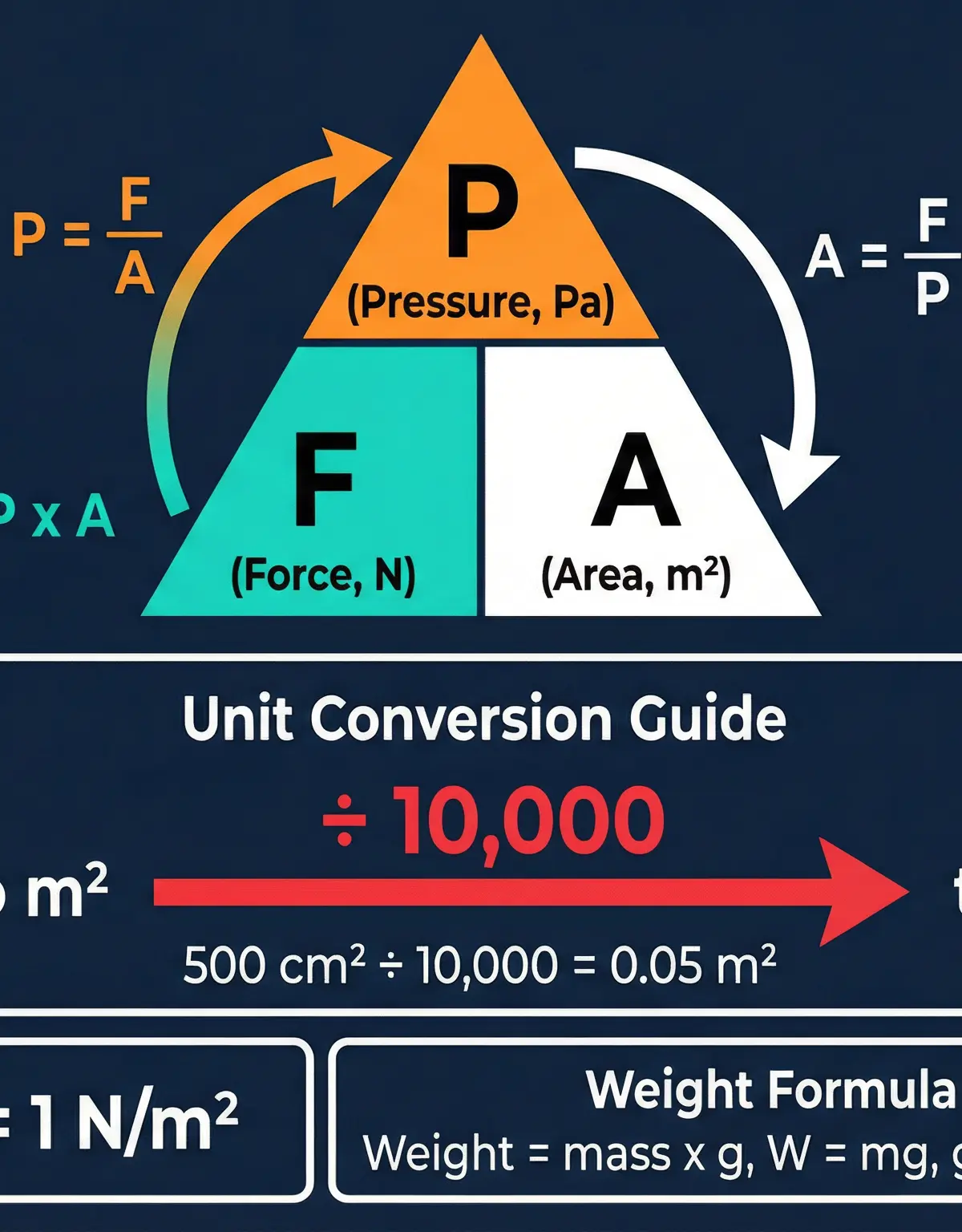
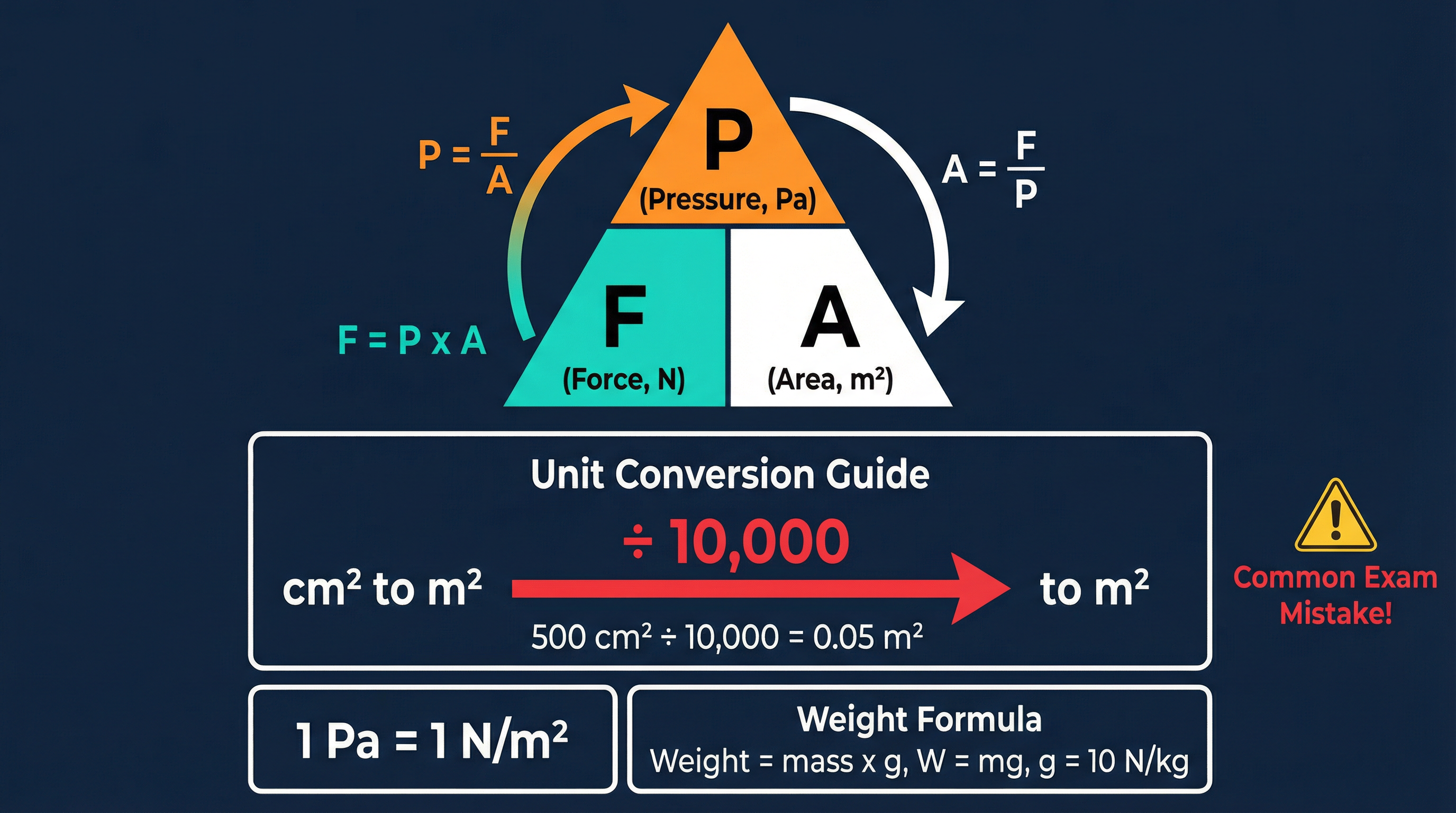
Pressure is defined as the force applied per unit area acting perpendicular to a surface. The formal equation is:
P = F / A
where P = pressure (Pa), F = force (N), A = area (m²)
The unit of pressure is the Pascal (Pa), named after the French physicist Blaise Pascal. A crucial fact to memorise is that 1 Pa = 1 N/m² — these two units are completely equivalent and either is acceptable in an exam answer. This equivalence also serves as a powerful unit-checking tool: if your answer is in N/m², you have calculated pressure correctly.
The equation can be rearranged using the formula triangle (cover the quantity you want to find): F = P × A and A = F / P. Candidates should practise all three rearrangements, as Higher tier questions may ask for force or area rather than pressure.
The inverse relationship between pressure and area is the conceptual core of this topic. For a constant force F, doubling the area A halves the pressure P. Halving the area doubles the pressure. This inverse proportionality (P ∝ 1/A when F is constant) explains every real-world application examined in this topic.
Concept 2: Force vs. Weight — A Critical Distinction
One of the most frequently penalised errors in OCR mark schemes is the substitution of mass (kg) directly into the force variable of the pressure equation. Mass and force are fundamentally different quantities. Mass is a scalar measure of the amount of matter in an object, measured in kilograms. Weight is a force — the gravitational pull on that mass — measured in Newtons.
When a question provides a mass in kilograms, candidates must first calculate the weight using:
W = m × g
where W = weight (N), m = mass (kg), g = gravitational field strength = 10 N/kg (on Earth)
For example, a person of mass 70 kg has a weight of 70 × 10 = 700 N. This 700 N is the force F that enters the pressure equation. Substituting 70 instead of 700 produces an answer ten times too small and forfeits the method mark for this step.
Examiners always award a dedicated mark for this weight calculation when mass is given, making it a free mark for well-prepared candidates.
Concept 3: Unit Conversion — cm² to m²
The pressure formula requires area in square metres (m²). However, exam questions frequently provide area in square centimetres (cm²), requiring a conversion before calculation.
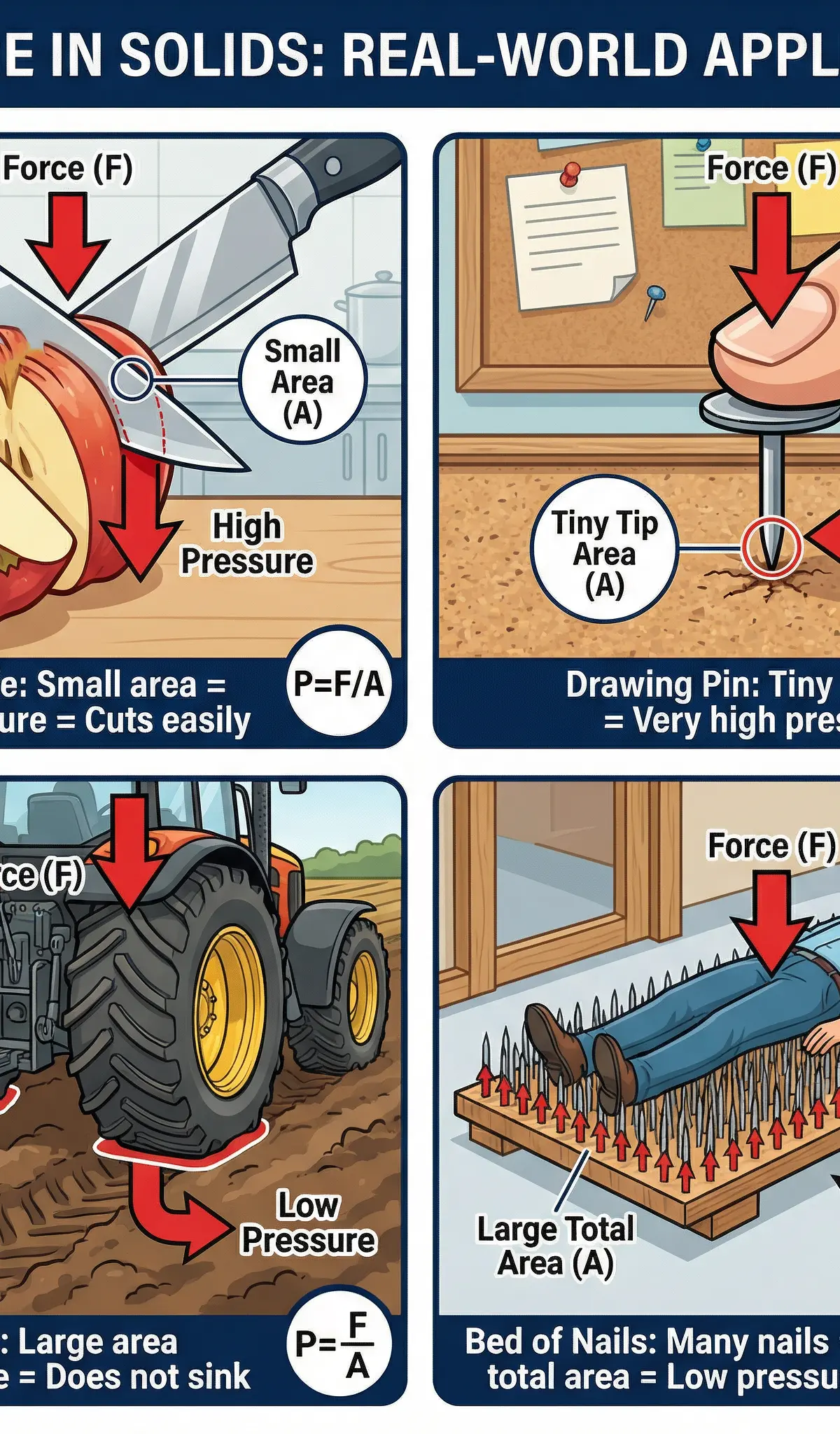
The conversion factor arises from the relationship between metres and centimetres: 1 m = 100 cm. Because area is a two-dimensional quantity, the conversion factor is squared: 1 m² = 100 × 100 = 10,000 cm². Therefore:
To convert cm² to m²: divide by 10,000
Example: 250 cm² ÷ 10,000 = 0.025 m²
The most common error — dividing by 100 rather than 10,000 — produces an area 100 times too large, resulting in a pressure 100 times too small. Candidates should write this conversion as a separate, clearly labelled step in their working to secure the dedicated mark.
A useful memory check: areas in m² are almost always small decimal numbers (e.g., 0.02 m², 0.005 m²). If your converted area is a large whole number, you have almost certainly made an error.
Concept 4: Explaining Pressure in Context
Explanation questions (typically 2–3 marks) require candidates to apply the P = F/A relationship to a described scenario. The mark scheme for these questions is highly specific, and vague language is explicitly penalised.
A full-mark explanation must include three elements:
- Identify the change in area (e.g., "the snowshoe increases the surface area in contact with the snow")
- State that force is constant (e.g., "the person's weight remains the same")
- Apply the equation to justify the outcome (e.g., "because P = F/A and A has increased while F is constant, the pressure decreases")
Phrases such as "spreads the force", "the impact is less", or "the weight is distributed" are considered insufficiently precise and will not earn marks. The word "because" is your most powerful tool in explanation questions — use it to explicitly link cause (change in area) to effect (change in pressure).
Mathematical Relationships
The following formulas are essential for this topic. Neither is provided on the OCR formula sheet and both must be memorised.
| Formula | Symbols | Units | Status |
|---|---|---|---|
| P = F / A | P = pressure, F = force, A = area | Pa (or N/m²) | Must memorise |
| W = m × g | W = weight, m = mass, g = 10 N/kg | N | Must memorise |
Rearrangements of P = F/A:
- To find force: F = P × A
- To find area: A = F / PUnit conversion (must memorise):
- cm² → m²: divide by 10,000
- m² → cm²: multiply by 10,000
Practical Applications
OCR examiners draw on a consistent set of real-world contexts for pressure questions. Understanding the physics behind each one prepares candidates for both familiar and novel scenarios.
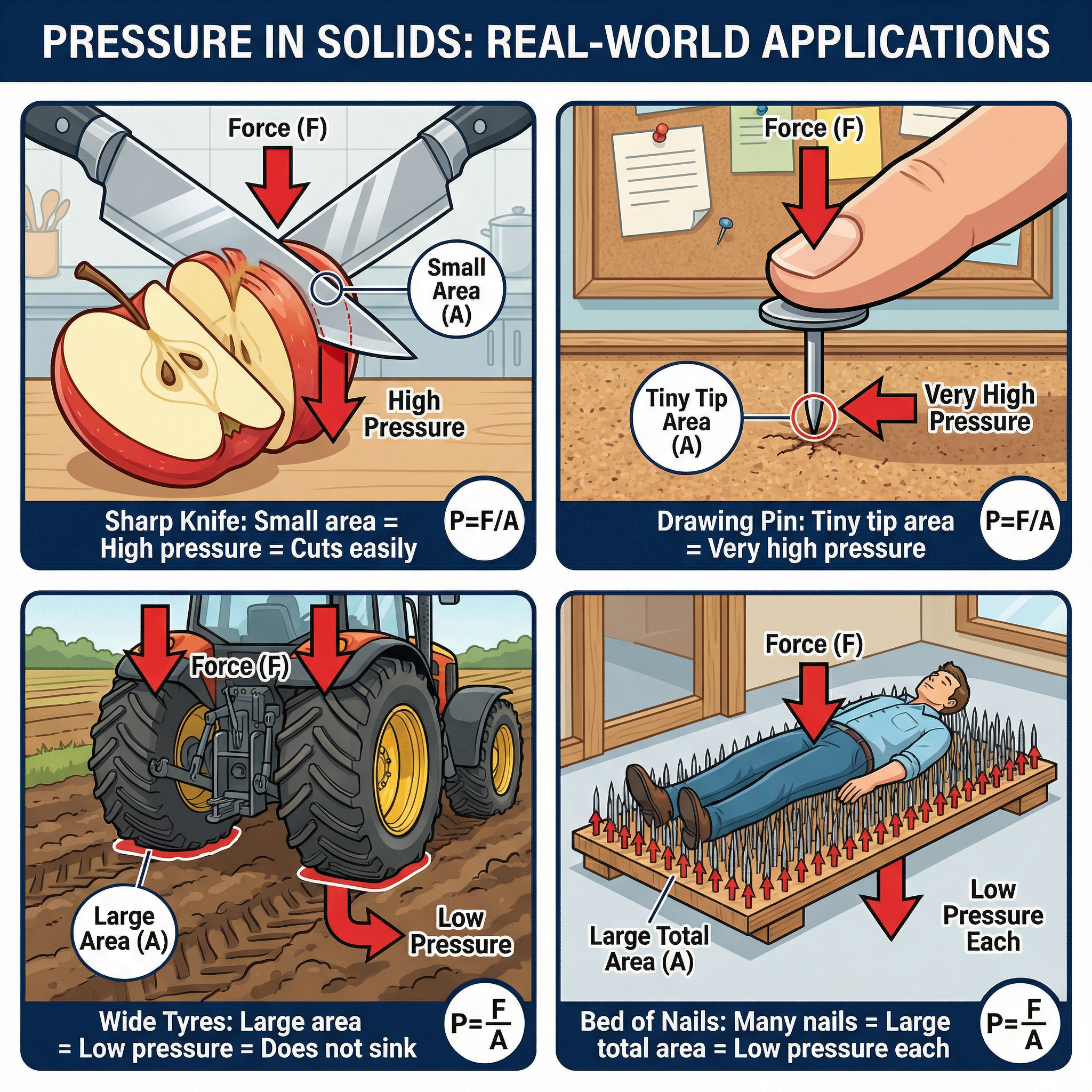
Snowshoes: The large surface area of a snowshoe distributes a person's weight over a much greater area than a boot, reducing the pressure on the snow surface so the person does not sink. This is the most frequently examined context.
Sharp knives and needles: A sharp blade or needle tip has an extremely small contact area. The same applied force therefore produces a very high pressure, sufficient to cut or pierce the material. A blunt blade has a larger area and produces lower pressure — insufficient to cut.
Drawing pins: The flat head has a large area (low pressure on the thumb) while the sharp tip has a tiny area (very high pressure on the board), allowing easy insertion with minimal effort.
Wide tractor tyres: Agricultural vehicles use wide tyres to maximise the contact area with soft soil, reducing the pressure and preventing the vehicle from sinking.
Bed of nails: A person lying on a bed of nails is not injured because the total area of all nail tips combined is large enough to keep the pressure at each individual nail below the threshold that would pierce skin. This is a classic Higher tier application question.
Visual Resources
4 diagrams and illustrations
Interactive Diagrams
2 interactive diagrams to visualise key concepts
Conceptual Flow Outline
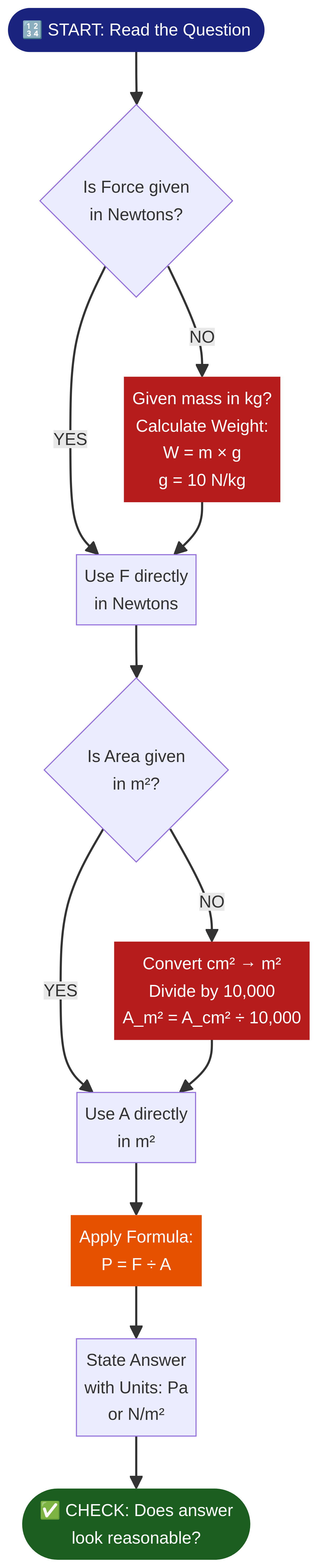
Pressure Calculation Flowchart: A step-by-step decision tree for solving any OCR GCSE pressure calculation. Red nodes indicate the two most common error points — mass-to-weight conversion and cm² to m² unit conversion. Follow this process for every calculation question.
Conceptual Flow Outline
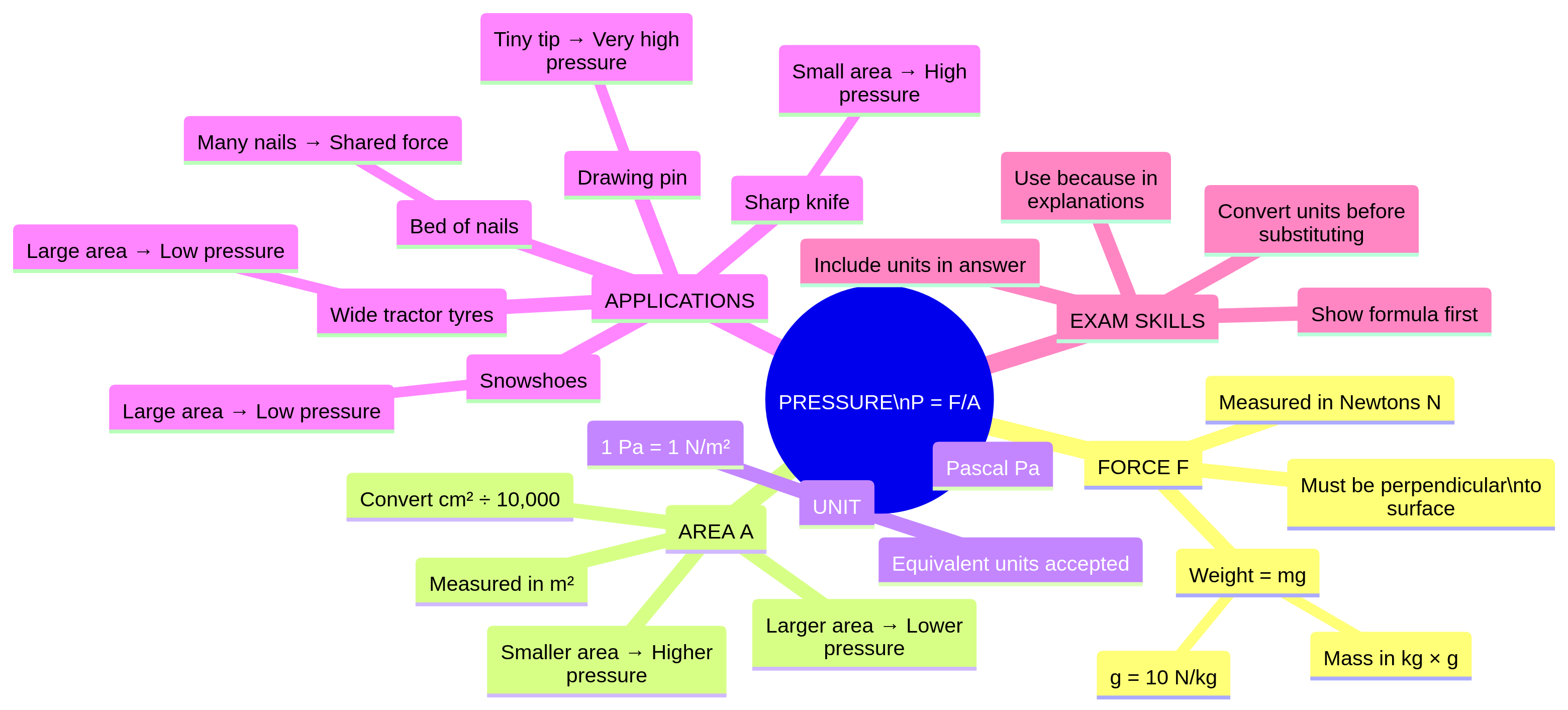
Pressure in Solids Concept Map: A complete mind map of Topic 2.8, showing the relationships between the core formula, its variables, units, real-world applications, and exam technique requirements. Use this for holistic revision and to identify any gaps in understanding.
Worked Examples
4 worked examples — open one to explore the question and available guidance.
Practice Questions
Test your understanding — click to reveal model answers
State the equation for pressure and give the unit. [2 marks]
Hint: Think about what two quantities are needed to calculate pressure. The unit is named after a French scientist.
A box has a weight of 400 N and rests on a floor. The base of the box has an area of 0.5 m². Calculate the pressure exerted by the box on the floor. [2 marks]
Hint: The force is already given in Newtons and the area is already in m², so you can apply the formula directly.
A student has a mass of 65 kg. They stand on one foot, which has a contact area of 180 cm² with the floor. Calculate the pressure exerted on the floor. Take g = 10 N/kg. Give your answer in Pa. [4 marks]
Hint: This question requires two conversions before you can use P = F/A: convert mass to weight (W = mg), and convert area from cm² to m² (divide by 10,000).
Explain why a sharp knife cuts through food more easily than a blunt knife, even when the same force is applied. Use the equation P = F/A in your answer. [3 marks]
Hint: Think about what is different between a sharp knife and a blunt knife. What does this difference do to the area? What does the equation tell you about the effect on pressure?
A hydraulic press exerts a force of 12,000 N on a metal plate. The plate has dimensions 40 cm × 25 cm.
(a) Calculate the area of the plate in m². [2 marks]
(b) Calculate the pressure exerted on the plate. Give your answer in Pa. [2 marks]
(c) The press is redesigned so that the plate has half the original area. State and explain what happens to the pressure if the same force is applied. [2 marks]
Hint: For part (a), calculate area in cm² first (length × width), then convert to m². For part (c), you do not need to calculate — use the inverse relationship between pressure and area.
A person of mass 72 kg wears skis. Each ski has an area of 0.15 m². The person stands on both skis.
(a) Calculate the total contact area of the skis with the snow. [1 mark]
(b) Calculate the pressure exerted on the snow. Take g = 10 N/kg. [3 marks]
(c) Without skis, the person's boots have a total contact area of 0.03 m². Calculate the pressure without skis and compare it to the pressure with skis. [3 marks]
Hint: For part (a), remember there are TWO skis. For part (c), calculate the new pressure and then make a quantitative comparison (e.g., how many times greater is one than the other?).
Test your understanding of Pressure in Solids
Active recall beats re-reading. Take an instant quiz now to test what you’ve learned and lock it into long-term memory.
7 days Premium · Then free forever · No card, no charge