OCR · GCSE · Physics
Sound Waves
Master OCR GCSE Physics Topic 5.3: Sound Waves. This guide deconstructs the core principles of longitudinal waves, the wave equation, and their real-world applications like sonar and ultrasound, providing everything candidates need to secure top marks.
- 7 min read
- 3 worked examples
- 5 practice questions
- 6 key terms
Study Notes

Overview
Sound is a fundamental topic in physics, representing a key example of a longitudinal wave. For OCR GCSE candidates, a thorough understanding of how sound is produced, how it travels, and how its properties are described is essential for exam success. This topic, 5.3 in the specification, focuses on the nature of sound waves, their properties (amplitude, frequency, wavelength), the wave equation, and critical applications such as sonar and medical ultrasound. Examiners frequently test the distinction between particle motion and energy transfer, and Higher Tier questions often involve multi-step calculations using the wave equation in practical contexts. This guide will break down these concepts, provide worked examples, and highlight common pitfalls to ensure you can approach any question with confidence.
Key Concepts
Concept 1: The Nature of Sound - Longitudinal Waves
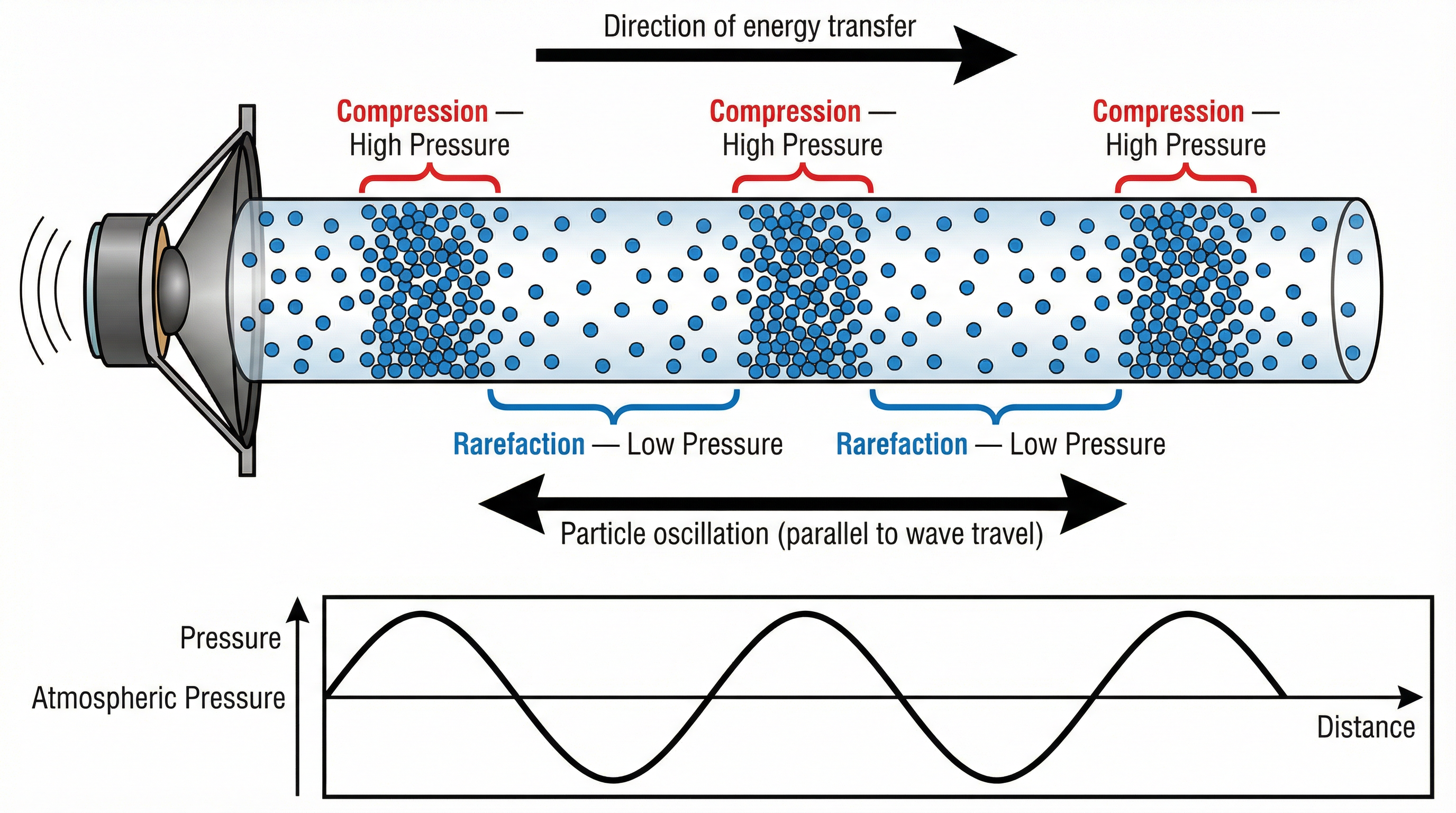
Sound waves are longitudinal waves. This is a non-negotiable fact that must be learned. It means the oscillations (vibrations) of the particles in the medium are parallel to the direction of energy transfer. Imagine a coiled spring (a slinky): if you push one end, a compression travels along the spring. The individual coils move back and forth, but the wave of compression moves forward. This is a perfect analogy for sound.
- Particle Motion vs. Energy Transfer: A common mistake is to think that air particles travel from a speaker to your ear. This is incorrect. The particles themselves only oscillate around a fixed position. It is the energy that is transferred through the medium. Credit is awarded for making this distinction clear.
- Compressions and Rarefactions: As a sound source (like a loudspeaker cone) vibrates, it creates areas where the air particles are bunched together and areas where they are spread apart.
- Compressions: Regions of high pressure and high density.
- Rarefactions: Regions of low pressure and low density.
A sound wave is, therefore, a propagating series of compressions and rarefactions. When describing sound, candidates MUST use these terms, not 'peaks' or 'troughs', which are reserved for transverse waves.

Concept 2: Properties of Sound Waves
Like all waves, sound has properties that determine how we perceive it.
- Frequency (f): The number of complete waves (or oscillations) passing a point per second. It is measured in Hertz (Hz). Frequency determines the pitch of the sound. A high frequency gives a high pitch (like a whistle), and a low frequency gives a low pitch (like a bass drum).
- Amplitude (A): The maximum displacement of a particle from its equilibrium (rest) position. Amplitude determines the loudness of the sound. A large amplitude corresponds to a loud sound, as more energy is being transferred.
- Wavelength (λ): The distance between two identical points on adjacent waves, for example, from the centre of one compression to the centre of the next. It is measured in metres (m).
It is crucial to remember: Amplitude affects loudness, Frequency affects pitch. Examiners often set questions to trap candidates who confuse these two properties.
Concept 3: The Wave Equation
The relationship between speed, frequency, and wavelength is defined by the wave equation. This is one of the most important formulas in the waves topic.
Wave Speed (v) = Frequency (f) × Wavelength (λ)
- v: wave speed, measured in metres per second (m/s)
- f: frequency, measured in Hertz (Hz)
- λ: wavelength (lambda), measured in metres (m)
This formula is given on the formula sheet, but candidates must be proficient in using and rearranging it. For example, to find frequency, the formula becomes f = v / λ.
Unit Conversions: A frequent source of error is failing to convert units. For example, if frequency is given in kilohertz (kHz), it must be converted to Hertz by multiplying by 1000 (e.g., 50 kHz = 50,000 Hz). If wavelength is in cm, it must be converted to m by dividing by 100.
Concept 4: Reflection and Echoes (Sonar)
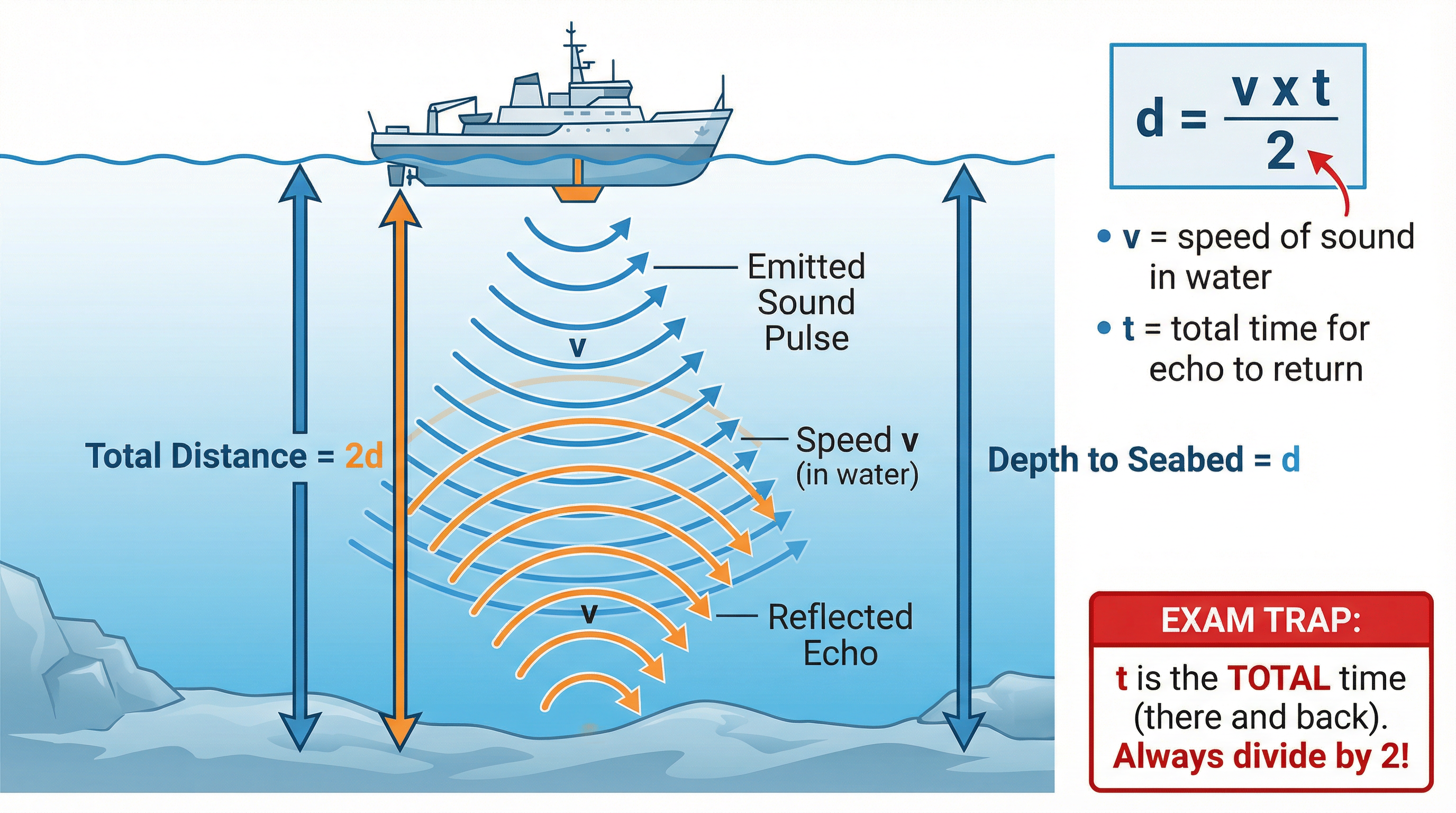
Sound waves can reflect off surfaces. A reflected sound wave is called an echo. This principle is used in SONAR (Sound Navigation and Ranging) to determine distances, such as the depth of the sea.
A pulse of sound is sent out, and the time it takes for the echo to return is measured. The total distance travelled by the sound is to the object and back again (2d). This is the most common exam trap.
Distance (d) = (Speed of Sound (v) × Time for echo (t)) / 2Candidates MUST remember to divide the total time by two to find the one-way distance. Marks are specifically allocated for this step.

Concept 5: Ultrasound
Ultrasound is sound with a frequency above the upper limit of human hearing (20,000 Hz). It has crucial applications in medicine and industry.
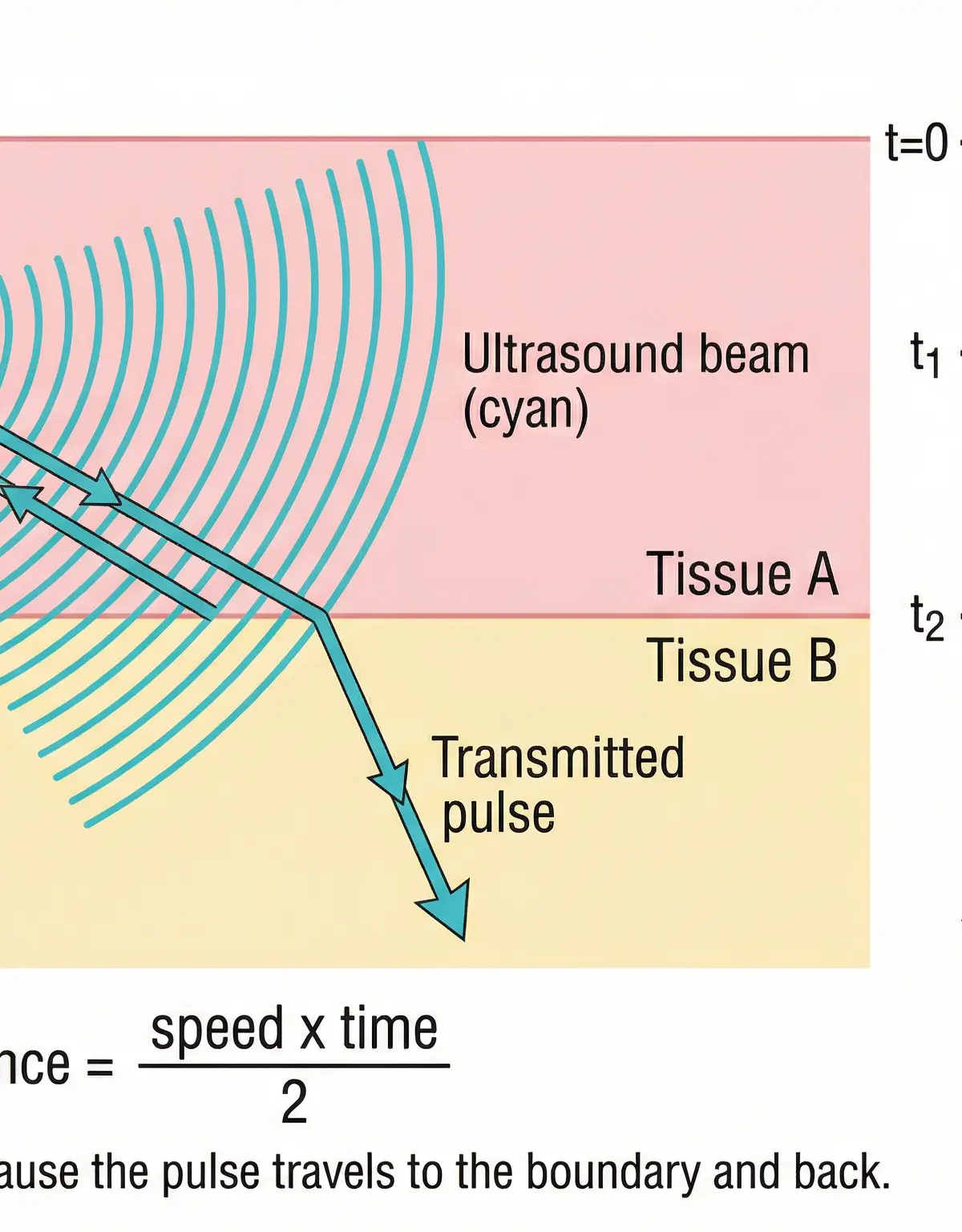
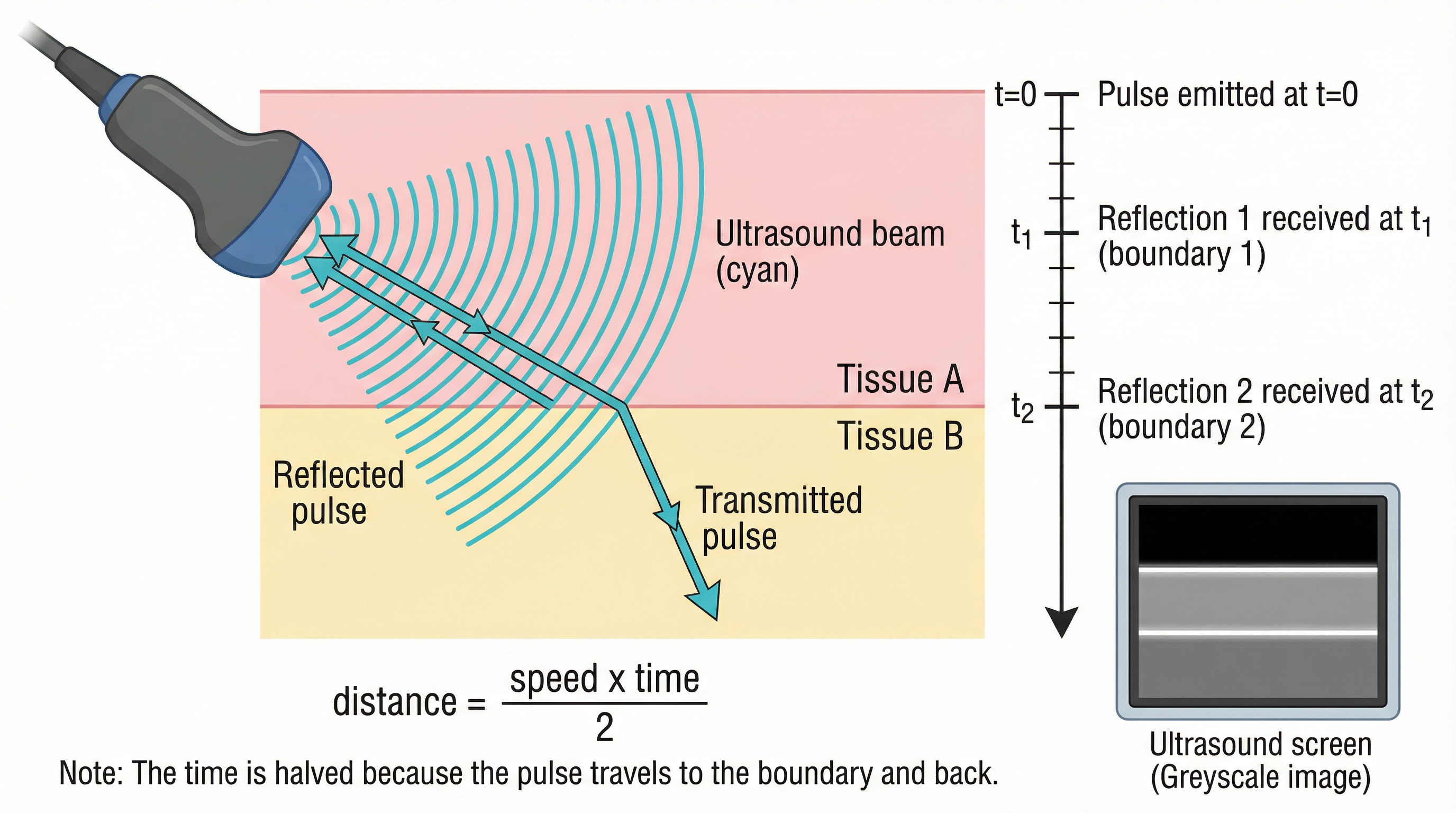
- Medical Imaging: Ultrasound scanners work by emitting pulses of ultrasound into the body. When these pulses hit a boundary between two different types of tissue (e.g., fluid and bone), some of the wave is partially reflected. The detector in the transducer picks up these reflected echoes, and the time taken for them to return is used to calculate the depth of the boundary. A computer then builds up an image from these distances. This is a non-invasive technique and is considered safer than X-rays as it does not use ionising radiation, making it ideal for applications like prenatal scanning.
- Industrial Quality Control: Ultrasound can be used to find flaws or cracks in materials like metal pipes without damaging them.
Mathematical/Scientific Relationships
- The Wave Equation (Must memorise how to use and rearrange):
v = f × λ- Given on the formula sheet
- Echo Distance Formula (Must memorise and understand):
d = (v × t) / 2or2d = v × t- Not given on the formula sheet
- Period and Frequency Relationship:
T = 1 / fwhere T is the period in seconds (s).- Given on the formula sheet
Practical Applications
- Sonar: Used by ships and submarines for mapping the seabed, locating shoals of fish, or detecting other underwater objects.
- Medical Ultrasound: Used for prenatal scanning (observing a foetus), imaging organs like the heart (echocardiogram) and kidneys, and breaking down kidney stones (lithotripsy).
- Musical Instruments: The production of sound through vibrating strings (guitar), air columns (flute), or surfaces (drums).
- Architectural Acoustics: Designing concert halls to have specific reflection and absorption properties to create the desired sound experience.
Visual Resources
3 diagrams and illustrations
Interactive Diagrams
2 interactive diagrams to visualise key concepts
Conceptual Flow Outline
Flowchart showing how a vibrating source produces a longitudinal sound wave.
Diagram could not be rendered
Sequence diagram illustrating the process of sonar echo location.
Worked Examples
3 worked examples — open one to explore the question and available guidance.
Practice Questions
Test your understanding — click to reveal model answers
State two differences between a sound wave and a light wave.
Hint: Think about the type of wave and what they can travel through.
A loudspeaker produces a sound wave with a wavelength of 0.50 m. The speed of sound in air is 340 m/s. Calculate the frequency of the sound wave.
Hint: You will need to rearrange the wave equation.
Explain how an ultrasound scanner produces an image of a foetus in the womb.
Hint: Think about pulses, reflections, and boundaries.
A person shouts at a cliff and hears the echo 1.5 seconds later. If the speed of sound is 330 m/s, how far away is the cliff?
Hint: Remember the sound has to travel there AND back.
A sound wave in water has a frequency of 25 kHz and a wavelength of 6 cm. A second sound wave in air has a frequency of 500 Hz and a wavelength of 68 cm. Compare the speeds of the two waves. (6 marks) [Higher Tier]
Hint: Calculate the speed of each wave first, remembering to convert all units to SI units (m, Hz, s). Then compare them.
Test your understanding of Sound Waves
Active recall beats re-reading. Take an instant quiz now to test what you’ve learned and lock it into long-term memory.
7 days Premium · Then free forever · No card, no charge