OCR · GCSE · Physics
The Electromagnetic Spectrum
This guide provides a comprehensive overview of the Electromagnetic Spectrum for OCR GCSE Physics (P5.2). It covers the properties of all seven wave types, their uses, and their hazards, with a specific focus on the key concepts and exam techniques required to achieve top marks.
- 5 min read
- 3 worked examples
- 5 practice questions
- 6 key terms
Study Notes
Overview
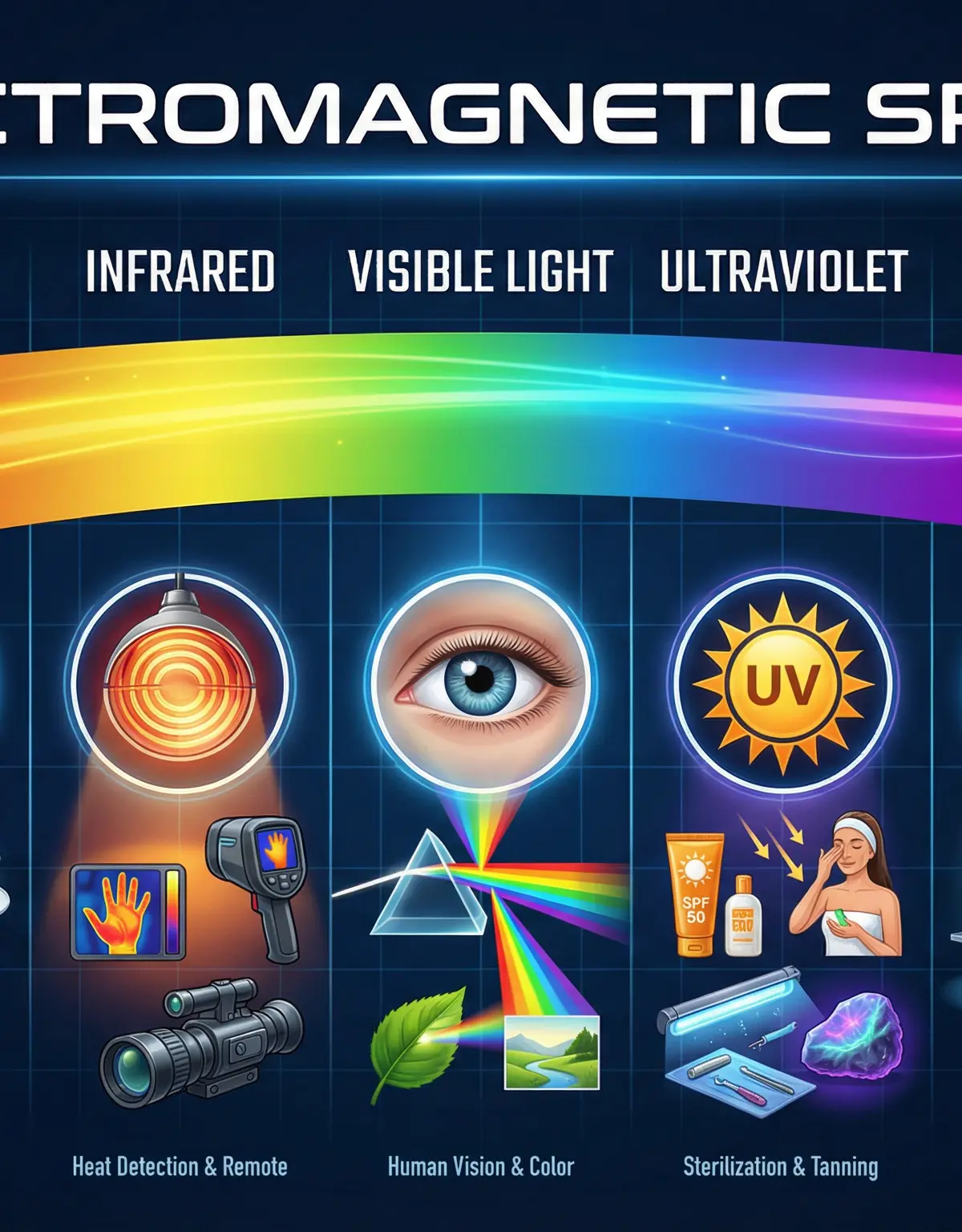
The Electromagnetic (EM) Spectrum is a continuous range of transverse waves that all travel at the same speed in a vacuum: 3.0 x 10^8 m/s. This topic is fundamental to physics, connecting ideas from waves, energy, and atomic structure. OCR examiners frequently test candidates' ability to recall the order of the spectrum, explain the inverse relationship between frequency and wavelength, and apply knowledge of wave properties to specific uses and hazards. Expect to see a mix of short-answer recall questions, calculation problems using the wave equation, and longer-form questions requiring you to compare and explain the risks of different types of radiation.
Key Concepts
Concept 1: The Wave Equation
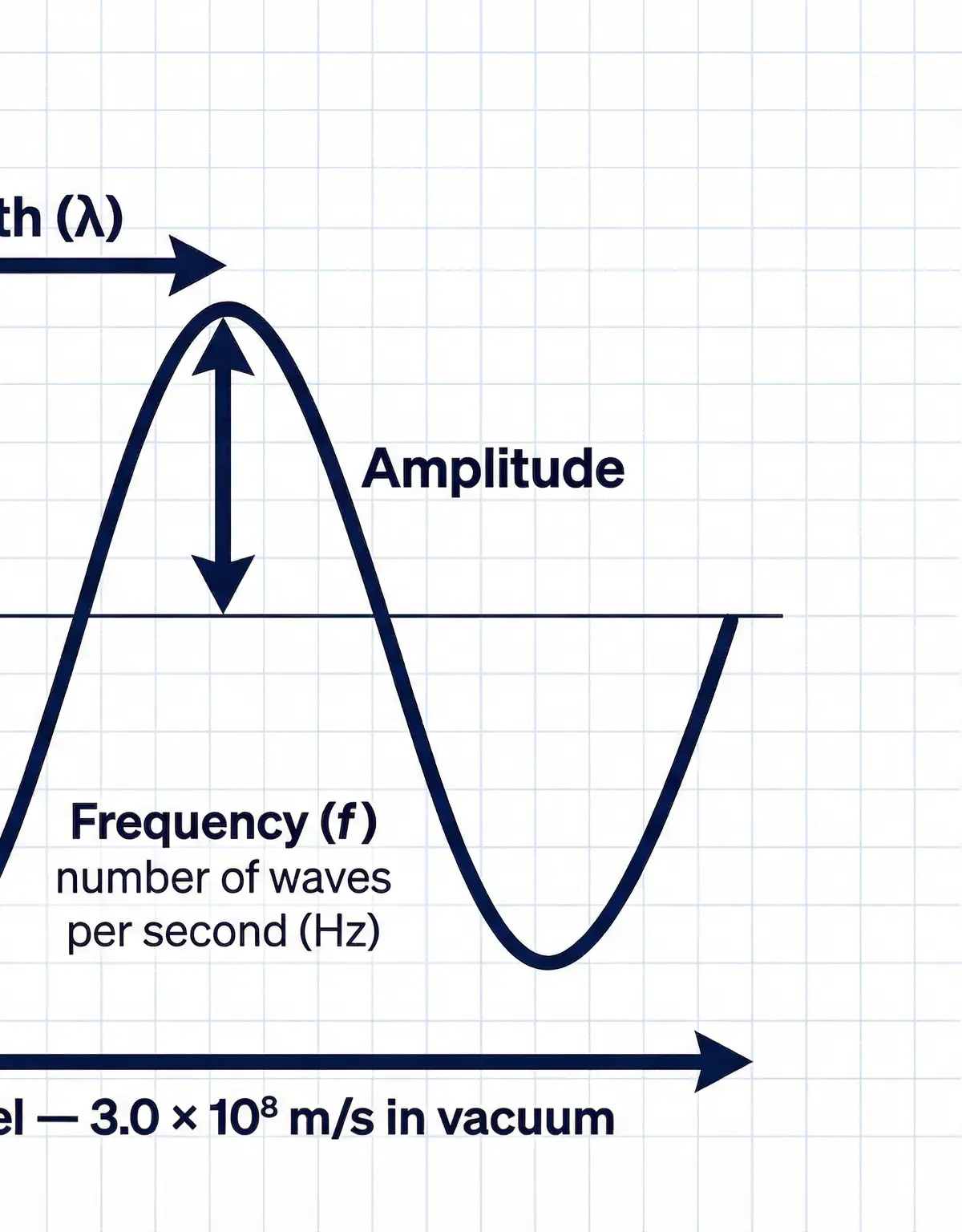
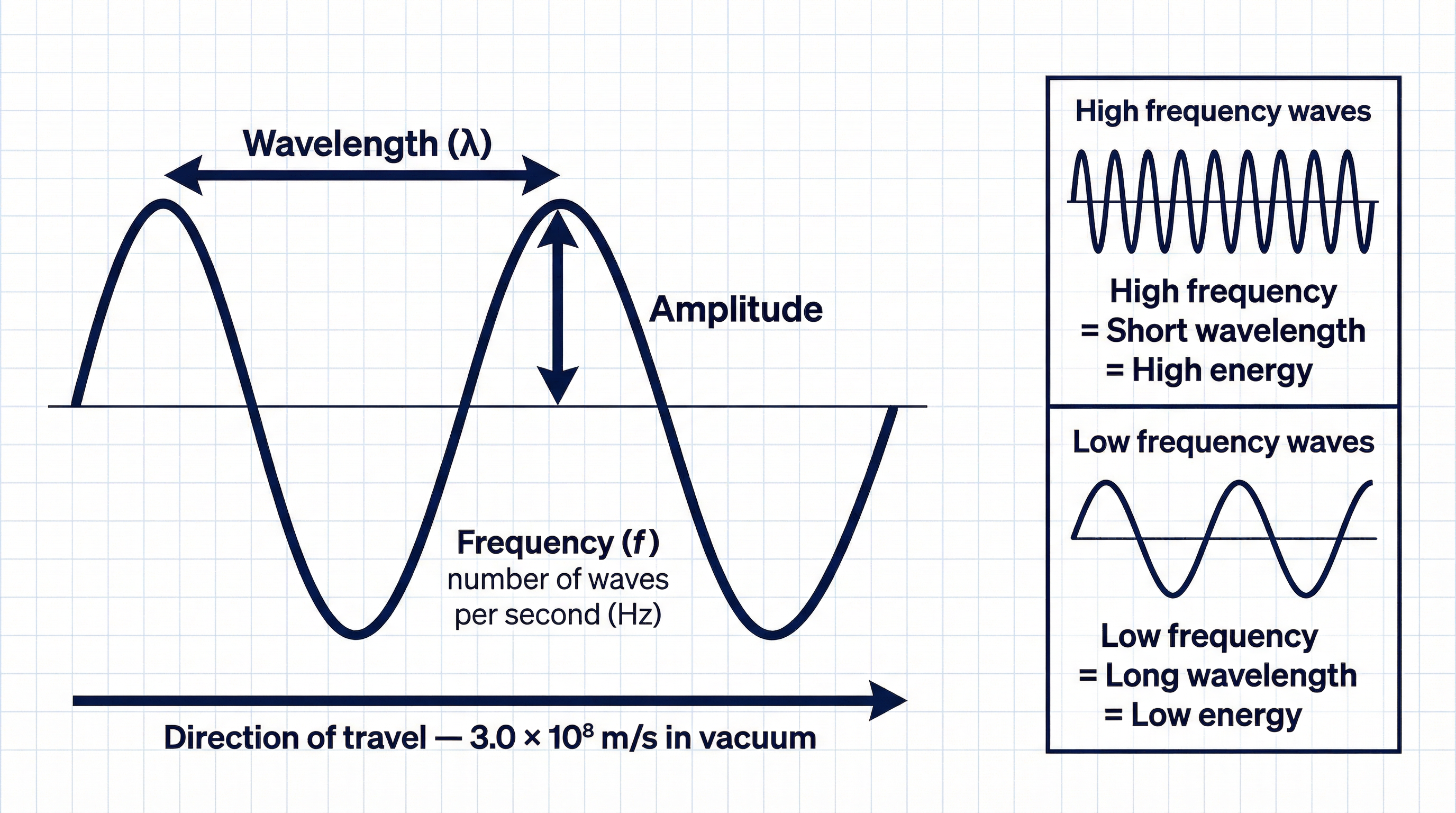
All waves, including those in the EM spectrum, are governed by the wave equation. This is a crucial formula that links the speed of a wave to its frequency and wavelength.
Formula: Wave Speed (v) = Frequency (f) x Wavelength (λ)
- Wave Speed (v): Measured in metres per second (m/s). For all EM waves in a vacuum, this is a constant value of 3.0 x 10^8 m/s.
- Frequency (f): The number of complete waves passing a point per second. Measured in Hertz (Hz).
- Wavelength (λ): The distance from one point on a wave to the equivalent point on the next wave. Measured in metres (m).
This relationship is an inverse proportion: as the frequency of an EM wave increases, its wavelength must decrease for the speed to remain constant. This is a key marking point.
Concept 2: The Order of the Spectrum
The EM spectrum is arranged by frequency and wavelength. You must memorise this order. From lowest frequency (longest wavelength) to highest frequency (shortest wavelength):
- Radio waves
- Microwaves
- Infrared
- Visible Light
- Ultraviolet
- X-rays
- Gamma rays
Concept 3: Generation and Absorption
Examiners expect you to know how certain waves are produced and how they interact with matter.
- Radio Wave Production: A key fact for OCR is that radio waves are produced by oscillations in electrical circuits. Using the term 'alternating current' (AC) creating an oscillating electric and magnetic field in a transmitter will gain credit.
- Infrared Absorption: When IR radiation is absorbed by a substance, it increases the internal energy of the particles, causing a rise in temperature. This is why we feel heat from the sun or a fire.
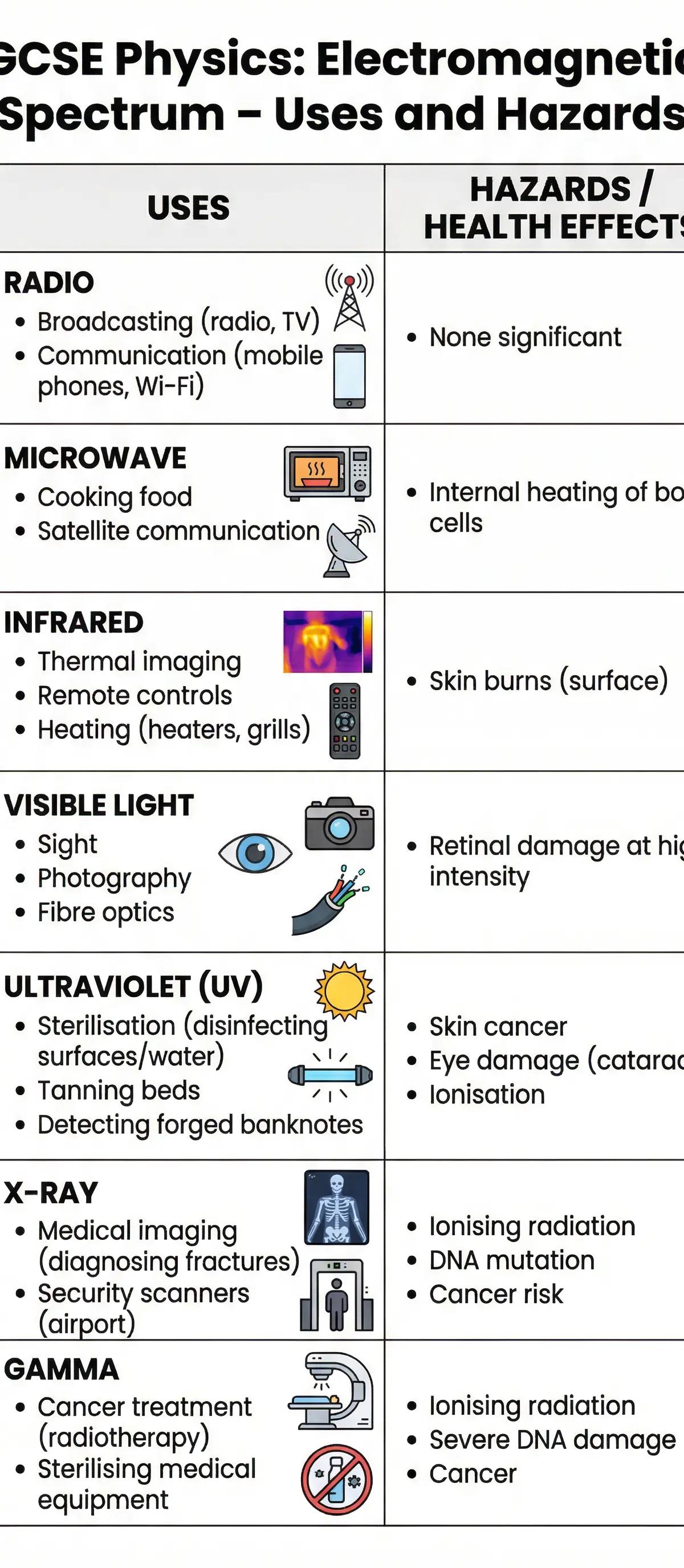
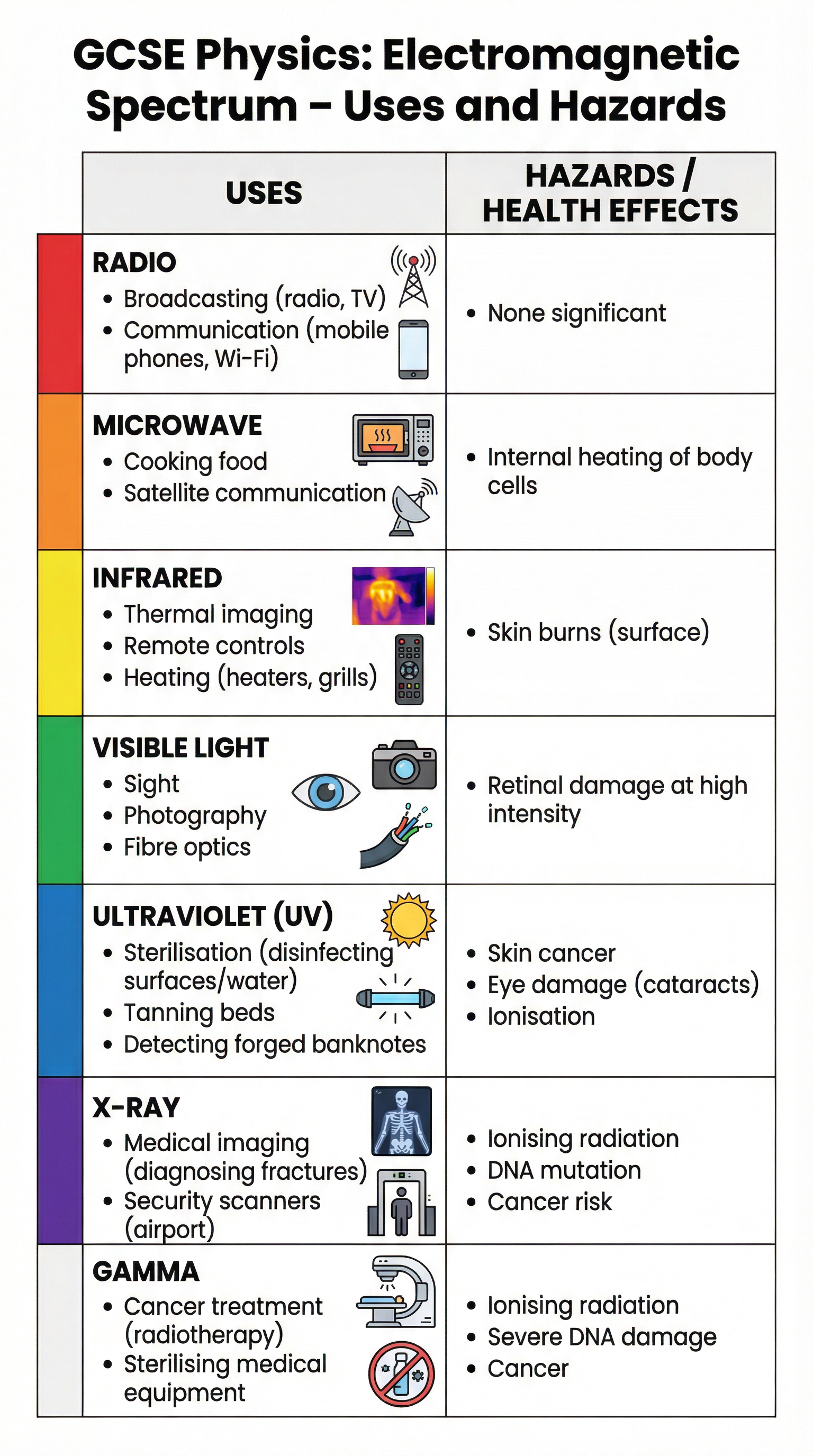
- Microwave Absorption: Microwaves are absorbed by water molecules, causing them to vibrate and heat up. This is the principle behind microwave ovens and also explains the hazard of internal heating of body cells.
Concept 4: Ionising Radiation
Higher-frequency waves carry more energy. From Ultraviolet upwards, the waves have enough energy to knock electrons off atoms, a process called ionisation. This is extremely important because it can damage living cells.
- Ionising Radiations: Ultraviolet (UV), X-rays, and Gamma rays.
- Mechanism of Harm: Ionisation can damage the DNA inside a cell's nucleus. This can cause the cell to die or, more dangerously, to mutate and become cancerous. When answering questions on hazards, you must use this precise language: ionisation -> DNA damage -> mutation -> cancer risk.
Mathematical/Scientific Relationships
- Wave Speed Equation (Must memorise how to rearrange):
v = f x λf = v / λλ = v / f
- Speed of all EM waves in a vacuum (Given on formula sheet):
c = 3.0 x 10^8 m/s
Unit Conversions (Must memorise):
- 1 kilometre (km) = 1000 m = 1 x 10^3 m
- 1 centimetre (cm) = 0.01 m = 1 x 10^-2 m
- 1 millimetre (mm) = 0.001 m = 1 x 10^-3 m
- 1 micrometre (μm) = 0.000001 m = 1 x 10^-6 m
- 1 nanometre (nm) = 0.000000001 m = 1 x 10^-9 m
Practical Applications
This topic does not have a specific required practical, but understanding the applications is essential.
- Communications: Radio waves (TV, radio), microwaves (satellites, mobile phones), and visible light (fibre optics) are used to transmit information.
- Heating: Infrared (heaters, grills) and microwaves (ovens) are used for heating.
- Medical Applications: X-rays are used for diagnosing bone fractures. Gamma rays are used in radiotherapy to destroy cancerous tumours. UV light is used to sterilise equipment.
Visual Resources
2 diagrams and illustrations
Interactive Diagrams
2 interactive diagrams to visualise key concepts
Conceptual Flow Outline
The order of the Electromagnetic Spectrum, showing the trend from low frequency/long wavelength (Radio waves) to high frequency/short wavelength (Gamma rays).
Conceptual Flow Outline
Flowchart showing the chain of events for how high-energy ionising radiation can lead to cancer. This is the level of detail required for an 'explain' question.
Worked Examples
3 worked examples — open one to explore the question and available guidance.
Practice Questions
Test your understanding — click to reveal model answers
State two properties that are the same for all electromagnetic waves.
Hint: Think about how they travel and their fundamental wave type.
Describe the difference between the hazards caused by microwaves and X-rays.
Hint: Think about heating vs. ionisation.
A mobile phone transmits a signal with a wavelength of 37.5 cm. Calculate the frequency of the signal in gigahertz (GHz).
Hint: Remember to convert cm to m first. 1 GHz = 1 x 10^9 Hz.
Explain why a lead apron is worn when taking a medical X-ray.
Hint: What do X-rays do to the body, and what property does lead have?
Visible light is the only part of the spectrum detected by the human eye. Describe the order of colours within the visible spectrum in terms of wavelength.
Hint: Think of a rainbow.
Test your understanding of The Electromagnetic Spectrum
Active recall beats re-reading. Take an instant quiz now to test what you’ve learned and lock it into long-term memory.
7 days Premium · Then free forever · No card, no charge