WJEC · A-Level · Physics
Magnetic Induction
Unlock top marks in WJEC A-Level Physics with this guide to Magnetic Induction (3.4). Master the core principles of flux linkage, Faraday's Law, and Lenz's Law, and learn how to apply them to exam-style questions involving generators, moving conductors, and graphical analysis.
- 6 min read
- 3 worked examples
- 5 practice questions
- 6 key terms
Study Notes
Overview

Welcome to Magnetic Induction, a cornerstone of A-Level Physics and a topic that elegantly bridges theoretical concepts with powerful real-world applications. This section of Unit 4 (WJEC 3.4) explores how a changing magnetic environment can generate an electrical current. It's the fundamental principle behind electrical generators, transformers, and even the simple act of swiping a credit card. A solid grasp of magnetic induction is crucial, as it not only carries significant marks but also provides synoptic links to topics like circular motion, energy conservation, and waves. Examiners frequently test this through a mix of calculation, explanation, and graphical interpretation questions. Candidates who can move fluidly between the mathematical formulation of Faraday's Law and the conceptual underpinning of Lenz's Law will be well-rewarded. This guide will equip you with the precise language, problem-solving strategies, and exam technique needed to excel.
Key Concepts
Concept 1: Magnetic Flux and Flux Linkage
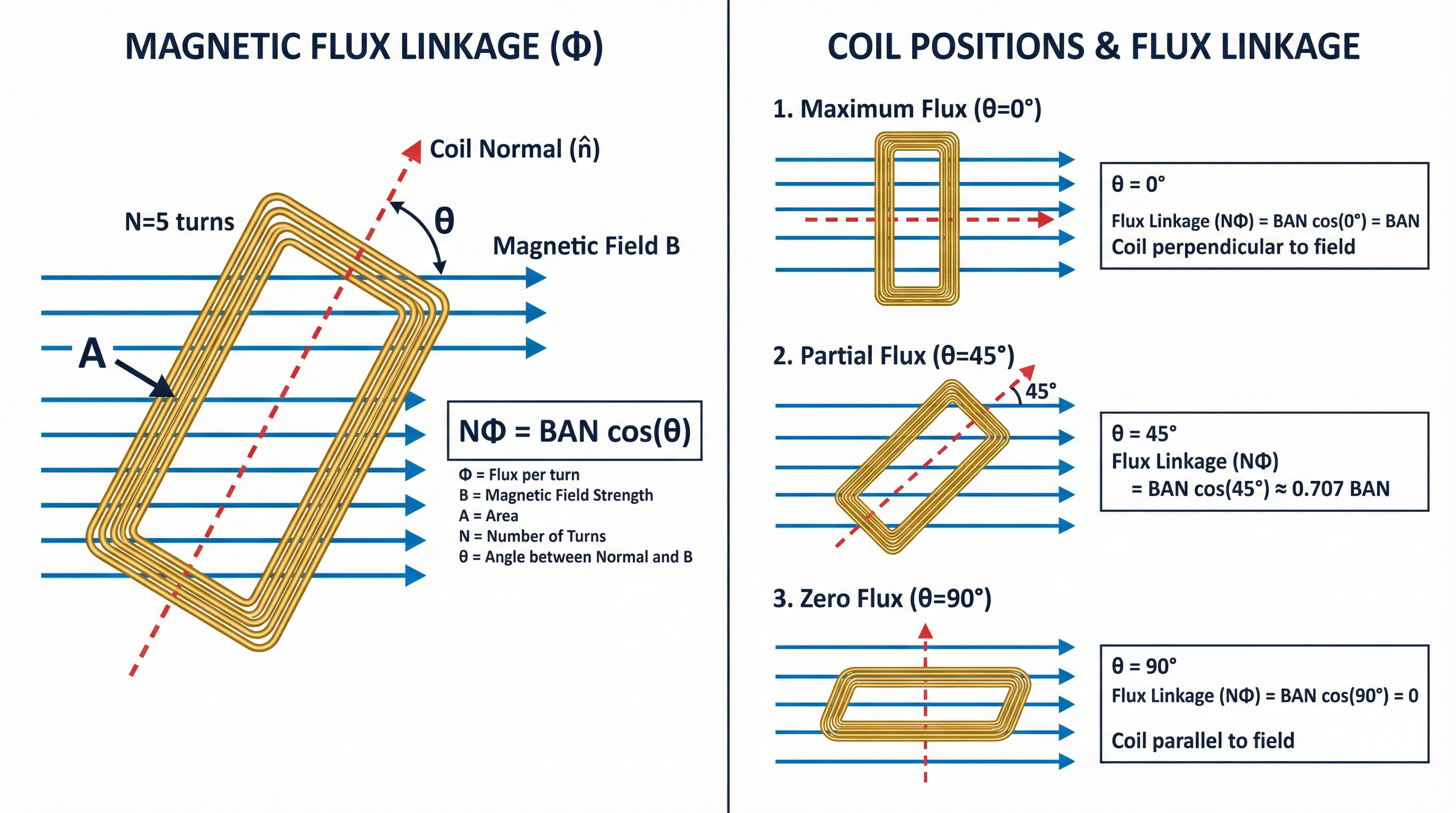
Before we can induce an e.m.f., we need to understand what's changing. That 'what' is magnetic flux. Think of it as the total amount of magnetic field passing through a given area. For a single loop of wire, the magnetic flux (Φ) is the product of the magnetic field strength (B), the area of the loop (A), and the cosine of the angle (θ) between the magnetic field lines and the normal to the area.
However, in most practical applications, we use a coil with many turns. Magnetic Flux Linkage (NΦ) is the crucial quantity here. It's simply the magnetic flux multiplied by the number of turns (N) in the coil. Examiners are strict on this distinction: credit is given for using 'flux linkage', not just 'flux', in the context of Faraday's Law.
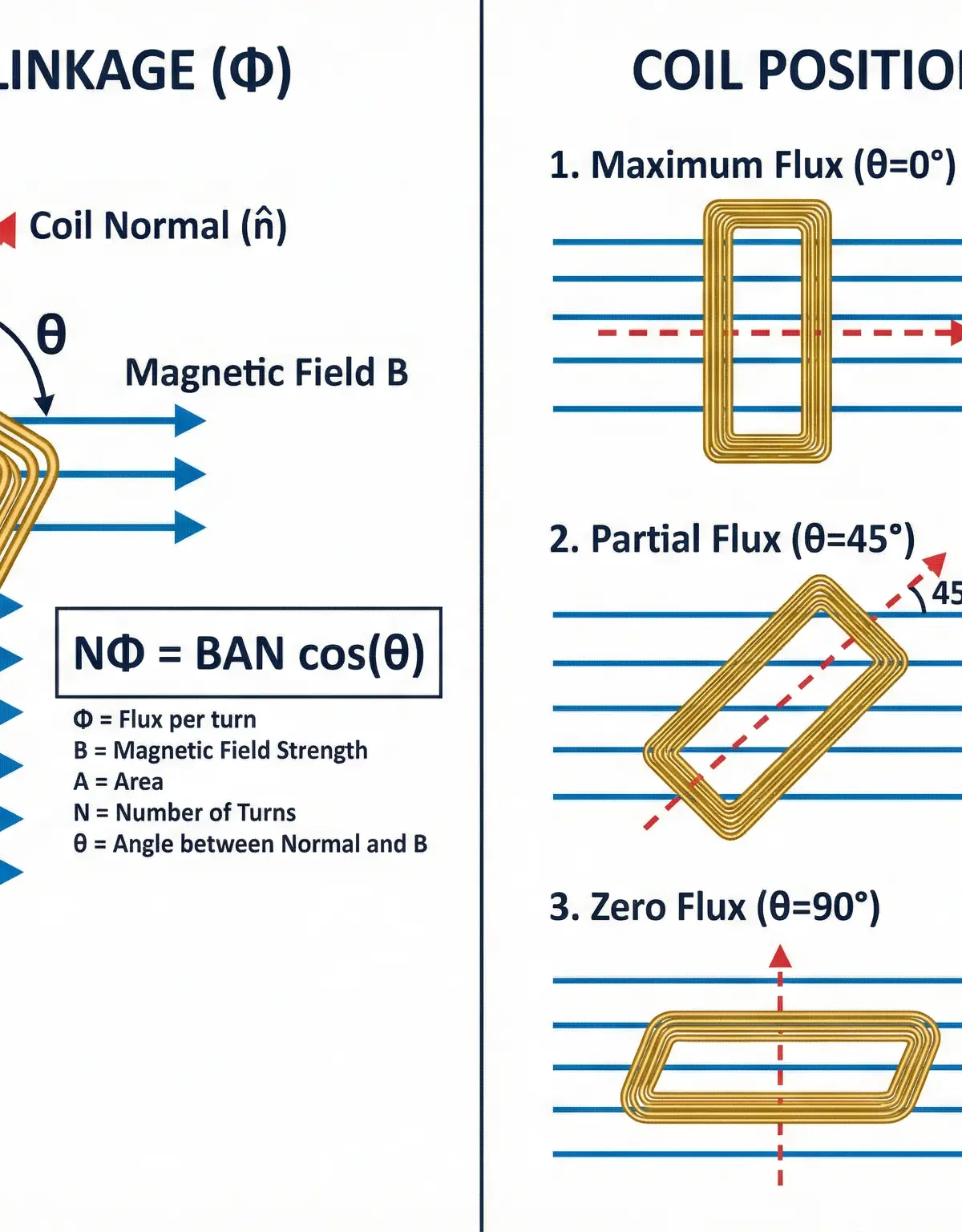
Example: A circular coil of 50 turns, each with a radius of 4.0 cm, is in a uniform magnetic field of 0.25 T. Initially, the plane of the coil is perpendicular to the field. The flux linkage is NΦ = BAN cos(0) = (0.25 T) * (π * (0.04 m)^2) * 50 = 0.0628 Wb.
Concept 2: Faraday's Law of Induction
This is the central law of this topic. Faraday's Law states that the magnitude of the induced e.m.f. (ε) is directly proportional to the rate of change of magnetic flux linkage. In calculus terms, this is expressed as ε = -d(NΦ)/dt. For calculations involving discrete changes, this is often approximated as ε = -Δ(NΦ)/Δt.
This equation tells us that to generate a voltage, you must change the flux linkage. You can do this by:
- Changing the magnetic field strength (B).
- Changing the area of the coil (A).
- Changing the angle between the coil and the field (θ), i.e., by rotating the coil.
Concept 3: Lenz's Law and Conservation of Energy
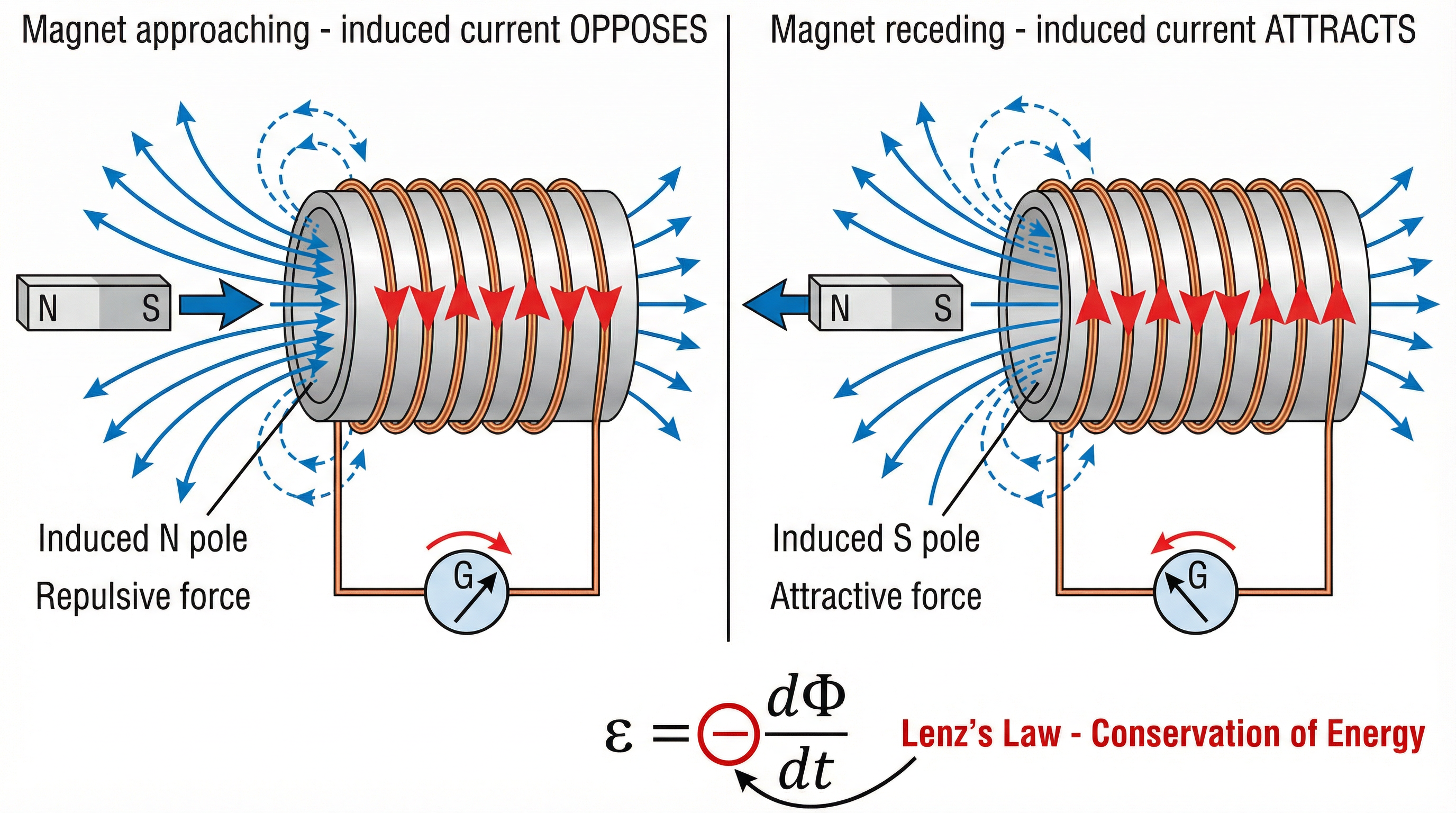
Faraday's Law gives us the size of the induced e.m.f., but what about its direction? That's governed by Lenz's Law, which is represented by the negative sign in Faraday's equation. Lenz's Law states that the direction of the induced current is always such that it creates a magnetic field to oppose the very change in flux that caused it.
This isn't just an arbitrary rule; it's a direct consequence of the Principle of Conservation of Energy. If the induced current assisted the change, it would create a runaway effect, generating infinite energy from nothing. Instead, to induce a current, you must do work against an opposing magnetic force. This work done is converted into the electrical energy of the induced current.
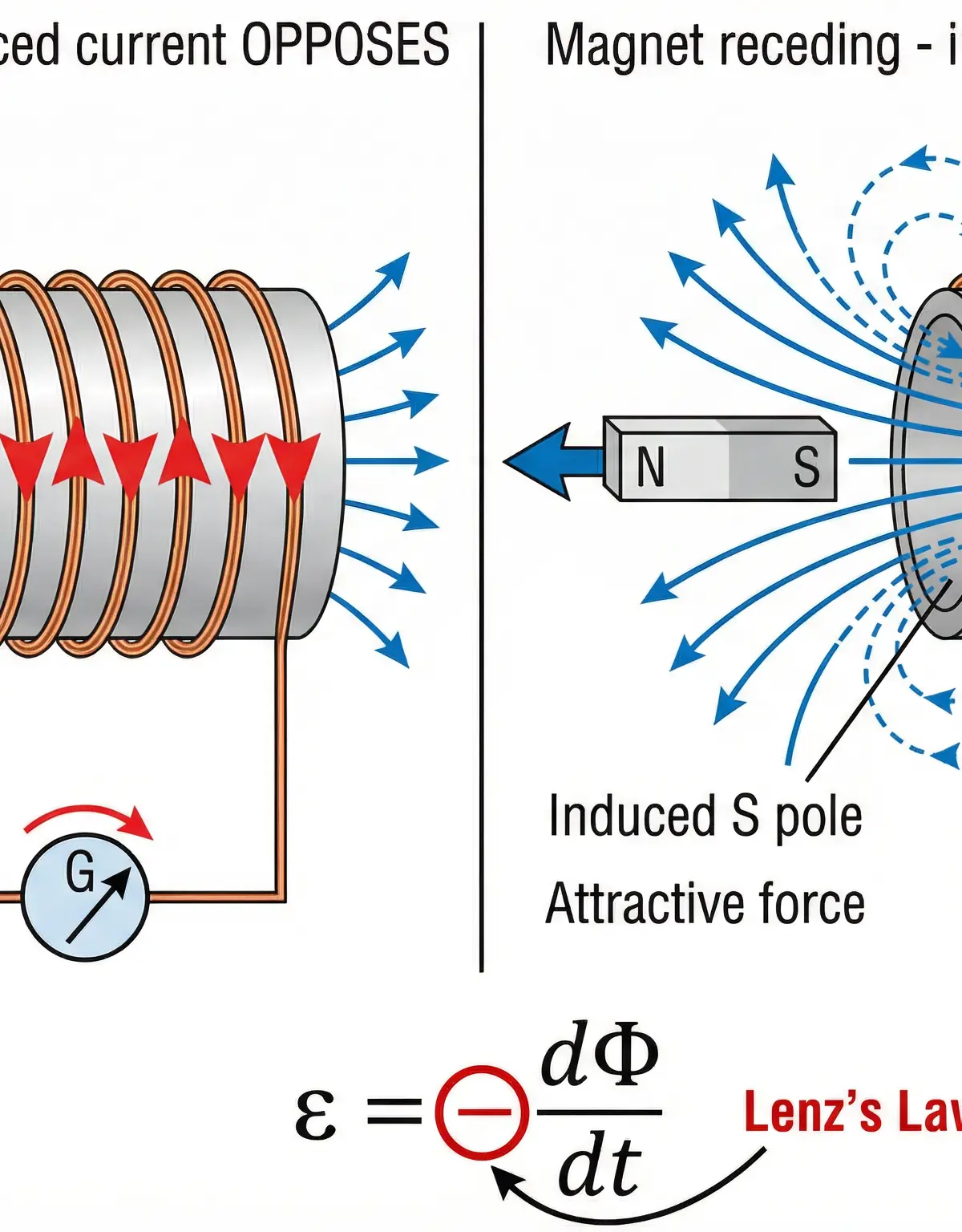
Example: Pushing the North pole of a bar magnet towards a coil induces a current. By Lenz's Law, this current must create a North pole on the face of the coil nearest the magnet to repel it and oppose its motion. Using the right-hand grip rule, we can determine the direction of current required to create this North pole.
Concept 4: Motional E.M.F.
A special case of induction occurs when a straight conductor of length L moves at a velocity v through a magnetic field B, cutting the field lines. This is known as motional e.m.f. If the conductor, field, and velocity are all mutually perpendicular, the induced e.m.f. is given by a simpler formula: ε = Blv. This is a useful shortcut and is directly derivable from Faraday's Law. It's often tested in scenarios involving rods sliding on rails.
Mathematical/Scientific Relationships
- Magnetic Flux Linkage:
NΦ = BAN cos(θ)(Must memorise) - Faraday's Law of Induction:
ε = -d(NΦ)/dtorε = -Δ(NΦ)/Δt(Given on formula sheet) - Motional E.M.F.:
ε = Blv(Given on formula sheet) - E.M.F. in a Rotating Coil:
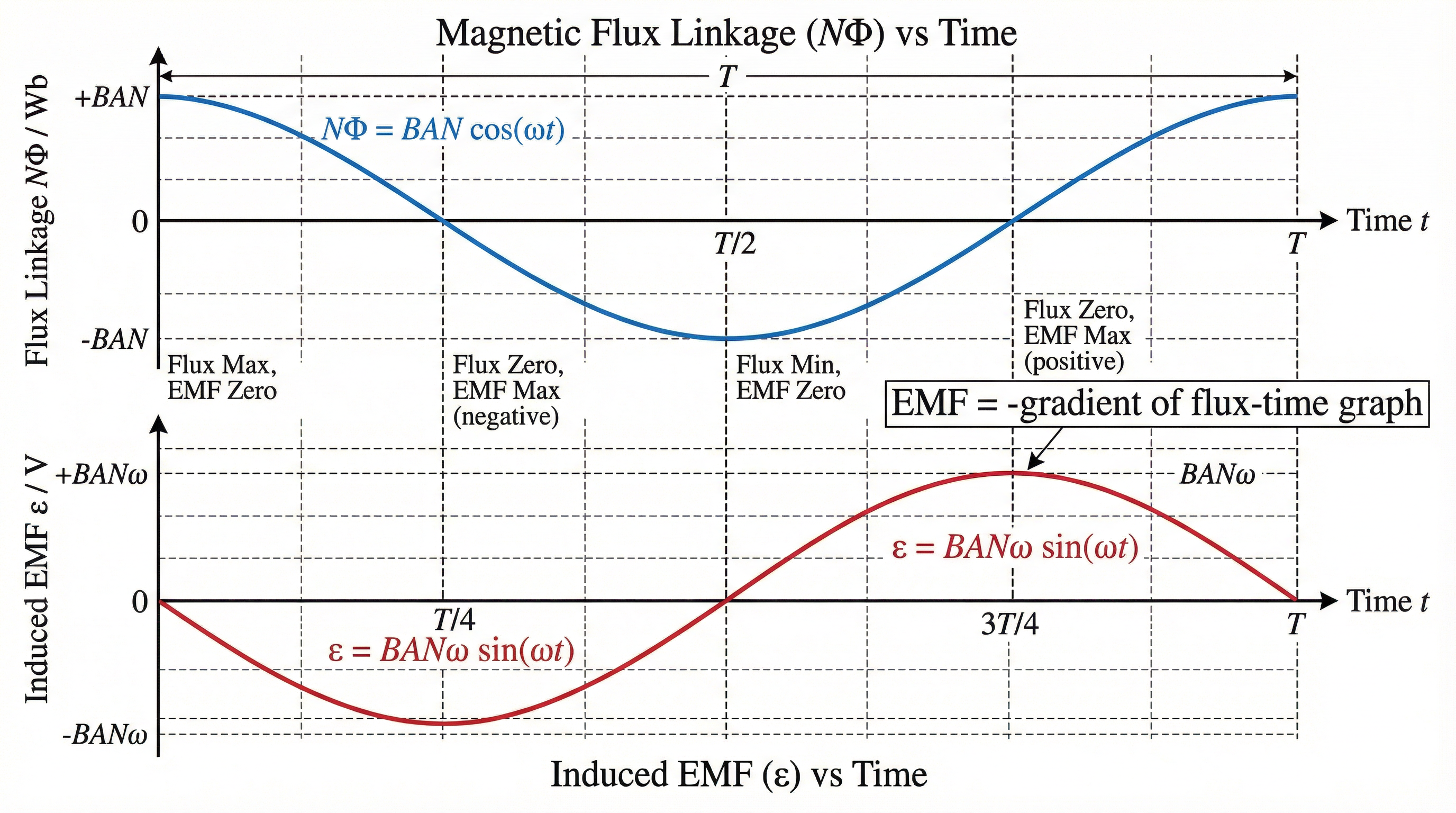
ε = BANω sin(ωt)(Must memorise) - Peak E.M.F. in a Rotating Coil:
ε_max = BANω(Must memorise)
Here, ω is the angular velocity in radians per second.

Practical Applications
- Generators: The most direct application. A coil is rotated within a magnetic field (or a magnet is rotated within a coil). The continuous change in flux linkage induces a continuous alternating e.m.f. The principles of peak e.m.f. (BANω) dictate how to generate more power.
- Transformers: Two coils, a primary and a secondary, are linked by a soft iron core. A changing current in the primary coil creates a changing magnetic flux, which is channelled through the core to the secondary coil. This changing flux linkage in the secondary induces an e.m.f. in it.
- Induction Hobs: A coil beneath the ceramic surface carries a high-frequency alternating current, creating a rapidly changing magnetic field. This induces large eddy currents within the metal of a saucepan placed on top. The resistance of the pan causes these currents to generate heat (I²R heating), cooking the food, while the hob itself remains cool.
- Card Readers: Swiping a credit card moves the magnetic strip (containing stored data) past a small coil (the read head). The moving magnetic field induces a tiny e.m.f. in the coil, which can be decoded into data.
Visual Resources
5 diagrams and illustrations
Interactive Diagrams
2 interactive diagrams to visualise key concepts
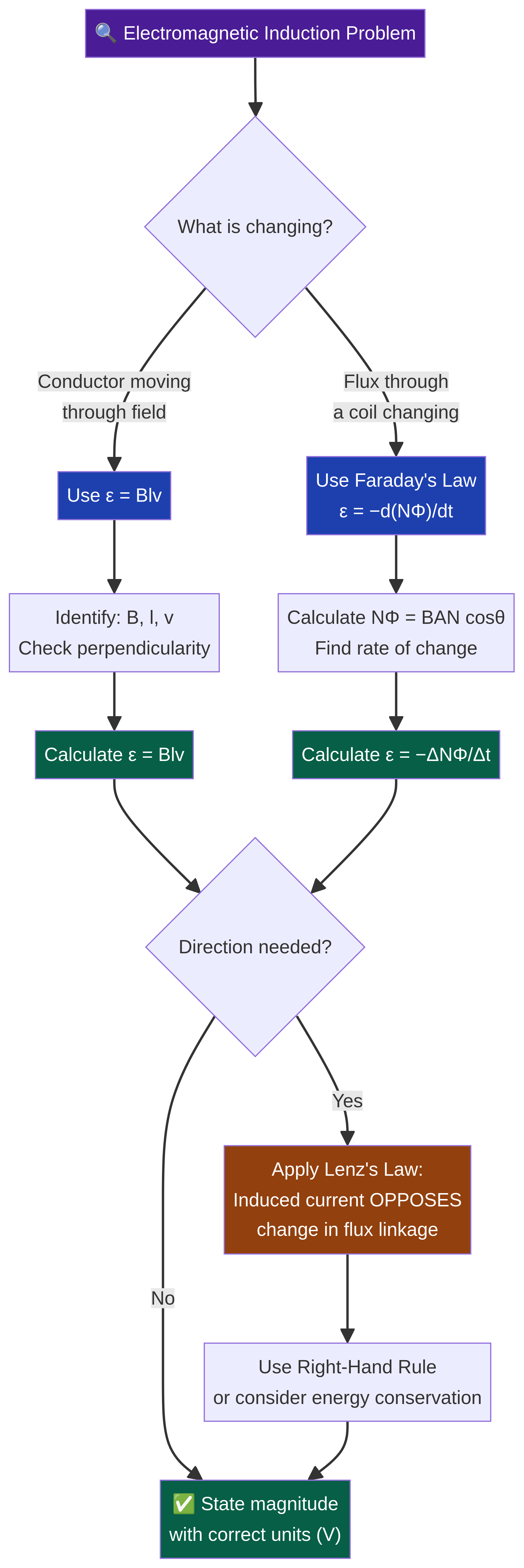
Conceptual Flow Outline
A flowchart to help decide which formula to use when solving magnetic induction problems.
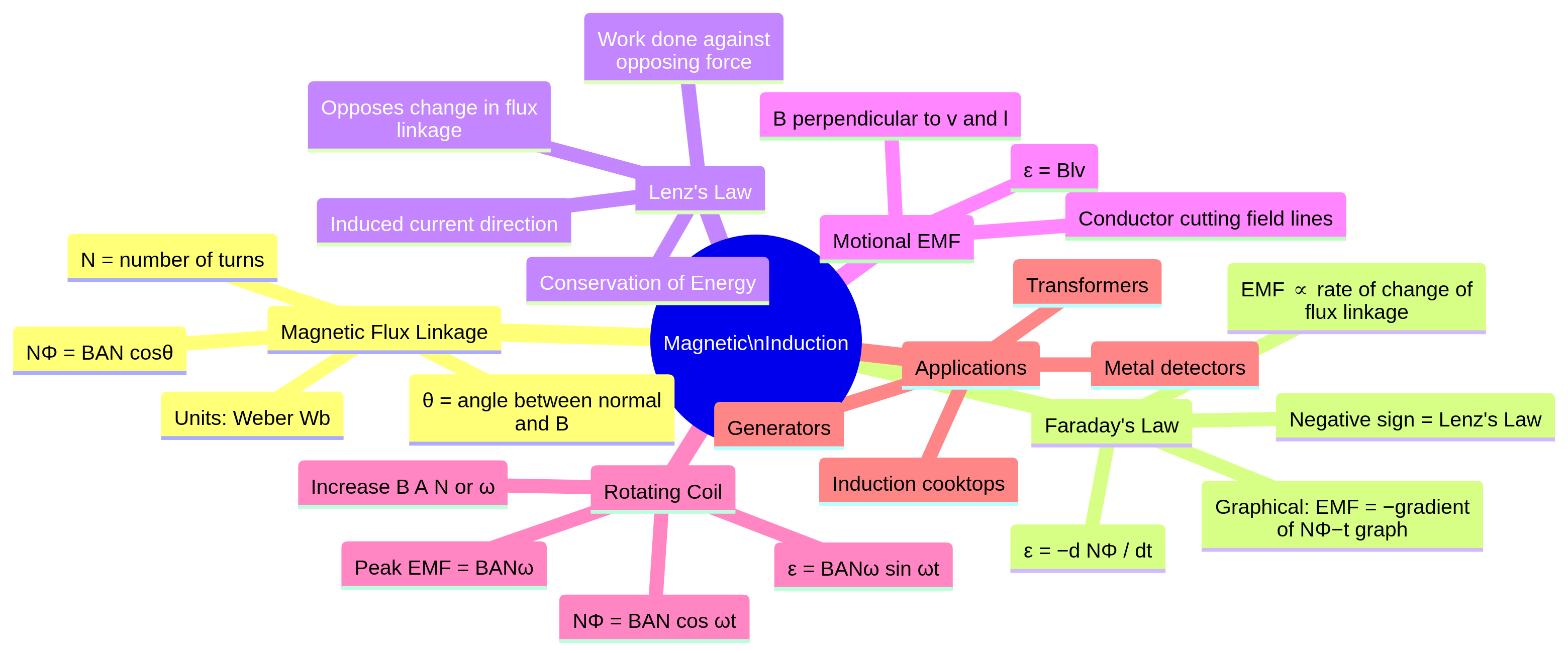
Conceptual Flow Outline
A concept map summarising the key ideas within the Magnetic Induction topic.
Worked Examples
3 worked examples — open one to explore the question and available guidance.
Practice Questions
Test your understanding — click to reveal model answers
A square coil of side 5.0 cm has 120 turns. It is placed in a magnetic field of flux density 60 mT so that the flux linkage is maximised. The coil is then rotated by 60° in 40 ms. Calculate the average e.m.f. induced.
Hint: First, calculate the initial and final flux linkage. Remember that θ is the angle to the normal.
Describe the key features of an experiment to investigate Faraday's law of electromagnetic induction.
Hint: Think about what you need to measure to verify the relationship ε ∝ Δ(NΦ)/Δt.
A simple d.c. electric motor is constructed. When the motor is running at its normal operating speed, the current drawn from the supply is smaller than the current drawn when the motor is first switched on. Explain this observation.
Hint: This is a synoptic question. Think about what happens in a motor (motor effect) and what happens in a generator (induction).
State two ways to increase the peak e.m.f. produced by a simple a.c. generator.
Hint: Think about the formula for peak e.m.f. in a rotating coil.
A straight, horizontal metal rod of length 45 cm is falling vertically at a constant speed of 8.0 m/s in a region where there is a horizontal magnetic field of 0.20 T directed into the page. Calculate the e.m.f. induced across the ends of the rod.
Hint: This is a motional e.m.f. problem. Use the appropriate formula.
Test your understanding of Magnetic Induction
Active recall beats re-reading. Take an instant quiz now to test what you’ve learned and lock it into long-term memory.
7 days Premium · Then free forever · No card, no charge