WJEC · A-Level · Physics
Thermal Physics and Kinetic Theory
Thermal Physics and Kinetic Theory bridges the macroscopic world of pressure, volume, and temperature with the microscopic reality of molecules in constant random motion — and WJEC tests both levels with rigour. Mastering this topic means owning the kinetic theory pressure derivation, applying the First Law of Thermodynamics with correct sign conventions, and never, ever substituting temperature in Celsius. Get this right and you're looking at a reliable source of high-mark questions across every paper.
- 9 min read
- 5 worked examples
- 6 practice questions
- 8 key terms
Study Notes

Overview
Thermal Physics and Kinetic Theory (WJEC specification reference 1.4) is one of the most mathematically demanding yet conceptually elegant topics in A-Level Physics. It operates on two levels simultaneously: the macroscopic level, where we describe gases using measurable quantities like pressure, volume, and temperature; and the microscopic level, where we model gases as vast collections of randomly moving molecules and derive macroscopic behaviour from first principles.
This dual perspective is precisely what makes the topic so rewarding — and so frequently examined. WJEC questions on this topic range from short 'State' questions worth 1 mark (testing precise definitions) to extended 'Show that' derivations worth 4–5 marks (testing your ability to construct a logical argument from Newton's Second Law through to the kinetic theory pressure equation). The First Law of Thermodynamics adds a further layer, requiring candidates to handle sign conventions with care and apply energy conservation to thermodynamic processes.
This topic connects directly to mechanics (Newton's Second Law underpins the kinetic theory derivation), waves and oscillations (internal energy and temperature link to thermal equilibrium concepts), and electricity (energy transfer and work done appear in both contexts). Examiners frequently set synoptic questions that require you to draw on these connections.
Key Concepts
Concept 1: Temperature, Internal Energy, and the Ideal Gas
Temperature is a measure of the average kinetic energy of the particles in a substance. This is the microscopic definition — and it is the one examiners expect at A-Level. The macroscopic experience of 'hotness' is simply our perception of this average molecular kinetic energy.
The internal energy of a substance is defined as the sum of the random distribution of kinetic and potential energies of all the molecules it contains. For a real substance, both kinetic energy (from molecular motion) and potential energy (from intermolecular forces) contribute. However, for an ideal gas, the intermolecular forces are assumed to be negligible, which means the potential energy contribution is zero. Therefore, the internal energy of an ideal gas is purely kinetic.
Examiner note: Candidates must explicitly state that potential energy is zero because intermolecular forces are negligible. Simply stating 'PE = 0' without justification will not earn the mark.
Temperature must always be expressed in Kelvin for gas law calculations. The conversion is: T = \theta + 273.15, where \theta is temperature in degrees Celsius. Absolute zero (0 K) is the temperature at which molecular motion theoretically ceases and internal energy is at its minimum. It is the foundation of the Kelvin scale.
The assumptions of an ideal gas are critical knowledge:
- Molecules are point masses (negligible volume compared to the container)
- Collisions between molecules and with container walls are perfectly elastic
- The duration of collisions is negligible compared to the time between collisions
- There are no intermolecular forces except during collisions
- The molecules move in random directions with a range of speeds
Concept 2: The Empirical Gas Laws
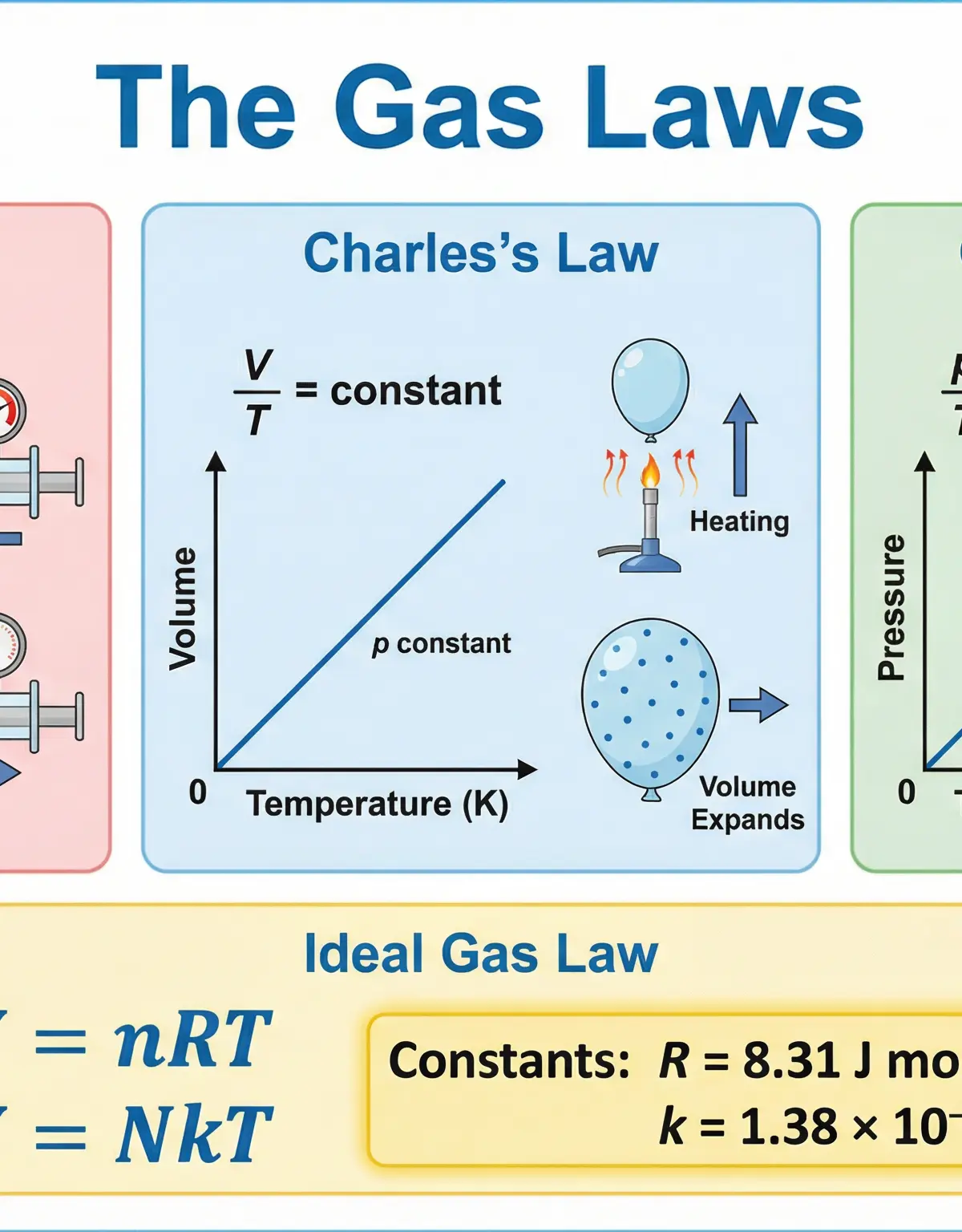
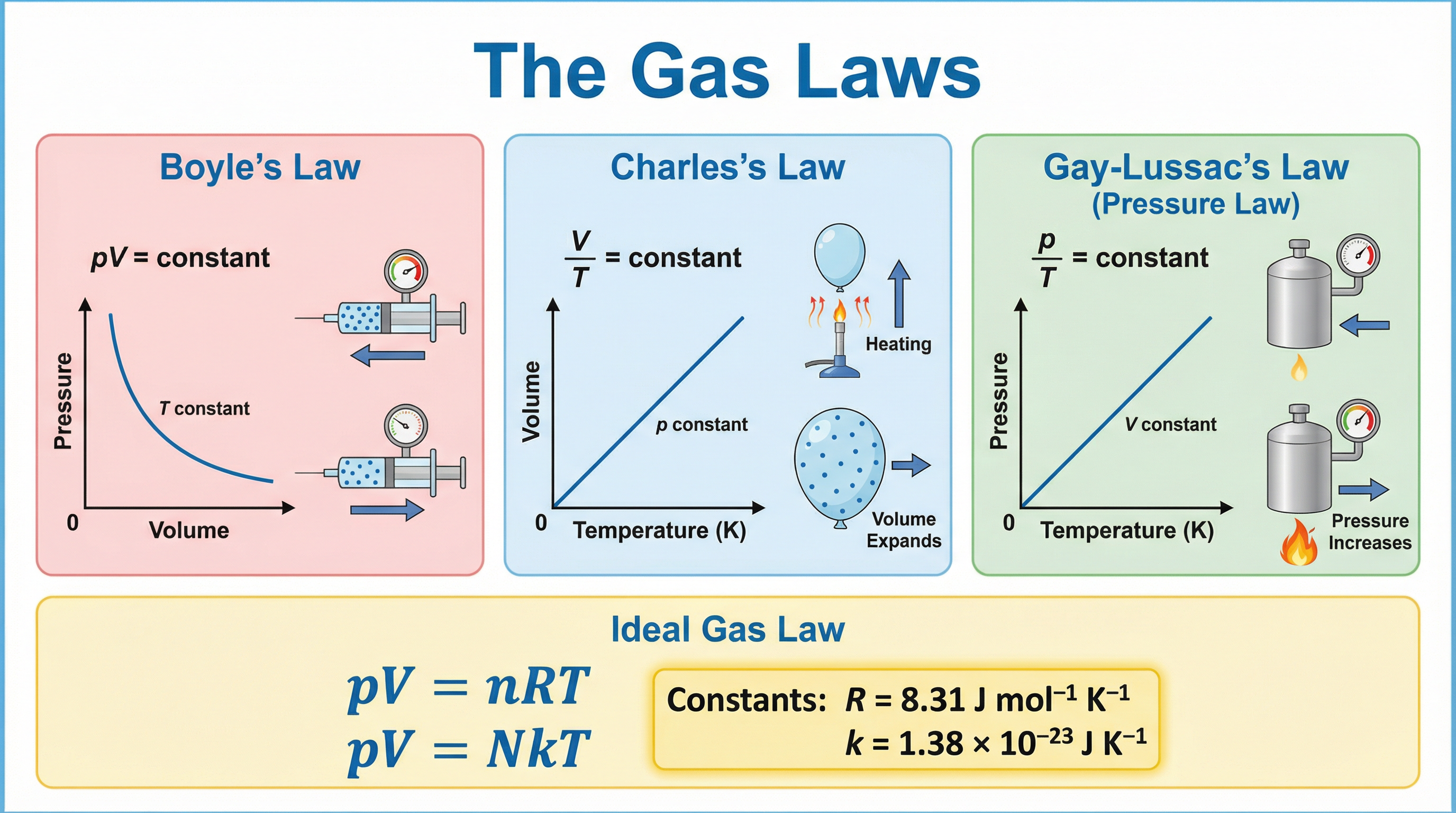
The three empirical gas laws describe how the macroscopic properties of a fixed mass of gas are related when one variable is held constant.
| Law | Constant | Relationship | Equation |
|---|---|---|---|
| Boyle's Law | Temperature (T) | $p \propto \frac{1}{V}$ | $pV = \text{constant}$ |
| Charles's Law | Pressure (p) | $V \propto T$ | $\frac{V}{T} = \text{constant}$ |
| Gay-Lussac's Law | Volume (V) | $p \propto T$ | $\frac{p}{T} = \text{constant}$ |
Combining all three gives the combined gas law: \frac{p_1 V_1}{T_1} = \frac{p_2 V_2}{T_2}, which is enormously useful for problems where a gas changes state.
Introducing the amount of gas yields the ideal gas equation in two equivalent forms:
pV = nRT \quad \text{(using moles)}
pV = NkT \quad \text{(using number of molecules)}
Where R = 8.31 \text{ J mol}^{-1} \text{K}^{-1} (molar gas constant) and k = 1.38 \times 10^{-23} \text{ J K}^{-1} (Boltzmann constant). Note that R = N_A k, where N_A = 6.02 \times 10^{23} \text{ mol}^{-1} is the Avogadro constant.
Concept 3: The Kinetic Theory Pressure Derivation
This is the most frequently examined derivation in this topic. WJEC regularly sets it as a 4–5 mark 'Show that' question. You must know every step.
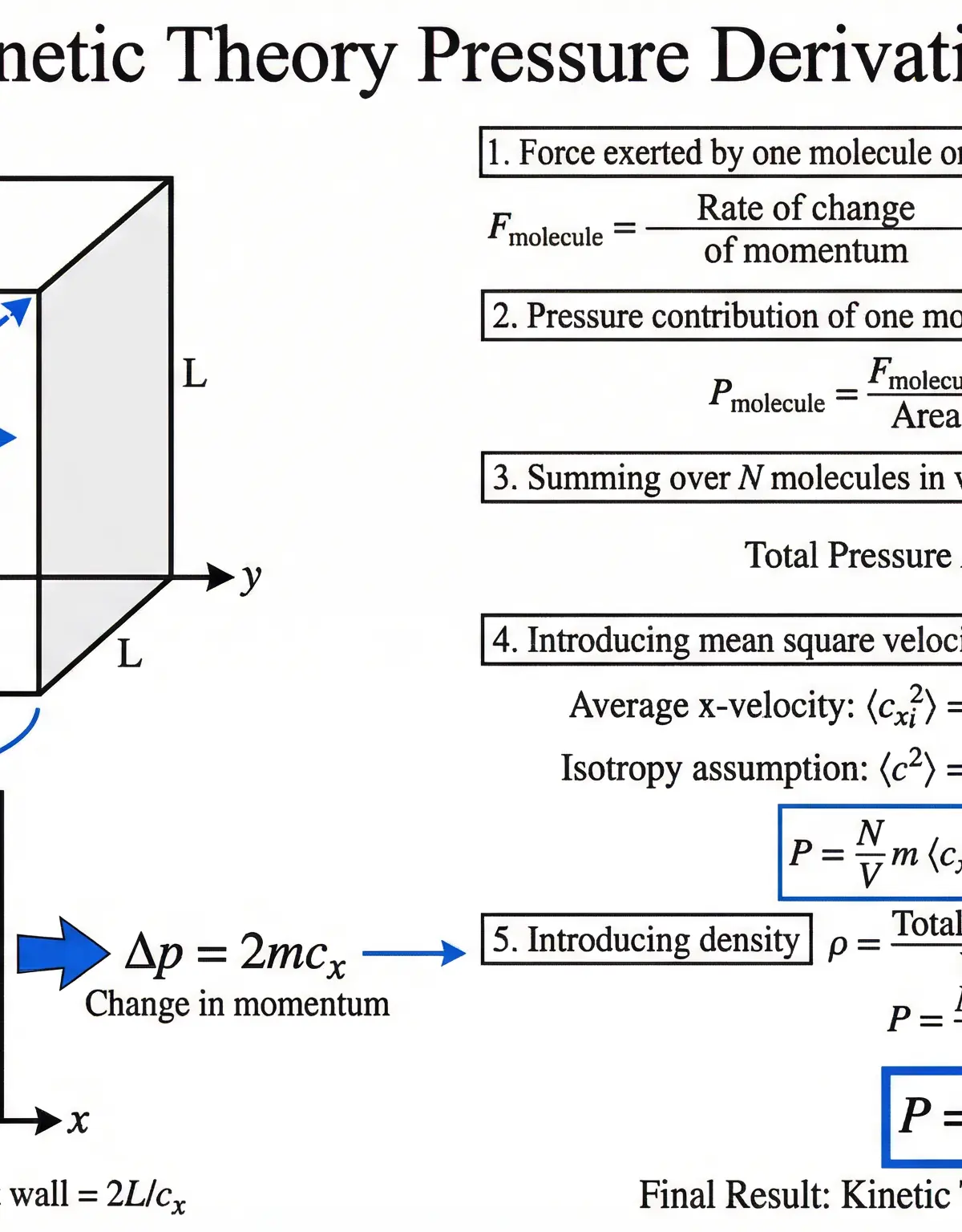
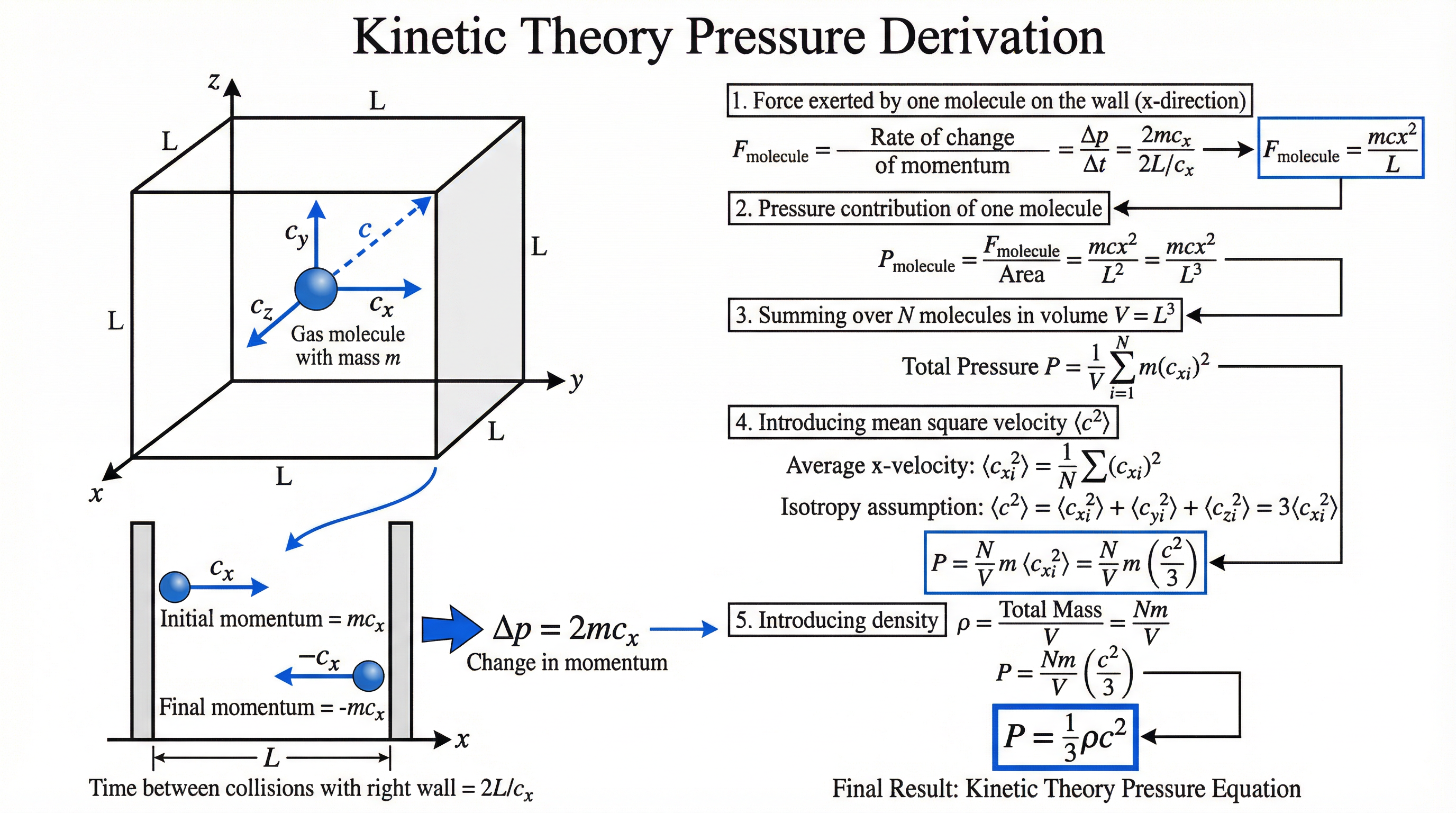
Consider a single molecule of mass m moving with x-component of velocity c_x inside a cubic box of side length L.
Step 1 — Change in momentum: When the molecule collides elastically with a wall perpendicular to the x-axis, its x-velocity reverses. Change in momentum = 2mc_x.
Step 2 — Time between collisions: The molecule must travel a distance 2L before hitting the same wall again. Time = \frac{2L}{c_x}.
Step 3 — Force (Newton's Second Law): By Newton's Second Law, force = rate of change of momentum:
F = \frac{\Delta p}{\Delta t} = \frac{2mc_x}{2L/c_x} = \frac{mc_x^2}{L}
Step 4 — Pressure from one molecule: Pressure = Force / Area = \frac{mc_x^2/L}{L^2} = \frac{mc_x^2}{L^3} = \frac{mc_x^2}{V}
Step 5 — Sum over N molecules: Total pressure = \frac{Nm\overline{c_x^2}}{V}
Step 6 — Isotropy assumption: Since molecular motion is random and isotropic, \overline{c_x^2} = \overline{c_y^2} = \overline{c_z^2} = \frac{1}{3}\overline{c^2}
Therefore: p = \frac{Nm\overline{c^2}}{3V}
Step 7 — Introduce density: Since \rho = \frac{Nm}{V}:
\boxed{p = \frac{1}{3}\rho\overline{c^2}}
Concept 4: Root Mean Square Speed and Temperature
By combining pV = NkT with p = \frac{Nm\overline{c^2}}{3V}, we can derive the relationship between molecular kinetic energy and temperature:
\frac{1}{2}m\overline{c^2} = \frac{3}{2}kT
This is a profound result: the average translational kinetic energy of a gas molecule depends only on temperature. It is directly proportional to absolute temperature.
The root mean square speed is defined as: c_{rms} = \sqrt{\overline{c^2}}
This is NOT the same as the mean speed \bar{c}. The order of operations is critical: Square each speed, find the Mean, then take the Root — hence 'root mean square'.
From the above: c_{rms} = \sqrt{\frac{3kT}{m}} = \sqrt{\frac{3RT}{M}}, where M is the molar mass.
Concept 5: The First Law of Thermodynamics
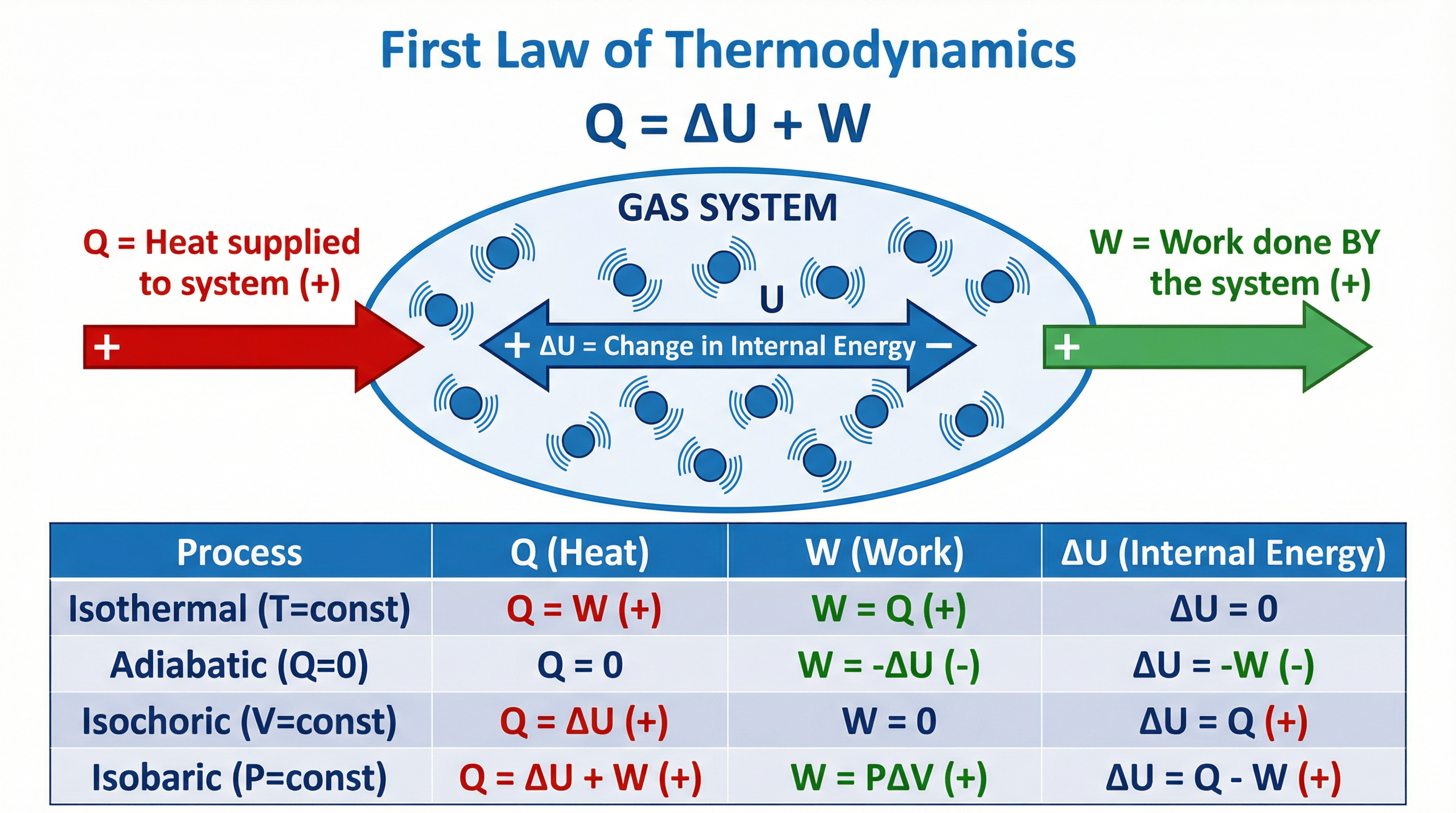
The First Law is a statement of conservation of energy for a thermodynamic system:
\boxed{Q = \Delta U + W}
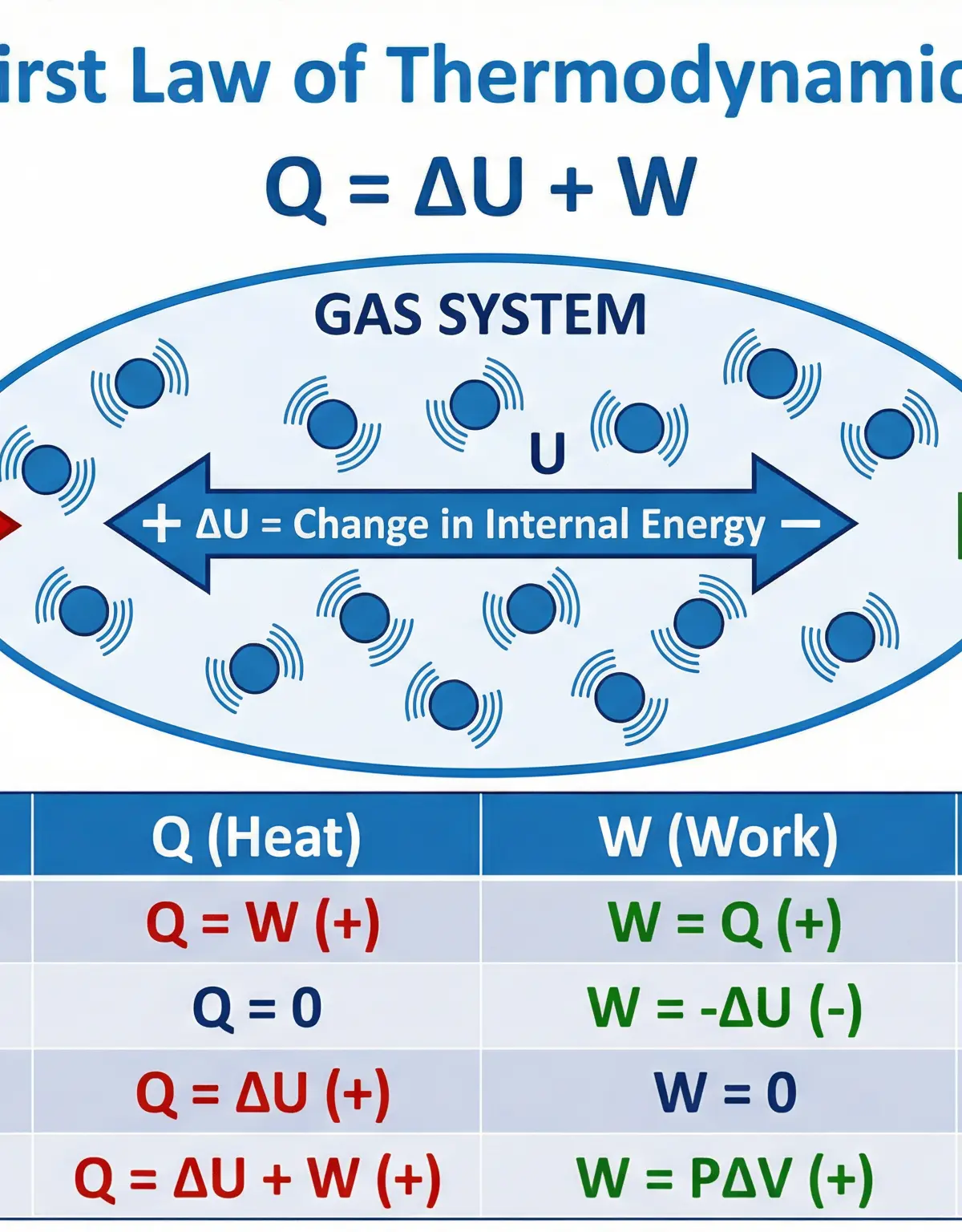
Where:
- Q = heat supplied to the gas (positive when heat flows in)
- \Delta U = increase in internal energy of the gas
- W = work done by the gas (positive when gas expands)
The sign convention is critical:
| Situation | Sign of Q | Sign of W | Effect on ΔU |
|---|---|---|---|
| Heat supplied to gas | + | — | ΔU increases |
| Gas expands (does work) | — | + | ΔU decreases |
| Gas compressed (work done on it) | — | − | ΔU increases |
For a gas expanding against a constant pressure: W = p\Delta V
Special thermodynamic processes:
- Isothermal (T constant): \Delta U = 0, so Q = W
- Adiabatic (Q = 0): \Delta U = -W (internal energy decreases if gas expands)
- Isochoric (V constant): W = 0, so Q = \Delta U
- Isobaric (p constant): W = p\Delta V, general First Law applies
Mathematical Relationships — Formula Summary
| Formula | Meaning | Status |
|---|---|---|
| $T = \theta + 273.15$ | Celsius to Kelvin | Must memorise |
| $pV = nRT$ | Ideal gas (moles) | Given on formula sheet |
| $pV = NkT$ | Ideal gas (molecules) | Given on formula sheet |
| $p = \frac{1}{3}\rho\overline{c^2}$ | Kinetic theory pressure | Given on formula sheet |
| $\frac{1}{2}m\overline{c^2} = \frac{3}{2}kT$ | KE–temperature link | Given on formula sheet |
| $Q = \Delta U + W$ | First Law | Must memorise |
| $W = p\Delta V$ | Work done by gas | Must memorise |
| $c_{rms} = \sqrt{\overline{c^2}}$ | RMS speed definition | Must memorise |
| $\frac{p_1V_1}{T_1} = \frac{p_2V_2}{T_2}$ | Combined gas law | Must memorise |
Unit conversions commonly lost:
- Pressure: 1 kPa = 1000 Pa; 1 atm ≈ 101,325 Pa
- Volume: 1 litre = 1 × 10⁻³ m³; 1 cm³ = 1 × 10⁻⁶ m³
- Temperature: Always convert °C → K before substituting
Practical Applications
This topic underpins a huge range of real-world technologies. The behaviour of gases in car engines (compression and expansion strokes) is a direct application of the First Law. Refrigerators and heat pumps operate on thermodynamic cycles. The inflation of tyres at different temperatures follows Gay-Lussac's Law — tyre pressure increases on a hot day because the gas inside heats up at constant volume. Atmospheric science and weather prediction rely on the ideal gas equation to model air masses.
For the required practical element, candidates may be asked to verify Boyle's Law using a Boyle's Law apparatus (a sealed column of gas with a pressure gauge), or to verify Charles's Law using a capillary tube in a water bath. In both cases, examiners test: apparatus identification, method steps, expected graph shape, and sources of error.
Listen to the full 13-minute study podcast above — covering all core concepts, exam tips, and a quick-fire recall quiz.
Visual Resources
3 diagrams and illustrations
Interactive Diagrams
3 interactive diagrams to visualise key concepts
Conceptual Flow Outline
Kinetic theory explanation of gas law behaviour: how a temperature increase leads to either a pressure increase (constant volume) or a volume increase (constant pressure), depending on the constraint applied to the system.
Conceptual Flow Outline
Step-by-step flowchart of the kinetic theory pressure derivation. The red box highlights the critical Newton's Second Law step that examiners specifically require candidates to state explicitly.
Conceptual Flow Outline
Concept map linking macroscopic thermodynamic quantities (pressure, volume, temperature, internal energy) to their microscopic kinetic theory equivalents. The equations connecting the two levels are shown on each arrow.
Worked Examples
5 worked examples — open one to explore the question and available guidance.
Practice Questions
Test your understanding — click to reveal model answers
State two assumptions of the kinetic theory model of an ideal gas. [2 marks]
Hint: Think about the nature of the molecules themselves and the nature of their collisions.
A gas is enclosed in a cylinder at a pressure of 1.50 × 10⁵ Pa and a temperature of 17°C. The gas is compressed until its pressure is 4.50 × 10⁵ Pa and its temperature is 127°C. Calculate the ratio of the final volume to the initial volume. [3 marks]
Hint: Use the combined gas law. Remember to convert both temperatures to Kelvin before substituting.
Explain, using kinetic theory, what happens to the internal energy of an ideal gas when it is compressed adiabatically. [3 marks]
Hint: Start with what 'adiabatic' means, then apply the First Law, then link to molecular kinetic energy.
Five molecules in a gas sample have speeds of 200 m s⁻¹, 350 m s⁻¹, 400 m s⁻¹, 500 m s⁻¹, and 550 m s⁻¹. Calculate the root mean square speed of these molecules. [3 marks]
Hint: Remember: Square each speed first, then find the mean of those squares, then take the square root. Do NOT find the mean speed first.
A sample of gas contains 3.01 × 10²³ molecules. The gas is at a temperature of 400 K. Calculate: (a) the number of moles of gas in the sample; (b) the total internal energy of the gas, assuming it behaves as an ideal gas. (N_A = 6.02 × 10²³ mol⁻¹, k = 1.38 × 10⁻²³ J K⁻¹) [4 marks]
Hint: For part (b), use the result that average KE per molecule = (3/2)kT, then multiply by the total number of molecules.
In a thermodynamic process, 500 J of heat is removed from a gas while the gas is compressed, with 300 J of work done on it. Calculate the change in internal energy of the gas and state whether the temperature of the gas increases or decreases. [3 marks]
Hint: Be very careful with signs. Heat removed means Q is negative. Work done ON the gas means W (work done BY the gas) is negative.
Test your understanding of Thermal Physics and Kinetic Theory
Active recall beats re-reading. Take an instant quiz now to test what you’ve learned and lock it into long-term memory.
7 days Premium · Then free forever · No card, no charge