WJEC · A-Level · Physics
Waves and Refraction
Master WJEC A-Level Physics Topic 3.1: Waves and Refraction. This guide breaks down Snell's Law, Total Internal Reflection (TIR), and optical fibres, providing examiner insights and multi-modal resources to help you secure top marks.
- 6 min read
- 3 worked examples
- 5 practice questions
- 6 key terms
Study Notes
Overview
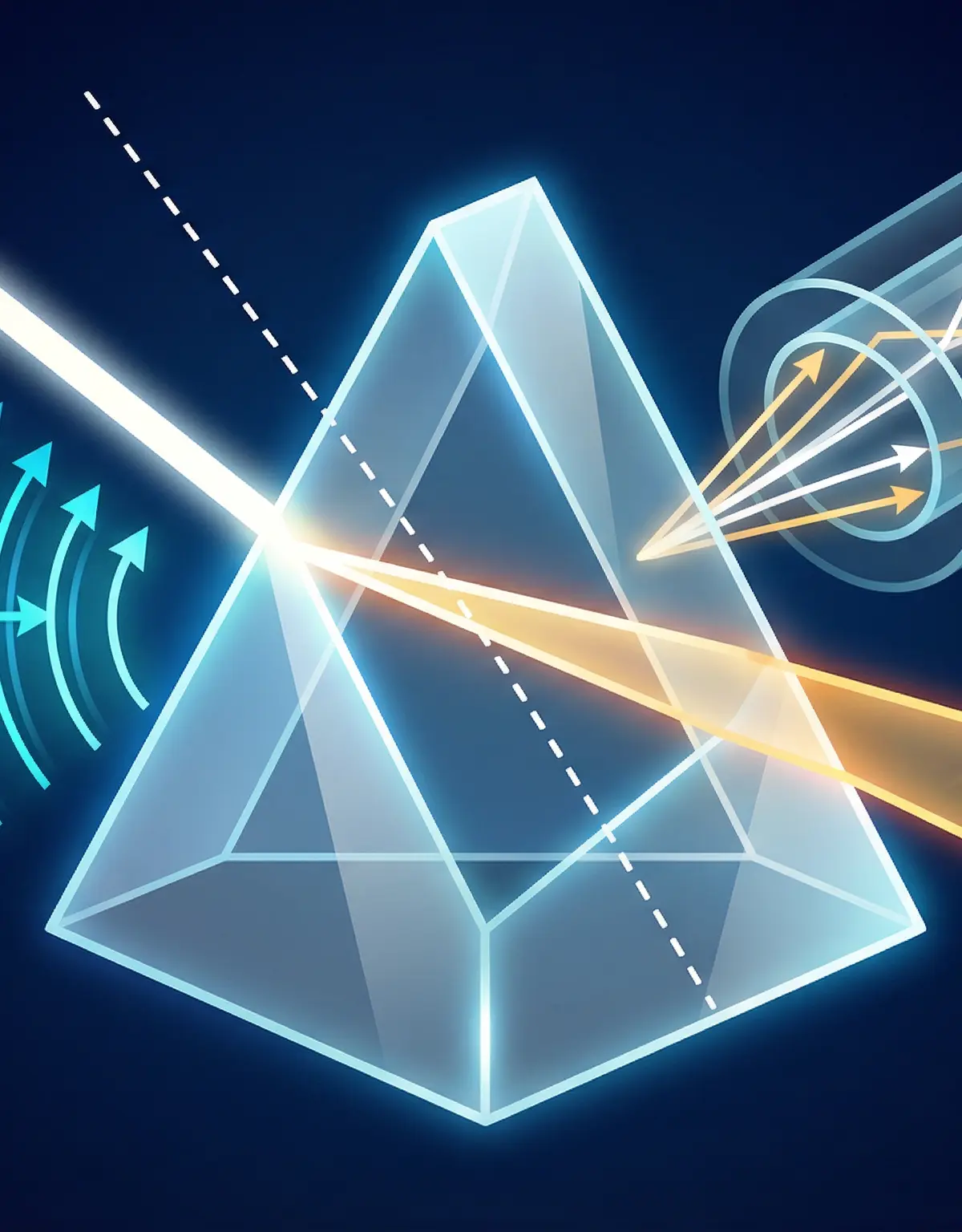
Welcome to your guide for WJEC A-Level Physics Unit 3.1: Waves and Refraction. This topic explores the fascinating behaviour of waves as they pass from one medium to another, a fundamental concept that underpins technologies from medical endoscopes to global telecommunications. In the exam, candidates are expected to demonstrate a rigorous understanding of the principles of refraction, apply Snell's Law with precision, and analyse the conditions for Total Internal Reflection (TIR). A significant portion of questions focuses on the practical application of these principles in step-index optical fibres, including the analysis of multipath dispersion. Mastery of this topic is crucial as it not only carries significant marks but also forms a synoptic link to other areas of physics, such as optics and modern communication systems. Expect to see a mix of calculation-based problems and descriptive questions requiring precise, mark-scoring definitions.
Key Concepts
Concept 1: Refraction and Refractive Index
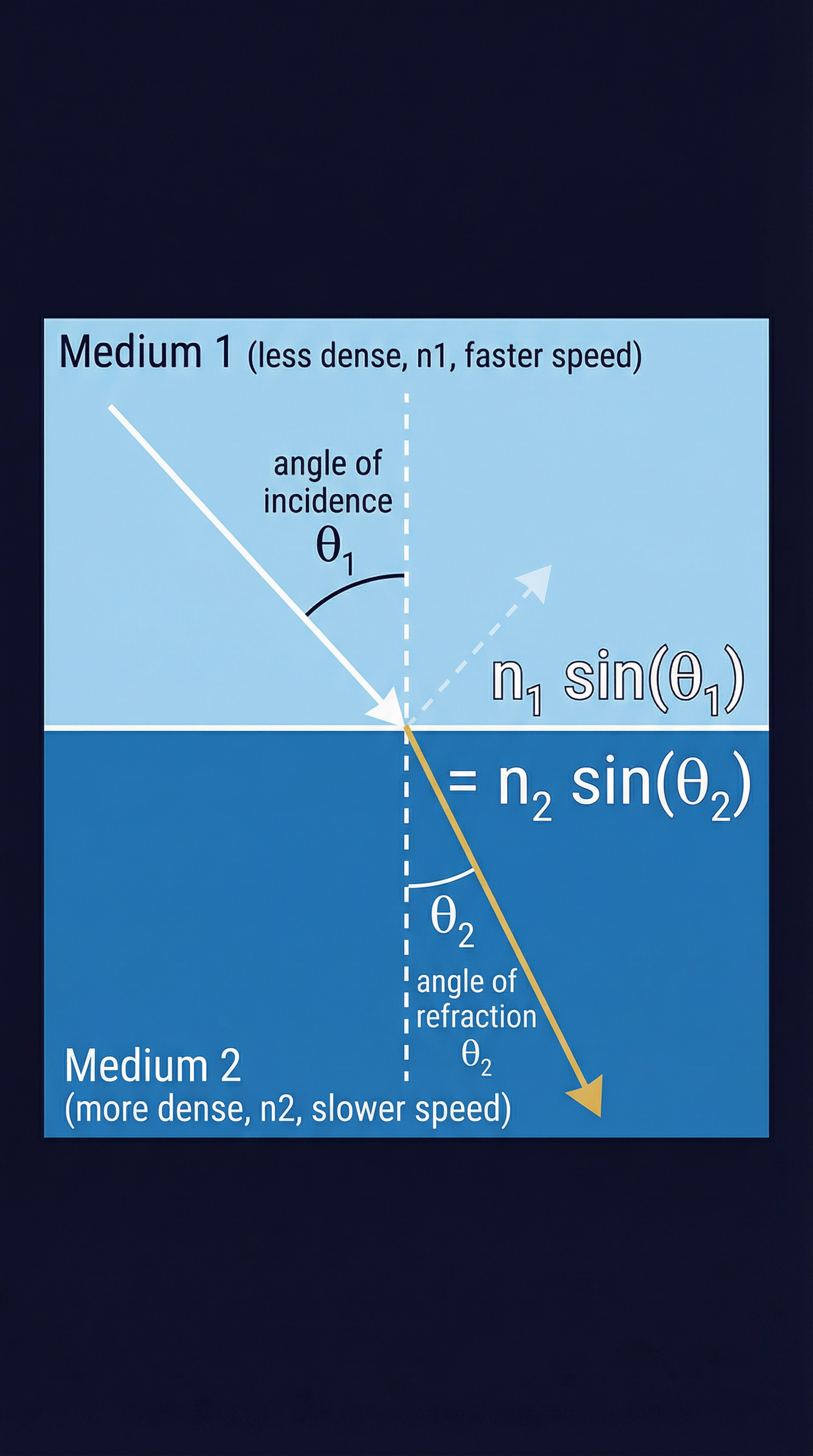
Refraction is the change in direction of a wave as it passes across the boundary between two different media. The key reason for this, and a point that examiners award direct marks for, is the change in the wave's speed. When a wave enters a more optically dense medium, it slows down and bends towards the normal. Conversely, when it enters a less optically dense medium, it speeds up and bends away from the normal.
Analogy: Imagine pushing a lawnmower from a smooth patio onto a patch of thick grass at an angle. The wheel that hits the grass first slows down, while the other continues at its original speed, causing the lawnmower to pivot. The wave behaves in the same way.
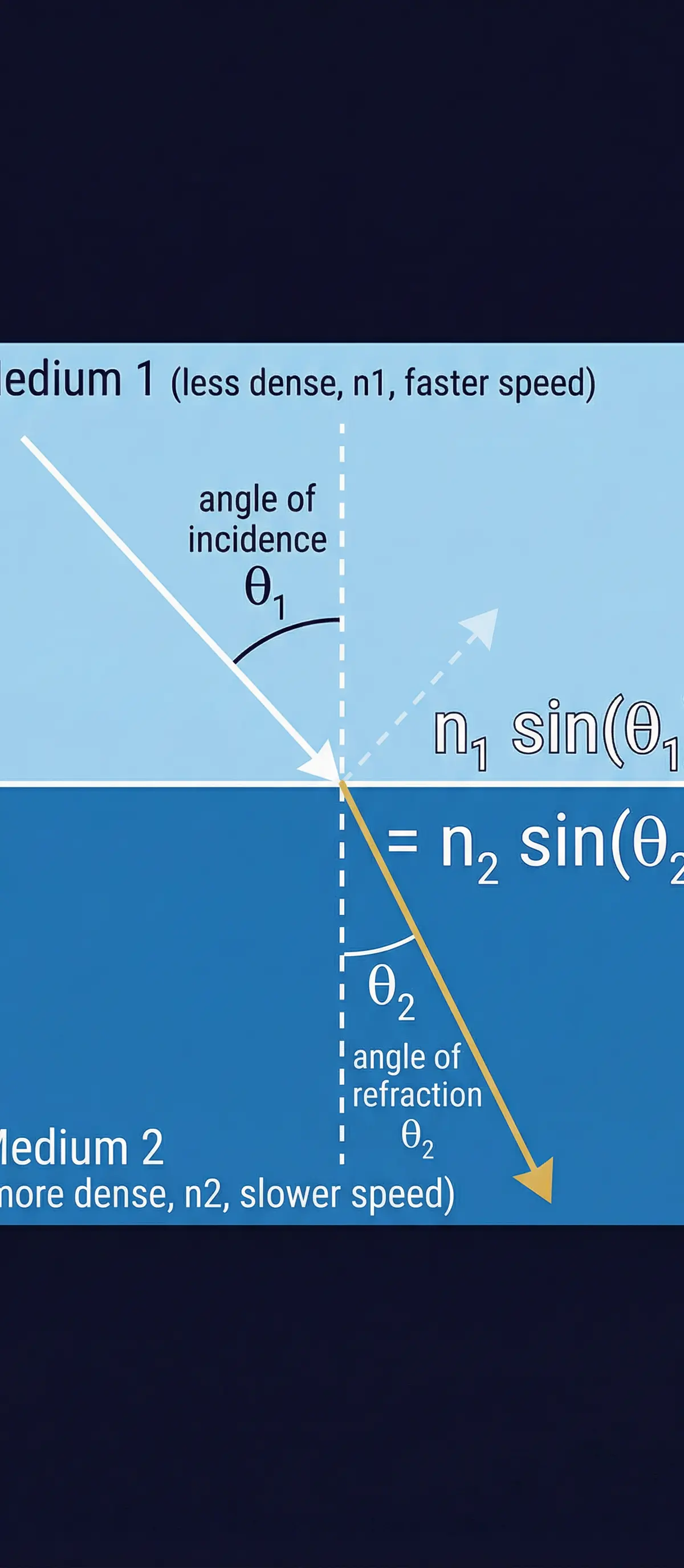
The refractive index (n) of a medium is a dimensionless number that describes how much light slows down in that medium. It is defined as the ratio of the speed of light in a vacuum (c) to the speed of light in the medium (v).
Example: The refractive index of water is approximately 1.33. This means light travels 1.33 times slower in water than it does in a vacuum.
Concept 2: Snell's Law
Snell's Law is the formula that allows us to calculate exactly how much a wave will bend. It provides a mathematical relationship between the angles of incidence and refraction and the refractive indices of the two media.
Examiner Tip: Always measure angles from the normal, not the surface boundary. This is the most common source of lost marks in calculations.
Concept 3: Total Internal Reflection (TIR) and the Critical Angle
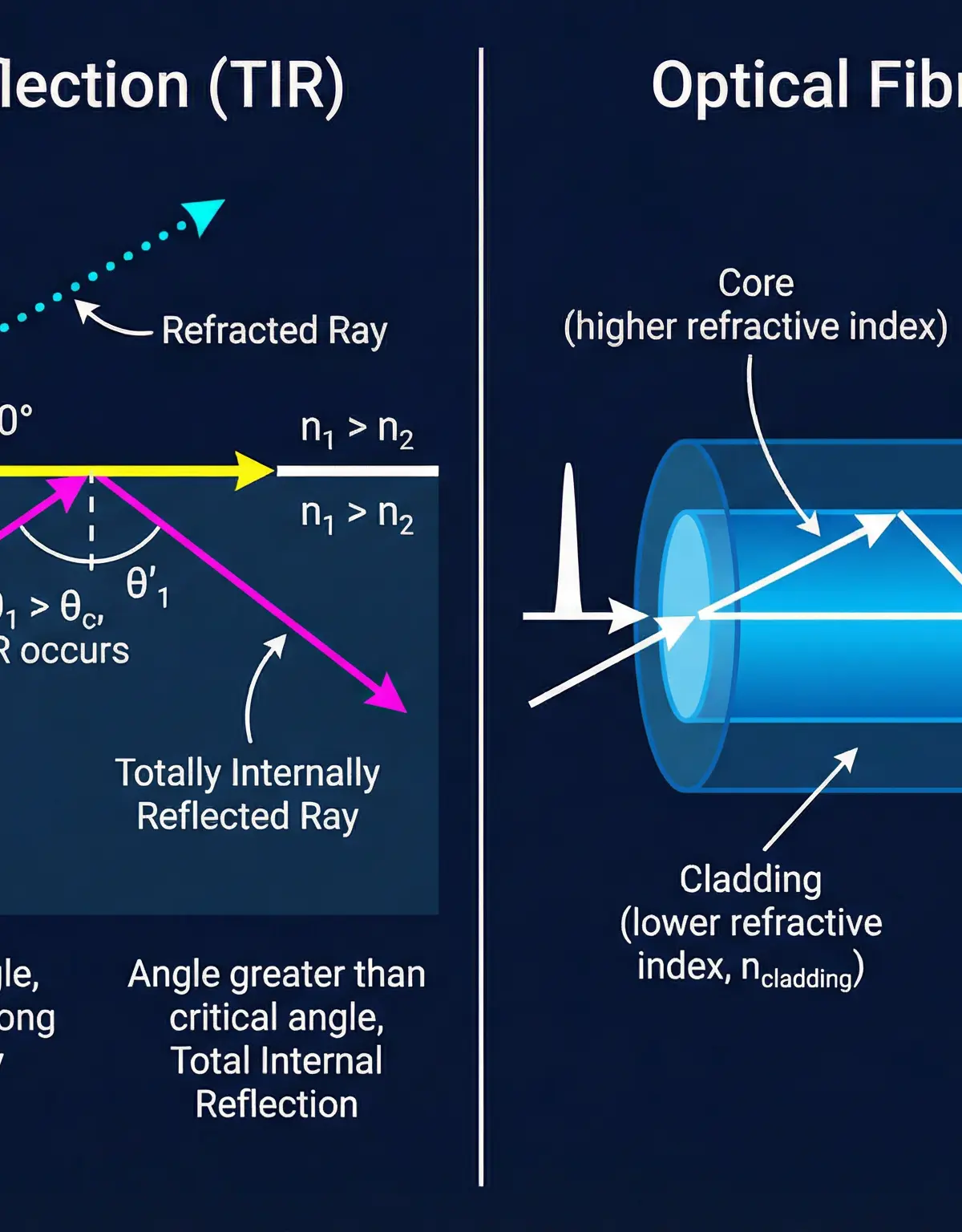
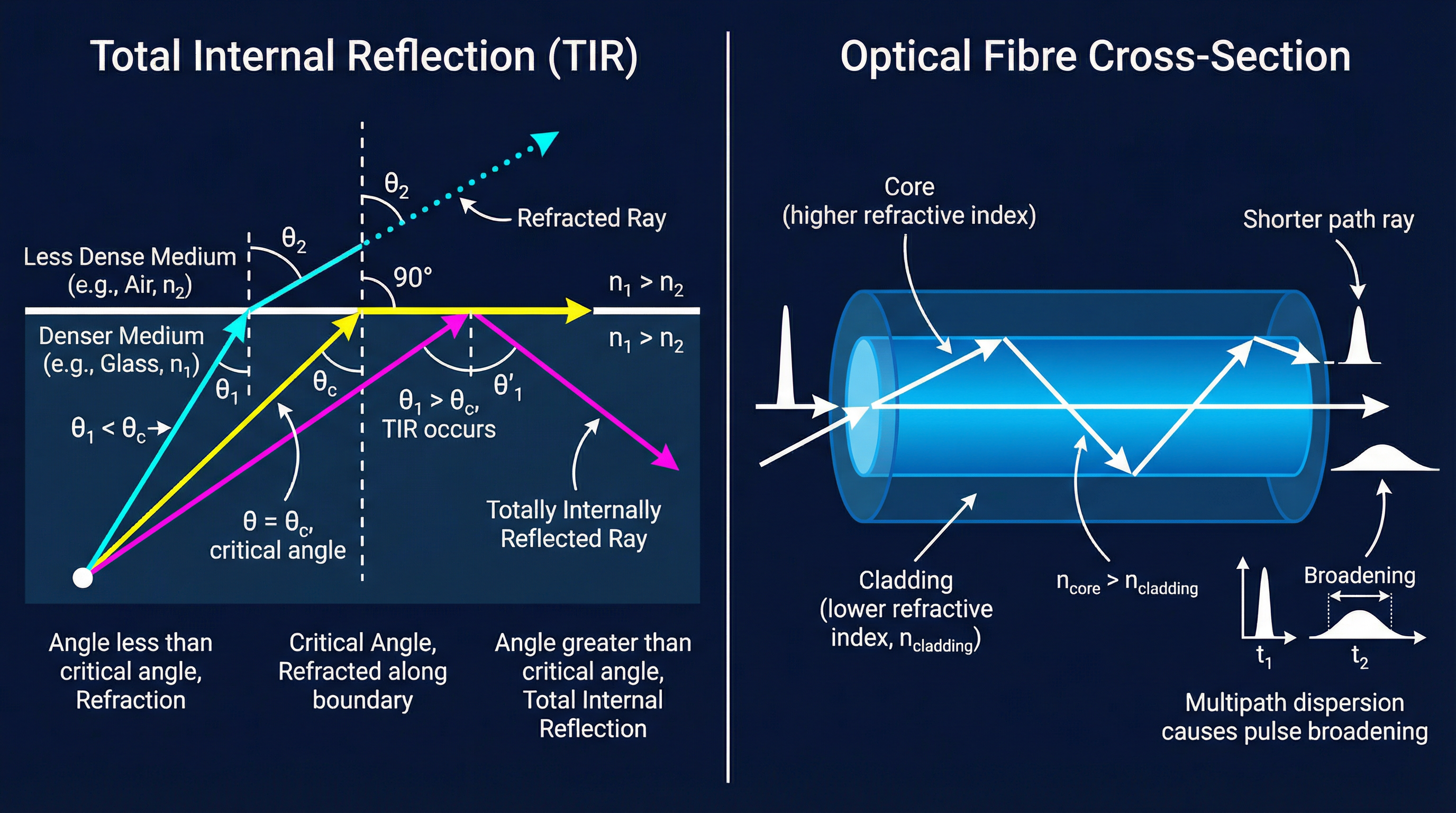
When light travels from a more optically dense medium to a less optically dense one (e.g., from glass to air), it bends away from the normal. As the angle of incidence increases, the angle of refraction gets closer to 90 degrees. The critical angle (C or θc) is defined as the specific angle of incidence in the denser medium for which the angle of refraction is exactly 90 degrees.
If the angle of incidence is greater than the critical angle, no refraction occurs. Instead, all the light is reflected back into the denser medium. This phenomenon is called Total Internal Reflection (TIR).
For TIR to occur, two conditions MUST be met:
- The light must be travelling from a more optically dense medium to a less optically dense medium (n1 > n2).
- The angle of incidence must be greater than the critical angle (θ1 > C).
Concept 4: Step-Index Optical Fibres
A step-index optical fibre is a practical application of TIR. It consists of a central core made of glass with a high refractive index (n_core), surrounded by a layer of cladding with a slightly lower refractive index (n_cladding). Light signals entering the core strike the core-cladding boundary at an angle greater than the critical angle, undergoing TIR and bouncing along the fibre over vast distances.
However, a problem arises in multimode fibres called multipath dispersion. Different rays of light (modes) take different paths along the fibre. A ray travelling straight down the axis takes the shortest path, while a ray bouncing at a steep angle travels a much longer distance. This means that a single, sharp pulse of light sent into the fibre becomes spread out, or broadened, by the time it reaches the other end. This pulse broadening limits the maximum frequency of pulses and therefore the rate of data transmission.
Mathematical/Scientific Relationships
-
Refractive Index:
n = c / vn: refractive index (dimensionless)c: speed of light in a vacuum (≈ 3.00 x 10^8 m/s) - Given on formula sheetv: speed of light in the medium (m/s)- Status: Must memorise definition
-
Snell's Law:
n1 * sin(θ1) = n2 * sin(θ2)n1,n2: refractive indices of medium 1 and medium 2θ1,θ2: angle of incidence and angle of refraction, measured from the normal- Status: Given on formula sheet
-
Critical Angle:
sin(C) = n2 / n1(where n1 > n2)C: critical anglen1: refractive index of the denser mediumn2: refractive index of the less dense medium- Status: Must be derived from Snell's Law in 'Show that' questions
Practical Applications
- Telecommunications: Optical fibres form the backbone of the internet, carrying vast amounts of data as pulses of light.
- Medicine: Endoscopes use bundles of optical fibres to transmit light into the body and carry an image back out, allowing for minimally invasive surgery and diagnosis.
- Decorative Lighting: Fibre optic lamps use TIR to create points of light at the end of each fibre.
- Refractometers: Instruments used in industries like brewing and gemology to measure the refractive index of substances to determine their concentration or authenticity.
Visual Resources
2 diagrams and illustrations
Interactive Diagrams
2 interactive diagrams to visualise key concepts
Conceptual Flow Outline
A flowchart showing the conditions that determine whether refraction or Total Internal Reflection will occur at a boundary.
Diagram could not be rendered
A sequence diagram illustrating how multipath dispersion in an optical fibre causes an input pulse to broaden over time.
Worked Examples
3 worked examples — open one to explore the question and available guidance.
Practice Questions
Test your understanding — click to reveal model answers
State the two conditions necessary for total internal reflection to occur. [2 marks]
A submarine in the sea (n=1.38) shines a light beam upwards towards the surface. At what angle to the vertical must the beam be shone for it to refract exactly along the sea-air interface? [3 marks]
Hint: The question is asking you to calculate the critical angle for the sea-air boundary. Assume the refractive index of air is 1.00.
Explain why a diamond (n=2.42) sparkles more than a piece of glass (n=1.52) of the same shape. [4 marks]
Hint: Think about the critical angle for both materials when they are in air (n=1.00). How does this affect how light behaves inside them?
A 5.0 km long optical fibre has a core refractive index of 1.50. A ray of light travels straight down the axis, and another travels at the critical angle of 82°. Calculate the time difference between the two rays arriving at the end of the fibre. [6 marks]
Hint: First, find the speed of light in the core. Then, find the path length of the ray travelling at the critical angle. Finally, calculate the time for each path.
Describe an experiment to determine the refractive index of a glass block. [5 marks]
Hint: This is a required practical. Think about the equipment you would use and the measurements you would take.
Test your understanding of Waves and Refraction
Active recall beats re-reading. Take an instant quiz now to test what you’ve learned and lock it into long-term memory.
7 days Premium · Then free forever · No card, no charge