WJEC · GCSE · Physics
Forces and Motion
This topic bridges the gap between basic motion and advanced mechanics, covering how objects move in two dimensions and how to analyse complex motion using graphs. Mastering these concepts is essential for tackling high-mark questions on projectile motion and non-uniform acceleration."
- 4 min read
- 3 worked examples
- 5 practice questions
Study Notes

Overview
Further Motion Concepts (Topic 2.4) is a pivotal section of the A-Level Physics specification. It extends your understanding of kinematics from simple 1D motion to more complex 2D scenarios and non-uniform acceleration. This topic is not just about memorising equations; it's about developing a deep conceptual understanding of how forces and motion interact in the real world.
Examiners frequently test this area with multi-stage calculation questions and graphical analysis tasks. You will be expected to derive information from velocity-time graphs, resolve vectors to solve projectile motion problems, and apply the SUVAT equations in novel contexts. Success here requires precision: knowing when to use which equation, how to handle vector components independently, and how to interpret the physical meaning of graphical features like gradients and areas.
Key Concepts
Concept 1: Non-Uniform Acceleration and Graphs
In earlier topics, you dealt mainly with constant acceleration. Real-world motion often involves changing acceleration. The velocity-time (v-t) graph is your most powerful tool here.
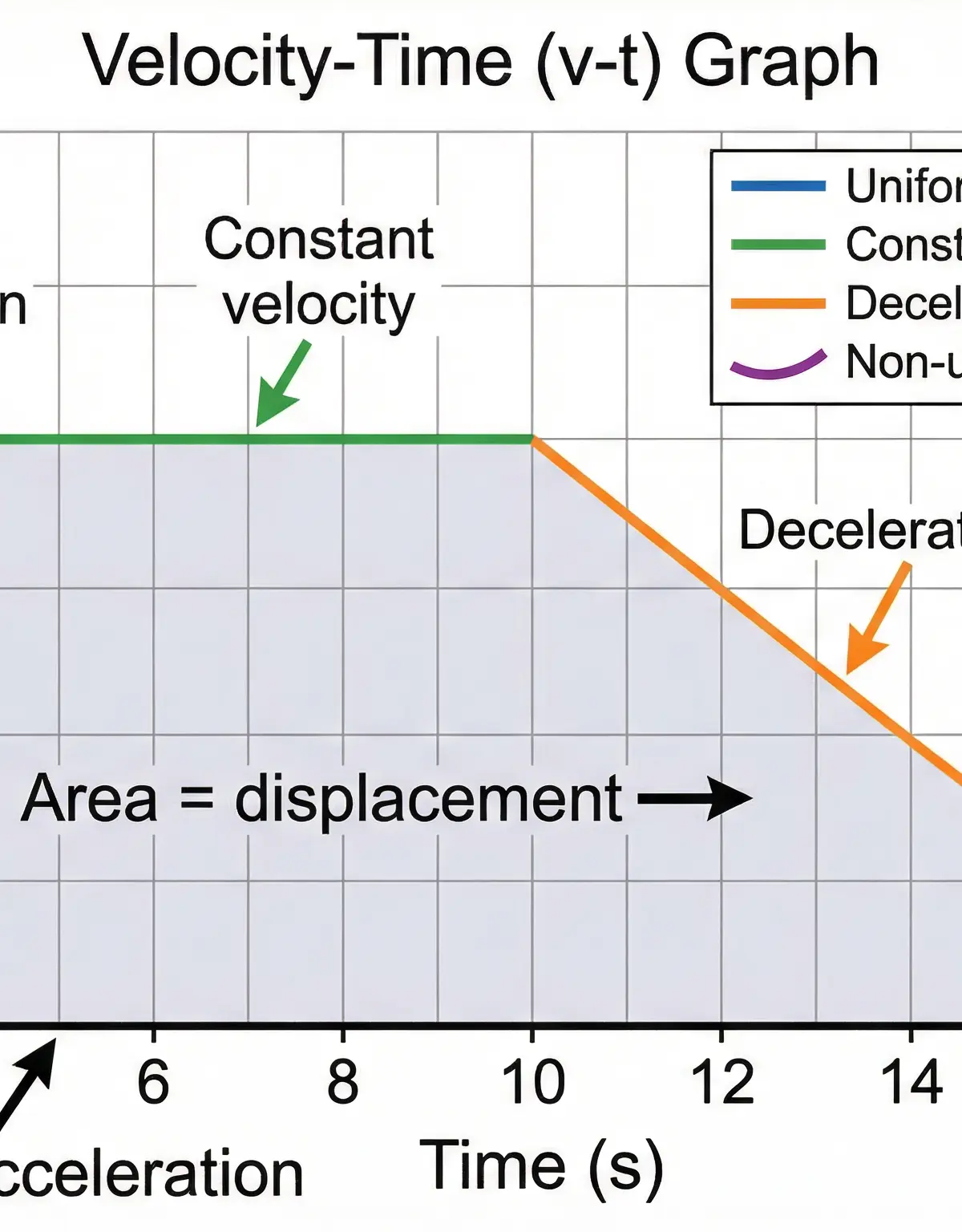
- Gradient = Acceleration: The slope of the line at any point represents the acceleration. A straight line means constant acceleration. A curved line means changing acceleration. To find the instantaneous acceleration on a curve, you must draw a tangent and calculate its gradient.
- Area = Displacement: The area between the graph line and the time axis represents displacement. For straight-line segments, split the area into rectangles and triangles. For curved lines, you might need to count squares (in an exam context) or use integration (in further maths contexts).
Examiner Tip: Be careful with negative velocity. If the graph goes below the x-axis, the object is moving in the opposite direction. The area below the axis represents negative displacement.
Concept 2: Projectile Motion
Projectile motion occurs when an object is launched into the air and is subject only to the force of gravity (ignoring air resistance). The key to solving these problems is the Principle of Independence of Motion: horizontal and vertical motions are completely independent of each other.
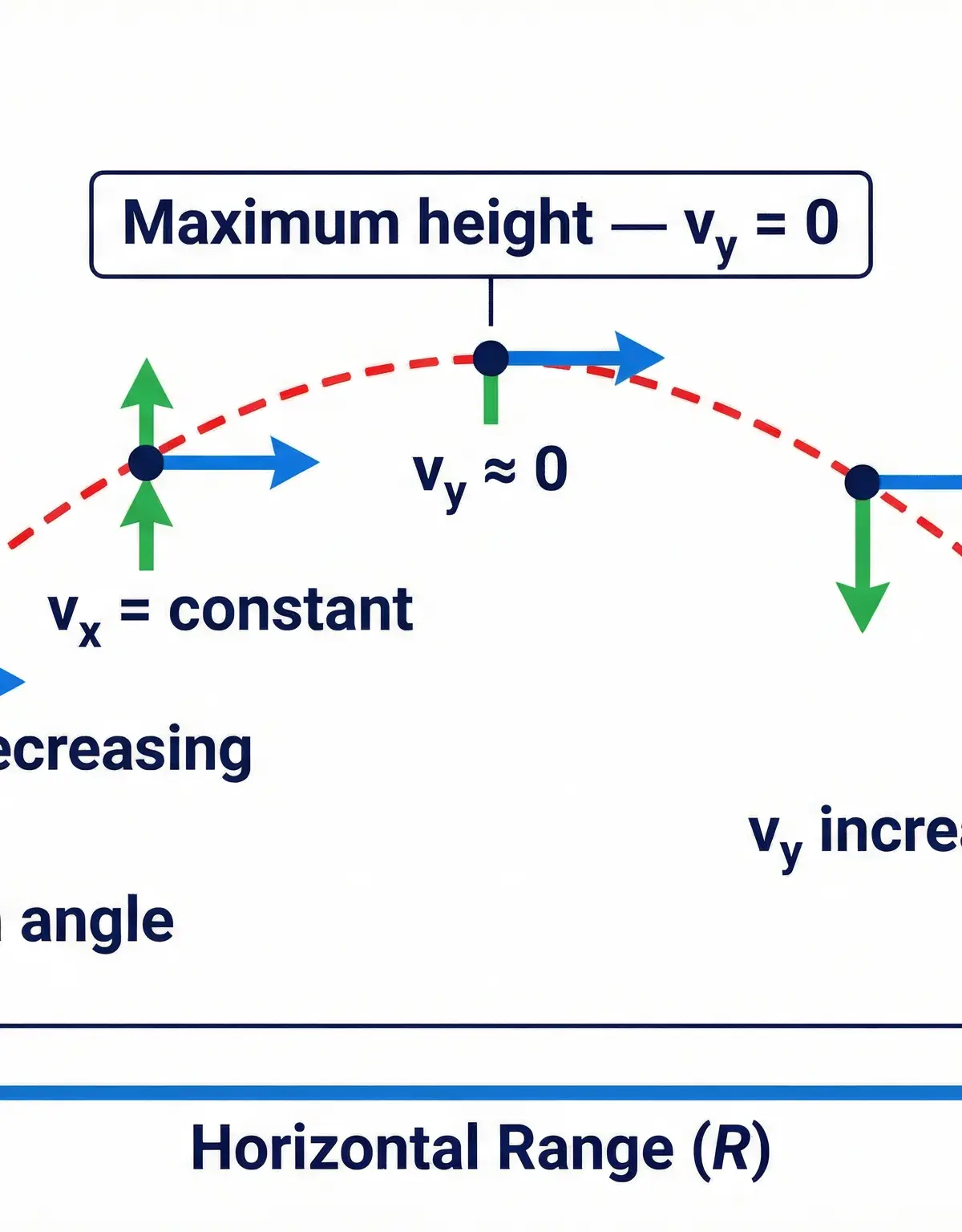
- Horizontal Motion: There is no acceleration horizontally (a_x = 0). Therefore, horizontal velocity (v_x) is constant. Distance = Speed × Time.
- Vertical Motion: Gravity acts downwards, causing a constant acceleration of g = 9.81 , ext{m/s}^2. You must use the SUVAT equations for the vertical component.
Example: A ball kicked at an angle \theta. You must first resolve the initial velocity u into components:
- u_x = u \cos \theta
- u_y = u \sin \theta
Concept 3: The SUVAT Equations
The equations of constant acceleration (SUVAT) are your toolkit. You must memorise them and know when to apply each one based on the variables you have (s, u, v, a, t).
- v = u + at
- s = ut + \frac{1}{2}at^2
- v^2 = u^2 + 2as
- s = \frac{(u+v)}{2}t
Crucial Constraint: These equations ONLY apply when acceleration (a) is constant. If a changes, you cannot use them directly.
Mathematical/Scientific Relationships
Resolving Vectors
For a velocity vector v at angle \theta to the horizontal:
- Horizontal component: v_x = v \cos \theta
- Vertical component: v_y = v \sin \theta
- Magnitude: v = \sqrt{v_x^2 + v_y^2}
- Direction: \theta = \tan^{-1}(\frac{v_y}{v_x})
Projectile Equations
- Time to max height: t = \frac{u \sin \theta}{g}
- Max height (H): H = \frac{(u \sin \theta)^2}{2g}
- Horizontal range (R): R = u_x \times \text{total time}
Practical Applications
- Sports Science: Analysing the trajectory of a basketball, golf ball, or javelin to optimise launch angle for maximum range (theoretically 45^\circ without air resistance).
- Ballistics: Calculating the path of projectiles for targeting.
- Safety Engineering: Designing crash barriers and crumple zones relies on understanding deceleration and impact forces from velocity-time data."
Worked Examples
3 worked examples — open one to explore the question and available guidance.
Practice Questions
Test your understanding — click to reveal model answers
A stone is thrown horizontally from the top of a 50m high cliff with a speed of 15 , ext{m/s}. Calculate how far from the base of the cliff the stone lands.
Hint: Calculate the time to fall 50m first using vertical motion. Then use that time for the horizontal distance.
Explain why the horizontal component of a projectile's velocity remains constant, while the vertical component changes.
A particle moves with non-uniform acceleration. Describe how you would find its velocity from its acceleration-time graph.
Derive the equation v^2 = u^2 + 2as using the other SUVAT equations.
A ball is thrown at 20 , ext{m/s} at 60^\circ. Calculate the time of flight.",
"marks": 3
Test your understanding of Forces and Motion
Active recall beats re-reading. Take an instant quiz now to test what you’ve learned and lock it into long-term memory.
7 days Premium · Then free forever · No card, no charge