Pearson Edexcel · GCSE · Psychology
The Self
Topic 8 sits at the heart of the Edexcel GCSE Psychology specification, asking a deceptively simple question: who are we, and how do we come to know ourselves? Candidates must master two contrasting explanations — Rogers' optimistic, humanistic model of self-actualisation and congruence versus Eysenck's deterministic, biologically-rooted PEN model — and apply Dweck's mindset theory and the Van Houtte and Jarvis (1995) study to real-world scenarios. Examiners consistently reward students who can distinguish precisely between self-concept and self-esteem, apply theories to novel scenarios with named quotation, and evaluate using the State-Explain-Consequence chain.
- 9 min read
- 5 worked examples
- 6 practice questions
- 10 key terms
Study Notes
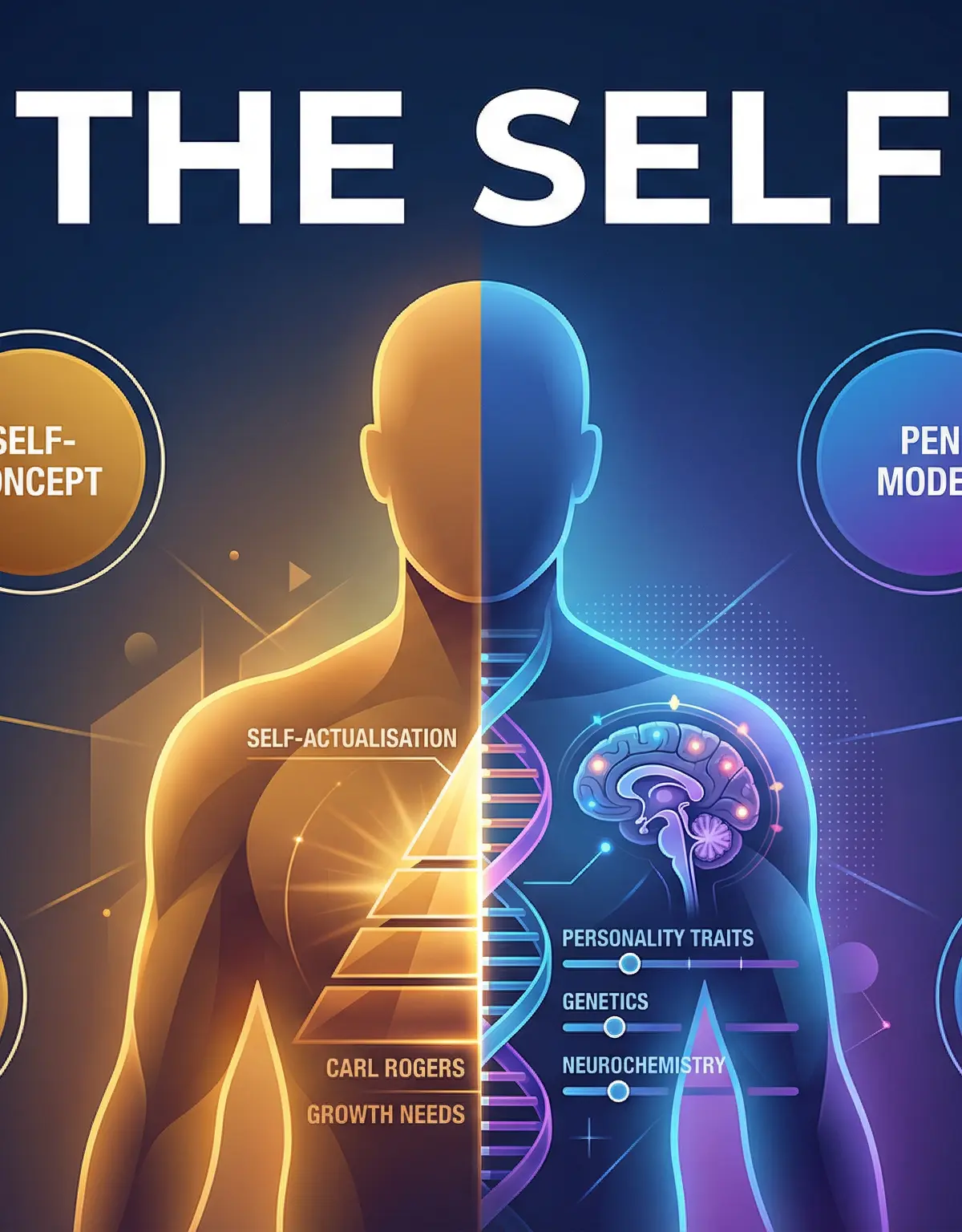
Overview
Topic 8 of the Edexcel GCSE Psychology specification centres on one of the most fundamental questions in psychology: how do we understand and develop a sense of self? Candidates are required to engage with two competing theoretical frameworks. The Humanistic approach, represented by Carl Rogers, argues that the self is a dynamic, growth-oriented construct shaped by experience, relationships, and the drive towards self-actualisation. In contrast, the Biological approach, represented by Hans Eysenck, proposes that personality — and therefore the self — is largely determined by genetics and neurological structure. Examiners expect candidates to demonstrate precise definitional knowledge (AO1), confident application to scenarios (AO2), and critical evaluation that engages with debates such as free will versus determinism (AO3). The AO weighting is 35% AO1, 35% AO2, and 30% AO3, meaning application and evaluation are just as important as factual recall.
Key Theories & Developments
Rogers' Humanistic Theory of the Self
Theorist: Carl Rogers (1902–1987)
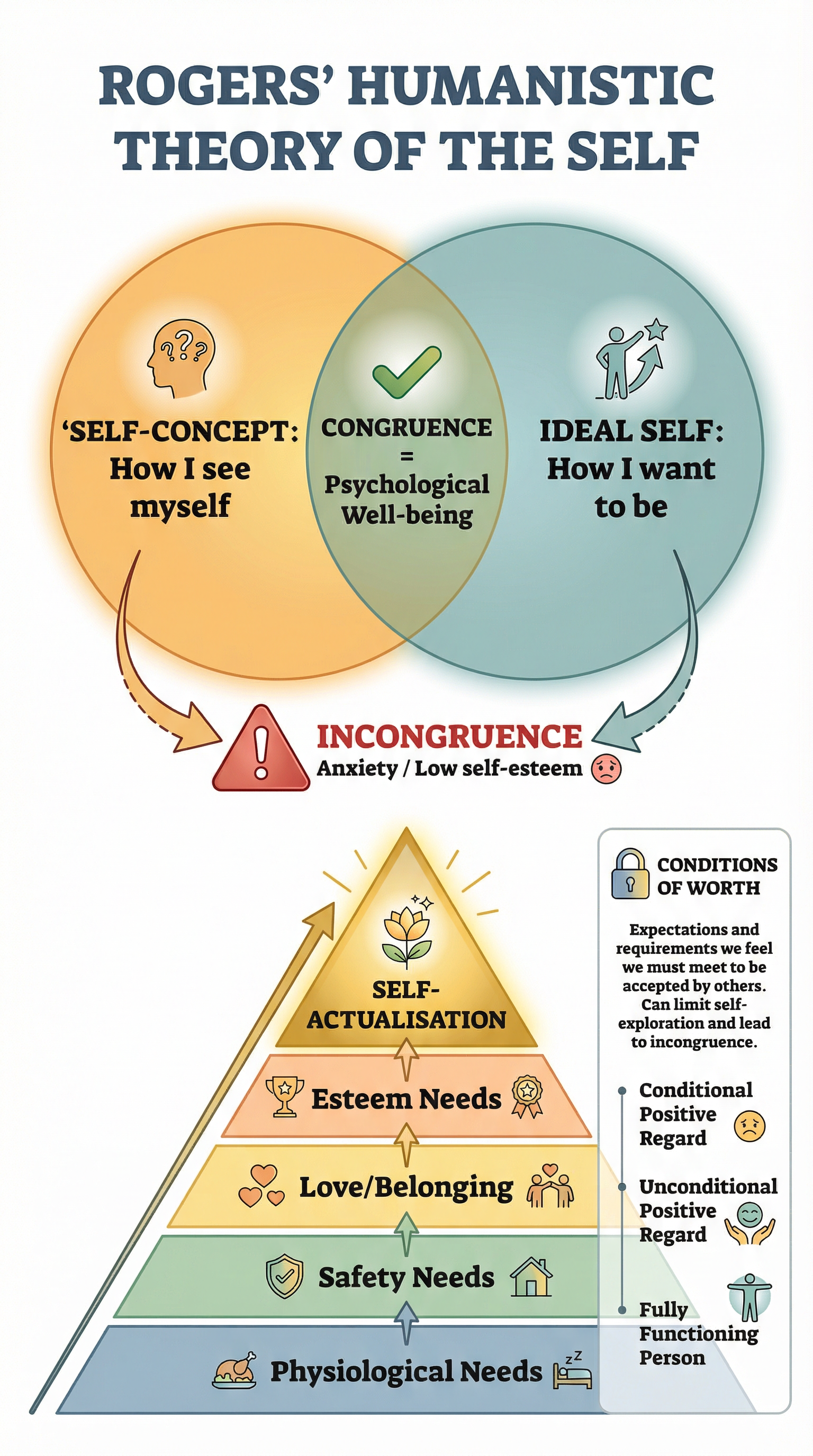
Core Idea: Rogers believed every human being has an innate drive towards growth and fulfilment, which he called self-actualisation — the process of becoming the best version of oneself. Central to this is the concept of the self, which Rogers divided into three components: the self-concept (how you actually see yourself), the ideal self (the person you aspire to be), and the real self (who you genuinely are).
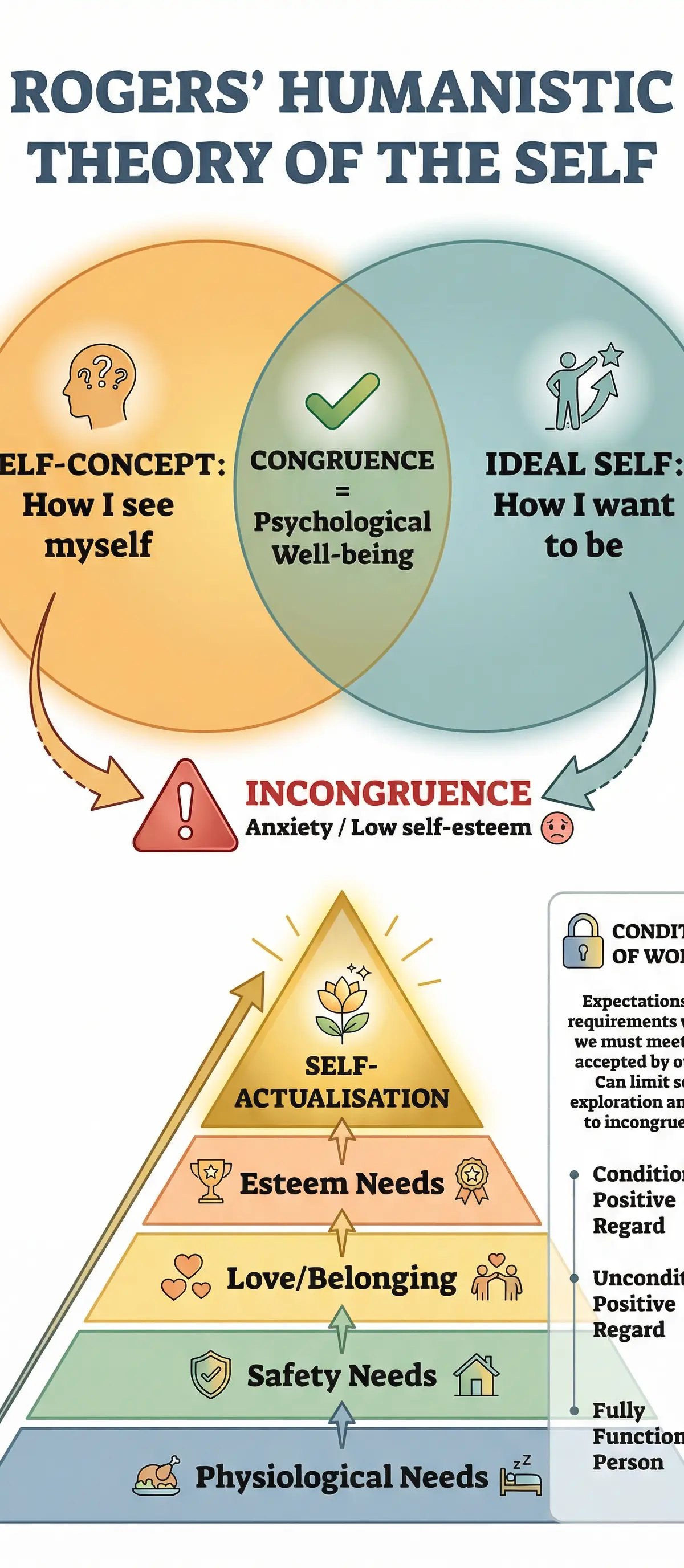
Congruence and Incongruence: When the self-concept and ideal self are closely aligned, a state of congruence exists. Rogers argued this is associated with high self-esteem, psychological well-being, and progress towards self-actualisation. When a significant gap exists between the two, incongruence results, producing anxiety, low self-worth, and psychological distress.
Conditions of Worth: Rogers argued that congruence is undermined when significant others (especially parents) offer conditional positive regard — love and acceptance that depends on meeting certain standards. For example, a child told 'I am only proud of you when you succeed' internalises these conditions of worth, distorting their self-concept to match external expectations rather than their authentic self. The antidote is unconditional positive regard: accepting a person fully, regardless of their behaviour.
Why It Matters for the Exam: AO2 questions will present a scenario (e.g., a student who only feels valued when achieving top grades) and ask candidates to apply Rogers' theory. Candidates must name the character, quote the scenario, and use precise terminology such as 'conditions of worth' and 'incongruence'.
Eysenck's Biological Theory of Personality (PEN Model)
Theorist: Hans Eysenck (1916–1997)
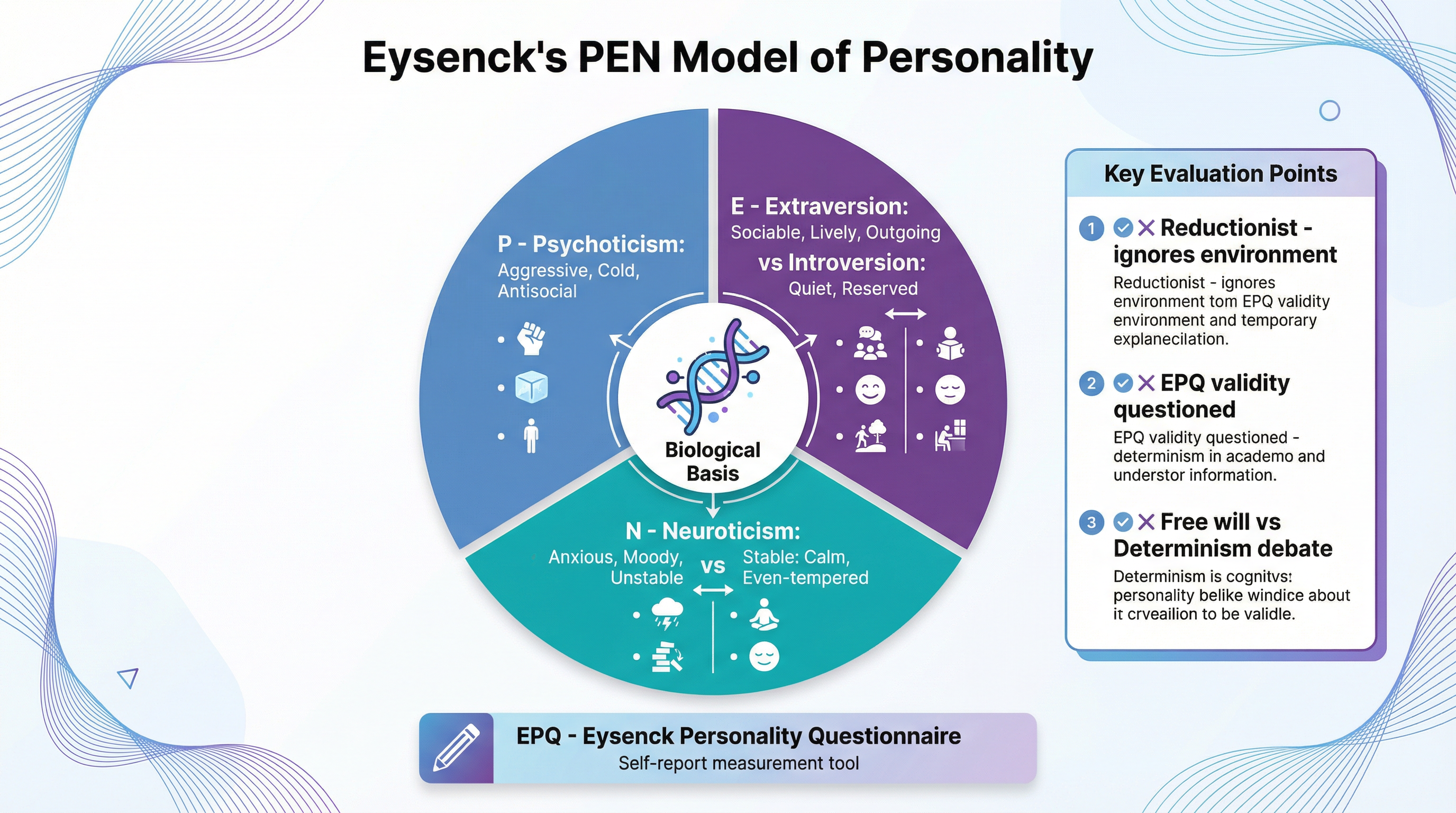
Core Idea: Eysenck proposed that personality is fundamentally biological in origin, rooted in the structure and functioning of the nervous system. He developed the PEN model, which identifies three core personality dimensions.
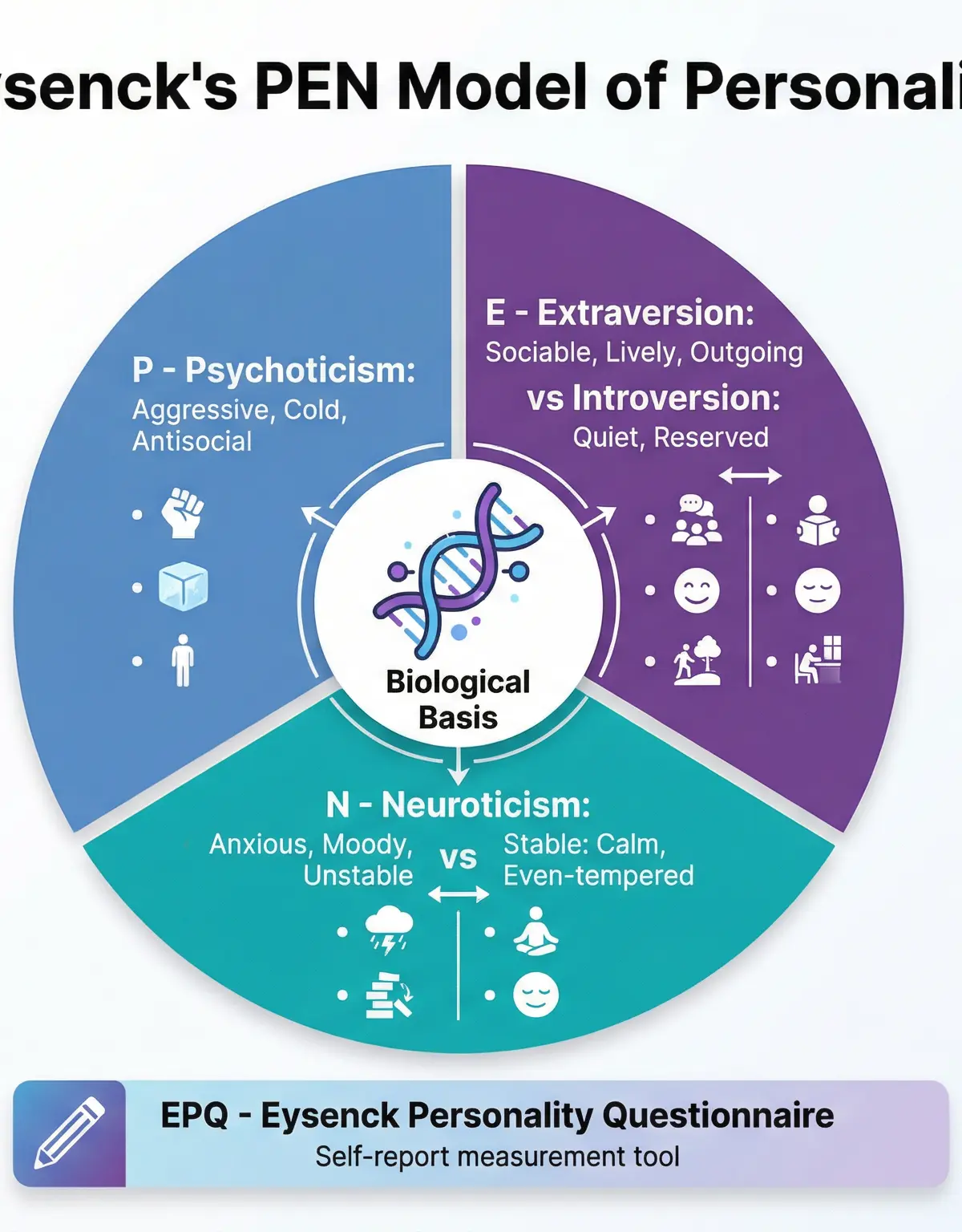
| Dimension | High Score Characteristics | Low Score Characteristics |
|---|---|---|
| P — Psychoticism | Aggressive, cold, antisocial, impulsive | Empathetic, cooperative, conventional |
| E — Extraversion | Sociable, lively, outgoing, sensation-seeking | Quiet, reserved, introverted, cautious |
| N — Neuroticism | Anxious, moody, emotionally unstable | Calm, even-tempered, emotionally stable |
Biological Basis: Eysenck linked extraversion to cortical arousal levels, suggesting extraverts have a chronically under-aroused nervous system and therefore seek external stimulation. Neuroticism was linked to the reactivity of the limbic system. These are inherited traits, making the theory deterministic — your personality is shaped by your biology, not your choices.
Measurement — The EPQ: Eysenck developed the Eysenck Personality Questionnaire (EPQ), a self-report measure that places individuals on each of the three dimensions. Candidates must know this tool by name for AO1 marks.
Critical Evaluation: The theory is criticised as biologically reductionist (reducing complex personality to three dimensions), and the EPQ has questionable validity as a self-report measure (social desirability bias). Crucially, the theory sits firmly on the determinism side of the free will vs determinism debate — a key AO3 evaluation point.
Dweck's Mindset Theory
Theorist: Carol Dweck (b. 1946)
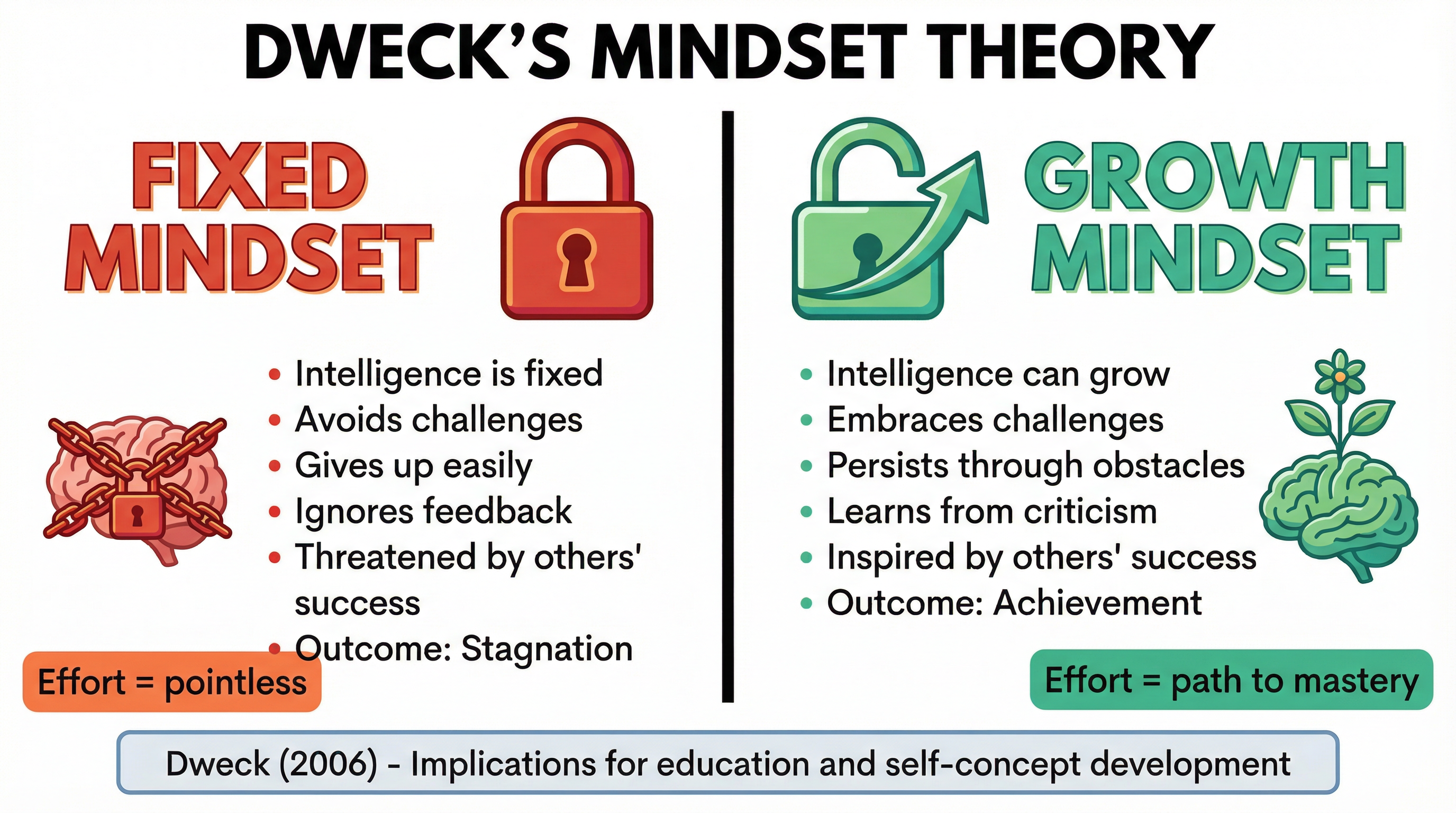
Core Idea: Dweck's research identified two fundamental beliefs people hold about their own intelligence and abilities, which she termed mindsets.
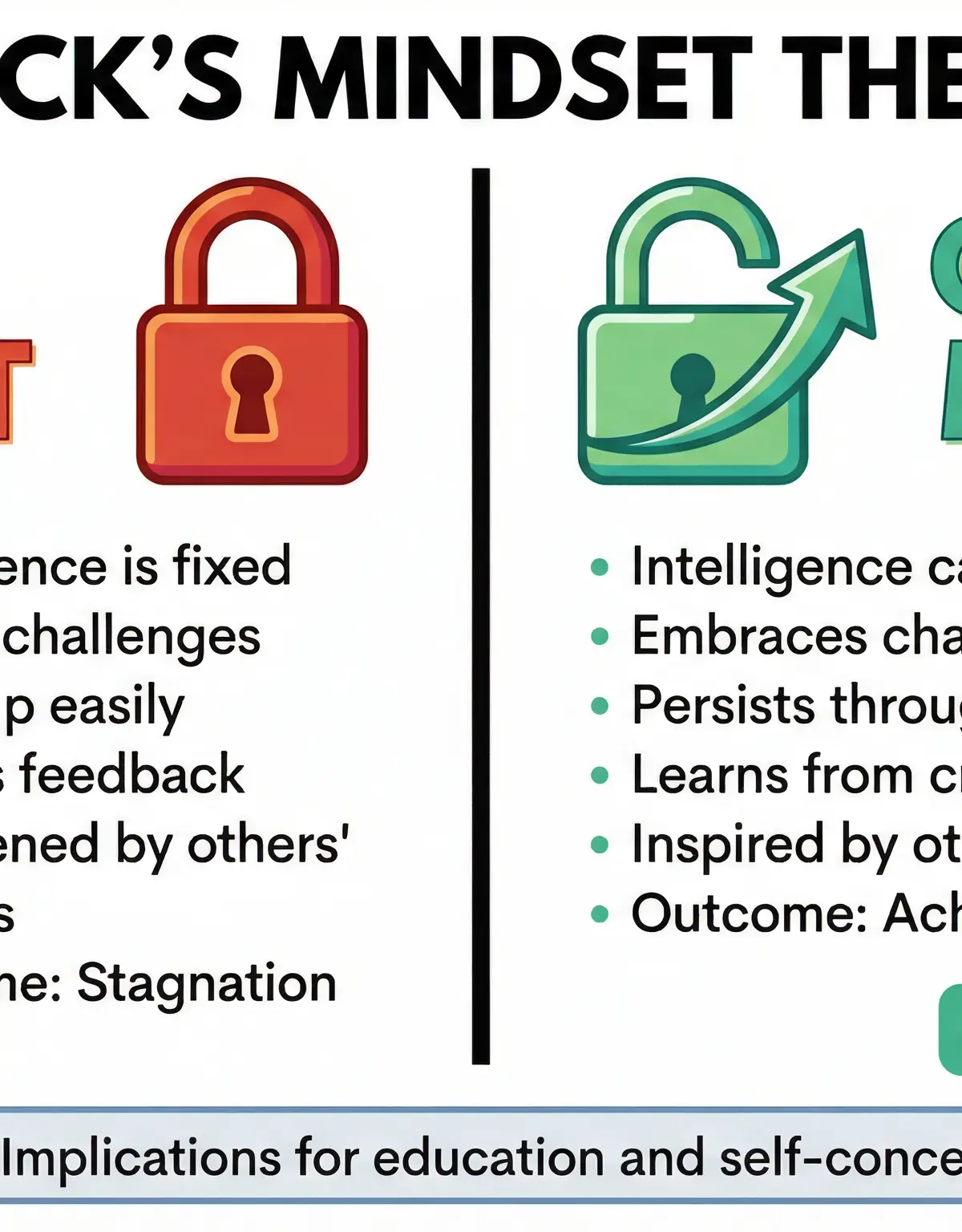
Fixed Mindset: The belief that intelligence is a fixed, innate trait — you either have it or you do not. Individuals with a fixed mindset avoid challenges (to protect their self-image), give up easily, and feel threatened by others' success. This mindset is closely linked to low self-esteem and a fragile self-concept.
Growth Mindset: The belief that intelligence and ability can be developed through effort, persistence, and learning from failure. Individuals with a growth mindset embrace challenges, persist through difficulty, and are inspired by others' success. This mindset supports a positive, resilient self-concept.
Exam Application: Dweck's theory is highly applicable in school scenarios. If a character in a question says 'I'm just not a maths person' and gives up, this reflects a fixed mindset. A candidate demonstrating AO2 would explicitly name the character, quote this statement, and explain that it reflects the belief that ability is fixed and cannot be changed.
Van Houtte and Jarvis (1995) — Core Study
Researchers: Van Houtte and Jarvis
Date: 1995
Topic: The relationship between pet ownership and psychosocial development in children.
Sample: 130 children
Key Finding: Pet ownership was associated with higher levels of autonomy in fifth graders (approximately 10–11 years old). Crucially, the study did not find a significant effect on self-esteem — a distinction examiners specifically test. Pets may support autonomy by providing a relationship where children can take responsibility and make decisions without adult interference.
Common Mistake: Candidates frequently describe the procedure of the study rather than the findings. Marks are awarded for the finding (autonomy, not self-esteem) and the specific sample detail (130 children).
Key Individuals
Carl Rogers (1902–1987)
Role: Founder of the Humanistic approach to psychology; developed the theory of the self, client-centred therapy, and the concept of unconditional positive regard.
Key Contributions: Self-concept, ideal self, congruence/incongruence, conditions of worth, unconditional positive regard, self-actualisation.
Impact: Rogers' work underpins modern counselling and therapeutic practice. For the exam, his theory is the primary humanistic explanation of the self and is central to AO1 and AO2 questions.
Hans Eysenck (1916–1997)
Role: Biological psychologist; developed the PEN model of personality and the Eysenck Personality Questionnaire.
Key Contributions: PEN model (Psychoticism, Extraversion, Neuroticism), biological determinism in personality, EPQ measurement tool.
Impact: Eysenck's work represents the biological, deterministic counterpoint to Rogers. His theory is essential for AO3 evaluation, particularly regarding reductionism and the free will vs determinism debate.
Carol Dweck (b. 1946)
Role: Developmental and social psychologist; researcher into motivation, personality, and development.
Key Contributions: Fixed and growth mindset theory (published in 'Mindset: The New Psychology of Success', 2006).
Impact: Dweck's theory has had significant influence on educational practice. For the exam, it is applied to scenarios involving academic self-concept and the impact of praise and feedback.
Second-Order Concepts
Causation
The development of the self-concept is caused by a complex interplay of biological inheritance (Eysenck) and social experience (Rogers). Rogers argues that conditions of worth, imposed by caregivers, cause incongruence by distorting the authentic self-concept. Eysenck argues that the biological substrate of the nervous system causes stable personality traits that persist across situations.
Consequence
Incongruence, according to Rogers, leads to anxiety, low self-esteem, and an inability to achieve self-actualisation. A fixed mindset, according to Dweck, leads to avoidance of challenge and stagnation of ability. Eysenck's theory implies that personality consequences are largely fixed by biology, which has implications for therapeutic intervention.
Change and Continuity
A key tension in this topic is between change (Rogers' humanistic belief in growth and the capacity for self-actualisation; Dweck's growth mindset) and continuity (Eysenck's biological determinism, which implies personality traits are stable and resistant to change). This maps directly onto the free will vs determinism debate.
Significance
This topic is significant because it underpins how psychology understands mental health, education, and personal development. The debate between humanistic and biological explanations of the self reflects a broader philosophical question about human nature that has real-world implications for therapy, schooling, and parenting.
Visual Resources
3 diagrams and illustrations
Interactive Diagrams
3 interactive diagrams to visualise key concepts
Conceptual Flow Outline
Rogers' model: the relationship between self-concept, ideal self, congruence, and self-actualisation
Conceptual Flow Outline
Eysenck's PEN model: three dimensions and their biological basis
Conceptual Flow Outline
Dweck's mindset theory: fixed vs growth mindset pathways
Worked Examples
5 worked examples — open one to explore the question and available guidance.
Practice Questions
Test your understanding — click to reveal model answers
Define 'self-concept'. (1 mark)
Hint: Think about the question 'Who am I?' — self-concept is the answer to this.
Explain the difference between self-concept and self-esteem. (2 marks)
Hint: One is a description, the other is an evaluation. Think: Concept = Characterisation; Esteem = Evaluation.
Jake is 14 years old. He wants to be a top footballer (his ideal self), but he sees himself as slow and unfit (his self-concept). His parents tell him they will only take him to football training if he tidies his room every day. Using Rogers' theory, explain how Jake's self-concept might be affected. (4 marks)
Hint: Identify TWO concepts from Rogers' theory (incongruence AND conditions of worth) and apply both to Jake specifically. Quote the scenario and name Jake.
Describe the findings of Van Houtte and Jarvis (1995). (2 marks)
Hint: The key finding is about AUTONOMY, not self-esteem. Include the sample size.
Evaluate Eysenck's biological explanation of personality. (6 marks)
Hint: Use the SEC chain for each point: State the criticism, Explain why it is a problem, link to the Consequence for validity. Aim for 3 evaluation points. Link at least one point to the free will vs determinism debate.
Compare Rogers' humanistic explanation of the self with Eysenck's biological explanation. (6 marks)
Hint: Use comparative language throughout: 'Both...', 'However...', 'Whereas Rogers...', 'In contrast, Eysenck...'. Identify similarities AND differences. Consider: free will vs determinism, reductionism, and the role of environment.