AQA · A-Level · Religious Studies
Religious Experience
Dive into the profound world of Religious Experience, a core component of AQA A-Level Philosophy. This guide unpacks the essential arguments, from William James' classic analysis to Swinburne's modern defence, equipping you with the critical tools to evaluate whether personal encounters can ever truly count as evidence for God."
- 6 min read
- 8 worked examples
Study Notes
Overview
The study of religious experience is a critical area of the Philosophy of Religion, demanding that candidates move beyond mere description to rigorous philosophical analysis. Examiners are looking for a clear understanding of how personal, often ineffable, events are categorised, interpreted, and philosophically defended as evidence for the divine. This topic requires you to engage with the foundational work of William James and Rudolf Otto, who sought to define and categorise these experiences, and the robust, probability-based arguments of Richard Swinburne. Crucially, you must be able to deploy and critique the major psychological and physiological challenges from thinkers like Freud, Feuerbach, and Persinger. High-level marks are awarded not for simply listing these views, but for synthesising them into a coherent argument that evaluates the ultimate question: are religious experiences veridical (truthful) accounts of a divine reality, or are they merely complex products of the human mind? Success in this topic hinges on your ability to handle nuanced concepts and argue a consistent line of reasoning in your AO2 responses.

Key Thinkers & Developments
William James (1842-1910)
Role: American philosopher and psychologist, a key figure in the philosophical school of pragmatism.
Key Actions: Published 'The Varieties of Religious Experience' (1902), a foundational text based on his study of hundreds of first-hand accounts (the Gifford Lectures). He approached the topic as a psychologist, focusing on the observable effects of the experience on an individual's life, rather than attempting to prove or disprove their supernatural origin.
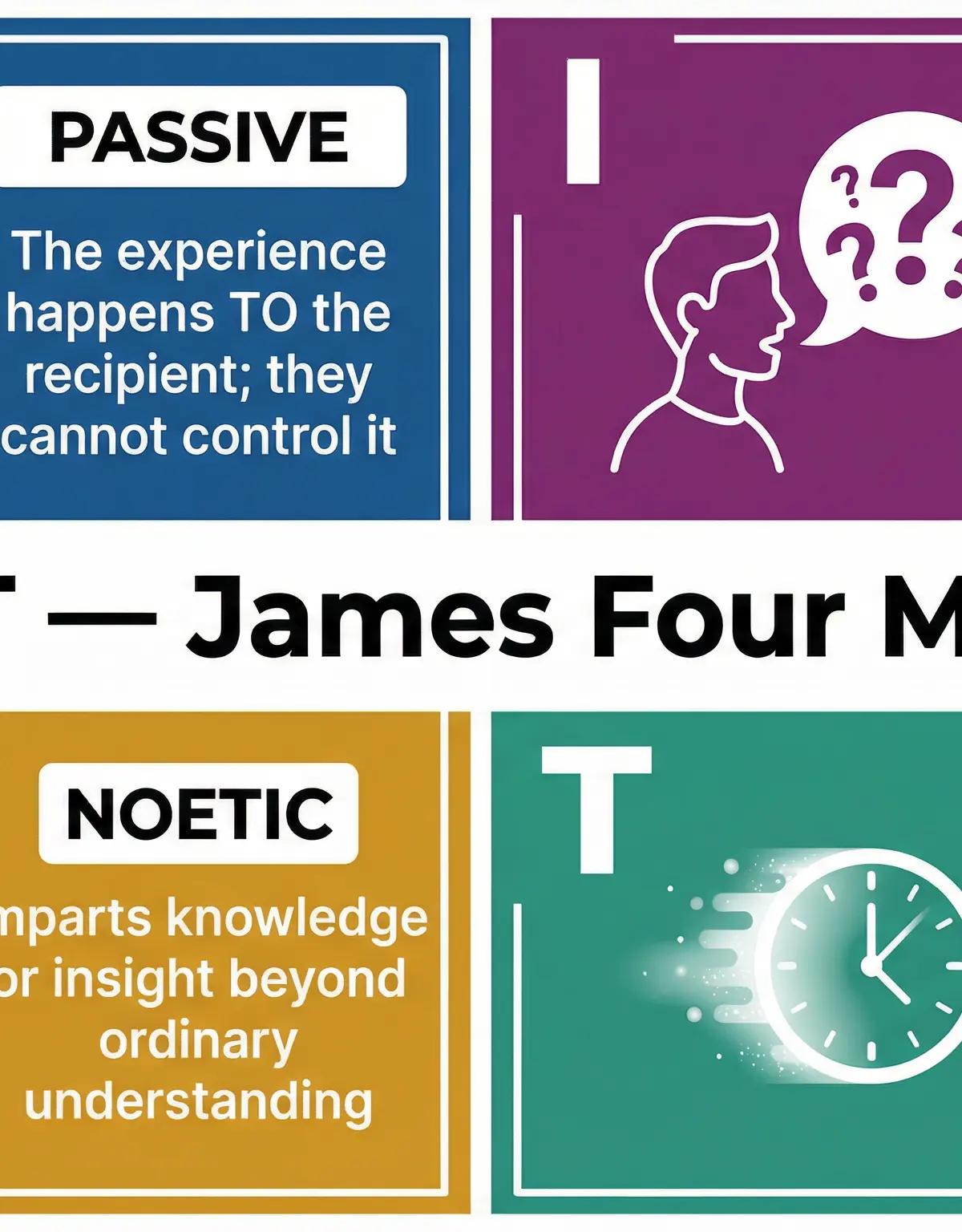
Impact: James provided the first systematic, philosophical framework for analysing mystical experiences. His four characteristics (PINT) remain the standard for classifying these events. His pragmatic conclusion - that we should judge an experience by its 'fruits' (its positive impact on a person's life) - offers a way to assess significance without getting bogged down in questions of supernatural origin. For the exam, James is your starting point for any AO1 question on the nature of religious experience.
Rudolf Otto (1869-1937)
Role: German Lutheran theologian and philosopher.
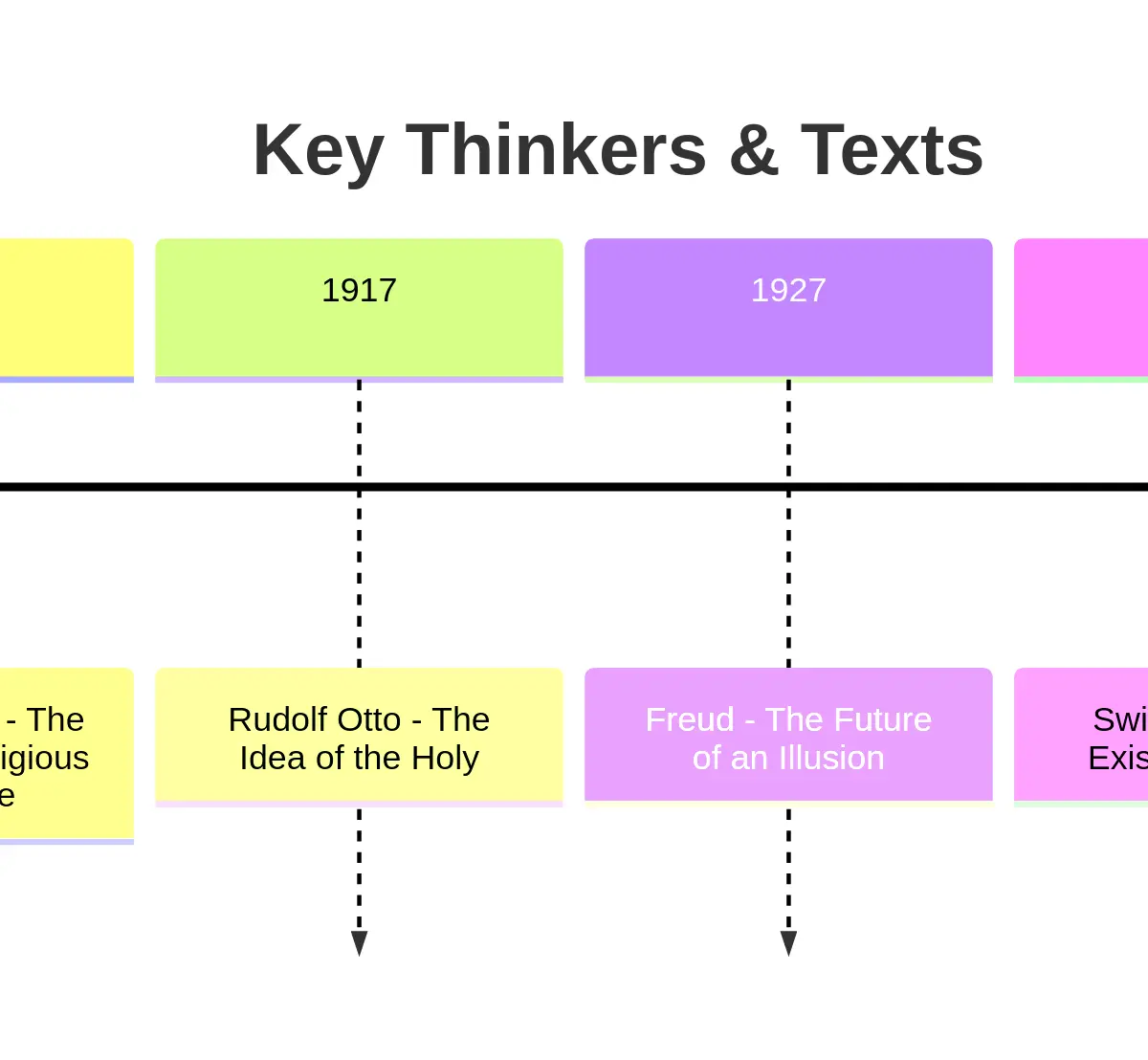
Key Actions: Published 'The Idea of the Holy' (1917), in which he coined the term numinous to describe the unique, irreducible quality of religious experience. He argued that at the heart of all religious feeling is an encounter with a "wholly other" reality.
Impact: Otto shifted the focus from the subject's psychological state to the object of the experience itself. His concept of the numinous, described as mysterium tremendum et fascinans, provides a powerful vocabulary for the awe, dread, and attraction felt in the presence of the divine. He argued that this experience is sui generis (in a class of its own) and cannot be explained away by psychology or sociology. This is a key argument against reductionist challenges.
Richard Swinburne (b. 1934)
Role: Influential British philosopher of religion at the University of Oxford.
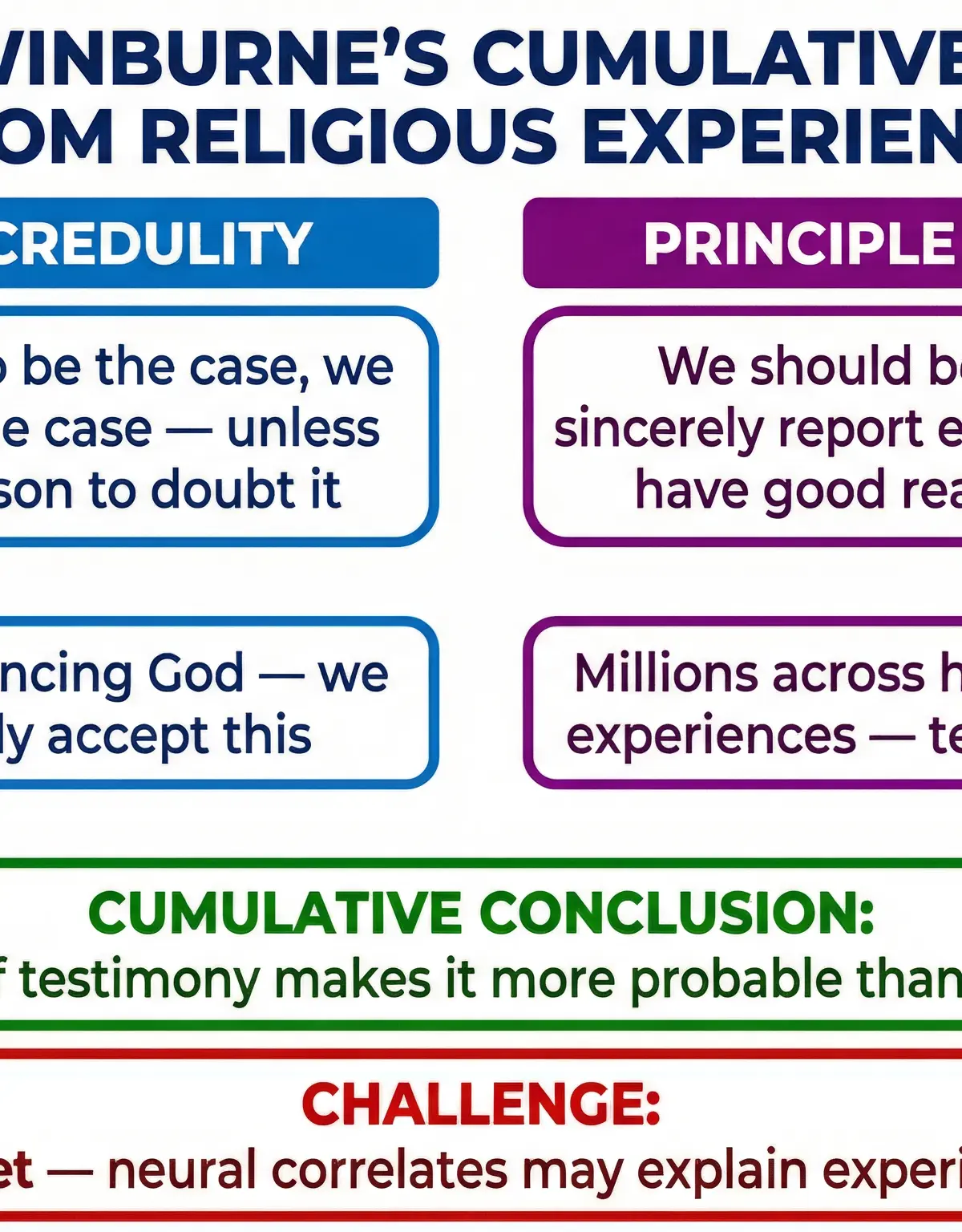
Key Actions: In his book 'The Existence of God' (1979), Swinburne developed a cumulative case for God's existence based on religious experience, using two key principles.
Impact: Swinburne provides the most robust modern philosophical defence. His Principle of Credulity (we should believe what our senses tell us, unless we have reason to doubt) and Principle of Testimony (we should believe what others report, unless we have reason to doubt them) shift the burden of proof to the sceptic. He argues that the sheer volume of testimony from millions of people across history makes it more probable than not that God exists. This probabilistic approach is essential for high-level AO2 evaluation.
The Challenge from Science & Psychology
Key Individuals: Ludwig Feuerbach, Sigmund Freud, Michael Persinger.
Key Actions: These thinkers offered naturalistic explanations for religious experience.
- Feuerbach ('The Essence of Christianity', 1841): Argued God is a human projection of our own idealised nature.
- Freud ('The Future of an Illusion', 1927): Argued religious belief is a form of wish-fulfilment, a projection of the infantile desire for a protective father figure.
- Persinger ('God Helmet' experiments, 1980s): Claimed to induce religious-like experiences by applying magnetic fields to the temporal lobes, suggesting a neurological basis.
Impact: These challenges form the core of the AO2 debate. They provide powerful counter-arguments to the claim that religious experiences are veridical. However, candidates must also be able to critique these challenges. For example, Freud and Feuerbach can be accused of the Genetic Fallacy (explaining the origin of a belief doesn't prove it false), and Persinger's findings can be countered by arguing that a neural correlate does not disprove a divine cause (if God interacts with us, it would have to be via the brain)."
Worked Examples
8 worked examples — open one to explore the question and available guidance.