Religious Practices: Five Pillars and Beyond
This study guide provides a comprehensive analysis of Islamic religious practices for AQA A-Level Religious Studies students. It critically examines the divergence between the Sunni Five Pillars and Shi'a Ten Obligatory Acts, offering exam-focused insights to help candidates achieve top marks."
Study Notes
Overview
This guide delves into the core religious practices of Islam, a mandatory component of the AQA A-Level Religious Studies (Component 2A: Islam) specification. For examiners, a candidate's ability to move beyond mere description to a critical analysis of these practices is the key differentiator between a middling and a top-grade response. This involves not only knowing the rituals but understanding their theological underpinnings, their sociological impact, and the significant variations between Sunni and Shi'a traditions. This topic requires you to analyse the function of practices like Salah, Zakah, and Hajj in shaping individual Muslim identity and fostering community (Ummah) cohesion. High-level responses will demonstrate a nuanced understanding of concepts like Jihad, moving beyond simplistic media portrayals to grasp its primary spiritual meaning. Credit is consistently awarded for candidates who can articulate the distinct theological reasoning behind the Shi'a Ten Obligatory Acts, particularly the inclusion of Khums and the explicit mention of Jihad, and contrast this with the Sunni framework of the Five Pillars.
The Core Frameworks: Pillars and Acts
Sunni Islam: The Five Pillars (Arkan al-Islam)
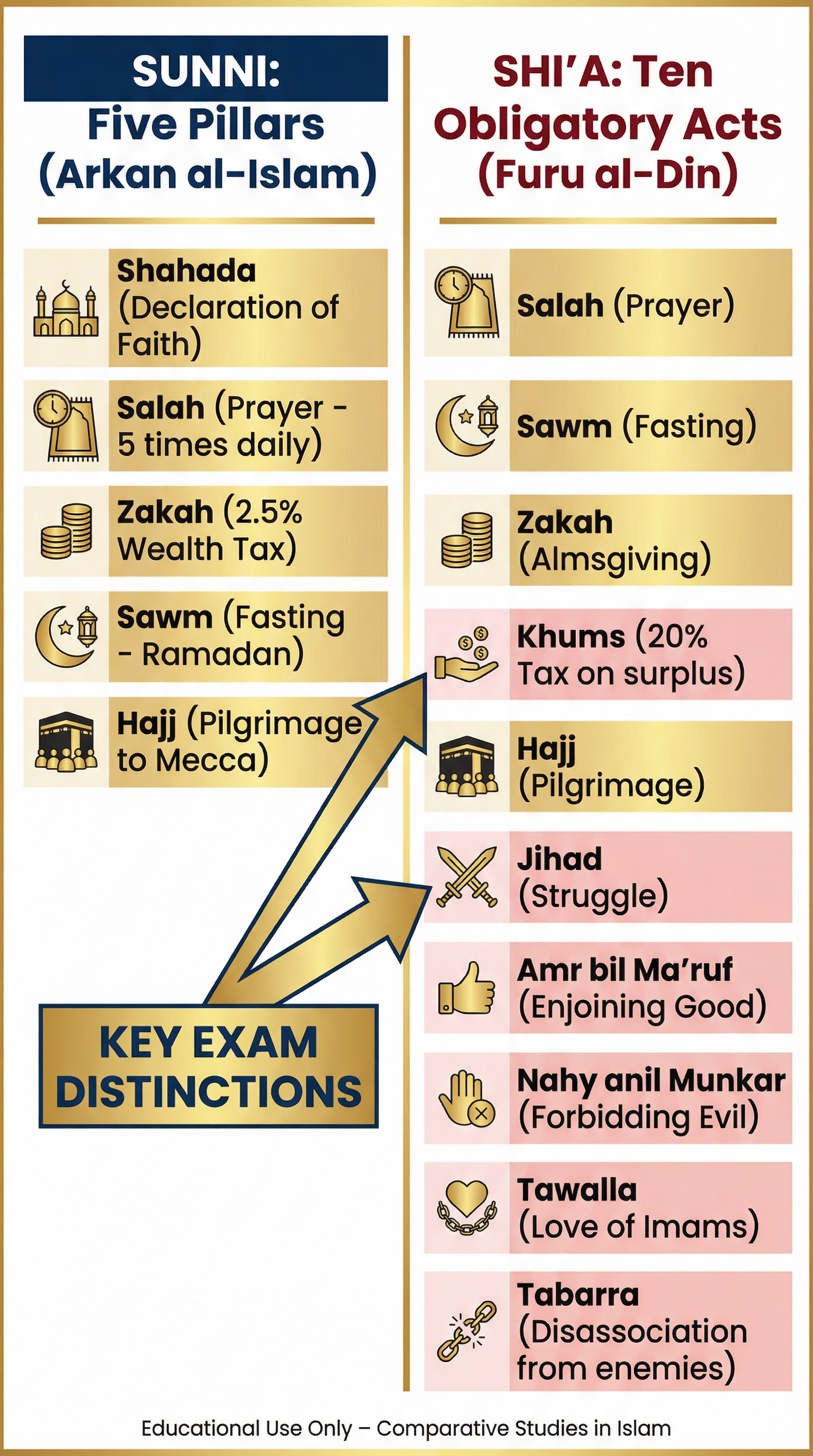
What they are: The Five Pillars are the foundational acts in Sunni Islam, considered mandatory by believers and are the foundation of Muslim life. They are: Shahada (Declaration of Faith), Salah (Prayer), Zakah (Almsgiving), Sawm (Fasting), and Hajj (Pilgrimage).
Why it matters: For the exam, you must treat these as a framework for Sunni identity. Each pillar has a dual function: a personal act of devotion and a public demonstration of community membership. For example, Salah performed in congregation strengthens community bonds, while Zakah institutionalises social welfare.
Specific Knowledge: Candidates must know the specific details: Salah is performed five times daily facing the Kaaba in Mecca. Zakah is a 2.5% tax on savings above the Nisab threshold (equivalent to 87.48g of gold). Sawm involves abstaining from food and drink from dawn till dusk during the month of Ramadan.
Shi'a Islam: The Ten Obligatory Acts (Furu al-Din)
What they are: The 'Branches of the Religion' in Shi'a Islam. While they include the core practices of Salah, Sawm, Zakah, and Hajj, they add six more, reflecting a distinct theological emphasis. These are: Khums (a 20% tax), Jihad (struggle), Amr bil Ma'ruf (enjoining good), Nahy anil Munkar (forbidding evil), Tawalla (love for the Ahl al-Bayt), and Tabarra (disassociation from their enemies).
Why it matters: The additions are crucial for analysis. Khums represents a different model of religious financial obligation. The explicit inclusion of Jihad elevates it as a core duty. Tawalla and Tabarra are central to Shi'a identity, reinforcing allegiance to the Imams and distinguishing the community from other Muslims.
Specific Knowledge: Be prepared to explain that Khums is a 20% tax on annual surplus profit. For Tawalla, you should be able to link this to the Shi'a doctrine of the Imamate and the love for the Prophet's family.
Key Practices Analysed
Hajj: The Pilgrimage
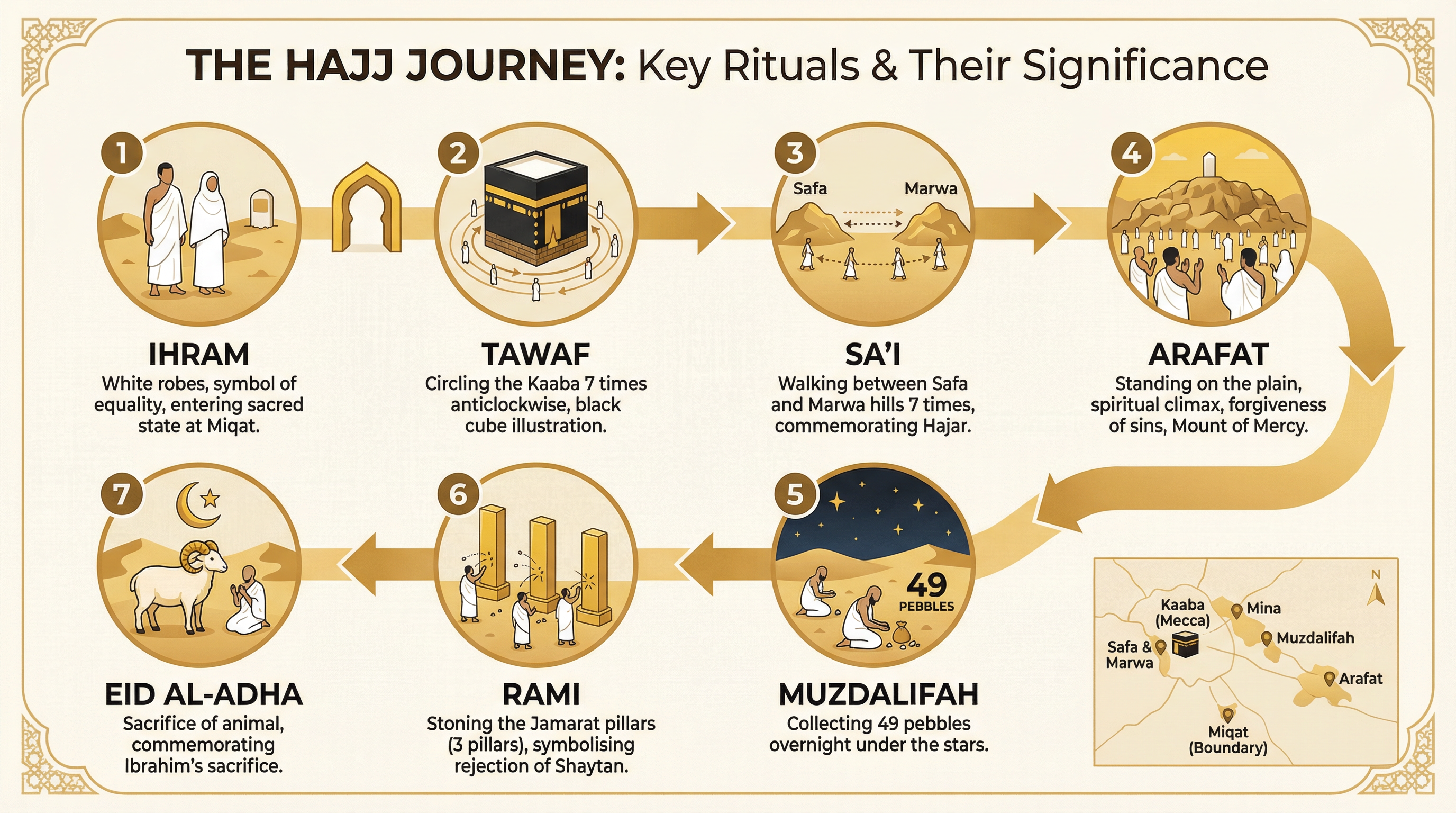
What happened: An annual pilgrimage to Mecca, obligatory once in a lifetime for all able-bodied and financially capable Muslims.
Why it matters: Examiners look for analysis of its significance. Spiritual: The state of Ihram (wearing two simple white cloths) symbolises the equality of all believers before God, stripping away markers of class and status. The standing at Arafat is the spiritual climax, a moment of intense personal supplication and repentance, believed to lead to the forgiveness of sins. Sociological: Hajj is a powerful manifestation of the Ummah (global Muslim community), bringing together millions from every corner of the world, reinforcing a shared identity.
Specific Knowledge: Key rituals include Tawaf (circling the Kaaba seven times), Sa'i (walking between the hills of Safa and Marwa), and Rami (the stoning of the pillars at Mina). You must be able to explain the symbolism of these acts (e.g., Rami symbolises rejecting Satan).
Zakah vs. Sadaqah
What they are: Two forms of charitable giving in Islam.
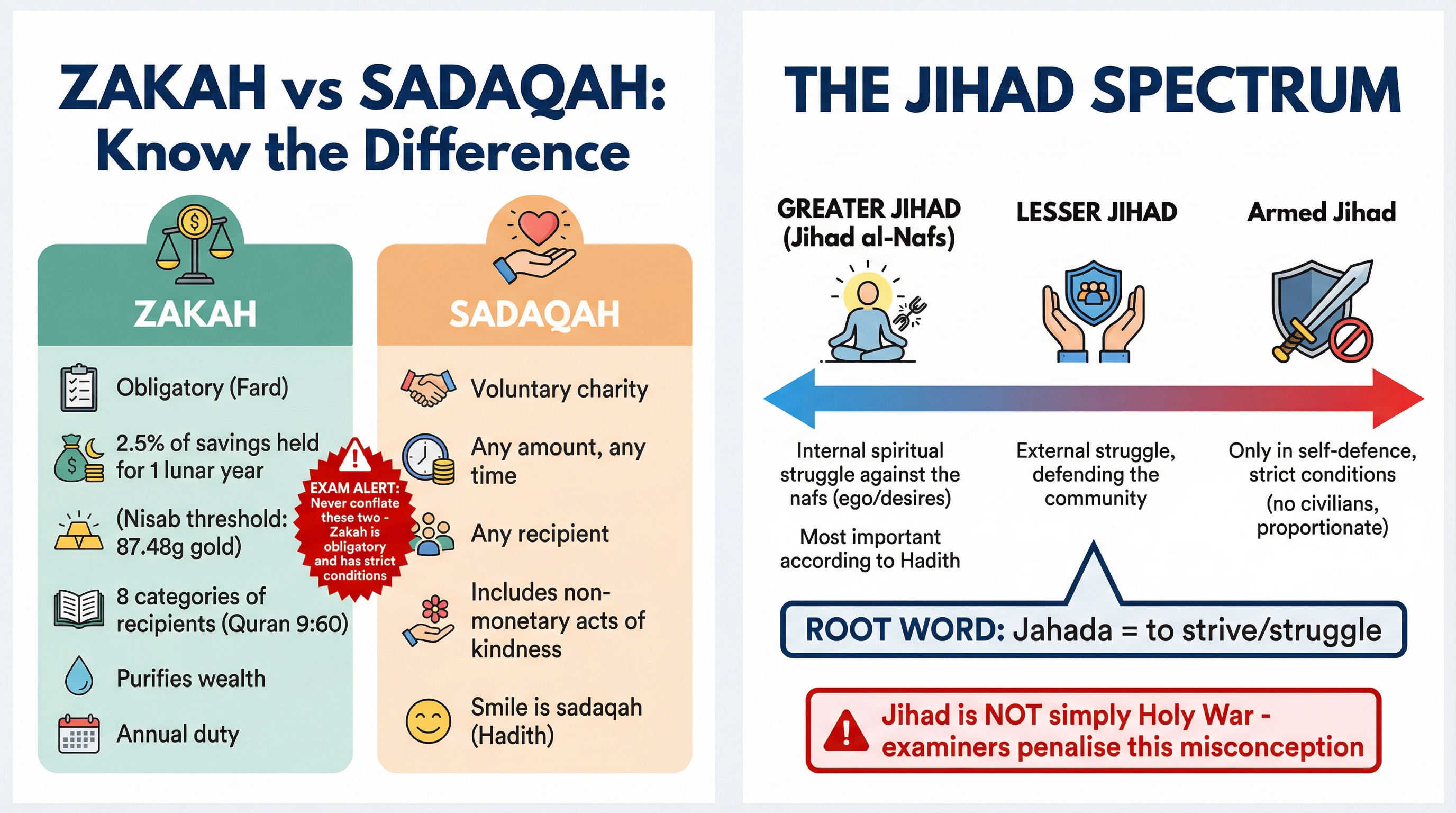
Why it matters: This is a classic area where candidates lose marks. You MUST distinguish them clearly. Zakah is an obligatory, calculated act (2.5% of surplus wealth), a formal religious duty that purifies wealth. Sadaqah is voluntary, spontaneous charity that can be any amount and includes acts of kindness. Conflating them suggests a superficial understanding.
Specific Knowledge: The authority for Zakah recipients is Qur'an 9:60, which lists eight categories. For Sadaqah, you can cite the hadith: "Even a smile is Sadaqah."
Jihad: The Struggle
What it is: The Arabic root 'Jahada' means 'to strive' or 'to struggle'.
Why it matters: This is perhaps the most misunderstood term. AQA examiners will penalise any answer that defines Jihad simply as 'Holy War'. You must explain the two forms. Greater Jihad (Jihad al-Nafs) is the internal, spiritual struggle to be a better Muslim, resist temptation, and live righteously. A famous hadith describes this as the most important form. Lesser Jihad is the outward struggle to defend Islam or the community, which can, in very specific and restricted circumstances, include armed conflict.
Specific Knowledge: For high marks, note that in Shi'a Islam, Jihad is one of the Ten Obligatory Acts, but classical jurisprudence often states that only the Imam can declare an offensive Jihad, a significant theological check on its use."
Worked Examples
3 detailed examples with solutions and examiner commentary
Practice Questions
Test your understanding — click to reveal model answers
Explain the role of Zakah in the life of a Muslim. (10 marks)
Hint: Think about both the spiritual impact on the individual giver and the social impact on the community (Ummah).
Explain the significance of the concept of Jihad in Islam. (10 marks)
Hint: Start by defining the literal meaning ('struggle') and then immediately introduce the concepts of Greater and Lesser Jihad.
Examine the significance of Ashura for Muslims. (10 marks)
Hint: This is a trick question. The key is to show you know it has different significance for Sunni and Shi'a Muslims. Dedicate a paragraph to each.
‘Hajj is more of a social event than a religious one.’ Evaluate this view. (25 marks)
Hint: Structure your answer as a debate. Argue for the 'social' view, then for the 'religious' view, then synthesise them in a conclusion. The best answers will argue they are inseparable.
Explain why the Five Pillars are important for Muslims. (12 marks - Specimen Paper)
Hint: Select three pillars and explain their importance in a separate paragraph for each. Focus on the 'why'.