AQA · A-Level · Religious Studies
Sources of Wisdom and Authority in Islam
The sources of wisdom and authority in Islam form the bedrock of Islamic theology, jurisprudence, and daily practice — and understanding their hierarchy is essential for any candidate aiming for the top marks in AQA Component 2A. From the absolute, uncreated word of Allah in the Qur'an to the divergent methodologies of Sunni scholarly consensus and Shi'a Imamate, this topic demands both precise definitional knowledge and sophisticated evaluative argument. Candidates who master the interplay between these sources — and who can articulate the Sunni-Shi'a divide with technical fluency — are consistently rewarded at the highest levels of the mark scheme.
- 11 min read
- 5 worked examples
- 5 practice questions
- 10 key terms
Study Notes
Overview
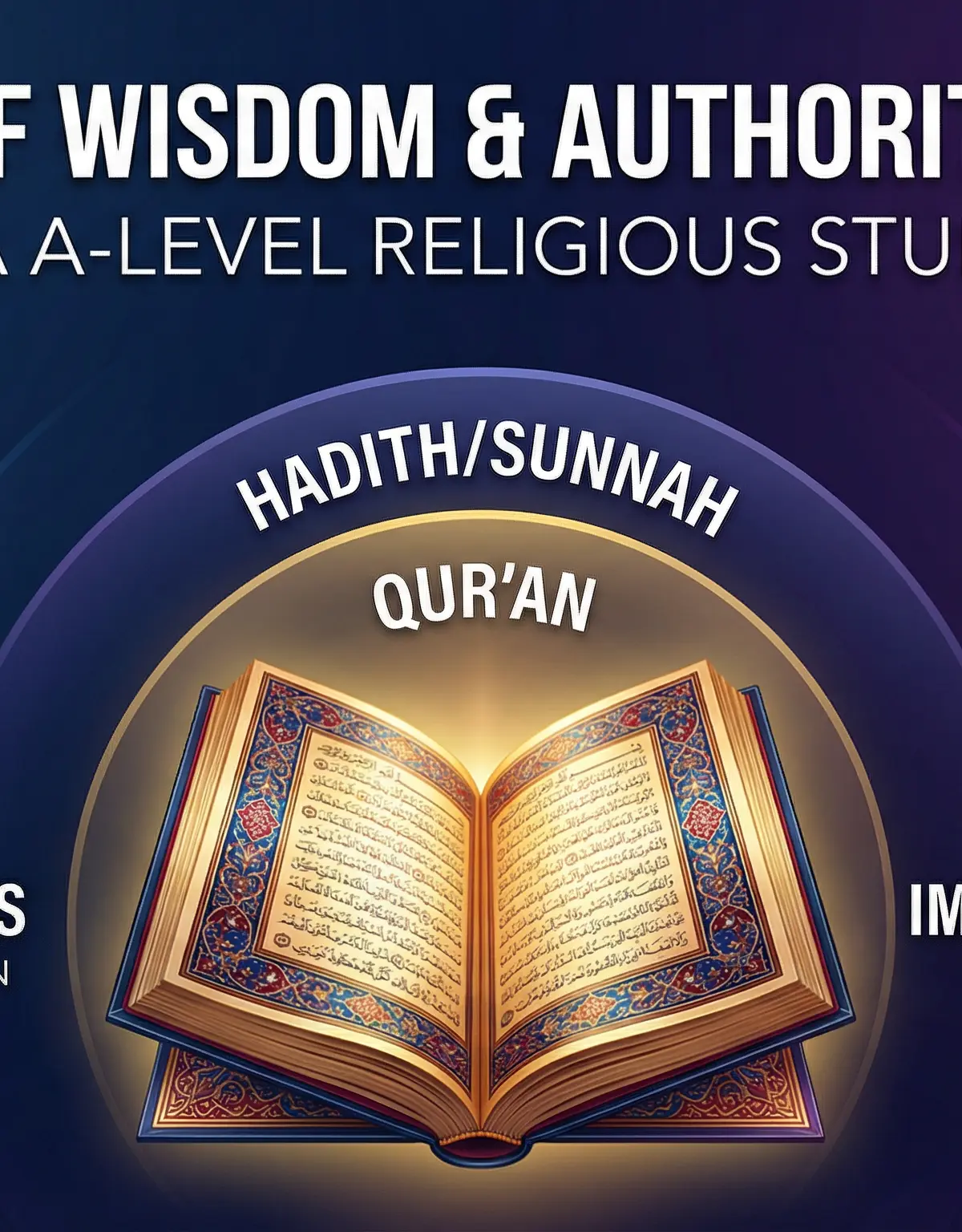
This topic sits at the heart of AQA A-Level Religious Studies Component 2A (Islam). It demands that candidates understand not merely what the sources of Islamic authority are, but how they function, why they are authoritative, and where Sunni and Shi'a traditions diverge in their application. Examiners at AQA consistently reward candidates who can deploy technical Arabic terminology with precision, who can evaluate the reliability of Hadith collections using the science of isnad, and who can construct a sustained argument about which source carries the greatest authority. This guide covers the Qur'an as kalam, the Sunnah and Hadith and their classification, and the divergent jurisprudential methodologies of Sunni fiqh (Ijma and Qiyas) and Shi'a fiqh (Imamate and Aql). The AO weighting is critical: AO1 accounts for 40% and AO2 for 60%, meaning evaluation and argument must dominate your answers.
The Qur'an: The Supreme Source
What It Is and Why It Matters
Date of Revelation: c. 610–632 CE; Uthmanic codification c. 650 CE under Caliph Uthman ibn Affan.
The Qur'an is the absolute, primary source of authority in Islam. Examiners award marks for candidates who use the term kalam — meaning the direct, literal speech of Allah — to describe it. It is not merely divinely inspired; it is the word of God, revealed to the Prophet Muhammad through the Angel Jibril over approximately 23 years. This distinguishes it fundamentally from the Bible or Torah, which Muslims regard as divinely inspired but humanly transmitted. The Qur'an comprises 114 chapters (Surahs) and 6,236 verses (Ayat), covering theology, law, ethics, and guidance for human life.
A critical piece of specific knowledge is the Uthmanic codification: after the Battle of Yamama (633 CE), in which many Hafiz (memorisers of the Qur'an) were killed, Caliph Abu Bakr commissioned a written compilation. Under Caliph Uthman (r. 644–656 CE), a standardised written text — the Mushaf Uthmani — was produced and all variant copies were destroyed. This act is theologically significant because it ensured the Qur'an's purity and uniformity across the Muslim world. Candidates who reference this codification in AO1 answers demonstrate the depth of knowledge required for Level 3 and above.
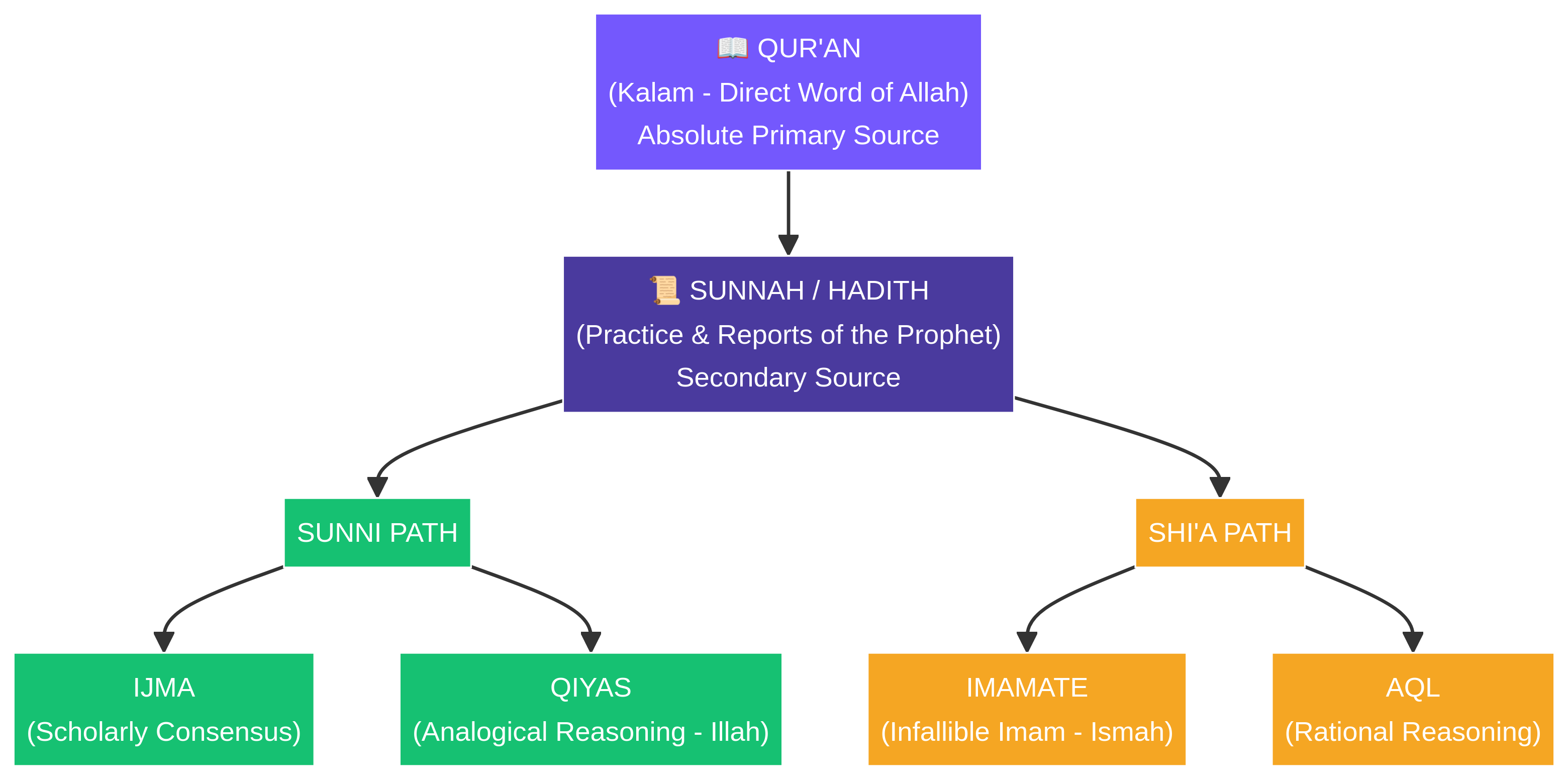
Why it matters for the exam: The Qur'an's authority derives from its status as kalam. Any legal or ethical question must first be answered by reference to the Qur'an. If the Qur'an is silent, Muslims turn to the Sunnah. This hierarchy is the foundation of Islamic jurisprudence (fiqh).
The Sunnah and Hadith
Distinguishing the Two — A Common Exam Pitfall
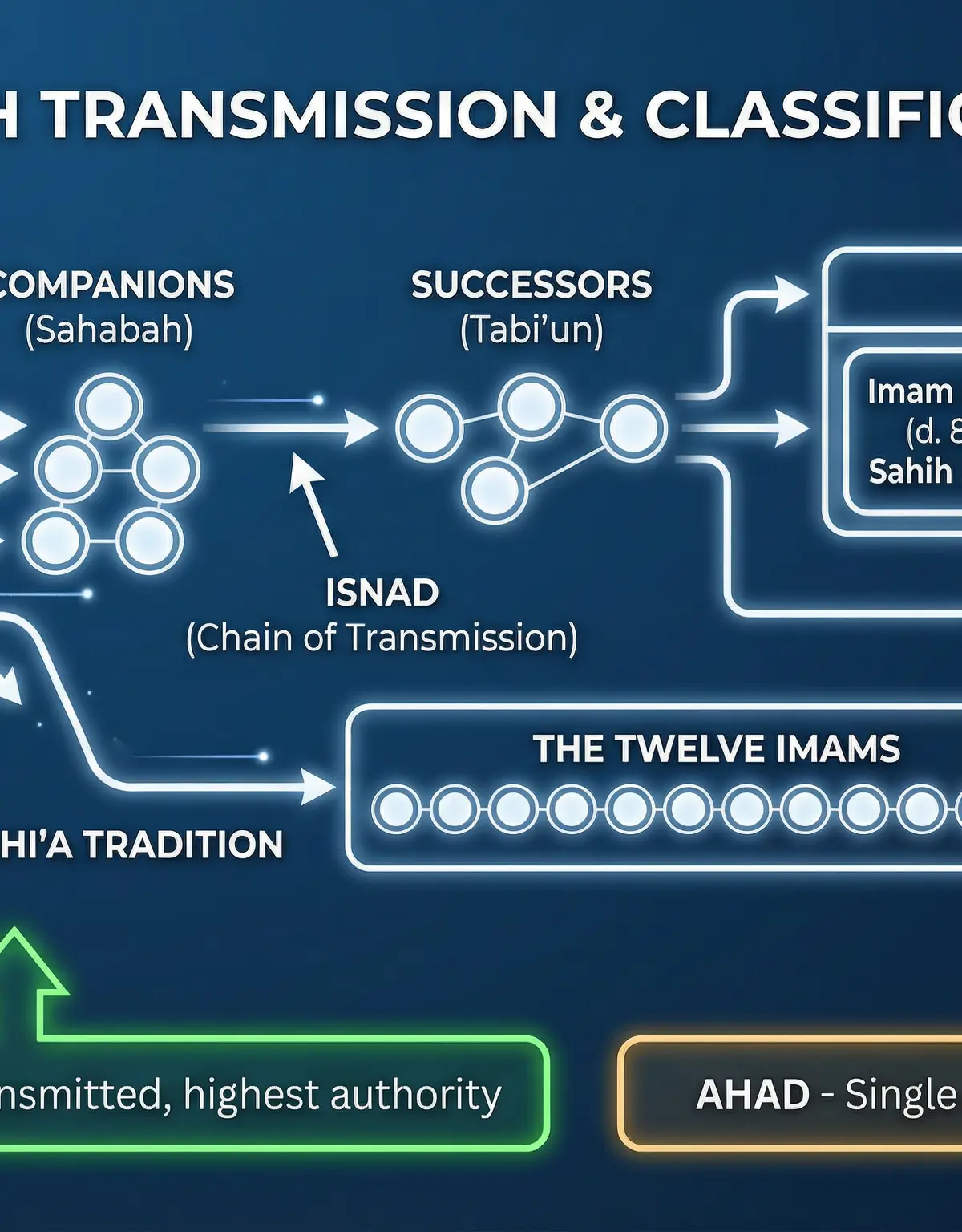
Candidates frequently lose marks by conflating Sunnah and Hadith. The distinction is precise and examiners will credit it:
- Sunnah (Arabic: 'trodden path') refers to the practice, conduct, and character of the Prophet Muhammad — his actions, his tacit approvals, and his way of life. It is the normative model for Muslim behaviour.
- Hadith (Arabic: 'report' or 'narrative') are the written records that transmit the Sunnah. A Hadith is a report of what the Prophet said, did, or approved.
The Sunnah is the content; the Hadith is the medium. A useful analogy: the Sunnah is the music, and the Hadith is the recording.
Hadith Classification: Mutawatir and Ahad
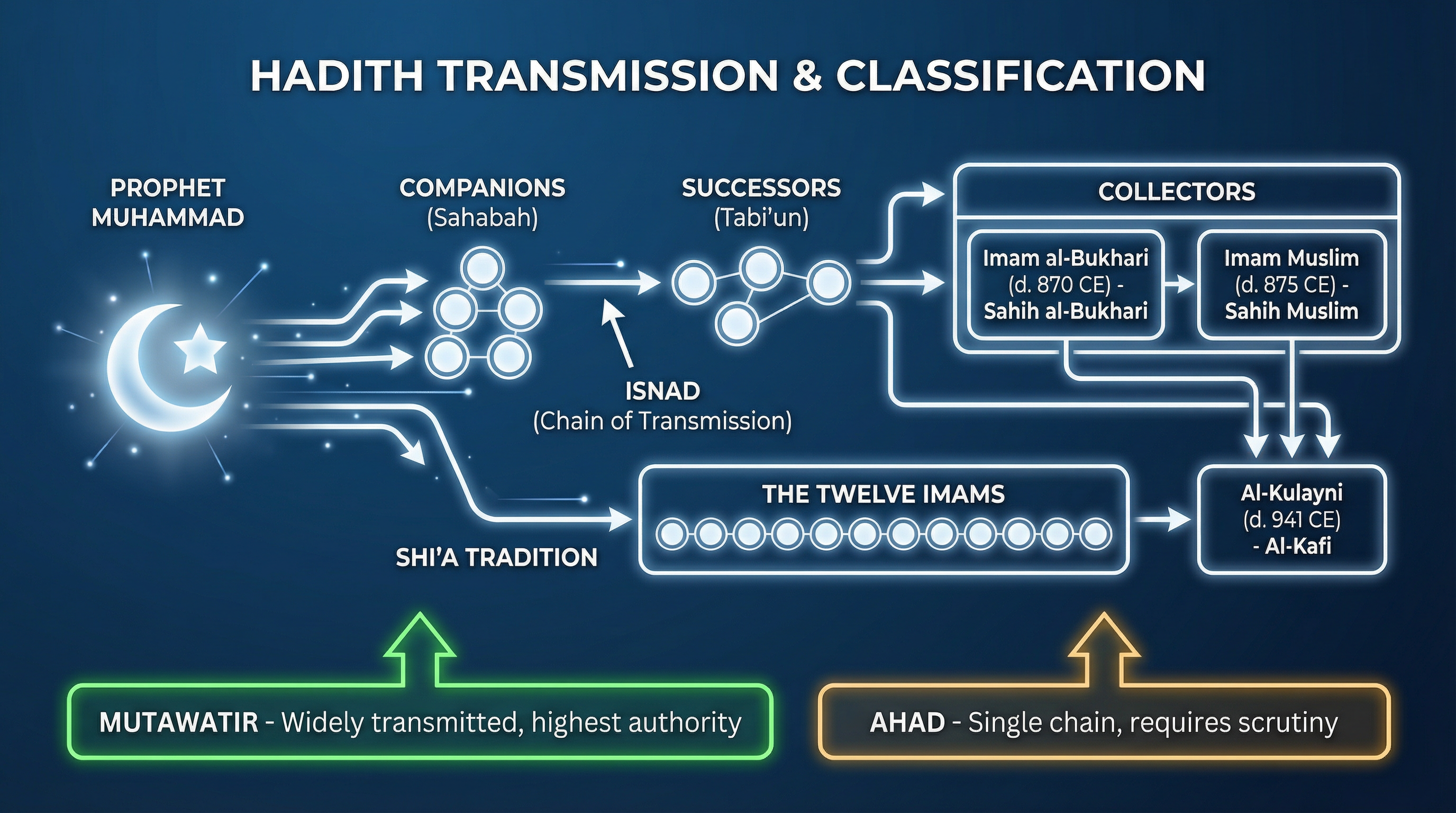
The reliability of a Hadith is assessed through its isnad — the chain of narrators linking the report back to the Prophet. This science of authentication is called 'Ilm al-Rijal (the science of narrators). Two key classifications examiners expect candidates to know:
- Mutawatir: A Hadith transmitted by so many independent chains of narrators at every level that fabrication is considered impossible. These carry near-certain (qat'i) authority, almost equivalent to the Qur'an in legal force.
- Ahad: A Hadith with a single or limited chain of narrators. These are treated with greater scrutiny and carry probabilistic (zanni) authority. They can establish legal rulings but are subject to debate.
Sunni Hadith Collections
The two most authoritative Sunni collections are:
- Sahih al-Bukhari (compiled by Imam Muhammad al-Bukhari, d. 870 CE): Regarded as the most authentic book after the Qur'an by Sunni Muslims. Al-Bukhari reportedly examined 600,000 Hadith and accepted only 7,275 as authentic.
- Sahih Muslim (compiled by Imam Muslim ibn al-Hajjaj, d. 875 CE): The second most authoritative Sunni collection. Together with Sahih al-Bukhari, these form the Sahihayn ('the two Sahihs').
Shi'a Hadith Collections
Shi'a Muslims accept only Hadith transmitted through the Prophet's family (Ahl al-Bayt) and the twelve Imams. Their primary collection is Al-Kafi (compiled by Al-Kulayni, d. 941 CE), which contains approximately 16,000 Hadith. Shi'a scholars apply their own isnad criteria, and a Hadith authenticated by a Sunni chain but not passing through an Imam is rejected.
Sunni Jurisprudence: Ijma and Qiyas
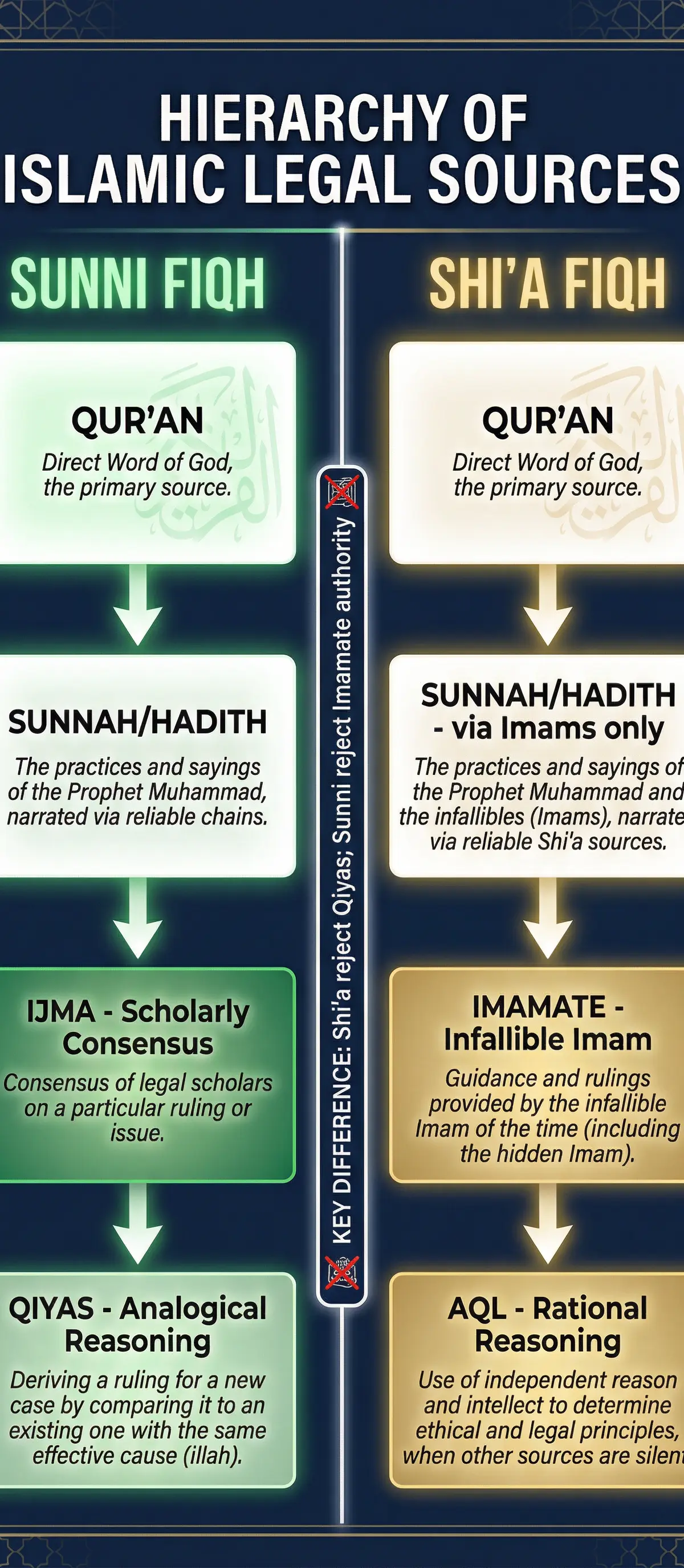
When the Qur'an and Sunnah do not provide a clear ruling on a new issue, Sunni jurists turn to two further sources:
Ijma (Scholarly Consensus)
Ijma is the consensus of qualified Islamic scholars (mujtahidun) on a legal or theological question. It is grounded in a Hadith attributed to the Prophet: 'My community will never agree on an error.' Ijma can be of two types: explicit (all scholars actively agree) or tacit (no scholar objects). Once established, Ijma carries significant authority and is very difficult to overturn. A classic example is the consensus that the five daily prayers (Salat) are obligatory — this is supported by both the Qur'an and Ijma.
Qiyas (Analogical Reasoning)
Qiyas is the process of deriving a ruling for a new case by analogy with an existing ruling, where the two cases share the same effective cause (illah). This is perhaps the most intellectually sophisticated of the secondary sources, and examiners reward candidates who can explain the mechanism with a specific example:
- The Qur'an (5:90) prohibits khamr (wine) because it causes intoxication.
- The illah (effective cause) is intoxication.
- By Qiyas, all intoxicants — cocaine, heroin, cannabis — are also prohibited, because they share the same illah.
This mechanism allows Islamic law to address contemporary issues not explicitly covered in the 7th-century text.
Shi'a Jurisprudence: Imamate and Aql
The Imamate and Ismah
Shi'a Islam rejects Qiyas as an unreliable human construct and instead grounds its jurisprudence in the authority of the Imamate. Shi'a Muslims believe that after the Prophet's death, divine guidance continued through twelve divinely appointed Imams, beginning with Ali ibn Abi Talib (the Prophet's cousin and son-in-law). These Imams possess Ismah — infallibility — meaning they are incapable of sin or error in matters of religion. Their interpretations of the Qur'an and Sunnah are therefore authoritative in a way that ordinary scholarly consensus (Ijma) cannot be.
The twelfth Imam, Muhammad al-Mahdi, is believed to be in occultation (ghayba) since 874 CE. During his absence, qualified Shi'a jurists (marjas) act as his representatives. The concept of Wilayat al-Faqih (guardianship of the jurist), developed by Ayatollah Khomeini in the 20th century, extends this authority to political governance.
Aql (Rational Reasoning)
Shi'a jurisprudence also employs Aql — independent rational reasoning — as a source of law. Unlike Qiyas, which reasons by analogy from existing texts, Aql involves the use of pure reason to determine ethical and legal principles. Shi'a scholars argue that reason is a gift from Allah and can independently arrive at truths consistent with divine guidance. This gives Shi'a fiqh a more rationalist character compared to Sunni fiqh.
Key Individuals
Imam Muhammad al-Bukhari (810–870 CE)
Role: Sunni Hadith scholar and compiler.
Key Actions: Spent 16 years travelling across the Islamic world to collect and authenticate Hadith. Reportedly examined 600,000 Hadith and accepted only 7,275 as meeting his strict isnad criteria.
Impact: His collection, Sahih al-Bukhari, is regarded as the most authoritative Hadith collection in Sunni Islam and is central to any discussion of the reliability of secondary sources.
Imam Ali ibn Abi Talib (c. 600–661 CE)
Role: First Shi'a Imam; cousin and son-in-law of the Prophet Muhammad.
Key Actions: Shi'a Muslims believe he was the rightful successor to the Prophet, as designated at the event of Ghadir Khumm (632 CE). His interpretations of the Qur'an and Sunnah form the foundation of Shi'a jurisprudence.
Impact: The question of his succession is the origin of the Sunni-Shi'a split, making him central to any discussion of divergent sources of authority.
Caliph Uthman ibn Affan (r. 644–656 CE)
Role: Third Caliph of the Sunni tradition; responsible for the standardisation of the Qur'an.
Key Actions: Commissioned the Uthmanic codex — a single, authoritative written text of the Qur'an — and ordered the destruction of all variant copies.
Impact: This act is foundational to the Qur'an's claim to absolute textual authority. Candidates who reference this in AO1 answers demonstrate Level 3 knowledge.
Al-Kulayni (864–941 CE)
Role: Shi'a Hadith scholar and compiler.
Key Actions: Compiled Al-Kafi, the most comprehensive and authoritative Hadith collection in Twelver Shi'a Islam, containing approximately 16,000 Hadith.
Impact: Al-Kafi is the Shi'a equivalent of Sahih al-Bukhari. Contrasting these two collections in an AO2 answer about Hadith reliability is a hallmark of a top-band response.
Second-Order Concepts
Causation
The hierarchy of Islamic sources did not emerge arbitrarily. The Qur'an's authority derives from its theological status as kalam. The Sunnah's authority derives causally from the Prophet's role as the living embodiment of the Qur'an's message — his practice is divinely guided. The secondary sources (Ijma, Qiyas, Imamate, Aql) emerged causally from the practical need to address new legal questions as Islam spread beyond the Arabian Peninsula into Persia, Egypt, and beyond.
Consequence
The divergence between Sunni and Shi'a methodologies has profound consequences: different legal rulings on prayer, marriage, inheritance, and political governance. The Shi'a concept of Ismah means that the Imam's authority supersedes scholarly consensus, with direct consequences for how Shi'a communities are governed (e.g., Wilayat al-Faqih in Iran).
Change and Continuity
The Qur'an represents absolute continuity — it is unchanging and uncreated. The Sunnah, transmitted via Hadith, has been subject to ongoing scholarly scrutiny and re-evaluation. The development of Qiyas and Ijma represents change — a dynamic, evolving methodology for applying fixed texts to new contexts.
Significance
This topic is significant because it explains how 1.8 billion Muslims derive ethical and legal guidance. It also explains the Sunni-Shi'a divide, one of the most consequential theological and political divisions in world history. For the exam, it is significant because it underpins virtually every other topic in the Islam component.
Source Skills
When approaching sources in this topic, apply the following framework:
Content: What does the source say? What specific claims does it make about authority?
Provenance: Who produced it? When? From what tradition (Sunni/Shi'a)? What is their purpose — to authenticate, to persuade, to legislate?
Limitations: What does the source not tell us? What perspective is absent? A Sunni jurist writing about Qiyas will not represent the Shi'a critique of it.
Judgement: Overall, how useful or reliable is this source for understanding Islamic authority? Always reach a final evaluative judgement.
Visual Resources
3 diagrams and illustrations
Interactive Diagrams
2 interactive diagrams to visualise key concepts
Conceptual Flow Outline
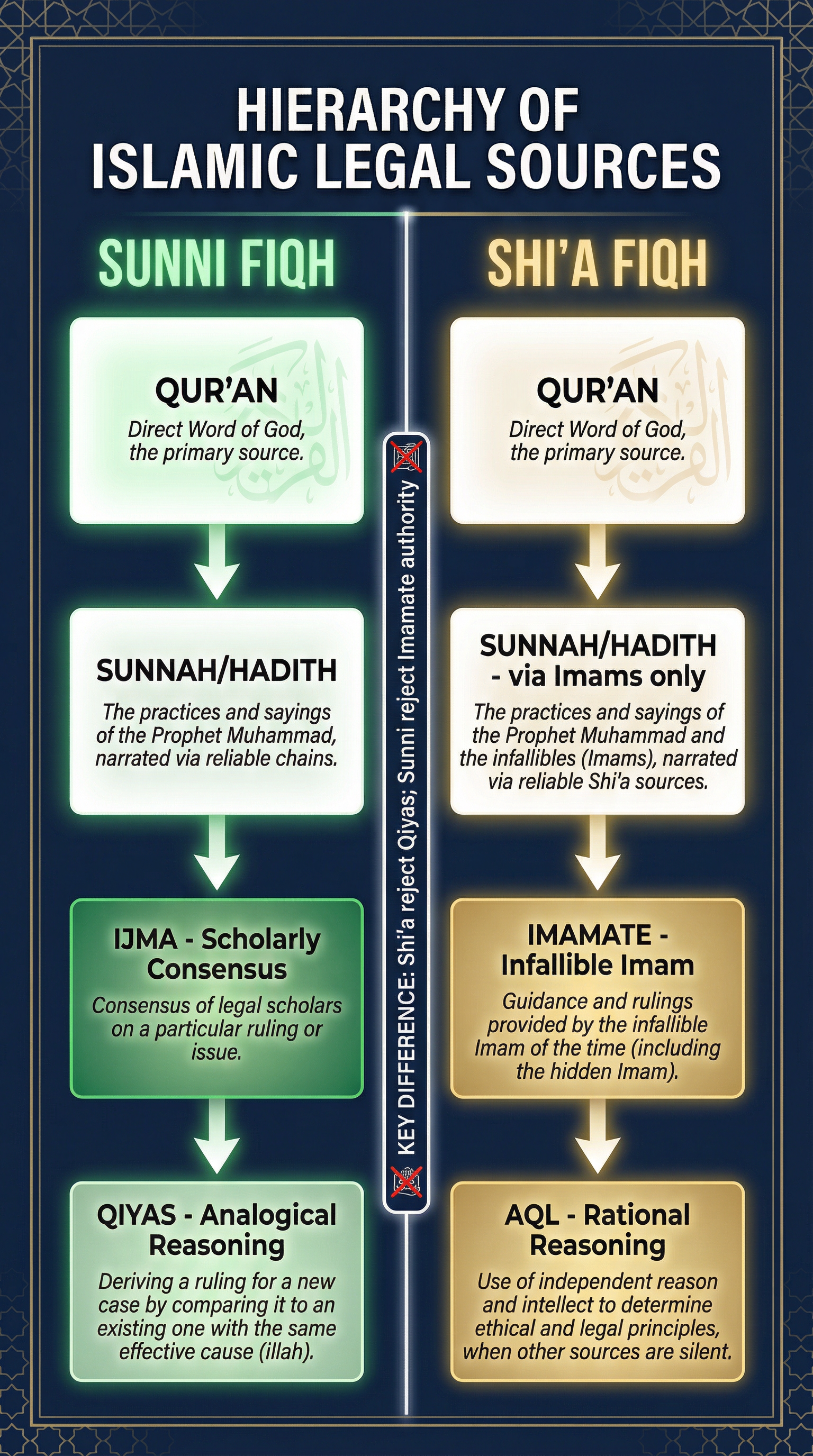
Hierarchy of Islamic Sources of Authority: Sunni and Shi'a paths from the Qur'an
Diagram could not be rendered
Timeline of key dates in the development of Islamic sources of authority
Worked Examples
5 worked examples — open one to explore the question and available guidance.
Practice Questions
Test your understanding — click to reveal model answers
Explain the role of the Qur'an as a source of authority in Islam. (10 marks)
Hint: Define kalam, reference the Uthmanic codification, explain why the Qur'an is the supreme source, and note any limitations (e.g., it does not address every contemporary issue).
'The Sunnah is more important than the Qur'an in shaping Muslim daily life.' Evaluate this view. (15 marks)
Hint: Argue that while the Qur'an is theologically supreme (kalam), the Sunnah provides the practical detail that governs daily practice. Consider the Shi'a perspective on the Sunnah's transmission. Conclude with a clear judgement.
Explain how Qiyas functions as a source of law in Sunni Islam. (10 marks)
Hint: Define Qiyas, explain the concept of illah, give the wine-to-intoxicants example, and note that it is one of the four usul (roots) of Sunni fiqh. Contrast briefly with Shi'a rejection.
'The Imamate is the most distinctive feature of Shi'a Islam.' Assess this view. (15 marks)
Hint: Consider the Imamate's theological basis (Ismah, divine appointment), its jurisprudential role (replacing Qiyas), and its political implications (Wilayat al-Faqih). Counter-argue by considering the Qur'an and Sunnah as shared sources. Conclude with a judgement.
Explain the significance of the Uthmanic codification for the authority of the Qur'an. (10 marks)
Hint: Explain what the Uthmanic codification was (c. 650 CE), why it was necessary (Battle of Yamama, variant copies), and why it matters for the Qur'an's authority (textual purity, uniformity). Note any Shi'a perspectives on the codification.