AQA · GCSE · Religious Studies
Forgiveness and Reconciliation
This study guide explores the crucial concepts of Forgiveness and Reconciliation within AQA GCSE Religious Studies. It unpacks core Christian and Islamic teachings, analyses key case studies like Coventry Cathedral and the story of Anthony Walker, and provides targeted exam advice to help students secure top marks."
- 5 min read
- 3 worked examples
- 5 practice questions
Study Notes
Overview
This topic explores the profound concepts of forgiveness and reconciliation, central to both Christian and Islamic thought. Forgiveness is the internal, spiritual act of pardoning a wrong, while reconciliation is the external, mutual process of restoring a broken relationship. AQA examiners expect candidates to distinguish clearly between these two terms, applying them to real-world scenarios of conflict resolution, criminal justice, and inter-personal relationships. A strong answer will move beyond generic statements about 'love' and 'peace', integrating specific sacred texts, denominational differences (e.g., Catholic vs. Protestant), and contemporary examples. This guide will equip you with the precise knowledge and analytical skills needed to evaluate the power and the limits of forgiveness in our complex world.
Key Concepts & Developments
The Lord's Prayer & Conditional Forgiveness
What happened: In the Gospel of Matthew, Jesus teaches his disciples a model prayer that includes the line, "forgive us our trespasses, as we forgive those who trespass against us." He immediately follows this by stating: "For if you forgive other people when they sin against you, your heavenly Father will also forgive you" (Matthew 6:14).
Why it matters: This establishes a core principle of Christian ethics: divine forgiveness is conditional upon human forgiveness. It is not an optional extra for a Christian; it is a required practice that directly impacts their relationship with God. Candidates must be able to explain this link clearly to gain credit for AO1.
Specific Knowledge: Matthew 6:14. The concept of 'conditional forgiveness'.
The Parable of the Unmerciful Servant
What happened: When asked by Peter how many times he should forgive, Jesus replies "not seven times, but seventy times seven" (Matthew 18:21-35) and tells a parable. A servant is forgiven a huge, unpayable debt by his king but then refuses to forgive a fellow servant a tiny amount. The king, enraged, has the first servant imprisoned.
Why it matters: This parable illustrates the Christian belief in unlimited, boundless forgiveness. The number 'seventy times seven' is symbolic, not literal, meaning forgiveness should not be counted or limited. The story serves as a stark warning against hypocrisy and highlights the immense scale of God's forgiveness, which humans are expected to emulate.
Specific Knowledge: Matthew 18:21-35. The phrase 'seventy times seven'.
Coventry Cathedral: Institutional Reconciliation
What happened: After Coventry Cathedral was destroyed by German bombing in November 1940, the Provost, Richard Howard, had the words "Father Forgive" inscribed on the sanctuary wall. A cross was made from charred medieval roof nails.
Why it matters: This is a prime example of institutional reconciliation. Instead of seeking revenge, the cathedral community chose a path of forgiveness and peace-building. The Cross of Nails has become a global symbol, with a worldwide network of partners dedicated to reconciliation. It shows how forgiveness can be a public, political, and community act, not just a private one.
Specific Knowledge: Coventry Cathedral, Cross of Nails, Provost Richard Howard, "Father Forgive".
The Sacrament of Reconciliation
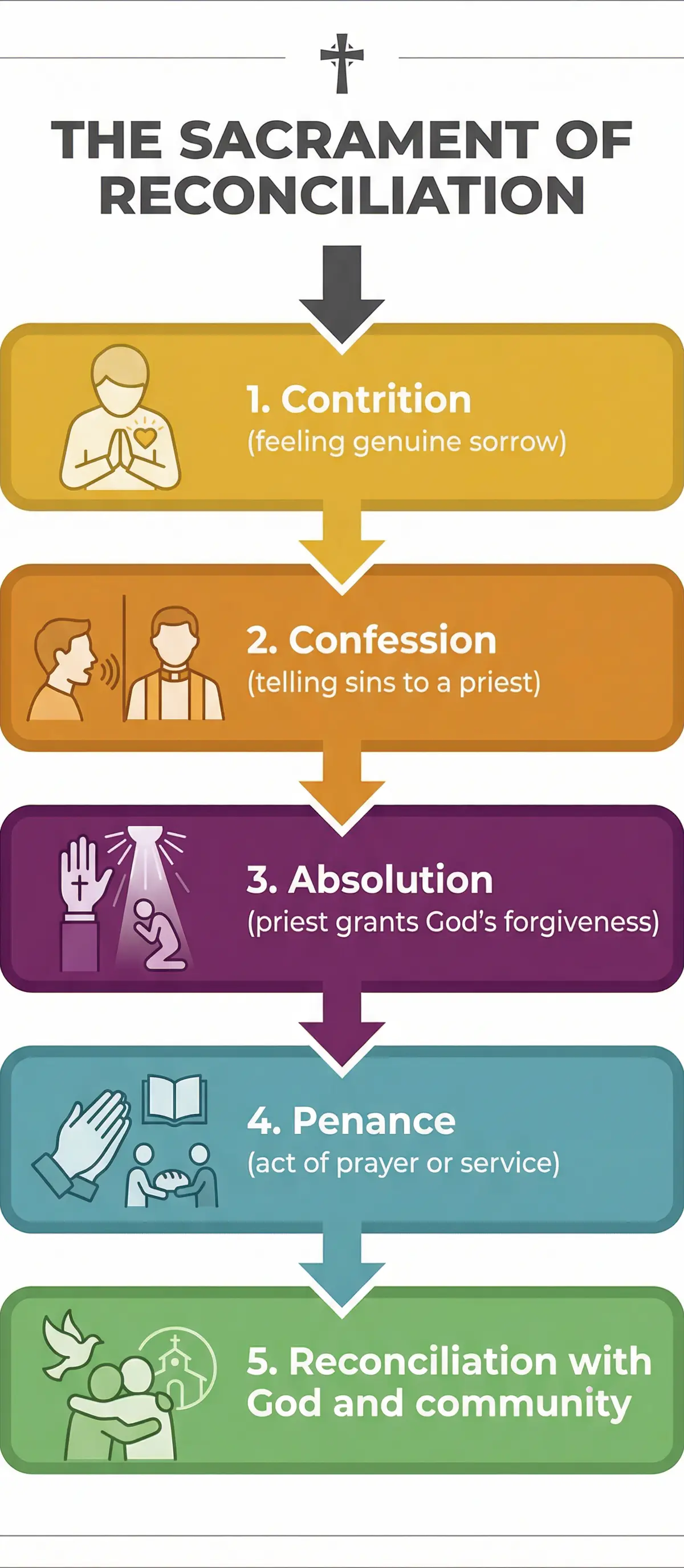
What happened: The Catholic Church has a formal sacrament for the forgiveness of sins, involving a priest.
Why it matters: This highlights a key denominational difference. For Catholics, forgiveness is mediated through the Church and its priests in a structured, sacramental way. For most Protestants, forgiveness is sought directly from God through personal prayer. Candidates must be able to explain this contrast.
Specific Knowledge: The five stages: Contrition, Confession, Absolution, Penance, Reconciliation. The role of the priest as 'in persona Christi'.
Key Individuals
Gee Walker
Role: Mother of Anthony Walker, a black British teenager murdered in a racist attack in 2005.
Key Actions: Publicly forgave her son's killers, citing her Christian faith and the example of Jesus on the cross.
Impact: Her actions provide a powerful contemporary case study of radical Christian forgiveness. It demonstrates that forgiveness can co-exist with a demand for legal justice (the killers were imprisoned) and is a spiritual act of releasing personal hatred, not a replacement for the rule of law.
Archbishop Desmond Tutu
Role: Anglican Archbishop and Chair of South Africa's Truth and Reconciliation Commission (TRC).
Key Actions: Led the TRC, which aimed to heal the wounds of apartheid by hearing testimony from both victims and perpetrators. He grounded the TRC's work in the Christian concept of forgiveness and the African philosophy of 'Ubuntu' (humanity towards others).
Impact: Tutu is a global figurehead for reconciliation. He showed how religious principles of forgiveness could be applied to a national, political process of healing after immense suffering and injustice. The TRC is a key example of restorative justice.
Listen to our Podcast
For a deeper dive into these concepts, exam tips, and a quick-fire quiz, listen to our 10-minute revision podcast.

Worked Examples
3 worked examples — open one to explore the question and available guidance.
Practice Questions
Test your understanding — click to reveal model answers
Explain two contrasting Christian beliefs about how a person receives forgiveness from God. (4 marks)
Hint: Think about the difference between Catholic and Protestant traditions.
Explain two reasons why Coventry Cathedral is an important example of reconciliation. (5 marks)
Hint: Think about the immediate response to the bombing and the long-term legacy.
'Christians must always forgive.' Evaluate this statement. (12 marks)",
"marks": 12
Explain the difference between forgiveness and reconciliation. (4 marks)
Hint: Think: one is internal and one-sided, the other is external and mutual.
Explain two Islamic teachings about forgiveness. (5 marks)
Hint: Consider the names of Allah and teachings from the Quran.