AQA · GCSE · Religious Studies
Key beliefs of Islam
This AQA GCSE Religious Studies guide on the Key Beliefs of Islam provides a comprehensive, exam-focused breakdown of the core theological principles of Sunni and Shi'a Islam. It is designed to equip candidates with the precise knowledge and analytical skills required to achieve top marks by focusing on key terminology, scriptural evidence, and common misconceptions.
- 6 min read
- 3 worked examples
- 5 practice questions
- 8 key terms
Study Notes
Overview
This study guide explores the fundamental beliefs of Islam as required by the AQA GCSE Religious Studies specification (8062). For a high-level grade, candidates must move beyond simple descriptions and demonstrate a nuanced understanding of the theological underpinnings of the faith, particularly the central concept of Tawhid (the oneness of God). A critical area where marks are often won or lost is the ability to accurately differentiate between the six articles of faith in Sunni Islam and the five roots of Usul ad-Din in Shi'a Islam. Examiners expect candidates to use precise Arabic terminology, reference the Qur'an and Hadith as sources of wisdom and authority, and evaluate the significance of these beliefs for Muslims today. This guide will provide the detailed knowledge, worked examples, and exam technique needed to confidently tackle any question on this topic, from short-answer definitions to extended 12-mark evaluative essays.
Key Beliefs: Sunni and Shi'a Islam
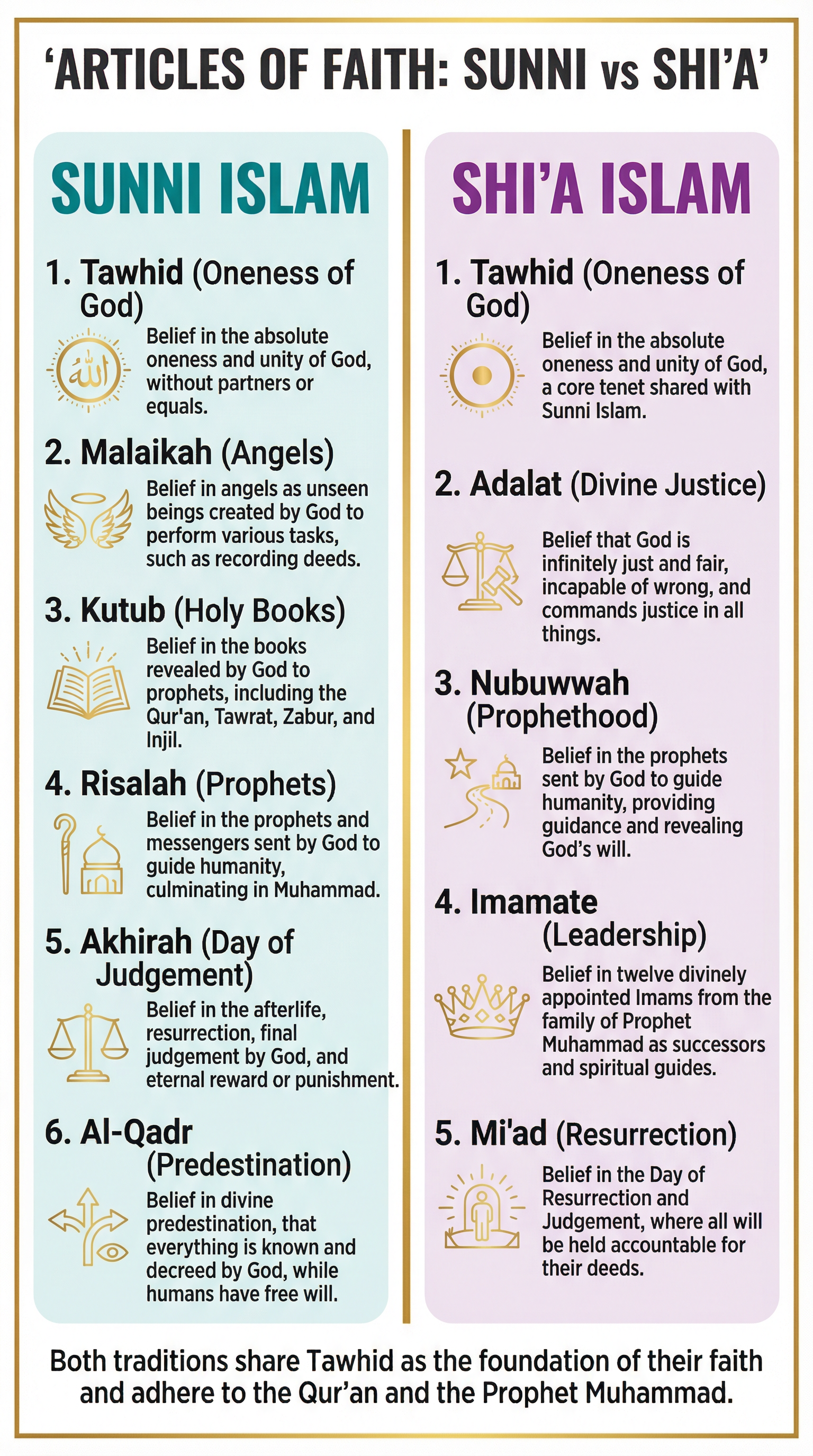
The Six Articles of Faith (Sunni Islam)
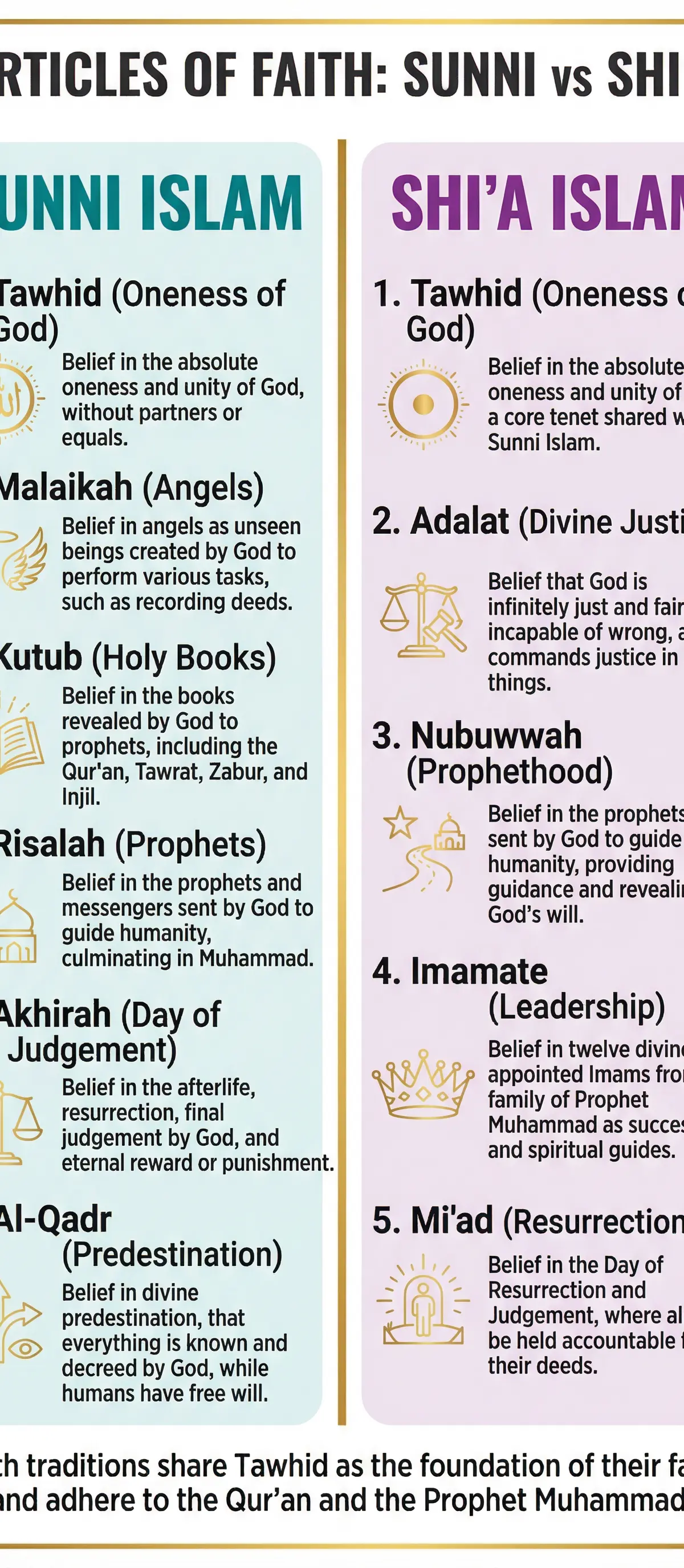
Sunni Muslims hold six key articles of faith, which are considered the bedrock of their belief system.
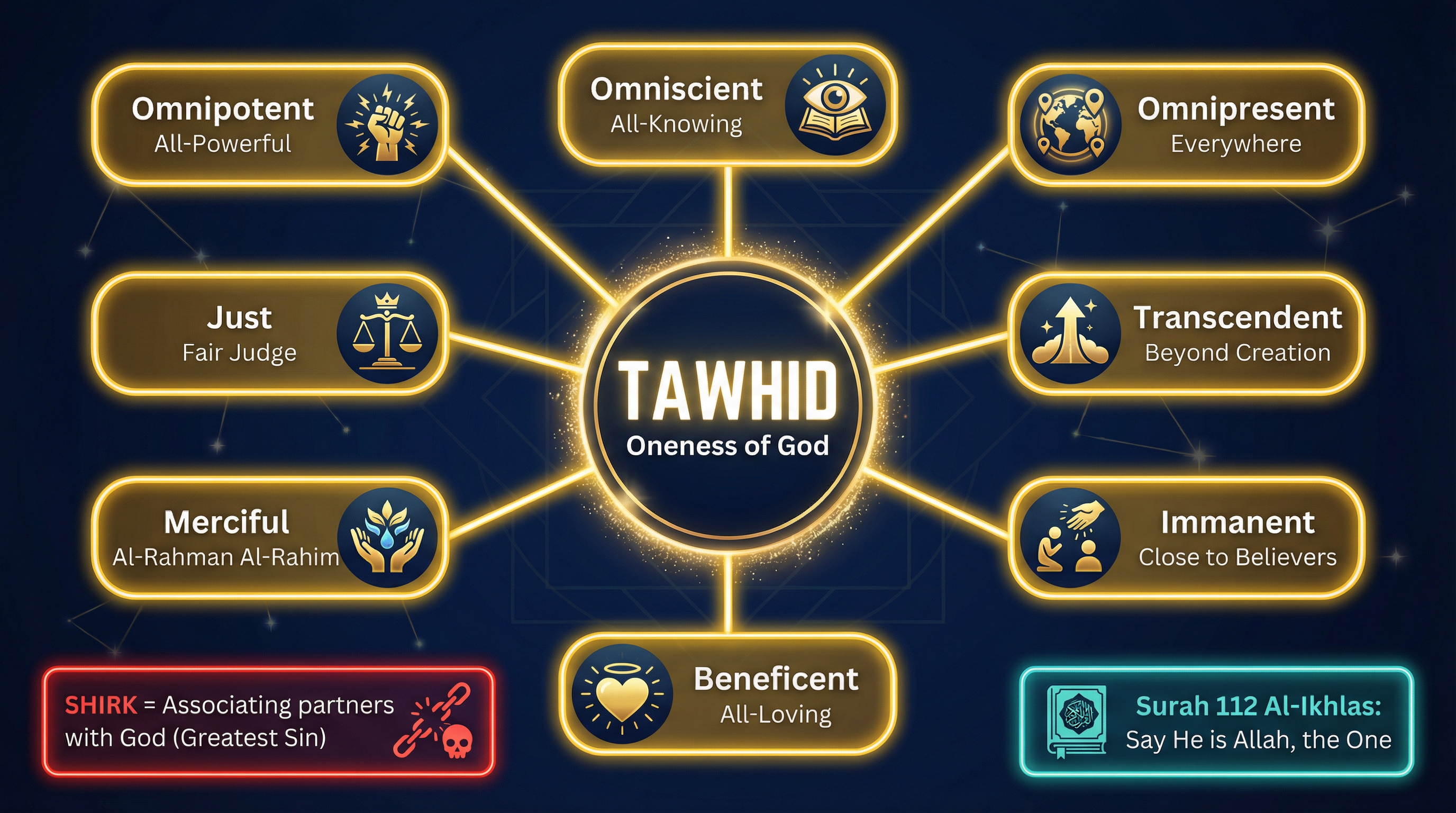
1. Tawhid (Oneness of God): The absolute belief that there is only one God, Allah. He is unique, eternal, and without partners. This is the most important belief in Islam. Any deviation from this, known as Shirk, is the greatest sin.
Source of Wisdom: "He is Allah, the One, Allah the eternal. He begot no one nor was He begotten. No one is comparable to Him." (Qur'an 112:1-4)
2. Malaikah (Angels): Belief in angels as beings created from light to serve God. They are messengers and guardians. For example, Jibril (Gabriel) revealed the Qur'an to Prophet Muhammad, and Kiraman Katibin (honourable scribes) record a person's deeds.
3. Kutub (Holy Books): Belief in the books revealed by God to his messengers, including the Scrolls of Abraham, the Torah of Moses, the Psalms of David, and the Gospel of Jesus. The Qur'an is considered the final and most complete revelation.
4. Risalah (Prophethood): Belief in the prophets as messengers of God. Muslims believe in a long line of prophets, including Adam, Ibrahim (Abraham), Musa (Moses), and Isa (Jesus). Prophet Muhammad is considered the final prophet, the 'Seal of the Prophets'.
5. Akhirah (Afterlife): Belief in a Day of Judgement when all humanity will be resurrected and judged by God based on their deeds. This leads to an eternal life in either Jannah (Paradise) or Jahannam (Hell).
6. Al-Qadr (Predestination): The belief that God has knowledge of and has decreed everything that will happen. However, this is paired with the concept of human free will, creating a theological debate about the extent of human responsibility.
The Five Roots of Usul ad-Din (Shi'a Islam)
Shi'a Muslims have five core beliefs known as the roots of their religion.
1. Tawhid (Oneness of God): This is the same foundational belief as in Sunni Islam.
2. Adalat (Divine Justice): A key differentiator. Shi'a Muslims believe that God is perfectly just and wise. He cannot do wrong. This belief implies that humans must have free will to be held accountable for their actions, as a just God would not punish someone for an action they were predestined to perform.
3. Nubuwwah (Prophethood): The same belief in God's prophets as in Sunni Islam, with Prophet Muhammad as the final messenger.
4. Imamate (Leadership): A belief unique to Shi'a Islam. It holds that after the death of Prophet Muhammad, leadership of the Muslim community should have passed to his appointed successors, the Imams, starting with his son-in-law, Ali. Shi'as believe in twelve infallible Imams who are the spiritual and political guides for the community.
5. Mi'ad (Resurrection): The belief in the Day of Resurrection and Judgement, when all will be held accountable for their deeds.
Second-Order Concepts
The Nature of God
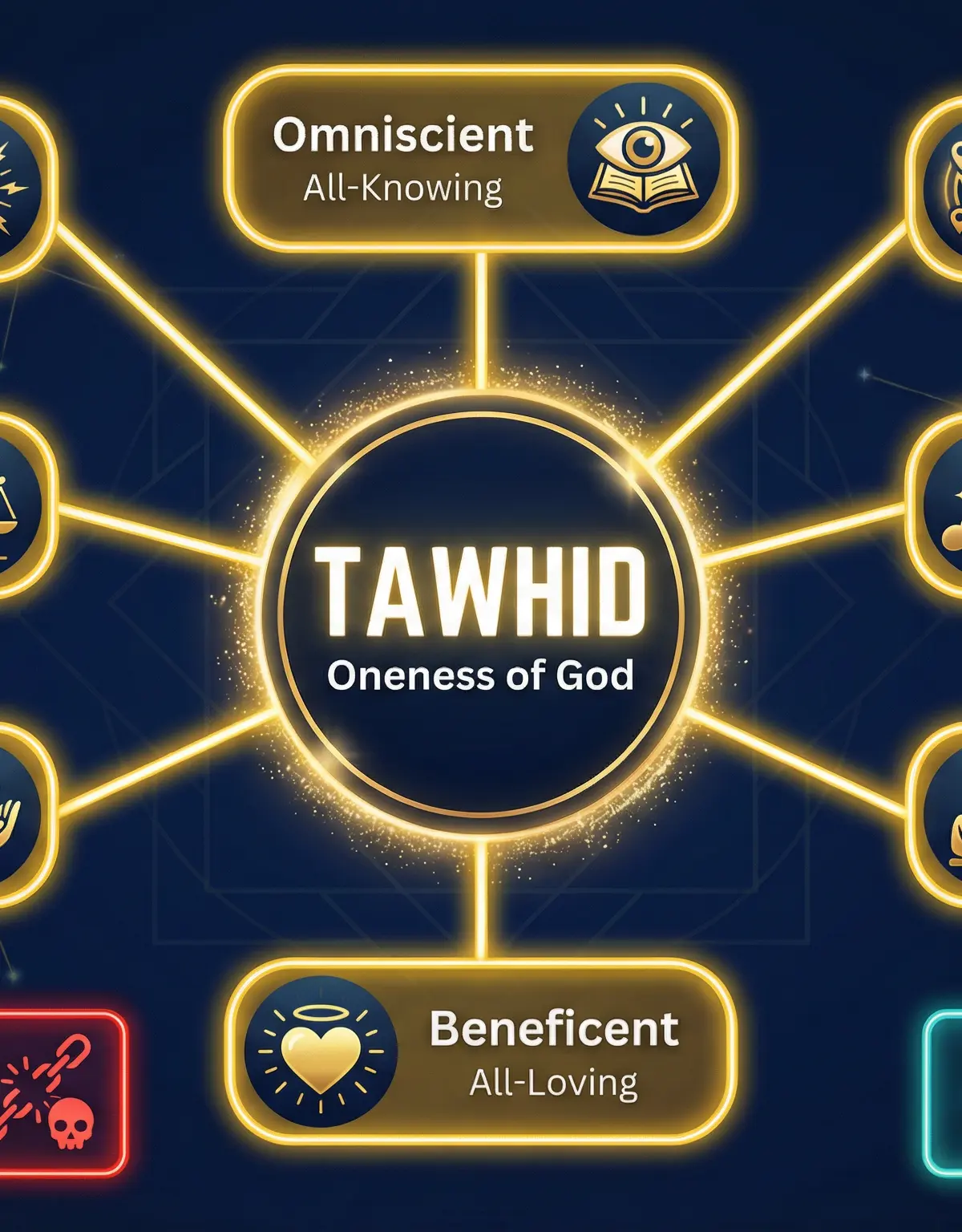
Understanding the nature of God is central to this topic. Candidates must be able to explain key attributes of Allah, linking them to the concept of Tawhid.
- Transcendent and Immanent: God is both above and beyond his creation (transcendent) but also close to and involved with it (immanent). The Qur'an states He is "closer to you than your jugular vein."
- Omnipotent, Omniscient, Beneficent: God is all-powerful, all-knowing, and all-good. These attributes are often referred to by His 99 names.
- Merciful and Just: God is both compassionate (Al-Rahman) and a fair judge (Al-Hakam). The tension between God's mercy and justice is a key area for evaluation in 12-mark questions.
The Afterlife Journey
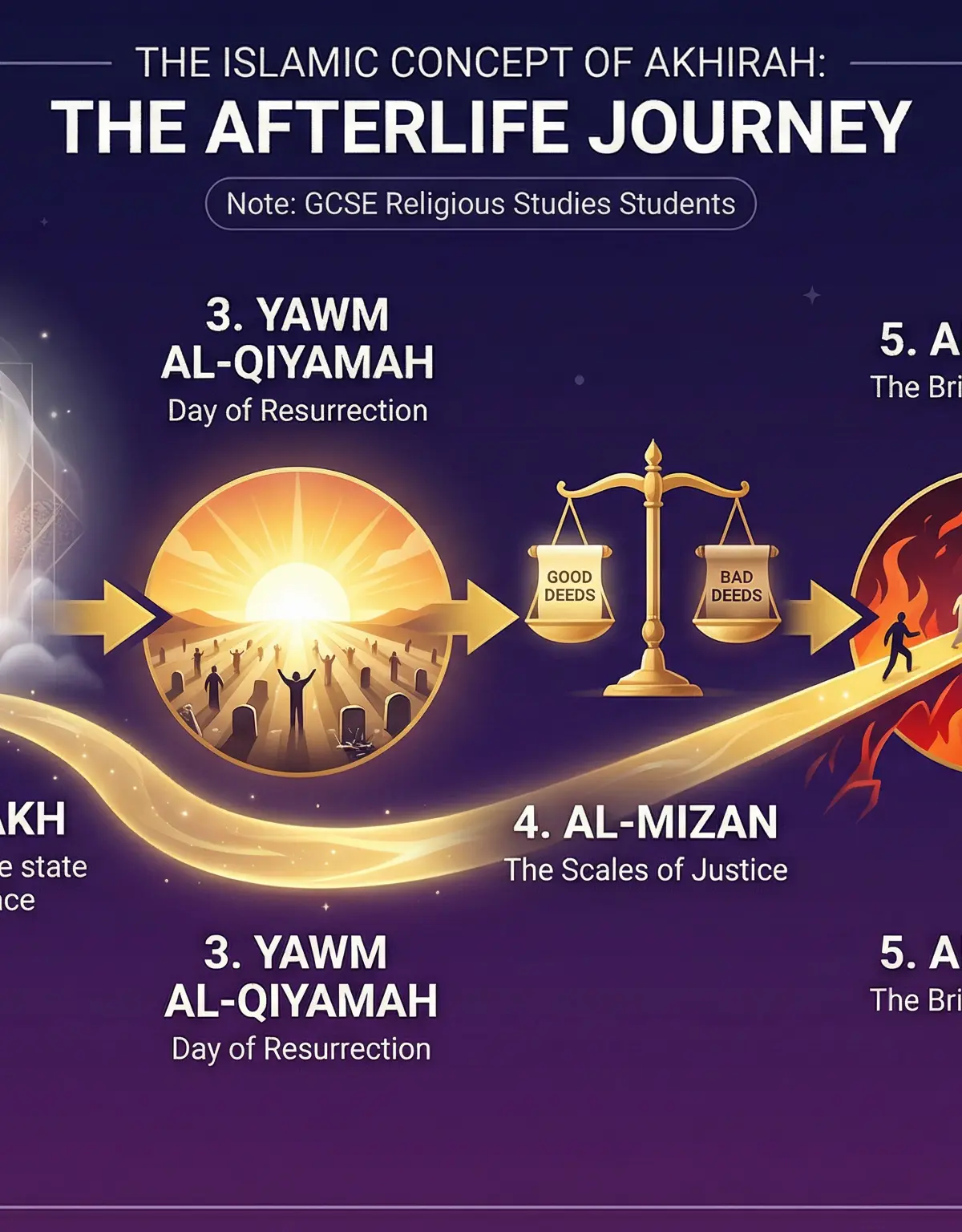
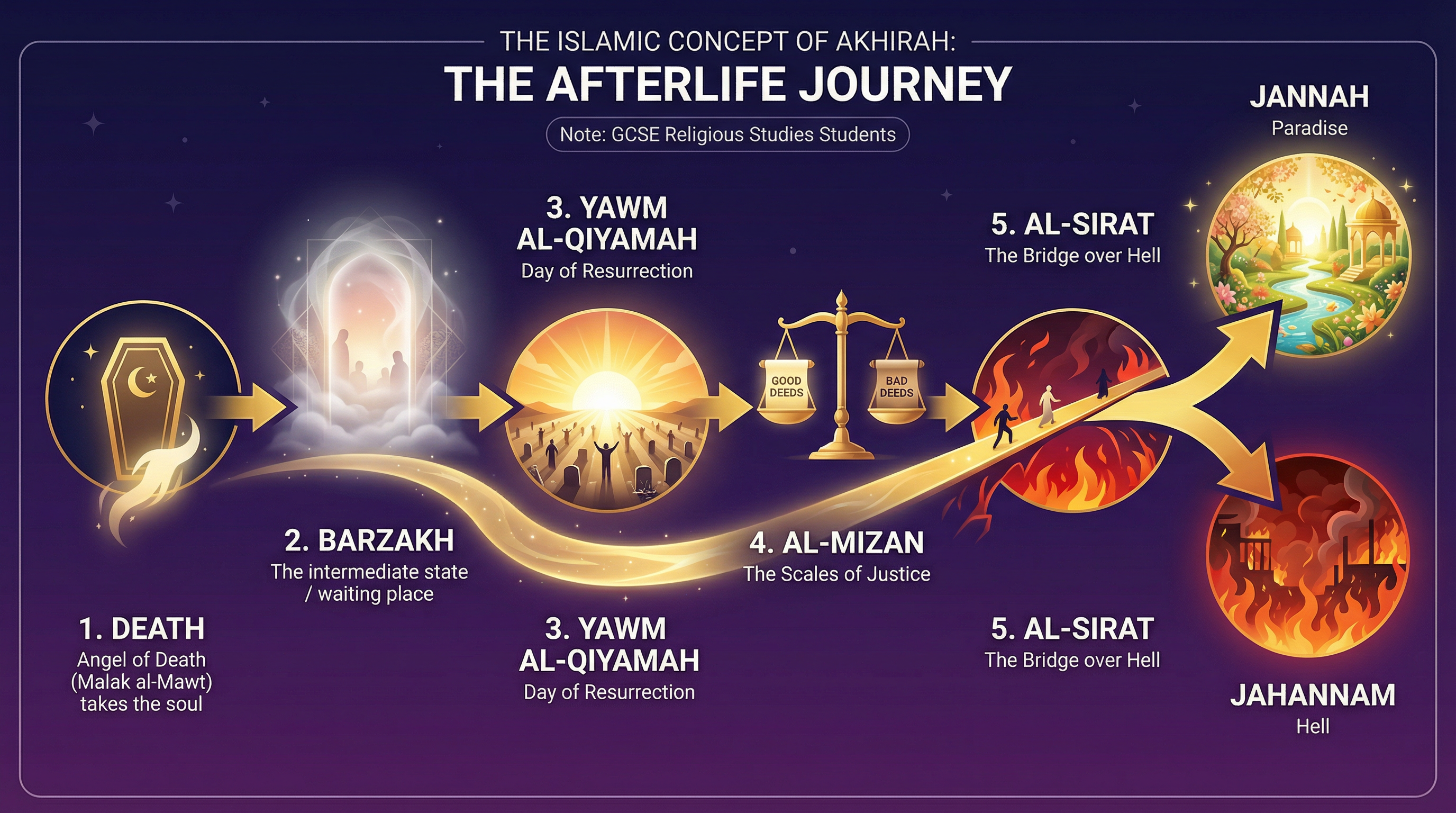
The concept of Akhirah involves a sequence of events that candidates should know.
- Death: The Angel of Death, Malak al-Mawt, takes the soul.
- Barzakh: The soul waits in an intermediate state until the Day of Judgement.
- Yawm al-Qiyamah: The Day of Resurrection. The world is destroyed and all are resurrected.
- Judgement: Each person's book of deeds is read, and their actions are weighed on the scales (al-Mizan).
- As-Sirat Bridge: All must cross a bridge over hell. For the righteous, it is broad and easy; for the wicked, it is sharp as a sword.
- Jannah or Jahannam: The final destination of Paradise or Hell.
Visual Resources
3 diagrams and illustrations
Interactive Diagrams
1 interactive diagram to visualise key concepts
Diagram could not be rendered
A timeline showing some of the key prophets in Islam and their significance.
Worked Examples
3 worked examples — open one to explore the question and available guidance.
Practice Questions
Test your understanding — click to reveal model answers
Explain two of the attributes of God in Islam. (4 marks)
Hint: Think about the 99 names of Allah. Choose two and explain what they mean.
Explain two ways in which belief in Risalah (prophethood) influences Muslims. (5 marks)
Hint: Think about how the prophets, especially Prophet Muhammad, act as role models and guides.
"For a Muslim, belief in the Day of Judgement is the only thing that matters." Evaluate this statement. (12 marks)
Hint: This is an evaluation question. Argue for and against the statement. Is the Day of Judgement the *only* thing that matters, or are other beliefs equally or more important? Remember to link your points back to Tawhid.
Describe the role of angels in Islam. (4 marks)
Hint: Think of at least two specific angels or types of angels and what they do.
Explain the difference between the Sunni and Shi'a belief about the succession of Prophet Muhammad. (5 marks)
Hint: Focus on the concepts of the Caliphate (Sunni) and the Imamate (Shi'a).