Relationships, Marriage, and Divorce — AQA GCSE Study Guide
Exam Board: AQA | Level: GCSE
This study guide for AQA GCSE Religious Studies delves into the complex and sensitive topic of relationships, marriage, and divorce. It provides a detailed exploration of Christian perspectives, contrasting them with secular British views, to equip students with the nuanced understanding required for top exam performance."
## Overview
This guide covers Theme A of the AQA GCSE Religious Studies specification, focusing on Relationships and Families. Examiners expect candidates to demonstrate a thorough understanding of the diversity of Christian beliefs regarding sexual relationships, marriage, cohabitation, divorce, and the nature of the family. A critical skill is the ability to contrast these religious views with non-religious perspectives prevalent in contemporary British society. This involves not just stating beliefs, but explaining their origins in sacred texts and tradition, and evaluating their relevance today. Marks are awarded for precise use of terminology (e.g., sacrament, covenant, annulment), accurate citation of sources of wisdom like the Bible, and the ability to construct well-argued evaluative essays. This topic is not just about memorising facts; it is about understanding the profound impact of faith on personal ethics and societal norms.

## Key Concepts & Beliefs
### Christian Teachings on Human Sexuality
**What are the beliefs**: The traditional Christian teaching is that sexual intercourse is a gift from God to be enjoyed exclusively within marriage. It is seen as having two main purposes: procreative (to have children) and unitive (to express love and deepen the marital bond). The Bible teaches that becoming "one flesh" is a sacred act (Genesis 2:24). Therefore, sex outside of marriage (premarital sex), adultery, and homosexual acts are traditionally considered sinful.
**Why it matters**: In the exam, candidates must be able to explain these traditional views and contrast them with modern, secular attitudes which often accept premarital sex and cohabitation in the context of a loving, committed relationship. Liberal Christians may also adopt a more flexible approach, emphasizing the quality of the relationship over marital status.
**Specific Knowledge**: Key texts include 1 Corinthians 6:18 ("Flee from sexual immorality") and the story of creation in Genesis. Candidates should understand the concepts of celibacy, chastity, and fidelity.
### Marriage: Sacrament vs. Covenant
**What are the beliefs**: For Christians, marriage is more than a legal contract.
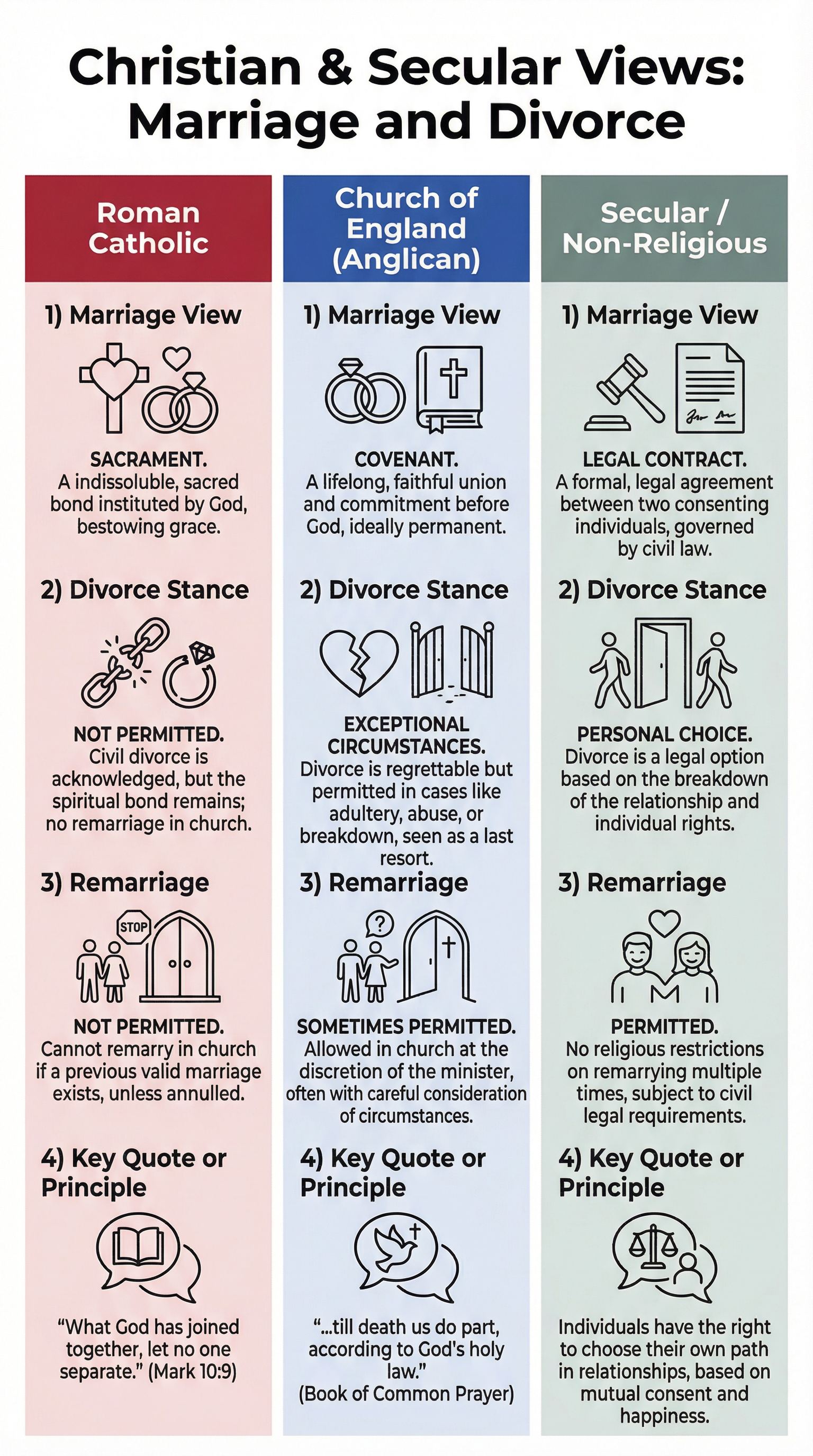
- **Roman Catholics** view marriage as a **sacrament**, an indissoluble spiritual bond made between a man and a woman, and God. It is a source of grace and cannot be broken by human action.
- **Anglicans (Church of England)** and other Protestants typically view it as a **covenant** – a solemn and binding promise made before God. While intended to be lifelong, it is acknowledged that covenants can sometimes be broken.
**Why it matters**: This distinction is crucial for understanding the different Christian approaches to divorce and remarriage. Examiners will credit candidates who can clearly explain the difference between a sacrament and a covenant.
**Specific Knowledge**: The most important quote is Mark 10:9: **"Therefore what God has joined together, let no one separate."** This is a versatile quote that can be used in almost any question on marriage or divorce.
### Divorce & Remarriage
**What are the beliefs**:
- **Roman Catholic Church**: Does not permit divorce. As a sacrament, a valid marriage cannot be ended. It does, however, have a process of **annulment**, which is a declaration that a true marriage never existed in the first place (e.g., due to lack of consent). A person who gets an annulment is free to marry in the church.
- **Church of England**: Allows for divorce as a last resort in cases of irretrievable breakdown. It is seen as a regrettable necessity in a fallen world. The Church allows for the remarriage of divorced people in church, often at the discretion of the priest.
- **Secular UK Law**: Divorce is a legal process that ends a marriage. It is available to any married couple and does not require a religious reason. Remarriage is legally permitted.
**Why it matters**: This is a major area of internal diversity within Christianity. Avoid saying "Christians believe...". Instead, be specific: "Catholics teach... whereas Anglicans permit...". This shows a higher level of understanding.
**Specific Knowledge**: Jesus’ teaching in Matthew 5:32 ("anyone who divorces his wife, except for sexual immorality, makes her the victim of adultery") is often cited as the basis for allowing divorce in some cases.
### The Family & Gender Roles
**What are the beliefs**: The traditional Christian family model is the nuclear family (mother, father, children). However, contemporary Britain has many different family structures (single-parent, blended, same-sex parent families). Christian teachings on love, compassion, and justice (e.g., "Love thy neighbour") are often applied to argue for the acceptance and support of all family types. Historically, Christianity has held complementarian views (men and women have different, complementary roles), but many Christians today hold egalitarian views (men and women are equal and should have the same roles and opportunities).
**Why it matters**: Candidates should be able to discuss the diversity of family life in the 21st century and how Christian teachings can be interpreted to apply to these different contexts. Questions on gender equality are common.
**Specific Knowledge**: Key texts include Ephesians 5 ("Wives, submit to your own husbands... Husbands, love your wives...") for traditional views, and Galatians 3:28 ("There is neither Jew nor Gentile, neither slave nor free, nor is there male and female, for you are all one in Christ Jesus") for egalitarian views.
"