AQA · GCSE · Religious Studies
The Nature of the Soul and Afterlife
This guide provides a comprehensive analysis of the nature of the soul and the afterlife in Christianity and Islam for AQA GCSE Religious Studies. It is designed to equip candidates with the precise knowledge and evaluative skills needed to achieve top marks by focusing on key theological concepts, scriptural evidence, and common exam pitfalls."
- 5 min read
- 3 worked examples
- 5 practice questions
Study Notes

Overview
This topic explores the fundamental questions of human existence: what is the soul, and what happens after we die? For the AQA GCSE exam, candidates must move beyond simple descriptions and critically analyse the distinct eschatological perspectives of Christianity and Islam. This involves contrasting dualist and non-dualist interpretations of the soul, integrating specific Sources of Wisdom and Authority (SOWA) to substantiate claims, and evaluating the logical coherence of these beliefs. Examiners expect a nuanced understanding of denominational variations (e.g., Catholic vs. Protestant views on Purgatory) and the ability to link metaphysical beliefs to their impact on moral conduct in this life. High-level responses will demonstrate a command of key terminology and the ability to construct well-supported arguments in extended writing.
Key Concepts & Beliefs
The Nature of the Soul
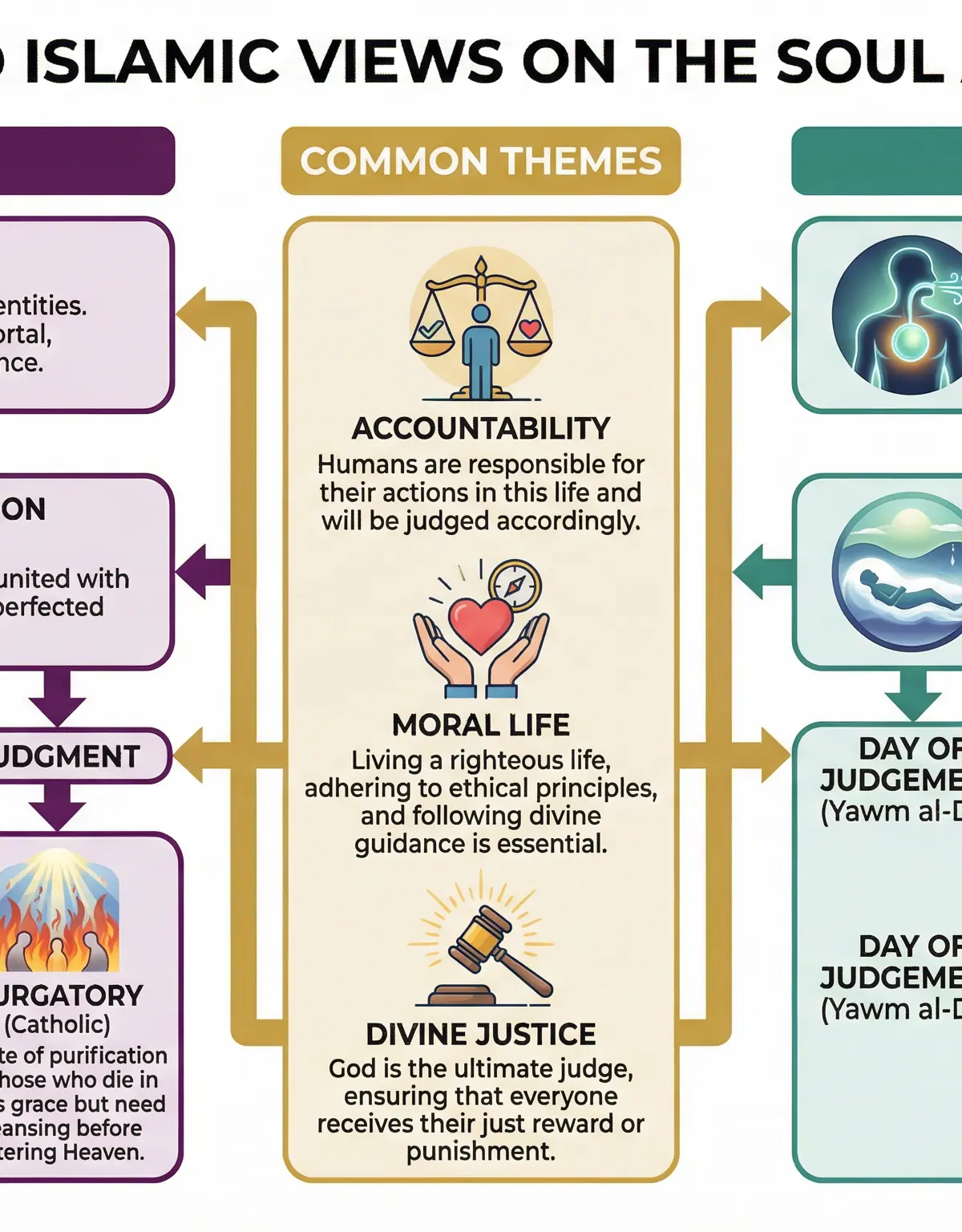
Christianity: Christian thought contains two main strands. The first, influenced by Platonic dualism, sees the soul as an immortal, spiritual substance separate from the mortal, physical body. The second, and more dominant view, is that of physical resurrection. This is the belief that at the end of time, the body and soul will be reunited in a transformed, glorified state known as the soma pneumatikon (spiritual body), as described by St. Paul in 1 Corinthians 15:44. Jesus's resurrection is the model for this belief.
Islam: In Islam, the soul is known as the Ruh. It is understood as a divine breath from Allah, which gives life to the body. The Ruh is not seen as naturally immortal in its own right; its continued existence after death is dependent on Allah's will. The Quran states that Allah "breathed into him [Adam] of His spirit" (Surah 15:29), highlighting the divine origin of the soul.
The Afterlife Journey
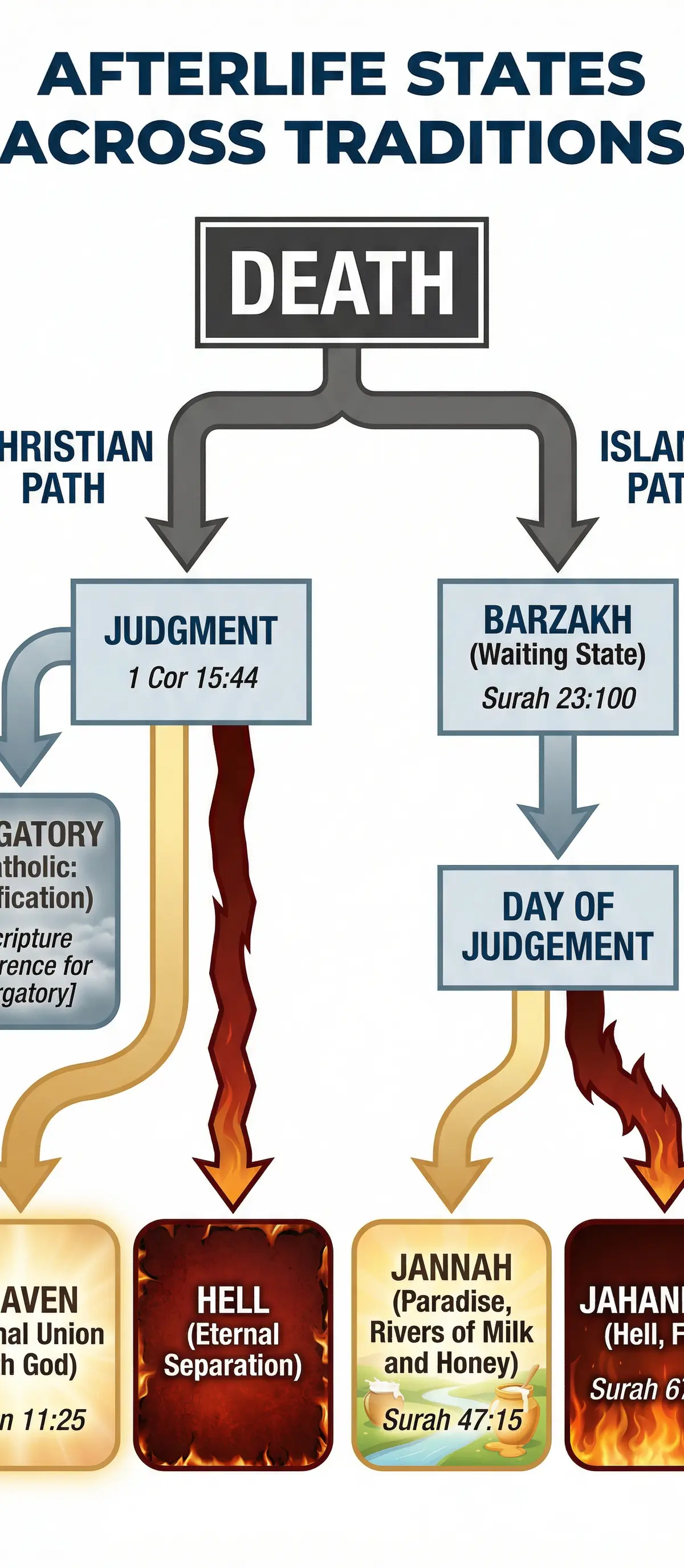
Christianity: After death, Christians believe in a judgment. This can be understood as an immediate (or particular) judgment after death, and a general (or Last) judgment at the end of time. The soul's destination is either Heaven (a state of eternal union with God), Hell (a state of eternal separation from God), or, in Catholic theology, Purgatory. Purgatory is a state of purification for those who have died in God's grace but are not yet ready for Heaven. This doctrine is rejected by Protestant denominations.
Islam: After death, the soul enters Barzakh, an intermediate state or barrier, where it awaits the Day of Judgment. The Quran says, "Behind them is a barrier until the Day they are raised up" (Surah 23:100). On Yawm al-Din (the Day of Judgment), all humanity will be resurrected, and their deeds weighed on the Mizan (divine scales). Those with more good deeds enter Jannah (Paradise), while those with more bad deeds face Jahannam (Hell).
Second-Order Concepts
Change & Continuity
Beliefs about the afterlife have shown both continuity and change. The core concepts of judgment, reward, and punishment are continuous across Christian history. However, the emphasis has changed. Early Christians focused heavily on the imminent return of Christ and the general resurrection. Over time, particularly with the influence of Greek philosophy, the concept of the immortal soul and immediate judgment became more prominent. The Protestant Reformation in the 16th century marked a significant change, with the rejection of Purgatory and the sale of indulgences.
Significance
Beliefs about the soul and afterlife are highly significant as they directly impact a believer's moral conduct, purpose in life, and response to death and suffering. The promise of Heaven or Jannah provides hope and a goal for righteous living, while the threat of Hell or Jahannam serves as a deterrent against sin. These beliefs also form the basis for religious rituals surrounding death and mourning.
Source Skills
When presented with a source, such as a biblical passage or a quote from a theologian, candidates must not simply describe it. For high marks, you must analyse its meaning and link it to the question. Consider:
- Provenance: Who wrote it? When? Why? (e.g., Is it St. Paul writing to a specific church to correct a misunderstanding?)
- Content: What specific theological idea is it supporting? (e.g., resurrection, judgment, the nature of the soul).
- Application: How does this source support or challenge a particular viewpoint? (e.g., How does 1 Corinthians 15 support physical resurrection over spiritual immortality?)."
Worked Examples
3 worked examples — open one to explore the question and available guidance.
Practice Questions
Test your understanding — click to reveal model answers
Explain two religious beliefs about judgment. Refer to sacred writings or another source of religious belief and teaching in your answer. (5 marks)
Hint: Think about the different types of judgment in Christianity, or contrast a Christian view with the Islamic Day of Judgment.
'The resurrection of the body is a confusing and outdated idea.' Evaluate this statement. (12 marks)",
"marks": 12
Describe two Christian beliefs about Heaven. (4 marks)
Hint: Think about what Heaven is like and who goes there.
Explain two contrasting Muslim beliefs about the afterlife. (5 marks)
Hint: Contrast the destination for the righteous with the destination for the unrighteous.
Explain two reasons why the resurrection of Jesus is important for Christians. (4 marks)
Hint: Think about what the resurrection proves and what it gives hope for.