Pearson Edexcel · A-Level · Religious Studies
Knowledge of God's Existence
This study guide provides a comprehensive analysis of the Edexcel A-Level Religious Studies topic on the Knowledge of God's Existence. It critically examines the core tension between Natural Theology (knowledge through reason) and Revealed Theology (knowledge through faith and grace), focusing on the pivotal arguments of Calvin, the Barth-Brunner debate, and Plantinga's Reformed Epistemology, equipping students to excel in AO1 and AO2."
- 6 min read
- 3 worked examples
- 5 practice questions
Study Notes

Overview
This topic requires a rigorous examination of the distinction between Natural and Revealed Theology. Candidates must evaluate whether human reason and observation (Natural) are sufficient to gain knowledge of God, or if the Fall has corrupted this capacity, necessitating faith and grace (Revealed). The core focus is the intellectual conflict between John Calvin's 'sensus divinitatis' and the 20th-century Barth-Brunner debate regarding the 'point of contact'. Examiners expect candidates to move beyond mere description to a critical evaluation (AO2) of these positions, contextualising them historically and assessing their theological coherence. Success in this area hinges on a precise understanding of key terms and the ability to construct a sustained, analytical argument regarding the epistemic possibilities for knowing God after the Fall.

Key Individuals & Debates
John Calvin (1509-1564)
Role: A principal figure of the Protestant Reformation and a foundational theologian for this topic.
Key Actions: In his 'Institutes of the Christian Religion' (1536), Calvin proposed that humans possess a 'sensus divinitatis' (an innate sense of the divine) and a 'semen religionis' (a seed of religion). This suggests a natural human disposition towards God.
Impact: Calvin provides a framework for Natural Theology, arguing that God's existence is evident in creation (Romans 1:20). However, he crucially argues that the Fall has corrupted this sense, leading not to true knowledge but to idolatry. Therefore, while Natural Theology makes humanity accountable to God, it is insufficient for salvation, which requires Revealed Theology (Christ and Scripture).
The Barth-Brunner Debate (1934)
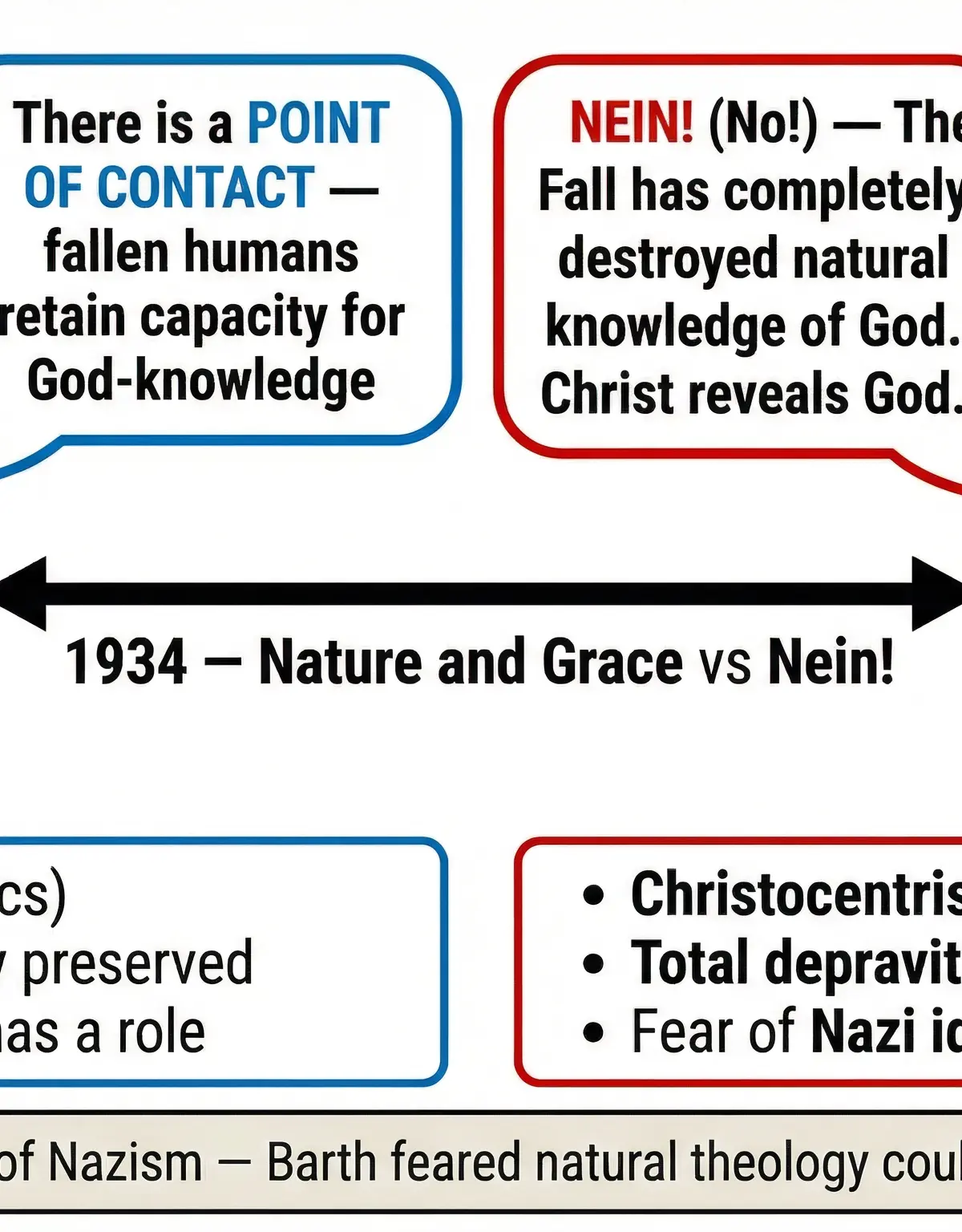
What happened: A landmark theological exchange between Swiss theologians Karl Barth and Emil Brunner over the validity of Natural Theology after the Fall.
Why it matters: This debate defines the central conflict for exam questions. Brunner, in 'Nature and Grace', argued for a 'point of contact' (Anknüpfungspunkt), suggesting the 'Imago Dei' (Image of God) in humans was damaged but not destroyed, allowing a role for reason and apologetics. Barth, in his famous response 'Nein!' ('No!'), rejected this entirely. For Barth, the Fall obliterated any natural point of contact; God can only be known through His own self-revelation in Jesus Christ (Christocentrism). Barth's stance was heavily influenced by the rise of Nazism, fearing that Natural Theology could be co-opted to idolise the state or race.
Specific Knowledge: Candidates must know the date (1934), the key terms ('point of contact', 'Nein!'), and the historical context (the rise of Nazism and the German Christian movement).
Alvin Plantinga (1932-Present)
Role: A contemporary American philosopher of religion.
Key Actions: Developed 'Reformed Epistemology', arguing that belief in God can be a 'properly basic belief'. This means it can be rational and warranted without being based on evidence or other arguments, much like the belief in other minds or the external world.
Impact: Plantinga provides a modern defence of a type of Natural Theology. He draws on Calvin's 'sensus divinitatis' to propose a cognitive faculty that, when functioning properly, produces belief in God. This sidesteps the need for traditional arguments for God's existence but raises questions about whether the 'sensus divinitatis' can be trusted post-Fall.
Second-Order Concepts
Causation
- Long-term cause: The Fall of Man is the theological event that causes the central problem: is human reason now corrupt and unreliable for knowing God?
- Mid-term cause: Calvin's formulation of the 'sensus divinitatis' sets the terms for the debate, creating a Protestant framework that accepts a form of natural knowledge while limiting its salvific power.
- Trigger cause: The rise of the Nazi-aligned 'German Christian' movement, which used natural theology to justify its ideology, directly triggered Barth's forceful 'Nein!' and his absolute rejection of any natural point of contact.
Consequence
- Immediate consequence: The Barth-Brunner debate created a sharp and enduring division in Protestant theology between those who see a role for reason and culture in theology and those who adopt a strictly Christocentric, revelation-only position.
- Long-term consequence: The debate continues to shape contemporary discussions on faith and reason, apologetics, and inter-faith dialogue. Plantinga's work is a direct continuation of this conversation in a modern philosophical context.
Change & Continuity
- Continuity: The fundamental questions asked by Paul in Romans 1 and Acts 17 about what can be known of God from creation continue throughout the centuries.
- Change: The emphasis shifts from a pre-modern confidence in reason (like Aquinas) to a post-Reformation scepticism (Calvin) and then to a radical, crisis-driven rejection of reason by Barth in the 20th century.
Significance
This topic is significant because it forces a decision on the very foundations of religious knowledge. The position a candidate takes has profound implications for evangelism, ethics, and the relationship between Christianity and secular culture. Examiners view this as a test of a student's ability to handle complex, abstract theological arguments and their historical contexts.
Source Skills
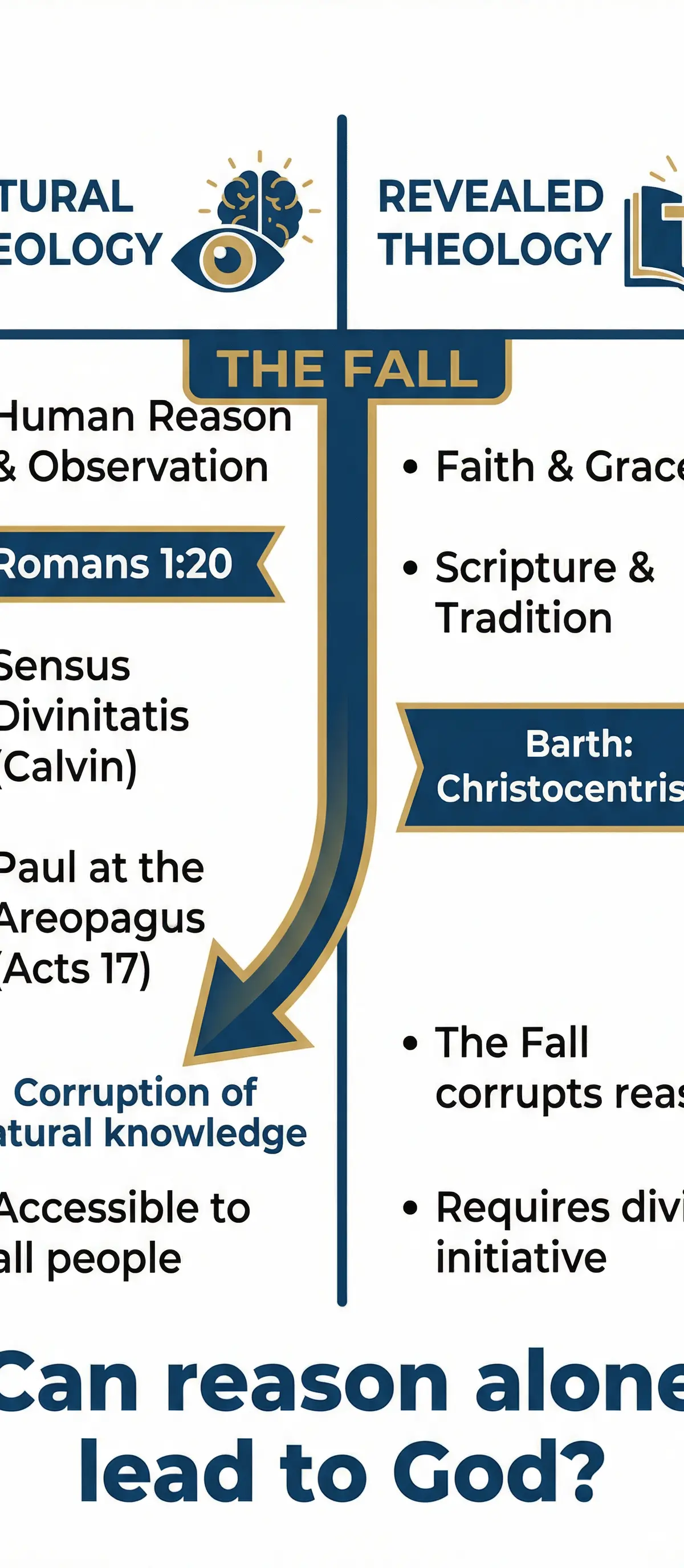
When presented with a scriptural source like Romans 1:18-21 or Acts 17:22-31, candidates must analyse it from the perspective of the key thinkers.
- Provenance: Who wrote it (e.g., Paul) and to whom? What was the context? (e.g., Paul addressing pagan philosophers in Athens).
- Content: What does the source claim about knowledge of God? Does it support Natural Theology (as Brunner might argue) or highlight its failure (as Calvin and Barth would stress)?
- Application: A top-level answer will use the source as evidence within the Barth-Brunner debate. For example: 'Brunner could use Paul's speech at the Areopagus as evidence for a point of contact, as Paul starts with their "unknown god". However, Barth would counter that Paul immediately pivots to the revelation of Christ and the resurrection, demonstrating the ultimate failure of their natural reason.'
"
Worked Examples
3 worked examples — open one to explore the question and available guidance.
Practice Questions
Test your understanding — click to reveal model answers
Clarify Calvin's distinction between knowing that God exists and knowing God. (10 marks)
Hint: Think about the difference between propositional knowledge and personal, relational knowledge. How does the Fall affect this?
Evaluate the claim that Barth's rejection of Natural Theology was driven more by politics than by theology. (20 marks)
Hint: Structure your essay to argue for and against the statement. Was his Christocentrism a pre-existing theological principle, or was it developed specifically in response to Nazism?
Clarify the arguments for Natural Theology presented in Acts 17 and Romans 1. (10 marks)
Hint: Go through each passage separately and explain what it suggests about the possibility of knowing God through reason or observation.
Evaluate Plantinga's concept of belief in God as a 'properly basic belief'. (20 marks)
Hint: Strengths: It reflects how many people actually come to faith; it avoids the weaknesses of the traditional arguments. Weaknesses: Is it a free pass for any belief? What about the problem of the Fall corrupting the 'sensus divinitatis'?
Explain the difference between the formal and material aspects of the 'Imago Dei' in Brunner's theology. (10 marks)
Hint: Material = the content, the relationship with God. Formal = the structure, the human capacity for reason/language.