Pearson Edexcel · A-Level · Religious Studies
Religious Figures and Sacred Texts
This study guide explores the complex relationship between religious figures and sacred texts in A-Level Religious Studies. It delves into the critical debates surrounding divine revelation, textual authority, and scholarly interpretation, providing students with the analytical tools needed to excel in the Edexcel examination."
- 7 min read
- 3 worked examples
- 5 practice questions
Study Notes
Overview
Welcome to your deep dive into Religious Figures and Sacred Texts for Edexcel A-Level Religious Studies. This topic moves beyond simple narratives to a sophisticated analysis of how authority is constructed, challenged, and interpreted within religious traditions. Examiners are not looking for a simple retelling of stories; they expect a rigorous theological and philosophical interrogation of the texts and figures that underpin faith. You will explore the fundamental distinction between propositional revelation (the text as the Word of God) and non-propositional revelation (the text as a vehicle for divine encounter). This involves grappling with the influential and often conflicting views of key scholars like Karl Barth, Rudolf Bultmann, and John Calvin. A central focus will be on hermeneutics—the theory of interpretation—and how different approaches (from fundamentalist to liberal) radically alter the meaning and relevance of sacred scriptures. For figures like Jesus Christ, you must be able to articulate and evaluate complex theological concepts such as the Chalcedonian Definition with precision. Success in this area requires you to think like a theologian, weighing arguments and forming substantiated judgments on the nature of divinity, authority, and meaning in a modern context.

Key Concepts & Developments
Propositional vs. Non-Propositional Revelation
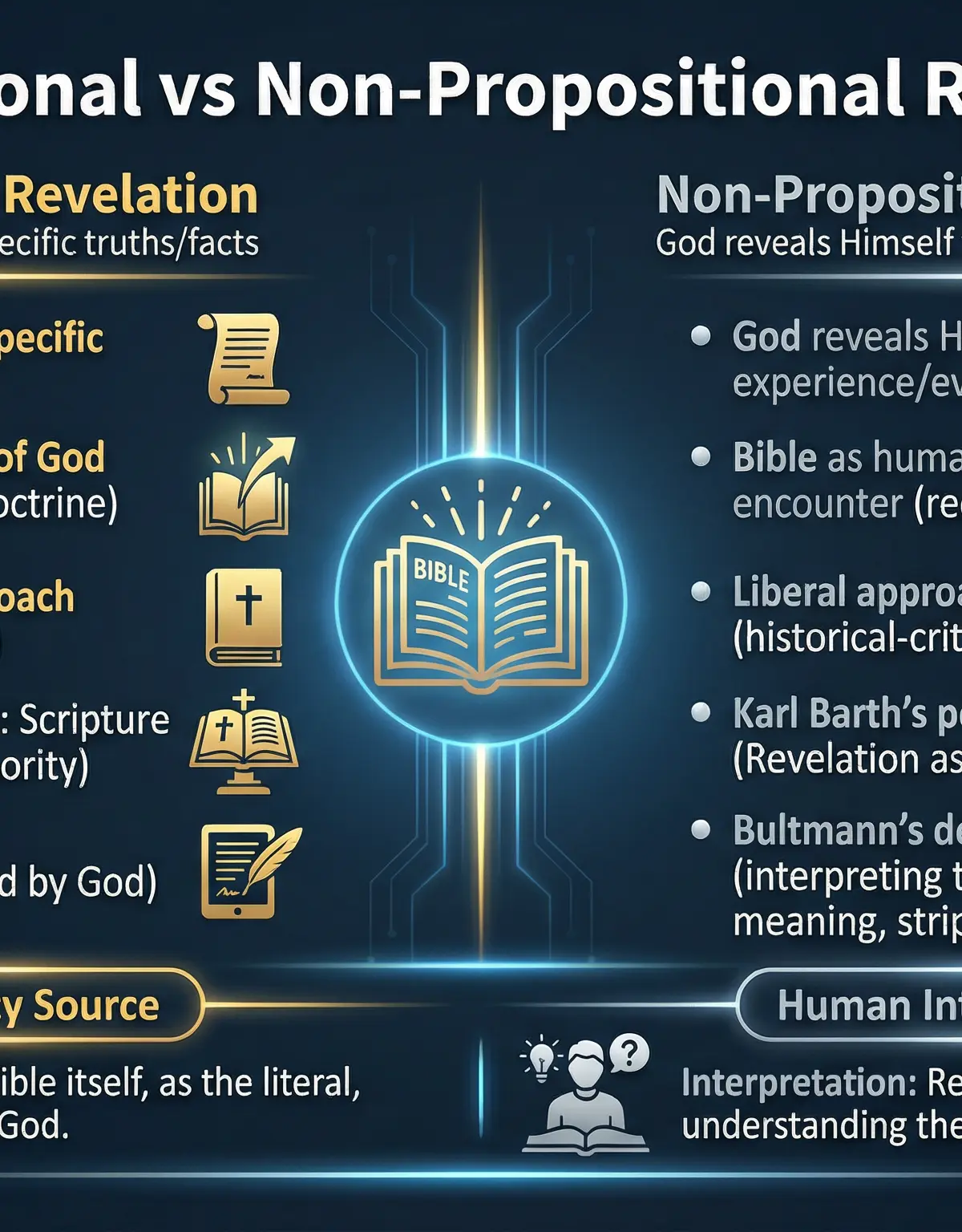
What it is: This is the central debate on how divine knowledge is communicated. Propositional Revelation holds that God communicates in specific, factual statements or propositions (e.g., 'God is the creator'). The sacred text is seen as a direct, divinely dictated container of these truths. In contrast, Non-Propositional Revelation argues that God does not reveal facts, but reveals Himself through experience, history, and personal encounter. The sacred text is therefore a human response to, and record of, these revelatory events.
Why it matters: This distinction is the foundation for almost every other debate in this topic. A candidate's stance here determines their approach to biblical authority, inspiration, and interpretation. Marks are awarded for clearly showing how a belief in one form of revelation logically leads to certain conclusions about the Bible. For example, a propositional view often leads to a fundamentalist or literalist hermeneutic, while a non-propositional view opens the door for liberal, historical-critical methods.
Specific Knowledge: You must associate Propositional views with Fundamentalism and thinkers like John Calvin (Sola Scriptura). You must link Non-Propositional views with Liberalism and key scholars like Karl Barth and Rudolf Bultmann.
The Christology of the Chalcedonian Definition
Date(s): 451 AD
What happened: The Council of Chalcedon was convened to settle the intense and often bitter debate about the nature of Jesus Christ. The resulting 'Chalcedonian Definition' became the orthodox statement for most of Christianity.
Why it matters: It provides the definitive language for Christian understanding of Jesus. The definition asserts that Christ is one person (hypostasis) existing in two natures (fully human and fully divine), which are united without confusion, change, division, or separation. For the exam, this is not just a historical fact but a core theological concept. Candidates must be able to explain why this definition was so important for countering heresies (like Arianism and Nestorianism) and how it shapes Christian doctrine on salvation and worship.
Specific Knowledge: Hypostatic Union, Council of Chalcedon (451 AD), 'two natures, one person'.
Key Individuals
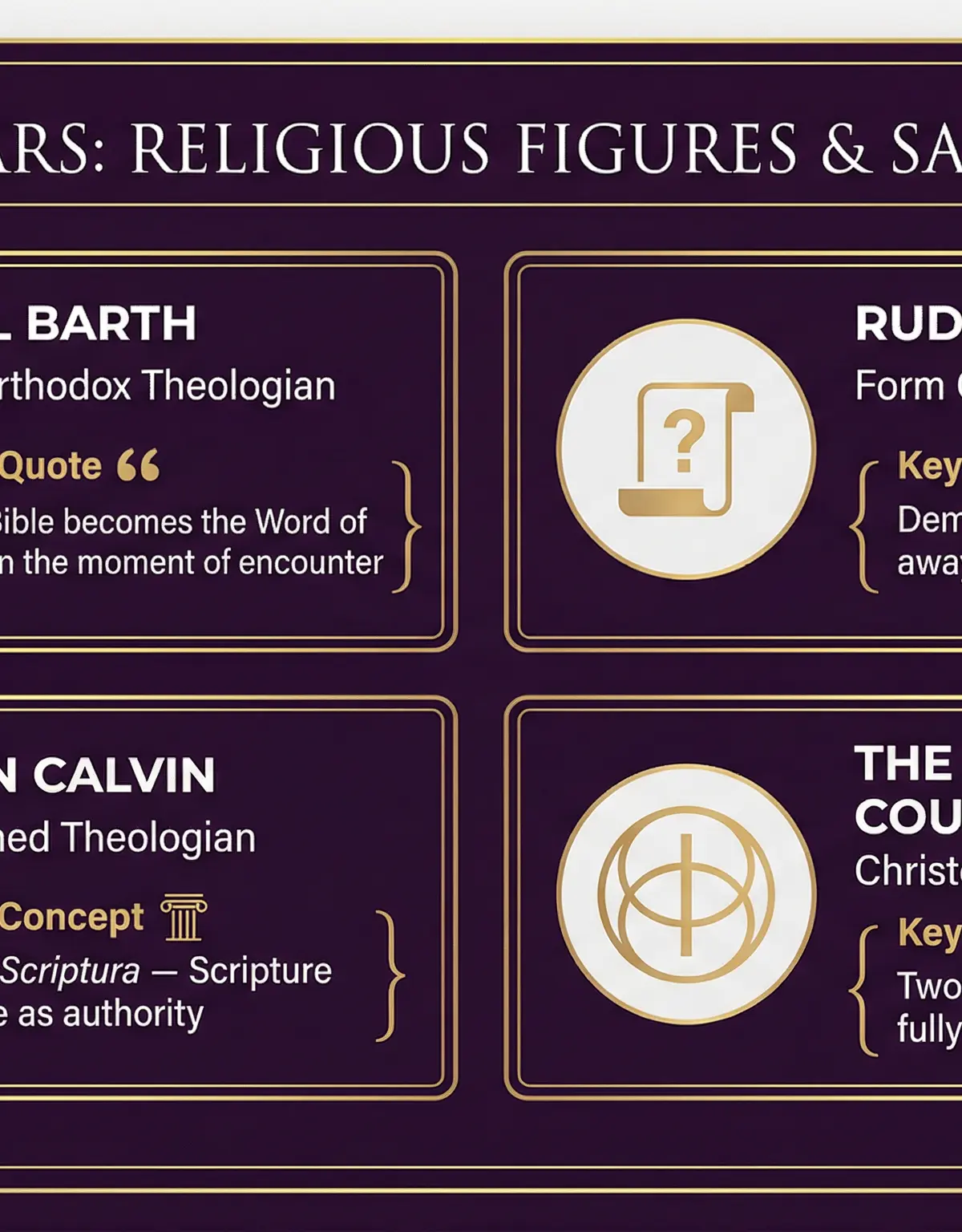
Karl Barth (1886-1968)
Role: Neo-Orthodox Theologian
Key Actions: Barth reacted against liberal theology's tendency to reduce Christianity to human ethics and experience. He re-emphasised God's transcendence and the centrality of revelation. His key idea is that the Bible is not, in and of itself, the Word of God. It is a human document. However, it becomes the Word of God in the dynamic moment of encounter, when God speaks to an individual through the text. This is a non-propositional, event-based view of revelation.
Impact: Barth offers a powerful third way between fundamentalist literalism and what he saw as overly subjective liberalism. He preserves the Bible's unique and authoritative status without requiring belief in its scientific or historical inerrancy. Examiners credit candidates who can explain this subtle but crucial position accurately.
Rudolf Bultmann (1884-1976)
Role: Form Critic & Existentialist Theologian
Key Actions: Bultmann is famous for his project of 'demythologisation'. He argued that the New Testament is written in the mythological language of a pre-scientific age (e.g., angels, demons, miracles, a three-tiered universe). To find the true, timeless message—the kerygma (proclamation)—for modern people, we must strip away this mythological husk. The goal is not to eliminate the miraculous but to interpret its underlying existential meaning.
Impact: Bultmann forces a radical re-evaluation of what it means for a sacred text to be 'true'. For him, truth is not about historical facticity but about existential meaning. The resurrection is not important as a literal event, but as a proclamation about the possibility of authentic existence. This is a challenging but high-level argument to deploy in an AO2 essay.
Second-Order Concepts
Causation
- Long-term cause: The philosophical shift of the Enlightenment, which prioritized reason and empirical evidence, created the conditions for the historical-critical approach to sacred texts, challenging traditional views of divine authorship.
- Short-term cause: The rise of biblical archaeology in the 19th century, which sometimes contradicted the biblical narrative, forced theologians to reconsider the nature of the text's truth claims.
Consequence
- Immediate consequence: A major division in Christian thought between 'liberal' and 'conservative'/'fundamentalist' wings, a division that still defines the theological landscape today.
- Long-term consequence: The development of multiple, sophisticated hermeneutical approaches, allowing for a more nuanced engagement with sacred texts that can account for their historical and literary contexts.
Significance
- The debates over religious figures and sacred texts are significant because they are fundamentally about the source and nature of authority. Who or what has the final say in matters of belief and practice: the text, the church, individual experience, or reason? How candidates answer this question of authority will shape their entire argument."
Worked Examples
3 worked examples — open one to explore the question and available guidance.
Practice Questions
Test your understanding — click to reveal model answers
Explain the difference between propositional and non-propositional views of revelation. (12 marks)
Hint: Define both terms clearly and use a key scholar for each view (e.g., Calvin for propositional, Barth for non-propositional).
Evaluate the claim that Bultmann's demythologisation destroys the Christian message. (20 marks)
Hint: Consider what is lost and what is gained by Bultmann's method. Does it save the Christian message for a modern audience, or gut it of its essential content?
Explain the significance of the Chalcedonian Definition. (8 marks)
Hint: Focus on *why* it was important. What problems did it solve?
To what extent is the Bible merely a human book? (20 marks)
Hint: This is a question about inspiration and authority. Contrast a fundamentalist view with Barth and Bultmann.
Explain John Calvin's view of the Bible. (8 marks)
Hint: Focus on Sola Scriptura and the idea of the Bible as the ultimate authority.