Pearson Edexcel · GCSE · Religious Studies
Just War Theory and Holy War
This study guide explores the complex ethical and theological questions surrounding religious attitudes to war. It provides a detailed analysis of Just War Theory and Holy War, equipping you with the critical knowledge and exam skills needed to achieve top marks in your Edexcel GCSE Religious Studies exam."
- 5 min read
- 3 worked examples
- 5 practice questions
Study Notes
Overview
This guide delves into the crucial and often controversial topic of religious responses to conflict, focusing on the Christian and Islamic traditions. For your Edexcel GCSE, a precise understanding of the distinction between Just War Theory and Holy War is essential for earning high marks. Just War Theory, developed by thinkers like St. Augustine and St. Thomas Aquinas, provides a rational framework of criteria to determine if a war can be morally justified. It is a theory of limitation and restraint. Holy War, in contrast, is war believed to be commanded by God, where the motivation is primarily theological, not ethical. Examiners expect candidates to not only know these concepts but to critically evaluate their relevance in the modern world, applying them to contemporary issues like terrorism and nuclear weapons. This guide will provide you with the detailed knowledge, key terminology, and analytical skills to deconstruct exam questions and build high-level arguments.
Key Concepts: Just War vs. Holy War
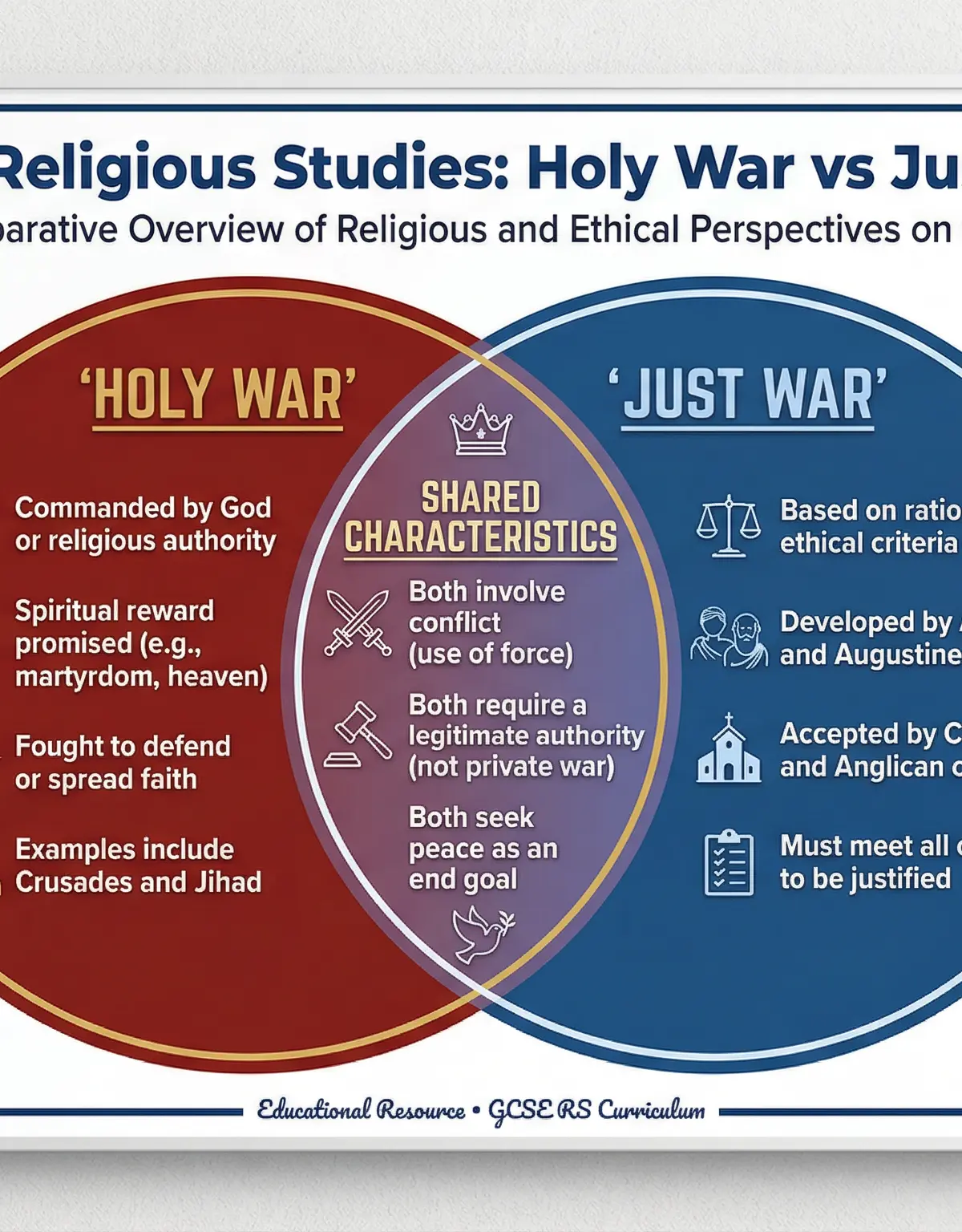
It is a fundamental error to confuse these two concepts. Credit is awarded for a clear and consistent distinction between them.
Just War Theory
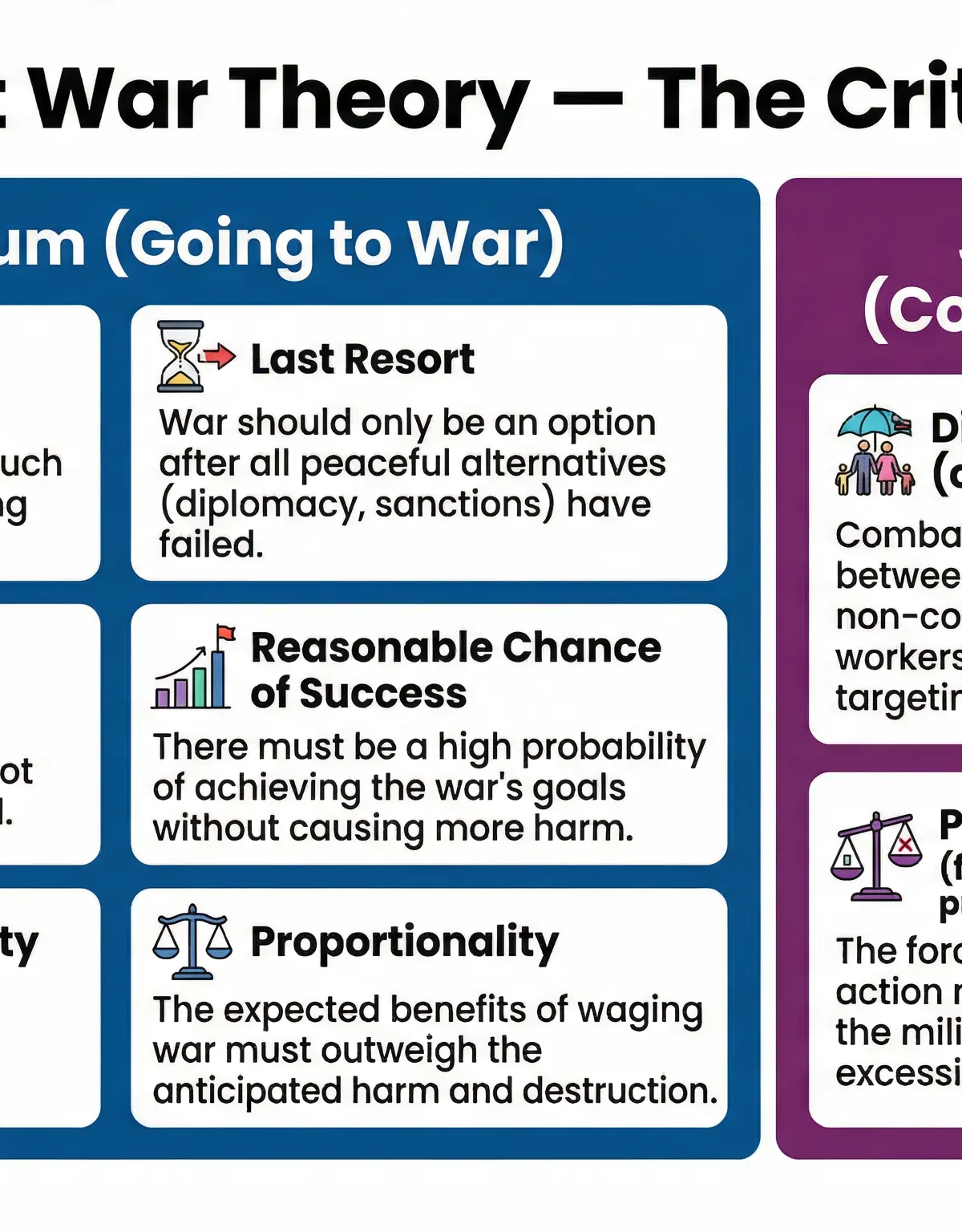
Developed by Christian philosophers, this theory argues that while war is a great evil, it can be a 'lesser of two evils' in certain, strictly limited circumstances. It is accepted by the Roman Catholic and Anglican churches. The criteria are split into two categories:
- Jus ad Bellum (Justice of going to war): The conditions that must be met before a war can be started.
- Jus in Bello (Justice in the conduct of war): The rules that must be followed during a war.
Holy War
This is a war fought for a religious purpose, believed to be commanded by God. The primary motivation is not based on a rational set of ethics, but on divine authority. Key features include:
- Divine Command: Believed to be willed or commanded by God (e.g., Pope Urban II's call for the First Crusade: 'Deus vult!' - 'God wills it!').
- Spiritual Reward: Participants are often promised spiritual benefits, such as the remission of sins or a place in paradise.
- Religious Goal: The aim is to defend or expand the faith, reclaim holy sites, or defeat perceived enemies of the religion.
- Examples: The Crusades in Christianity and the concept of Lesser Jihad in Islam are the primary examples candidates must know.
Key Individuals
St. Thomas Aquinas (1225-1274)
- Role: A highly influential Catholic theologian and philosopher.
- Key Actions: Systematised and developed Just War Theory based on the earlier work of St. Augustine. In his work Summa Theologica, he outlined three core conditions: Legitimate Authority, Just Cause, and Right Intention.
- Impact: His work forms the foundation of modern Just War Theory and is central to the official teaching of the Catholic Church on war.
Dietrich Bonhoeffer (1906-1945)
- Role: A German Lutheran pastor, theologian, and committed pacifist.
- Key Actions: Faced with the extreme evil of the Nazi regime, Bonhoeffer abandoned his pacifism to join a plot to assassinate Adolf Hitler. He believed it was his moral duty to resist tyranny, even if it meant committing a sinful act.
- Impact: Bonhoeffer's life and death represent a powerful case study in the real-world tensions between pacifism, the Sanctity of Life, and the duty to protect the innocent. Examiners credit responses that use his example to evaluate the limits of pacifism.
Second-Order Concepts
Causation
- Just War: The theory arose from the need for early Christians to reconcile the pacifist teachings of Jesus with the reality of living in the Roman Empire, which required military service.
- Holy War: The concept of Holy War often emerges in periods of intense religious fervour and perceived external threat, where a religious leader mobilises followers by claiming divine sanction.
Consequence
- Just War: The theory has profoundly influenced international law, including the Geneva Conventions, which govern the treatment of civilians and prisoners of war.
- Holy War: Historically, Holy Wars have led to extreme violence and the justification of acts that would be considered atrocities under Just War criteria.
Change & Continuity
- Change: The application of Just War Theory has had to adapt to modern warfare, particularly the development of nuclear weapons and the rise of non-state terrorist groups, which challenge criteria like 'Reasonable Chance of Success' and 'Legitimate Authority'.
- Continuity: The core principles of protecting the innocent (Discrimination) and using force as a last resort remain central to ethical debates about war today."
Worked Examples
3 worked examples — open one to explore the question and available guidance.
Practice Questions
Test your understanding — click to reveal model answers
Explain two Christian beliefs about violence. You must refer to a source of wisdom and authority in your answer. (5 marks)
Hint: Think about one belief that permits violence in some circumstances and one that forbids it entirely. Name the groups that hold these beliefs.
Explain two ways the concept of Jihad is understood in Islam. (4 marks)
Hint: Remember that 'Jihad' does not just mean 'Holy War'. What are the two different types?
'Protecting the innocent is the most important part of Just War Theory.' Evaluate this statement. (12 marks)
Hint: This is an evaluation question. You need to argue for and against the statement. Consider 'Just Cause' and 'Discrimination' but also weigh them against other criteria like 'Last Resort' and 'Legitimate Authority'.
Explain two of the Jus ad Bellum criteria. (4 marks)
Hint: Pick two from JRILL-P and explain what they mean in your own words.
Explain two contrasting Christian responses to the dilemma faced by Dietrich Bonhoeffer. (5 marks)
Hint: Use a pacifist perspective and a Just War perspective. Refer to a source of wisdom.