Pearson Edexcel · GCSE · Religious Studies
Key beliefs of Buddhism
This study guide provides a comprehensive overview of the key beliefs of Buddhism for Edexcel GCSE Religious Studies. It delves into the core concepts of the Three Marks of Existence, the Four Noble Truths, and the distinction between Theravada and Mahayana Buddhism, all tailored to meet examiner expectations and maximize marks.
- 5 min read
- 3 worked examples
- 4 practice questions
- 8 key terms
Check what you remember
Read the wording for your board, then hide it and explain Anicca in your own words. Rough notes are fine. This is a self-check, with no mark or grade.
Reference: Pearson Edexcel
Impermanence; the belief that all conditioned things are in a constant state of flux and will cease to exist.
Study Notes
Overview
This guide explores the fundamental tenets of Buddhism, a tradition founded by Siddhartha Gautama over 2,500 years ago. For Edexcel GCSE candidates, mastering these core beliefs is not just about understanding a religion; it is about demonstrating precise analytical and evaluative skills. Examiners expect candidates to articulate the philosophical underpinnings of Buddhism, using correct Pali terminology, and to distinguish clearly between the major schools of thought, particularly Theravada and Mahayana. This unit requires a firm grasp of concepts such as the Three Marks of Existence, the Four Noble Truths, and the divergent paths of the Arhat and the Bodhisattva. Success in this topic hinges on the ability to deploy specific knowledge, including key teachings and Sources of Wisdom and Authority (SOWA), to construct well-supported arguments. This guide will equip you with the detailed knowledge and exam technique required to achieve the highest marks.
Key Beliefs & Developments
The Three Marks of Existence
What they are: These are the three fundamental characteristics of all conditioned phenomena in the universe according to the Buddha. They are Anicca (Impermanence), Anatta (No-Self), and Dukkha (Unsatisfactoriness/Suffering).
Why they matter: Understanding the Three Marks is crucial for grasping the Buddhist worldview. Examiners award marks for defining these terms accurately using the Pali words and explaining their significance. The concept of Anatta, in particular, is a common source of confusion and a key differentiator from other religions like Hinduism. It is the foundation for the doctrine of rebirth, not reincarnation.
Specific Knowledge: Candidates must know the Pali terms and their English translations. A key source is the Dhammapada, which states, "All conditioned things are impermanent (Anicca)... All conditioned things are unsatisfactory (Dukkha)... All things are not-self (Anatta)."
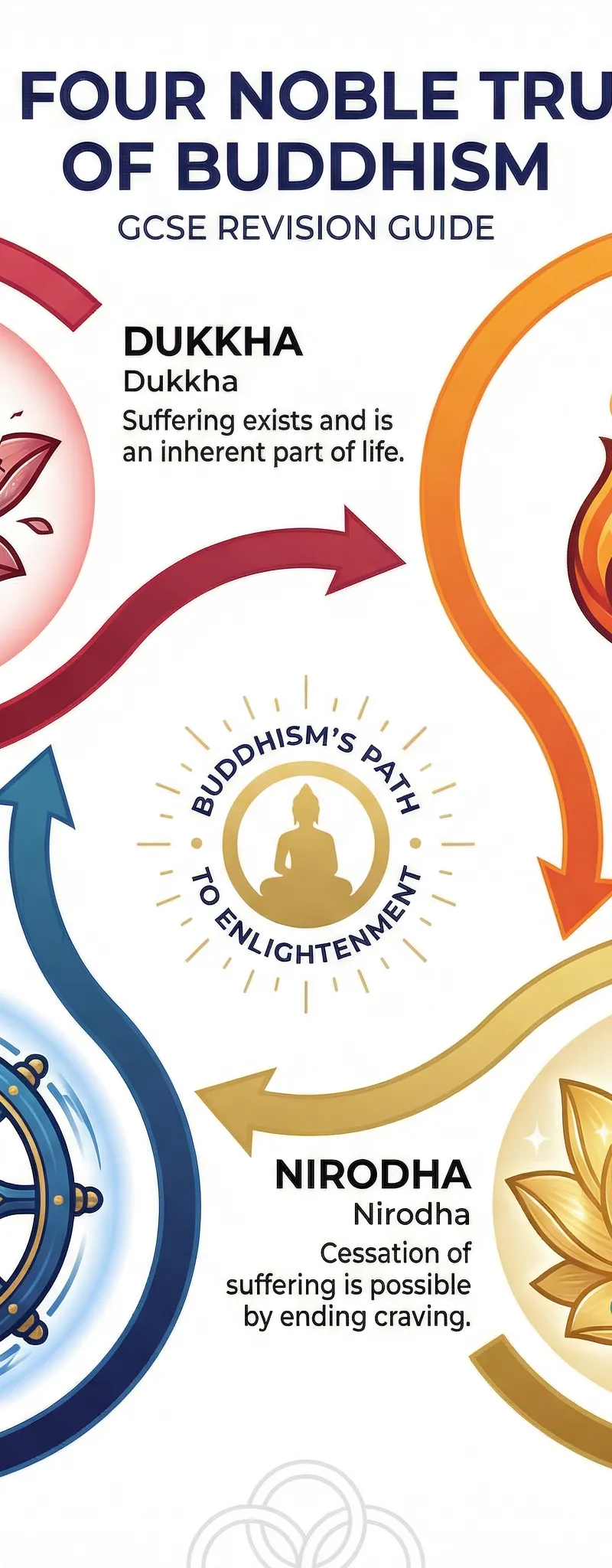
The Four Noble Truths
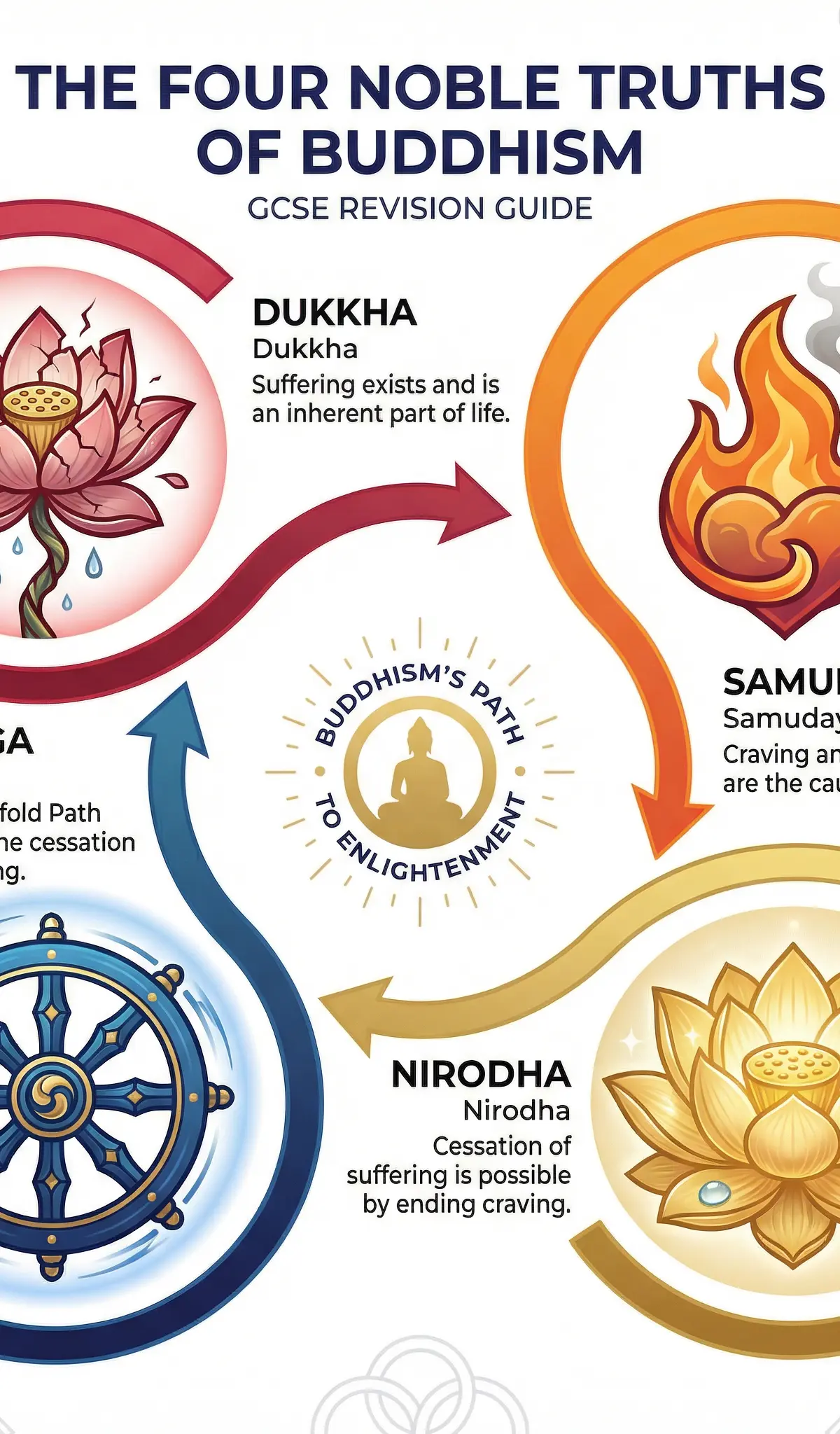
What they are: The Four Noble Truths are the Buddha's diagnosis of the human condition and his prescription for liberation. They form the core of his first sermon.
- Dukkha: The truth of suffering. Life inevitably involves suffering and unsatisfactoriness.
- Samudaya: The truth of the origin of suffering. The cause is Tanha (craving or thirst).
- Nirodha: The truth of the cessation of suffering. It is possible to end suffering by extinguishing craving.
- Magga: The truth of the path to the cessation of suffering. The way to achieve this is the Noble Eightfold Path.
Why they matter: This is the central framework of Buddhist teaching. Candidates must be able to explain all four truths and the relationship between them. Marks are specifically awarded for linking Samudaya to Tanha.
Specific Knowledge: Know the four truths by their Pali names and be able to explain the three types of Tanha (craving for sensual pleasure, existence, and non-existence).
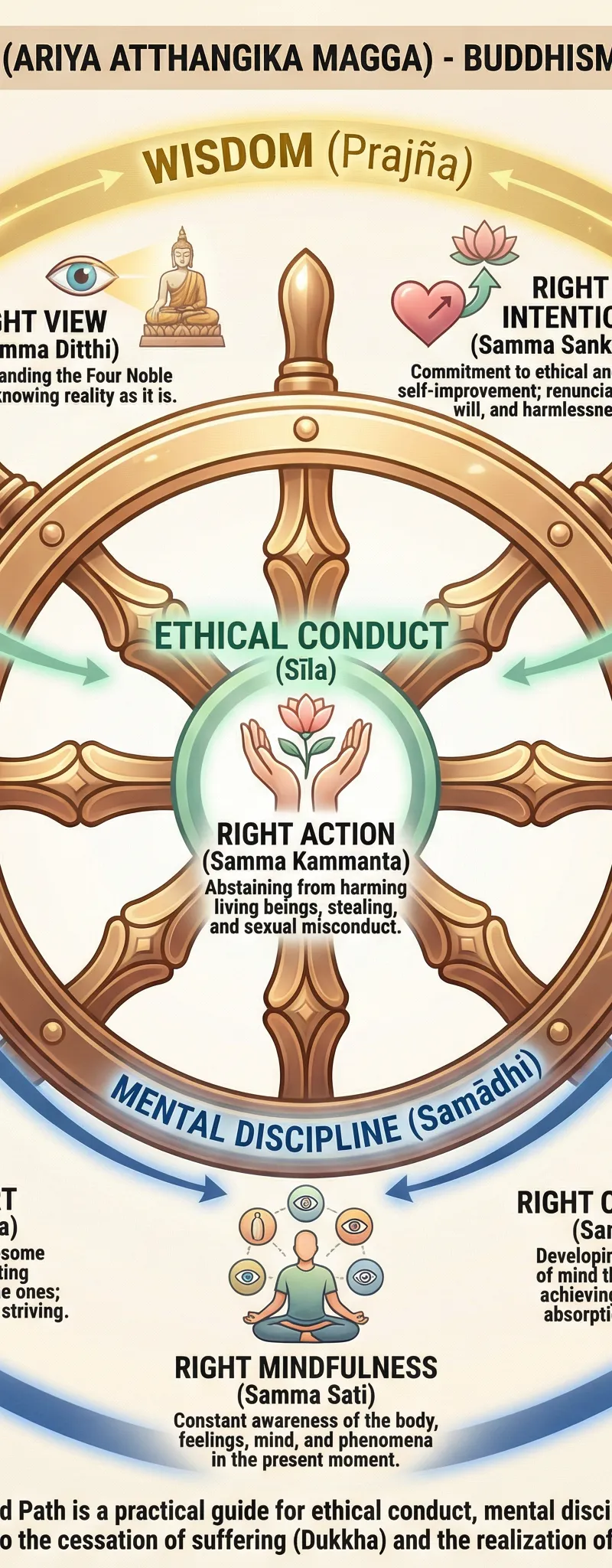
The Noble Eightfold Path
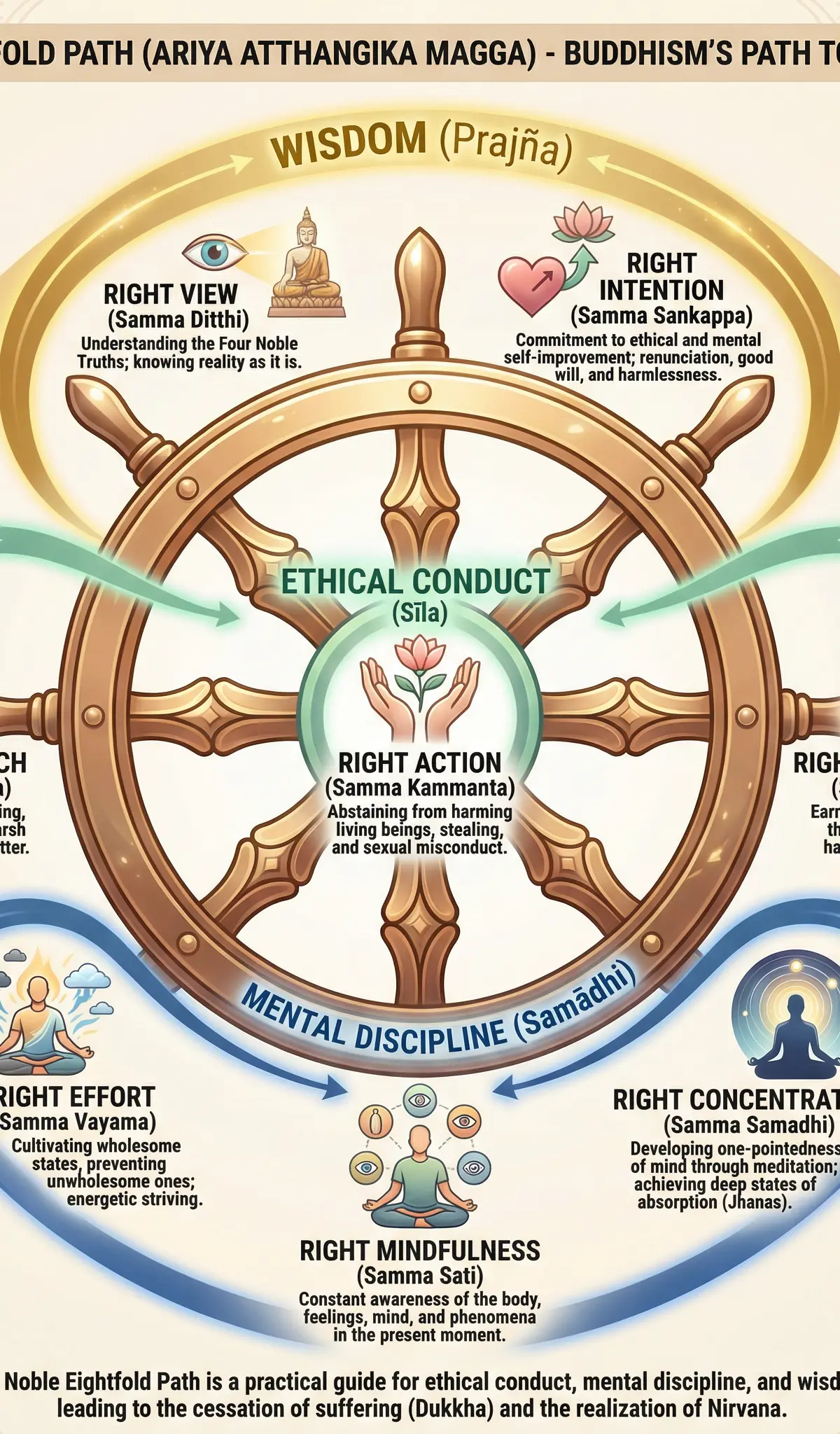
What it is: The practical guide to ending suffering, prescribed in the Fourth Noble Truth. It is a set of eight interconnected practices.
Why it matters: This demonstrates how Buddhism is a practical path, not just a set of beliefs. Candidates should be able to name the eight elements and group them into the three sections: Wisdom (Prajna), Ethical Conduct (Sila), and Mental Discipline (Samadhi).
Specific Knowledge: Right View, Right Intention (Wisdom); Right Speech, Right Action, Right Livelihood (Ethical Conduct); Right Effort, Right Mindfulness, Right Concentration (Mental Discipline).
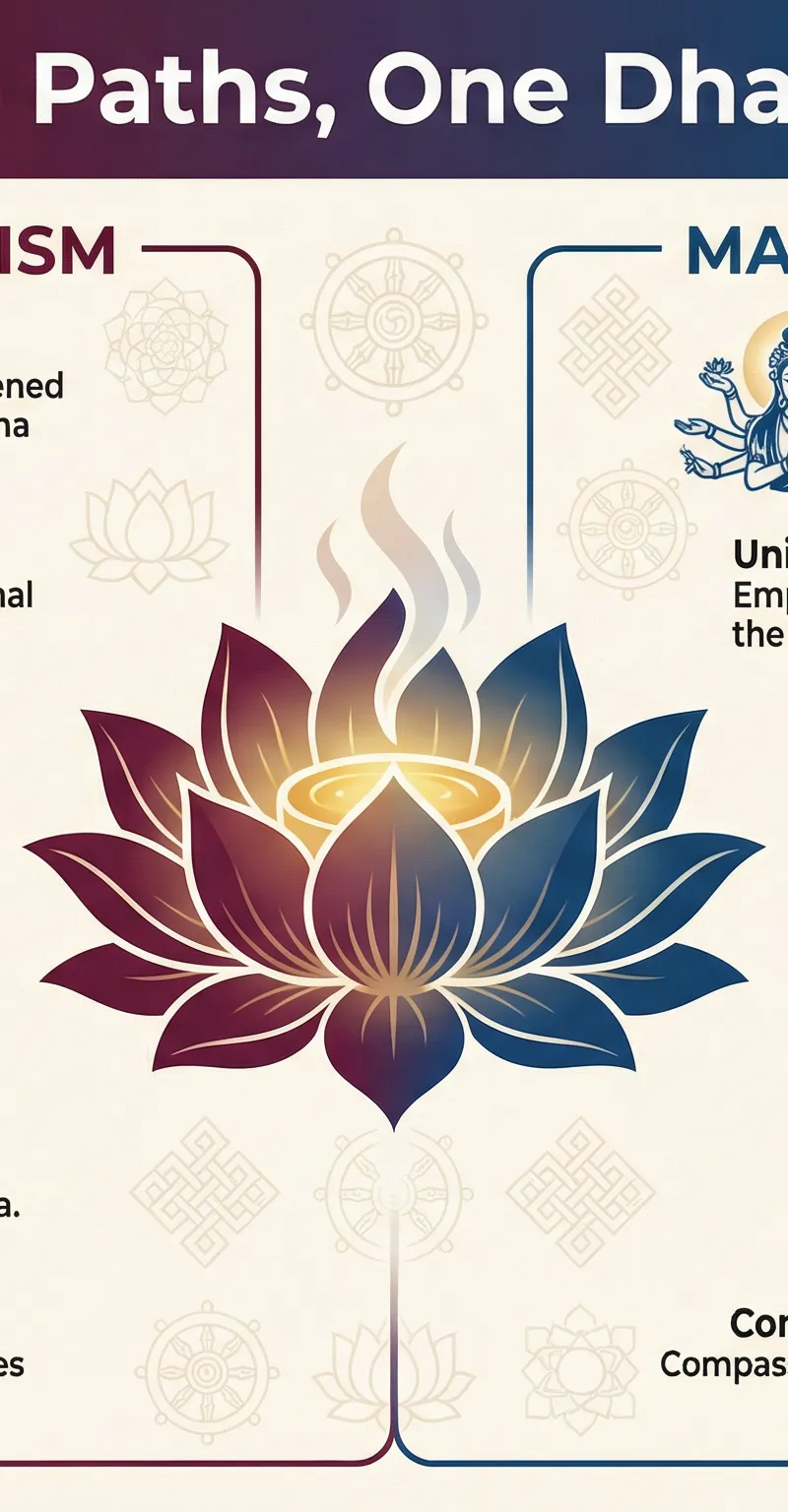
Theravada and Mahayana Buddhism
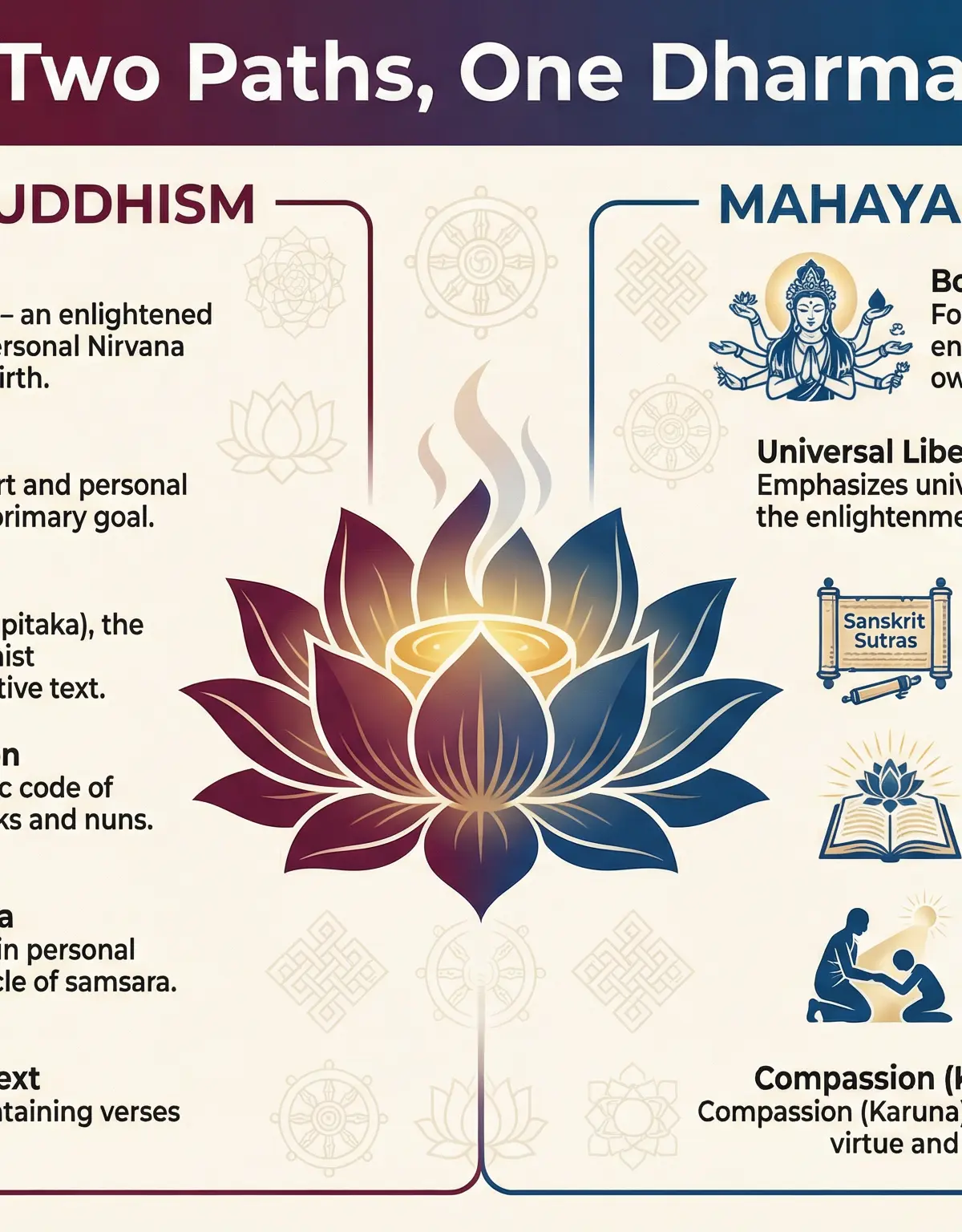
What they are: The two major schools of Buddhism.
Why they matter: This is a critical area of comparison that frequently appears in exams. Candidates must be able to contrast their core ideals, key texts, and understanding of human destiny.
Specific Knowledge:
- Theravada: 'The Way of the Elders', Pali Canon (Tipitaka), Arhat ideal (personal liberation), focus on wisdom, Buddha as a historical figure.
- Mahayana: 'The Great Vehicle', Sanskrit Sutras (e.g., Lotus Sutra), Bodhisattva ideal (universal liberation), focus on compassion (Karuna), Buddha as a transcendent principle.
Key Individuals
Siddhartha Gautama, the Buddha
Role: The founder of Buddhism, the 'Awakened One'.
Key Actions: Renounced his princely life after witnessing the Four Sights. Achieved enlightenment under the Bodhi tree. Taught the Dharma (his teachings) for 45 years.
Impact: His teachings form the basis of one of the world's major religions. In the Theravada tradition, he is the ultimate teacher and guide. In Mahayana, he is seen as one of many Buddhas, a manifestation of ultimate reality.
Worked Examples
3 worked examples — open one to explore the question and available guidance.
Practice Questions
Try the question, then reveal an answer plan or example response
Describe two of the Three Marks of Existence. (5 marks)
Hint: Choose two from Anicca, Anatta, and Dukkha. Define the Pali term and explain its meaning.
Explain two ways the belief in Karma influences Buddhists. (8 marks)
Hint: Think about how the law of cause and effect (Karma) impacts a Buddhist's actions and their view of the future. Remember to include a Source of Wisdom.
Explain two Buddhist beliefs about the nature of the Buddha. (8 marks)
Hint: Contrast the view of the Buddha in Theravada and Mahayana traditions. Use specific terminology.
"The Four Noble Truths are the only teaching a Buddhist needs to understand." Evaluate this statement. (12 marks)
Hint: Argue for and against the statement. Are the Four Noble Truths self-contained? What other teachings are essential? Come to a justified conclusion.
Exam technique
How to turn what you know into marks
How to approach the question
1. **BUG** the question: **B**ox the command word, **U**nderline the key topic, **G**lance at the number of marks. 2. Plan your points, especially for 8 and 12-mark questions.
How to structure your answer
- Essay questions
- For a 12-mark 'Evaluate...' question: Introduction with your judgement -> Argument 1 (For) -> Argument 2 (Against) -> Argument 3 (For/Against) -> Conclusion that develops your initial judgement.
- Source questions
- Not applicable for this paper, but a good skill is Content -> Provenance -> Limitations -> Judgement.
- Explain questions
- For an 8-mark 'Explain two ways...' question, use two separate PEE paragraphs: **P**oint, **E**xplain, **E**vidence (Source of Wisdom).
Timing
Approximately 1.5 minutes per mark. For a 12-mark question, this means around 18 minutes.
Common pitfalls
- Confusing rebirth (no soul) with reincarnation (soul).
- Forgetting to include a Source of Wisdom and Authority in 8-mark questions, capping your mark at 4.
- Describing the Buddha as a god.
- In evaluation questions, just listing two sides without coming to a justified conclusion.
What the command words want
- Describe
- Give a detailed account of two features.
- Evaluate
- Make a judgement. Argue for and against the statement, using evidence, and write a justified conclusion.
- Explain why
- Provide reasons. Use causal connectives like 'because', 'this led to', 'as a result of'.
- Explain two ways/beliefs
- Structure as two separate PEE paragraphs. The second one MUST contain a Source of Wisdom.
Watch or listen (optional)
Test your understanding of Key beliefs of Buddhism
Active recall beats re-reading. Take an instant quiz now to test what you’ve learned and lock it into long-term memory.
7 days Premium · Then the free plan continues · No card, no charge