Pearson Edexcel · GCSE · Religious Studies
Pilgrimage
This study guide explores Christian pilgrimage, a vital topic for Edexcel GCSE Religious Studies. It delves into the contrasting traditions of Lourdes and Iona, equipping students with the theological understanding and specific knowledge needed to analyse and evaluate this complex practice in an exam context."
- 5 min read
- 3 worked examples
- 5 practice questions
Study Notes
Overview
Pilgrimage, a journey to a sacred place for religious reasons, is a core practice in many faiths, and a key topic in the study of Christianity. For examiners, it is a rich area for assessment, blending theology, practice, and the diversity of Christian belief. This guide focuses on the Edexcel specification, contrasting the Catholic shrine of Lourdes with the ecumenical community of Iona. Candidates are expected to understand not just what happens at these sites, but why it matters. This involves analysing the theological motivations for pilgrimage—such as seeking healing, doing penance, or imitating Christ—and evaluating the arguments for and against its necessity. A successful candidate will move beyond simple description to a nuanced analysis, using specific details and Sources of Wisdom and Authority (SOWA) to support their arguments. This guide provides the detailed knowledge and exam technique required to achieve the highest marks.

Key Pilgrimage Sites
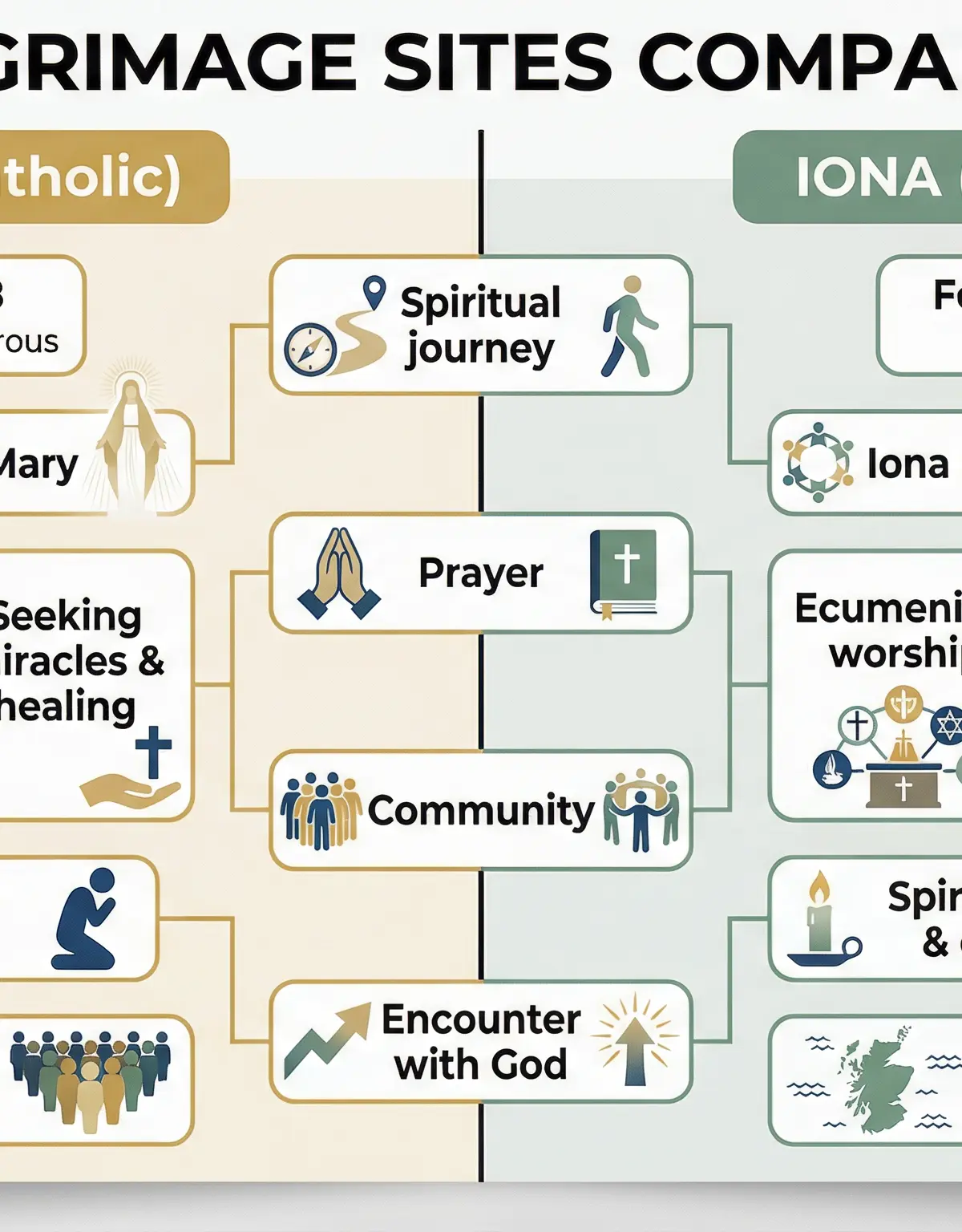
Lourdes, France
Founded: 1858
What happened: A 14-year-old peasant girl, Bernadette Soubirous, reported eighteen apparitions of the Virgin Mary in a grotto. Mary instructed her to dig for a spring, the water of which is now believed to have healing properties. The Catholic Church has officially recognised 70 miracles at Lourdes.
Why it matters: Lourdes is the quintessential example of a Catholic pilgrimage site focused on sacraments, miracles, and Marian devotion. It demonstrates the belief in divine intervention, the role of saints as intercessors, and the importance of physical acts of penance and devotion. For examiners, it provides a clear case study of faith in practice.
Specific Knowledge: Candidates must know the name Bernadette Soubirous, the date 1858, and the key activities: bathing in the waters, candlelit processions, and the Stations of the Cross.
Iona, Scotland
Founded: 563 AD
What happened: The Irish monk, St. Columba, established a monastery on this remote island, which became a major centre for the spread of Christianity in Scotland and Northern England. In 1938, George MacLeod founded the modern Iona Community, an ecumenical group dedicated to worship, peace, and social justice.
Why it matters: Iona represents a different model of pilgrimage. It is non-miraculous and ecumenical (welcoming all Christian denominations). The focus is on spiritual renewal, community building, and connecting with the natural world and the history of Celtic Christianity. It provides a crucial contrast to Lourdes, highlighting the diversity within Christian pilgrimage.
Specific Knowledge: Candidates must know the name St. Columba, the date 563 AD, the Iona Community (1938), and the key activities: ecumenical worship, hiking the Pilgrim's Way, and shared community life.
Theological Concepts
Reasons for Pilgrimage
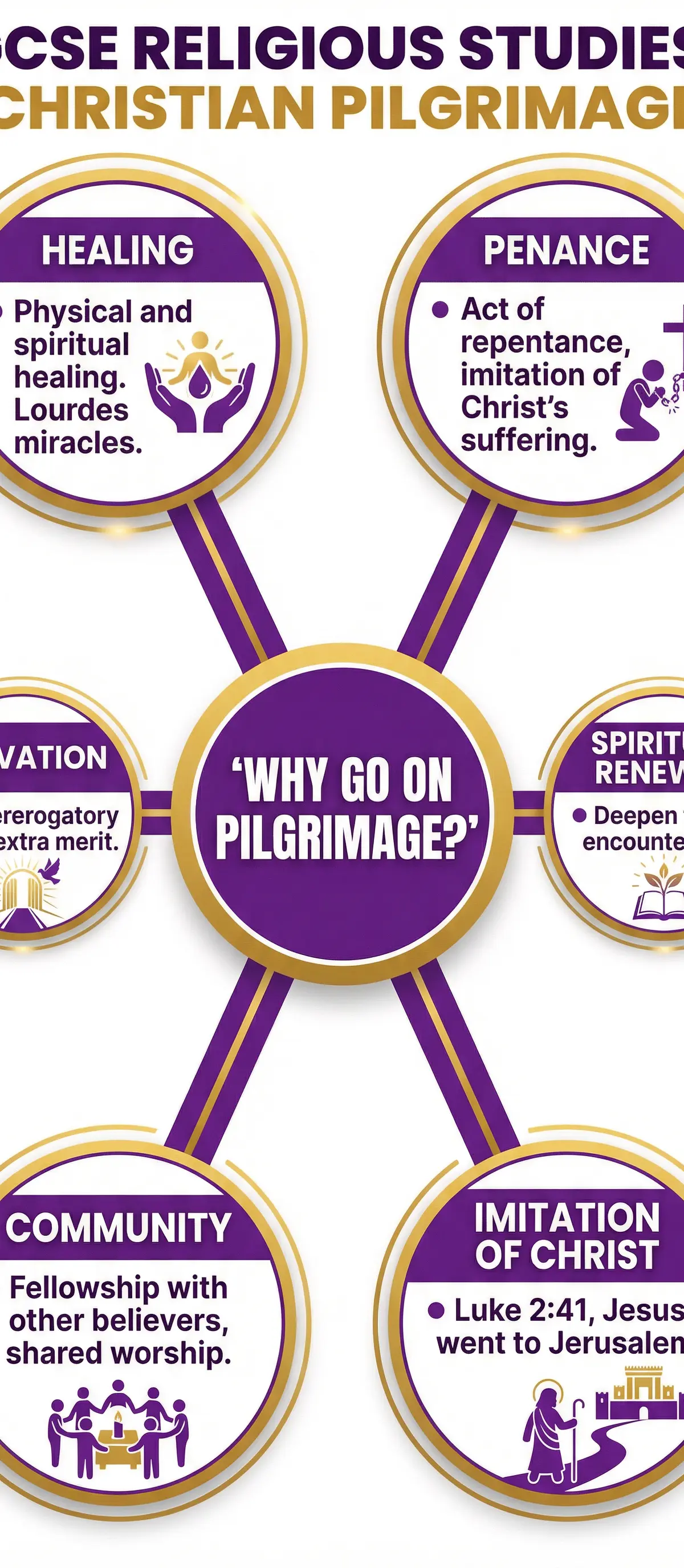
Candidates must understand the theological motivations that drive Christians to undertake a pilgrimage. These are often tested in 'explain' questions.
- Healing: To seek a physical or spiritual cure, as seen at Lourdes.
- Penance: To show sorrow for sin and seek forgiveness, sometimes through physically demanding journeys.
- Spiritual Renewal: To step away from daily life to deepen one's faith and relationship with God.
- Imitation of Christ: To follow the example of Jesus, who himself went on pilgrimage to Jerusalem (Luke 2:41).
- Community: To share an experience of faith with fellow believers.
Arguments Against Pilgrimage
Evaluation questions require candidates to assess the value of pilgrimage. This means engaging with Protestant and Non-Conformist critiques.
- God is Omnipresent: If God is everywhere, there is no need to travel to a special place to encounter Him.
- Salvation by Faith Alone (Sola Fide): A core Protestant belief that salvation is a gift from God received through faith, not earned by 'good works' like pilgrimage.
- Risk of Idolatry: Some Protestants argue that venerating saints, relics, or statues at pilgrimage sites distracts from the worship of God alone and can be a form of idolatry, which is forbidden in the Ten Commandments."
Worked Examples
3 worked examples — open one to explore the question and available guidance.
Practice Questions
Test your understanding — click to reveal model answers
Explain two ways in which pilgrimage can affect a Christian's life. (4 marks)
Hint: Think about both the immediate experience and the long-term impact on faith.
Explain two contrasting views on the value of pilgrimage. (8 marks)
Hint: Contrast the Catholic view with a Protestant view. Use theological terms.
Describe the activities that take place at Lourdes. (4 marks)
Hint: Name two specific activities and give a little detail about each.
Explain why Iona is an important site of pilgrimage for some Christians. (4 marks)
Hint: Think about its history and its modern community.
'A Christian does not need to go on a pilgrimage to be close to God.' Evaluate this statement. (12 marks)
Hint: This is a classic evaluation question. Argue both sides and come to a justified conclusion.