Pearson Edexcel · GCSE · Religious Studies
Religious practices of Sikhism
This study guide provides a comprehensive, exam-focused overview of Sikh religious practices for Edexcel GCSE Religious Studies. It explores how core beliefs in equality, service, and devotion are expressed through worship at the Gurdwara, the Langar, and the articles of faith known as the Five Ks, equipping candidates with the specific knowledge and exam technique required to achieve top marks."
- 7 min read
- 3 worked examples
- 4 practice questions
Study Notes
Overview
This guide covers the core religious practices of Sikhism as required by the Edexcel GCSE Religious Studies B specification. For candidates, understanding Sikh practices is not merely about describing rituals; it is about explaining how these physical acts are a profound expression of core theological beliefs. Examiners expect candidates to demonstrate a clear understanding of the connection between practice (what Sikhs do) and belief (what Sikhs believe). Key areas of focus include worship (puja) in the Gurdwara, the concept of selfless service (seva) embodied by the Langar, and the articles of faith worn by initiated Sikhs (the Five Ks). Mastery of this topic involves the precise use of Gurmukhi terminology, the ability to link practices to the teachings of the Gurus, and the skill of referencing the Guru Granth Sahib as a Source of Wisdom and Authority (SoWA). This guide will provide the detailed knowledge and analytical framework necessary to excel in all question types, from short-answer descriptions to 12-mark evaluations.
Key Practices & Beliefs
The Gurdwara: The Doorway to the Guru
What it is: The Gurdwara is the Sikh place of worship and community hub. Crucially, it is open to all people, regardless of their faith, caste, gender, or background. This openness is a physical manifestation of the core Sikh belief in the equality of all humanity.
Key Features:
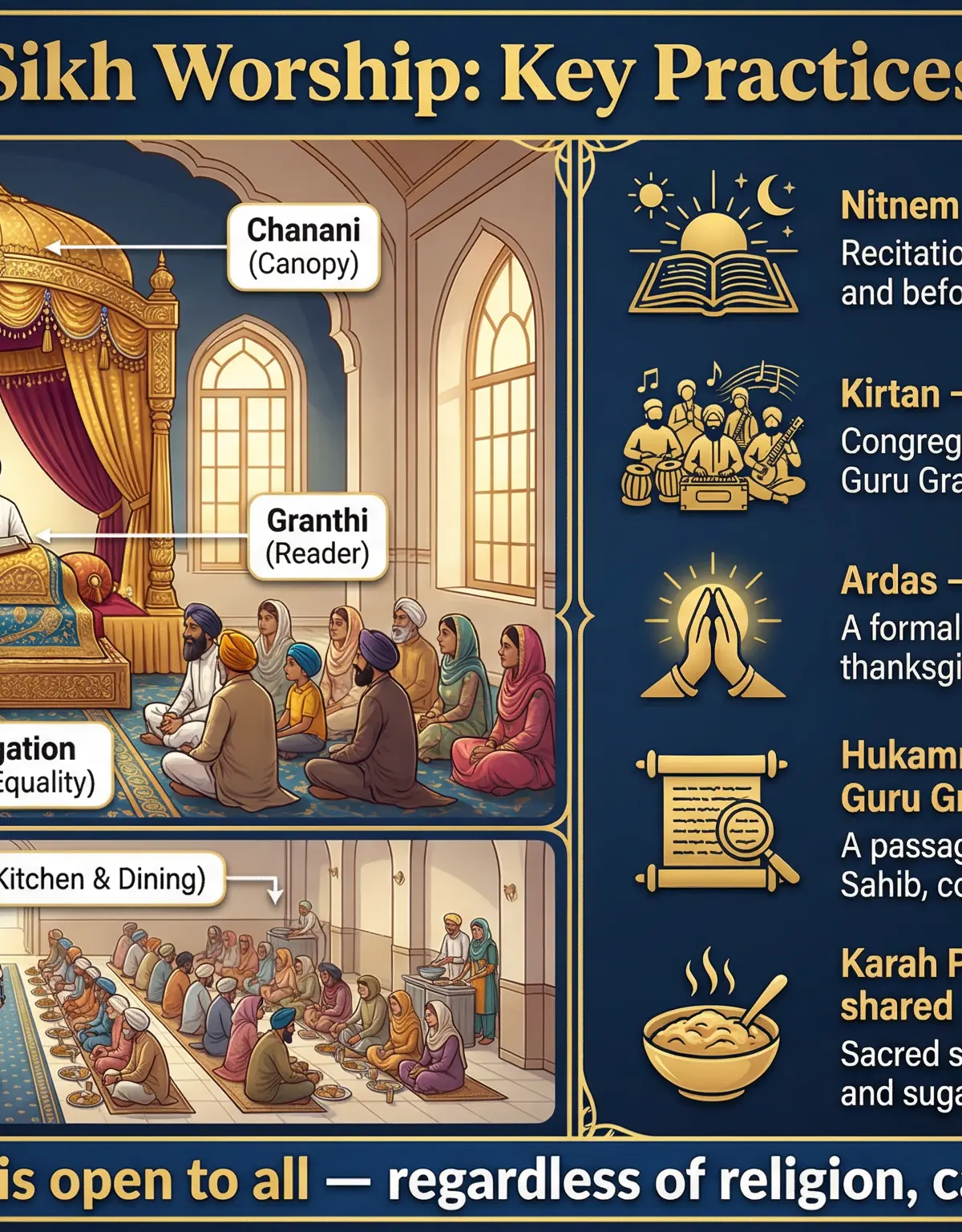
- The Darbar Sahib: The main prayer hall where the congregation, known as the Sangat, gathers.
- The Takht: A raised platform where the Guru Granth Sahib is placed. This signifies its supreme authority.
- The Guru Granth Sahib: The sacred scripture, treated as the living Guru. It is placed on a throne (Manji Sahib) and covered by a canopy (Chanani).
- The Granthi: A trained reader of the Guru Granth Sahib. It is vital for candidates to understand that a Granthi is not a priest; Sikhism has no priesthood, and any Sikh (male or female) can perform this role.
- Congregation: Worshippers sit on the floor, demonstrating equality and humility before the Guru.
Why it matters: Questions on the Gurdwara test a candidate's understanding of equality. Marks are awarded for explaining how features like the open-door policy and sitting on the floor are direct challenges to social hierarchies like the caste system.
Langar: Radical Equality in Practice
What it is: The Langar is the free community kitchen found in every Gurdwara. A simple vegetarian meal is served to all visitors without charge.
Why it matters: Langar is one of the most powerful concepts for exam answers. It was established by Guru Nanak to challenge the Hindu caste system, which forbade people of different castes from eating together. By having everyone share the same food while sitting at the same level, Langar is a practical demonstration of the belief in equality. It also embodies two of the three pillars of Sikh life: Vand Chakko (sharing with others) and Seva (selfless service).
Specific Knowledge: Candidates should explicitly state that Langar was a rejection of the caste system. Using the term 'Vand Chakko' will gain credit.
The Five Ks (Panj Kakars): Articles of Faith
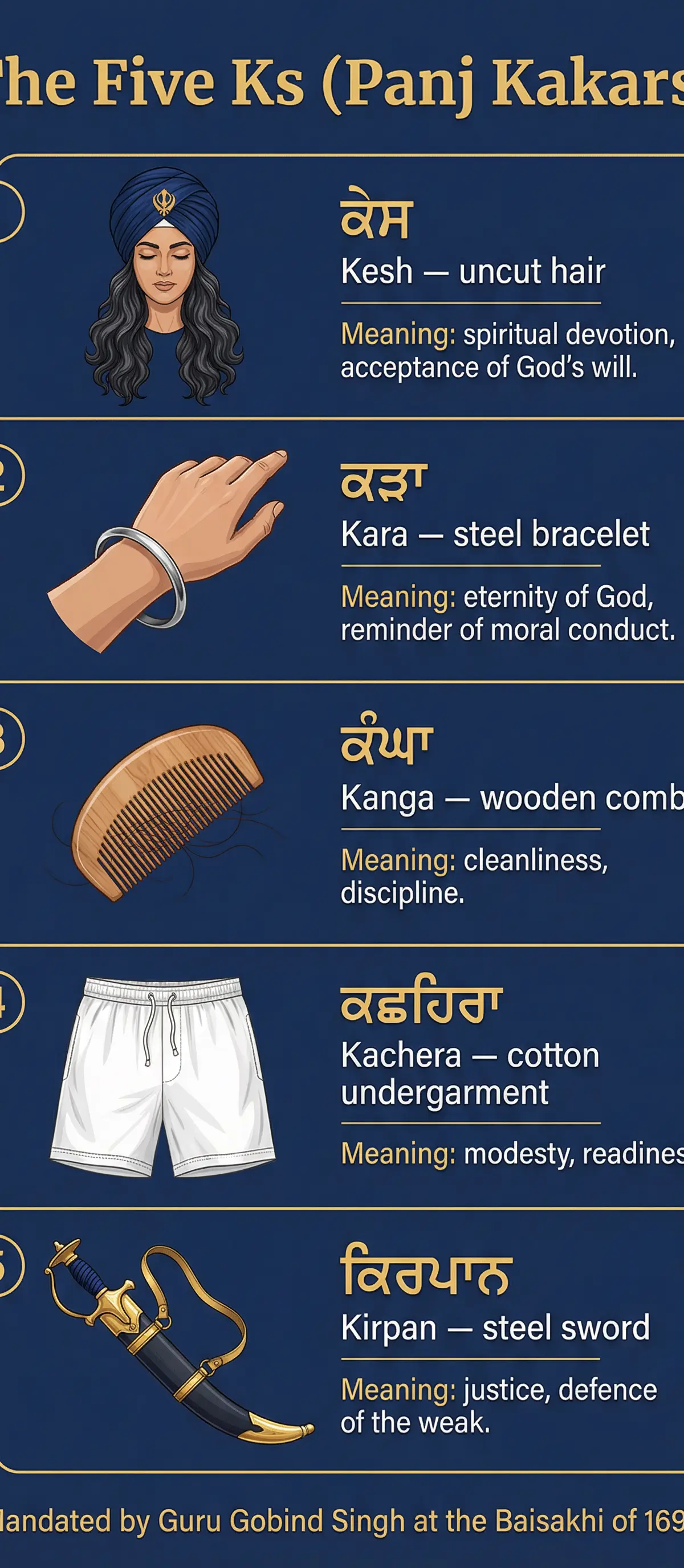
What they are: Five items that initiated (Amritdhari) Sikhs must wear at all times. They were mandated by the tenth Guru, Guru Gobind Singh, at the founding of the Khalsa in 1699.
Why they matter: These are not cultural symbols; they are articles of faith, each with a deep theological meaning. Describing them as mere 'symbols' will lose marks. They are a collective uniform for the Khalsa, identifying a Sikh as ready to uphold justice and live by the Sikh code of conduct (Rehat Maryada).
Key Individuals
Guru Nanak (1469-1539)
Role: The founder of Sikhism and the first of the ten human Gurus.
Key Actions: Established the core principles of Sikhism: one God (Ik Onkar), equality of all humankind, and selfless service. He founded the institution of Langar to put the principle of equality into practice.
Impact: His teachings, recorded in the Guru Granth Sahib, are the foundation of all Sikh practice. His famous declaration, "There is no Hindu, there is no Muslim," is a key SoWA for questions on equality.
Guru Gobind Singh (1666-1708)
Role: The tenth and final human Guru.
Key Actions: Created the Khalsa in 1699, a community of initiated Sikhs. He mandated the wearing of the Five Ks and declared the Guru Granth Sahib as the eternal, living Guru to succeed him.
Impact: He shaped the modern Sikh identity. The founding of the Khalsa gave Sikhs a distinct identity and a mission to uphold justice. His actions are central to understanding the duties of an Amritdhari Sikh.
Second-Order Concepts
Causation
Sikh practices were caused by the need to create a distinct community based on new theological insights. The caste system in 16th-century India was a primary cause for the creation of Langar. The persecution faced by Sikhs under the Mughal emperors was a key factor in Guru Gobind Singh's decision to create the Khalsa, a community of saint-soldiers.
Consequence
The consequence of these practices was the formation of a strong, cohesive Sikh identity. Langar had the long-term consequence of embedding equality as a central pillar of Sikh life. The Five Ks have the consequence of making Sikhs visibly identifiable, which has at times led to both pride and persecution.
Change & Continuity
Continuity: The core beliefs in one God, equality, and service have remained constant since Guru Nanak. The Guru Granth Sahib continues to be the ultimate source of authority.
Change: The most significant change was the creation of the Khalsa by Guru Gobind Singh. This introduced a new level of commitment and a collective identity for initiated Sikhs, formalising practices like the Five Ks.
Significance
The significance of Sikh practices lies in their direct and unambiguous link to belief. They are not abstract rituals but are lived ethics. For an exam answer, the significance of Langar is its challenge to social injustice; the significance of the Five Ks is their role in forging a committed spiritual identity.
Source Skills
For Edexcel RS, the key 'source' is the Guru Granth Sahib. Candidates must be able to reference its teachings to support their points in (c) and (d) questions. You don't always need a direct quote, but you must be able to refer to a teaching. For example, "The Guru Granth Sahib teaches that all people are equal in the eyes of God." A versatile quote to memorise is Guru Nanak's teaching: "Truth is high, but higher still is truthful living." This can be used to argue that practices (living) are more important than just belief."
Worked Examples
3 worked examples — open one to explore the question and available guidance.
Practice Questions
Test your understanding — click to reveal model answers
Describe two features of Sikh worship in the Gurdwara. (4 marks)
Hint: Think about what happens in the main prayer hall (Darbar Sahib). Name a feature and describe it.
Explain two reasons why the Kirpan is important for Sikhs. (5 marks)
Hint: Link the physical object to a belief. Remember to include a Source of Wisdom/Authority.
Explain two contrasting beliefs within Sikhism about the importance of being an Amritdhari Sikh. (4 marks)
Hint: Think about the difference between Amritdhari and Sahajdhari Sikhs.
"The main purpose of the Gurdwara is to provide free food." Evaluate this statement. (12 marks)
Hint: A classic evaluation question. Argue for (importance of Langar) and against (importance of worship, scripture, community). Come to a justified conclusion.