Pearson Edexcel · GCSE · Religious Studies
Sources of Authority
This guide provides a comprehensive analysis of the Sources of Wisdom and Authority (SOWA) for Edexcel GCSE Religious Studies. It is designed to equip candidates with the precise knowledge and exam technique required to achieve top marks by exploring how sacred texts, institutional bodies, and personal conscience shape belief and ethical decision-making in Christianity and Islam."
- 18 min read
- 3 worked examples
- 5 practice questions
Study Notes
Overview
Understanding the Sources of Wisdom and Authority (SOWA) is fundamental to success in Edexcel GCSE Religious Studies. This topic explores the origins of religious belief and practice, examining how believers determine what is right and true. Examiners expect candidates to demonstrate a sophisticated understanding of the hierarchy of authority, from divine revelation in sacred texts to the role of personal conscience. A key focus is the analysis of how different interpretations (Literalist vs. Liberal) and denominational traditions (e.g., Catholic vs. Protestant; Sunni vs. Shi'a) lead to diverse ethical standpoints. Mastery of SOWA is not just about one topic; it is the key that unlocks high-level analysis across the entire specification, enabling candidates to explain the 'why' behind religious standpoints on everything from family life to matters of life and death. Credit is awarded for moving beyond generic statements to precise, well-supported arguments that show a clear chain of reasoning from source to belief.
The Hierarchy of Authority
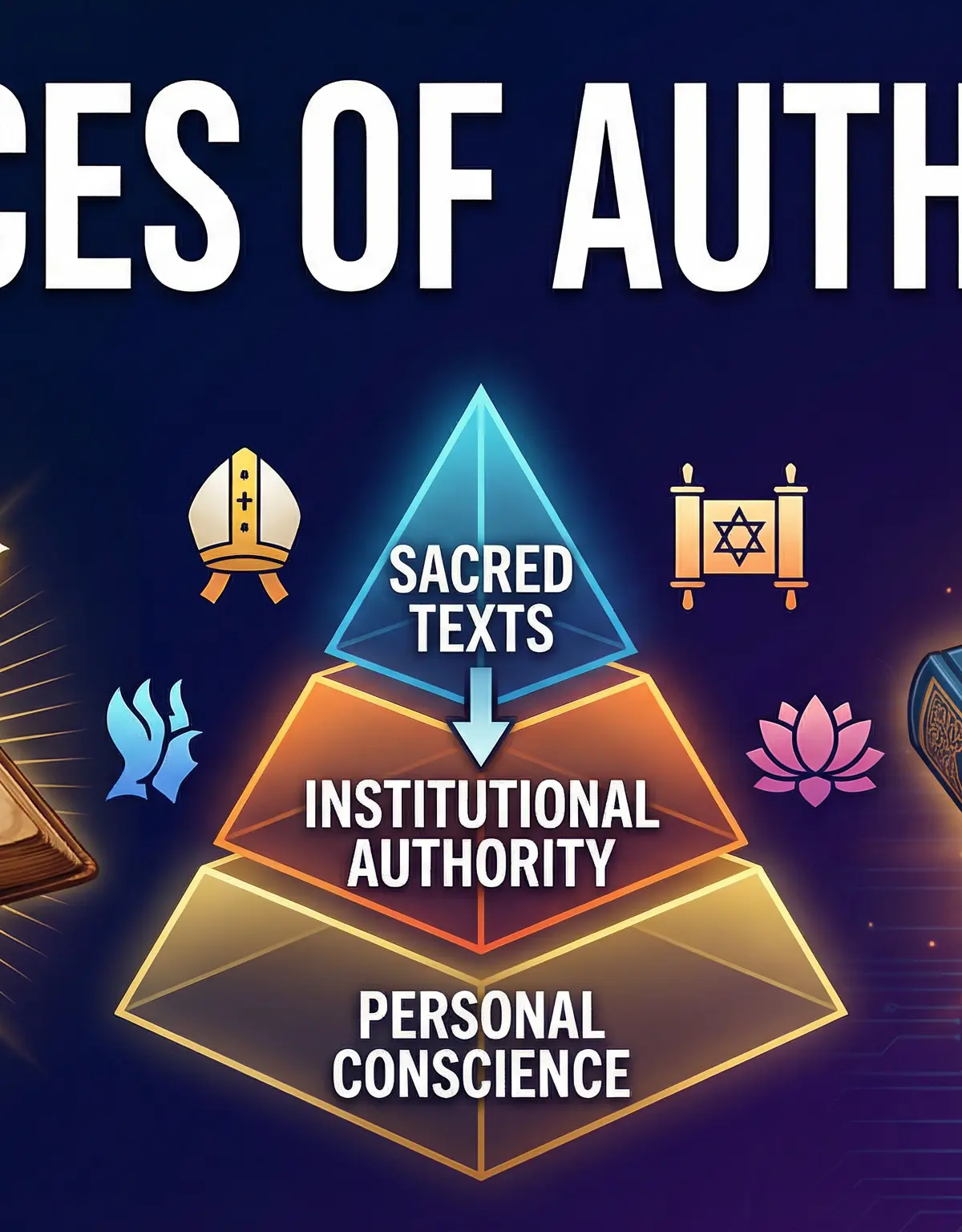
Examiners often conceptualise SOWA as a hierarchy. While different traditions give varying weight to each level, a general model helps clarify their relationship. At the apex is the authority that is considered most direct and binding, with authority becoming more subjective and interpretive as one moves down.

1. Sacred Texts (Divine Revelation)
What it is: For Christians, this is the Bible; for Muslims, the Qur'an. These texts are considered the foundational and ultimate source of authority, believed to be the Word of God (divine revelation).
Why it matters: This is the highest source of authority. For many believers, particularly those in literalist traditions, if the sacred text commands something, the debate is over. For example, the Qur'an's direct prohibition of charging interest (riba) is absolute for devout Muslims. In Christianity, the Ten Commandments (Exodus 20) provide a foundational moral code.
Specific Knowledge: Candidates must know the difference between the Old and New Testaments (Bible) and the role of the Gospels. For Islam, knowing the Qur'an was revealed to Prophet Muhammad (PBUH) via the Angel Jibril is essential.
2. Institutional Authority & Tradition
What it is: This includes the formal teaching authority of a religious institution and the established traditions. In Catholicism, this is the Magisterium (the Pope and Bishops). In Shi'a Islam, it is the Imamate. Tradition also includes the writings of early Church Fathers (like St. Augustine) and the Hadith & Sunnah in Islam (the sayings and actions of the Prophet Muhammad).
Why it matters: These bodies and traditions interpret the sacred texts for contemporary life. They create a consistent framework for belief. For example, the Catholic Church's stance on abortion is not just from one Bible verse, but from a long tradition of interpretation by the Magisterium, which sees it as a violation of the sanctity of life.
Specific Knowledge: Apostolic Succession (Catholicism), The Imamate (Shi'a Islam), Hadith collections (Sahih al-Bukhari, Sahih Muslim), Sola Scriptura (Protestantism).
3. Reason and Conscience
What it is: This refers to a believer's own intellect and moral compass. It is the internal sense of right and wrong, which many believers see as God-given.
Why it matters: Reason and conscience are used to apply religious teachings to personal situations. Liberal traditions place a high value on conscience. For example, a Quaker might be a pacifist based on their personal conscience, which they believe is guided by the Holy Spirit, informed by the teachings of Jesus.
Specific Knowledge: St. Thomas Aquinas taught that reason is a gift from God to help understand revelation. The concept of the 'inner light' in Quakerism.
Interpretations: Literal vs. Liberal
How a believer interprets the sacred text is a major factor in their ethical decision-making. This is a crucial area for analysis in the exam.
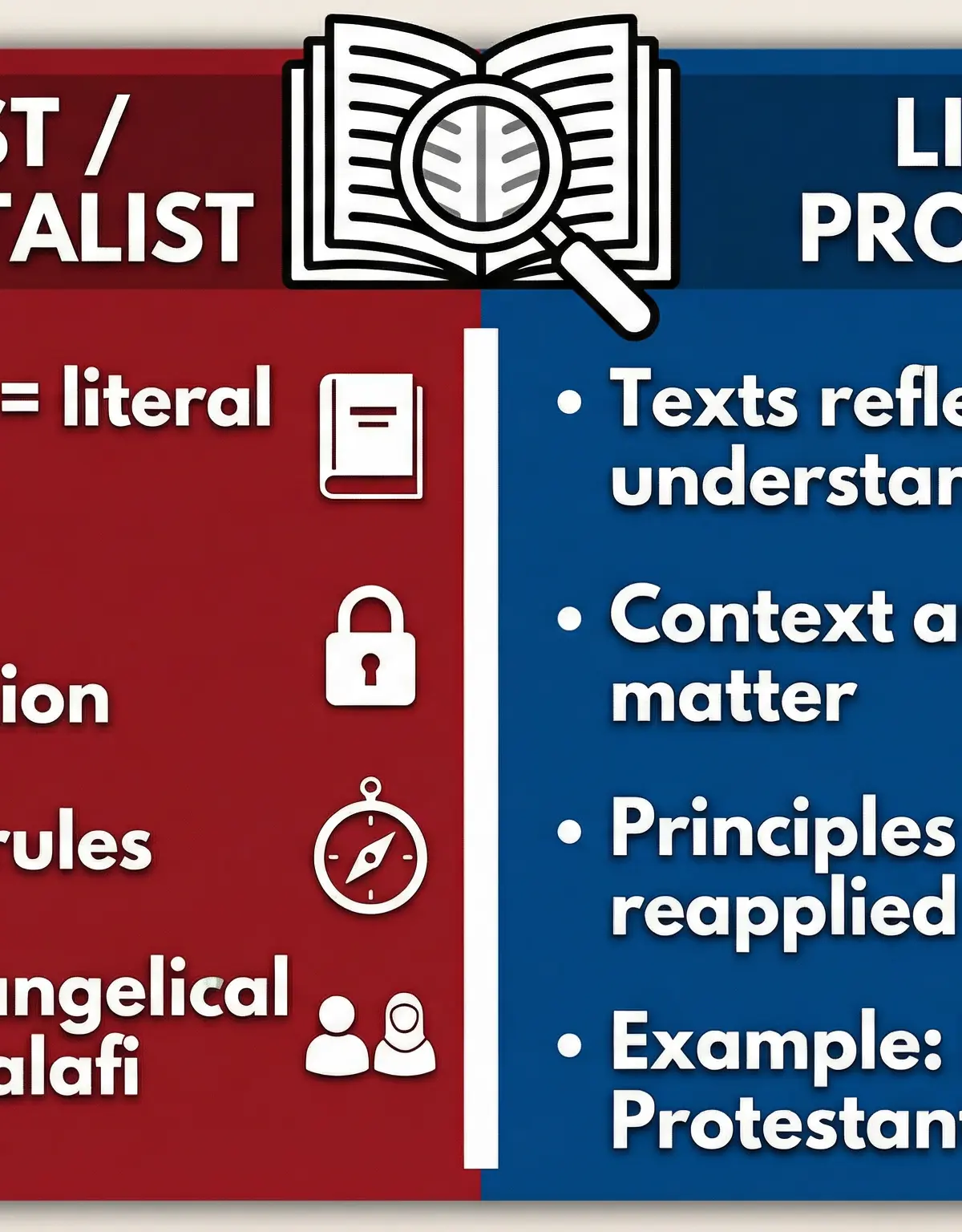
Literalist / Fundamentalist Interpretation
What it is: The belief that the sacred text is the literal, inerrant word of God. It should be followed exactly as it is written, without need for reinterpretation.
Why it matters: This leads to fixed, absolute moral rules. For example, a Christian literalist might point to Genesis to argue for a six-day creation and reject the theory of evolution. A Salafi Muslim may reject certain forms of modern finance based on a literal reading of the Qur'an's prohibitions on interest.
Liberal / Progressive Interpretation
What it is: The belief that the sacred text was written by humans inspired by God within a specific historical and cultural context. The underlying principles (e.g., love, justice) are timeless, but the specific rules may need to be reinterpreted for modern life.
Why it matters: This allows for more flexibility in ethical decision-making. For example, a liberal Christian might argue that the Bible's passages on the role of women reflect the patriarchal society of the time and that the core principle of equality before God (Galatians 3:28) is more important today.
Source Skills for Religious Studies
When presented with a quote in the exam (often in a (d) question), you must analyse it effectively. Use the 'FARM' technique mentioned in the exam tips. The provenance of a source is key: a quote from the Qur'an carries more weight for a Muslim than a quote from a modern philosopher. A statement from the Pope is binding for Catholics but not for Protestants. Always identify the source and evaluate its authority for the specific religious tradition in question before you even begin to analyse its content. For example, when evaluating a statement, you might say, 'This argument is compelling for a Catholic as it comes from the Catechism of the Catholic Church, which is part of the Magisterium's authoritative teaching.'
",
"podcast_script": "Welcome to Revision Ready — the podcast that gets you exam-confident, one topic at a time. I'm your host, and today we're diving deep into one of the most important and most frequently mishandled topics in Edexcel GCSE Religious Studies: Sources of Wisdom and Authority. Whether you call it SOWA for short, or you've seen it written as Sources of Authority on your specification, this topic underpins almost every single question you'll face in your exam. So let's get into it.
By the end of this episode, you'll know exactly what the main sources of authority are in Christianity and Islam, how different denominations and traditions use them differently, how to write answers that examiners will reward with top marks, and the most common mistakes that cost students marks every single year. Let's go.
Section One: What are Sources of Wisdom and Authority?
So, first things first. What do we actually mean by a Source of Wisdom and Authority? In Religious Studies, this refers to anything that a religious believer turns to in order to guide their beliefs, their moral decisions, and their practices. Think of it as the answer to the question: "How do you know what God wants you to do?"
Now, Edexcel organises these sources into a kind of hierarchy — and understanding that hierarchy is absolutely key to scoring well. At the very top, you have Sacred Texts. For Christians, that's the Bible. For Muslims, that's the Qur'an. These are considered the most authoritative sources because believers regard them as the direct or inspired word of God.
Below that, you have Institutional Authority. For Roman Catholics, this is the Magisterium — the teaching authority of the Church, led by the Pope. For Shi'a Muslims, this is the Imamate — the line of divinely guided Imams descended from the Prophet Muhammad, peace be upon him. These institutions interpret the sacred texts and apply them to contemporary situations.
Then you have Tradition and Religious Leaders. This includes things like the Hadith in Islam — the recorded sayings and actions of the Prophet Muhammad — and Church Tradition in Christianity, which includes the writings of early Church Fathers like St Augustine and St Thomas Aquinas.
And at the base of the pyramid, you have Personal Conscience and Reason. This is the individual believer's own moral sense and rational thinking. It's the most subjective source and, for many traditions, the least authoritative on its own — but it still plays a role, particularly in liberal and progressive traditions.
Now here's the crucial exam point: different denominations and traditions weight these sources differently. And this is where candidates either shine or fall flat.
Section Two: Christianity — How Different Denominations Use Sources of Authority
Let's start with Roman Catholics. For Catholics, authority flows through a very specific channel. The Bible is foundational, but it is interpreted through the lens of Sacred Tradition and the Magisterium. The Magisterium — the Pope and the College of Bishops — has the authority to define doctrine. This is based on the concept of Apostolic Succession: the idea that the Pope is the direct successor of Saint Peter, to whom Jesus said in Matthew 16:18, "You are Peter, and on this rock I will build my church." Catholics believe this gives the Pope a unique teaching authority, and when the Pope speaks ex cathedra — that is, formally on matters of faith and morals — this is considered infallible. So for a Catholic, if the Magisterium teaches that contraception is wrong, as it did in the 1968 encyclical Humanae Vitae, that teaching carries enormous authority.
Now contrast that with Protestant Christians, particularly those in the Reformed or Evangelical tradition. Their approach is captured in the Latin phrase Sola Scriptura — Scripture Alone. This was a central principle of the Protestant Reformation in the 16th century, championed by figures like Martin Luther and John Calvin. The argument is that the Bible alone is the supreme authority for Christian belief and practice. The Pope has no special authority. Tradition is useful but not binding. This is why Evangelical Christians will often cite specific Bible verses as their primary justification for a moral position.
And then there are Liberal Protestants, who take a more nuanced view. They accept the Bible as a source of authority, but they argue that it was written by human beings in specific historical contexts, and therefore its teachings must be reinterpreted for each generation. They might use reason, conscience, and contemporary ethical thinking alongside the Bible. This is sometimes called a contextual or progressive approach.
Here's a memory hook for you: think of the three Cs — Catholics use Church, Conservatives use Canon, Liberals use Context. Church, Canon, Context. That's your shorthand for the three main Christian approaches to authority.
Section Three: Islam — Sunni and Shi'a Approaches to Sources of Authority
Now let's turn to Islam. In Islam, the primary source of authority is the Qur'an. Muslims believe it is the literal, unchanged word of Allah as revealed to the Prophet Muhammad through the Angel Jibril over approximately 23 years. Because it is considered directly from God, it carries absolute authority. This is a really important point for your exam: the Qur'an's authority is not contextual or conditional — it is absolute. When you're writing about Islamic authority, you can say: "The Qur'an is considered by Muslims to be the direct and unaltered word of Allah, and therefore its commands are binding on all believers."
The second major source is the Sunnah — the example of the Prophet Muhammad — and the Hadith, which are the recorded sayings and actions of the Prophet. These are collected in books like Sahih al-Bukhari and Sahih Muslim. The Hadith are used to interpret and apply the Qur'an. For example, the Qur'an commands Muslims to pray, but it is the Hadith that explains how to pray — the specific positions, the words, the number of times per day.
Now here's where it gets really interesting for your exam: the difference between Sunni and Shi'a Islam. Sunni Muslims, who make up around 85 to 90 percent of the world's Muslim population, follow the four main schools of Islamic law — the Hanafi, Maliki, Shafi'i, and Hanbali schools. They use a process called Ijtihad — independent legal reasoning — and Qiyas — analogical reasoning — to apply Qur'anic principles to new situations.
Shi'a Muslims, by contrast, place enormous authority in the Imamate. They believe that after the Prophet's death, leadership of the Muslim community should have passed to Ali ibn Abi Talib, the Prophet's cousin and son-in-law, and then to a line of twelve Imams. These Imams are believed to have a special, divinely guided authority to interpret the Qur'an. In the absence of the twelfth Imam — who Shi'a Muslims believe went into occultation, or hiding, in 874 CE — senior scholars called Ayatollahs exercise religious authority on his behalf.
Your memory hook for Islam: Q-S-I. Qur'an first, Sunnah and Hadith second, Ijtihad and Imamate third. Q-S-I.
Section Four: Literalist versus Liberal Interpretation
One of the most important distinctions you need to understand is between literalist and liberal interpretation of sacred texts. This distinction appears across both Christianity and Islam, and examiners love to test it.
A literalist or fundamentalist approach treats the sacred text as the direct, inerrant word of God, to be followed exactly as written. Evangelical Christians who believe in biblical inerrancy, and Salafi Muslims who follow a strict, text-based approach to the Qur'an, are examples of literalist traditions. For a literalist, if the text says something, that settles the matter — there is no room for reinterpretation based on modern values or cultural context.
A liberal or progressive approach, by contrast, argues that sacred texts were written by human beings inspired by God, and that they reflect the cultural context of their time. Therefore, the underlying principles — love, justice, compassion — should be extracted and reapplied to contemporary situations, even if the specific rules no longer apply. Liberal Protestants and Sufi Muslims often take this approach.
Why does this matter for your exam? Because when you're asked to explain why Christians or Muslims hold a particular view on an ethical issue — say, gender equality, or homosexuality, or environmental ethics — the answer almost always comes back to which source of authority they prioritise and how they interpret it. A Catholic will cite the Magisterium. An Evangelical will cite a specific Bible verse. A Liberal Protestant will cite the principle of love from Jesus's teaching in Matthew 22:37 to 39, where he says the greatest commandments are to love God and love your neighbour.
Section Five: Exam Tips and Common Mistakes
Right, let's talk exam technique. This is where marks are won and lost.
Tip number one: Be specific. Never write "The Bible says" without a reference. Examiners are looking for precision. Write "Matthew 5:9 states" or "Genesis 1:27 teaches" or "Surah 2:255, the Ayat al-Kursi, describes." This is the difference between a Level 2 and a Level 3 answer.
Tip number two: Show the chain of reasoning. It's not enough to cite a source — you must explain how that source leads to the belief or practice. The formula is: Source says X, therefore believers do Y, because Z. For example: "The Qur'an in Surah 2:183 commands fasting during Ramadan, therefore Muslims fast from dawn to sunset throughout the month, because they believe obedience to Allah's direct command is an act of worship and spiritual discipline."
Tip number three: For (c) questions — the five-mark Explain questions — you must include a recognisable reference to a source of authority. If you don't, your mark is capped at three out of five. This is one of the most common and most avoidable mistakes in the exam.
Tip number four: For (d) questions — the fifteen-mark evaluation questions — use the FARM technique. F for Focus on the stimulus quote immediately. A for Agree with the statement using evidence. R for Refute or challenge the statement using a counter-argument. M for Make a judgement about which argument is stronger and why. And critically, when you make that judgement, base it on the authority of the source you're citing. Say something like: "This argument is more robust because it relies on the direct word of God as found in the Qur'an, whereas the counter-argument relies on analogical reasoning, which is a weaker form of authority."
Tip number five: Don't generalise. Never say "Christians believe" or "Muslims think" without specifying which denomination or tradition. Catholics, Evangelical Protestants, and Liberal Protestants can hold very different views on the same issue. Sunni and Shi'a Muslims approach authority differently. Examiners will credit you for making these distinctions — and penalise you for ignoring them.
Common mistake number one: Confusing the Ten Commandments with the Beatitudes. The Ten Commandments are from Exodus 20 and Deuteronomy 5 — they're the laws given to Moses. The Beatitudes are from Matthew 5:3 to 12 — they're the blessings Jesus pronounced in the Sermon on the Mount. These are completely different texts with different purposes. Don't mix them up.
Common mistake number two: Claiming all Christians accept the Pope's authority. Only Roman Catholics accept papal authority. Protestants explicitly reject it — that was one of the central issues of the Reformation.
Common mistake number three: In evaluation questions, presenting two sides without making a judgement. You must reach a conclusion. Examiners are looking for AO2 skills — that means analysis and evaluation, not just description.
Section Six: Quick-Fire Recall Quiz
Right, let's test your knowledge. I'll ask a question, give you three seconds to think, then give you the answer. Ready?
Question one: What is the Latin term for the Protestant principle that the Bible alone is the supreme authority? ... Sola Scriptura.
Question two: What is the name of the Catholic Church's teaching authority, led by the Pope? ... The Magisterium.
Question three: What are the recorded sayings and actions of the Prophet Muhammad called? ... The Hadith.
Question four: In which Gospel does Jesus say "You are Peter, and on this rock I will build my church"? ... Matthew, chapter 16, verse 18.
Question five: What is the term for independent legal reasoning in Islamic jurisprudence? ... Ijtihad.
Question six: Which two denominations follow the principle of Sola Scriptura? ... Evangelical Protestants and Reformed Christians — though many Protestant denominations broadly accept this principle.
Question seven: What percentage of the world's Muslims are Sunni? ... Approximately 85 to 90 percent.
How did you do? If you got five or more, you're in great shape. If you got fewer than five, go back and review the key terms — they're the building blocks of every answer you'll write.
Section Seven: Summary and Sign-Off
Let's bring it all together. Sources of Wisdom and Authority is a topic about how religious believers know what God wants them to do. The key sources are Sacred Texts, Institutional Authority, Tradition and Religious Leaders, and Personal Conscience. Different denominations weight these differently: Catholics prioritise the Magisterium alongside Scripture; Protestants prioritise Scripture alone; Shi'a Muslims prioritise the Imamate alongside the Qur'an; Sunni Muslims use the Qur'an, Hadith, and Ijtihad.
The literalist versus liberal distinction is crucial for explaining why believers within the same religion can reach different conclusions on ethical issues.
In the exam, be specific with your citations, show the chain of reasoning from source to belief to practice, distinguish between denominations, and always reach a judgement in evaluation questions.
You've got this. Keep revising, keep practising past papers, and remember: the examiner wants to give you marks. Your job is to make it easy for them by being precise, specific, and analytical.
This has been Revision Ready. Good luck in your exam — I'll be rooting for you. Take care."
Worked Examples
3 worked examples — open one to explore the question and available guidance.
Practice Questions
Test your understanding — click to reveal model answers
Explain two ways Christians use reason as a source of authority. (5 marks)
Hint: Think about how reason helps to understand the Bible and apply its teachings. Consider the views of key thinkers.
Explain two reasons why the Hadith is an important source of authority for Muslims. (5 marks)
Hint: Focus on the relationship between the Hadith and the Qur'an. How does one support the other?
'The Bible is no longer a useful guide for Christians in the 21st century.' Evaluate this statement. (15 marks)
Hint: This is an evaluation question. You need to argue for and against the statement, using evidence from different Christian traditions (Literalist, Liberal, Catholic) and come to a justified conclusion.
Explain two ways the Pope is a source of authority for Roman Catholics. (5 marks)
Hint: Think about the Pope's role as a teacher and leader. Use the key terms Apostolic Succession and Magisterium.
Explain two reasons why some Christians might not accept the Bible as the only source of authority. (5 marks)
Hint: Think about the Catholic and Liberal Christian perspectives. What other sources do they value and why?