Pearson Edexcel · GCSE · Religious Studies
War, Peace, and Justice
This study guide for Edexcel GCSE Religious Studies delves into the complex ethical issues of War, Peace, and Justice. It provides a comprehensive analysis of key religious and secular perspectives, equipping candidates with the knowledge and skills to excel in their exams.
- 7 min read
- 3 worked examples
- 5 practice questions
- 6 key terms
Study Notes

Overview
This unit explores the profound questions surrounding human conflict, examining when, if ever, violence can be justified. For Edexcel GCSE Religious Studies, candidates must move beyond simple assertions and apply detailed knowledge of religious teachings to complex ethical scenarios. Examiners expect a nuanced understanding of concepts like Just War Theory, Holy War, and Pacifism, supported by precise references to Sources of Wisdom and Authority (SOWA). This guide will break down these core ideas, provide the specific knowledge needed to access the top mark bands, and highlight the common pitfalls that prevent candidates from achieving their potential. We will analyse Christian and Islamic perspectives, ensuring you can articulate both similarities and differences with clarity and confidence. By mastering the content and exam technique in this guide, you will be prepared to tackle any question on War, Peace, and Justice.
Key Concepts & Beliefs
Just War Theory
What it is: A doctrine, principally of Christian origin, that provides a moral framework for judging whether a war is justifiable. It is not a pro-war theory, but a way of limiting conflict.
Why it matters: It is the dominant ethical framework used by many governments and religious bodies, including the Church of England and the Catholic Church, to evaluate the morality of warfare. Candidates must be able to apply its criteria to specific conflicts.
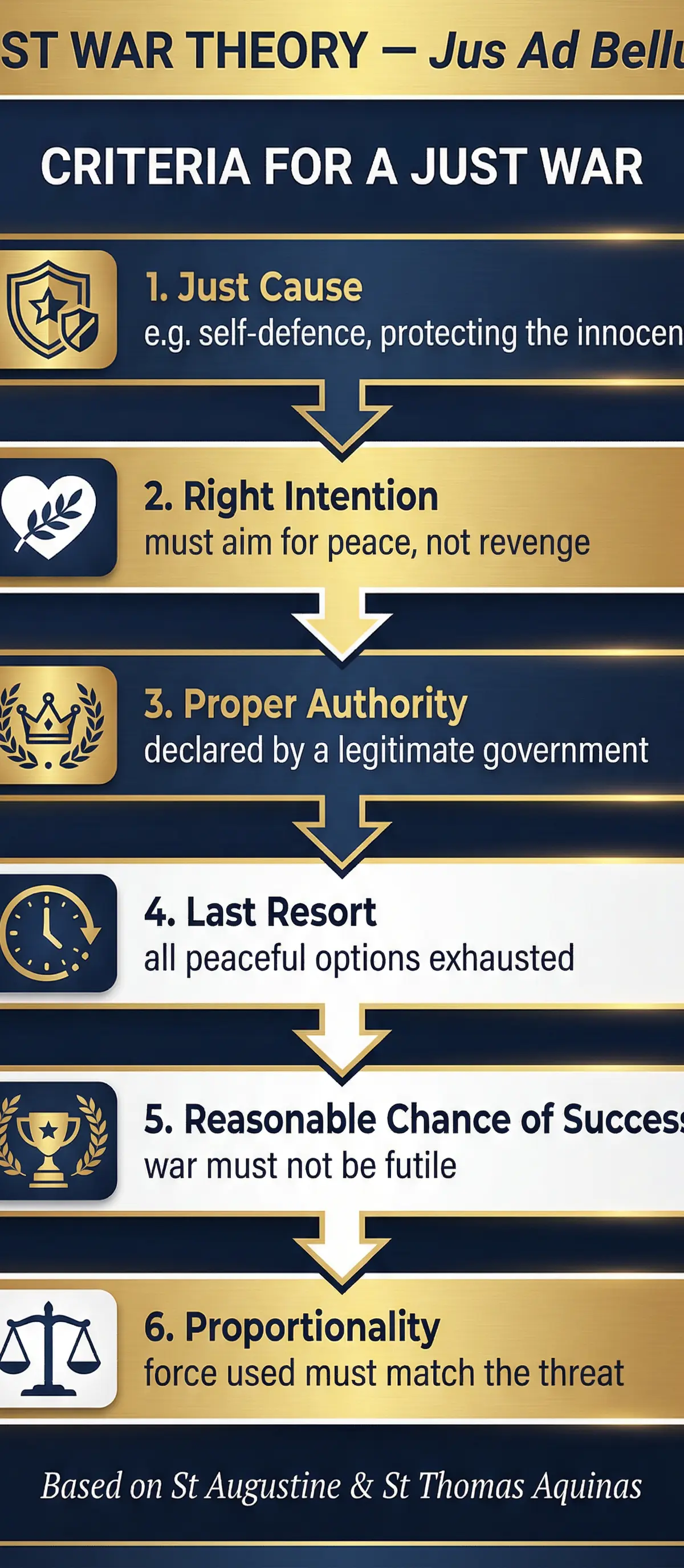
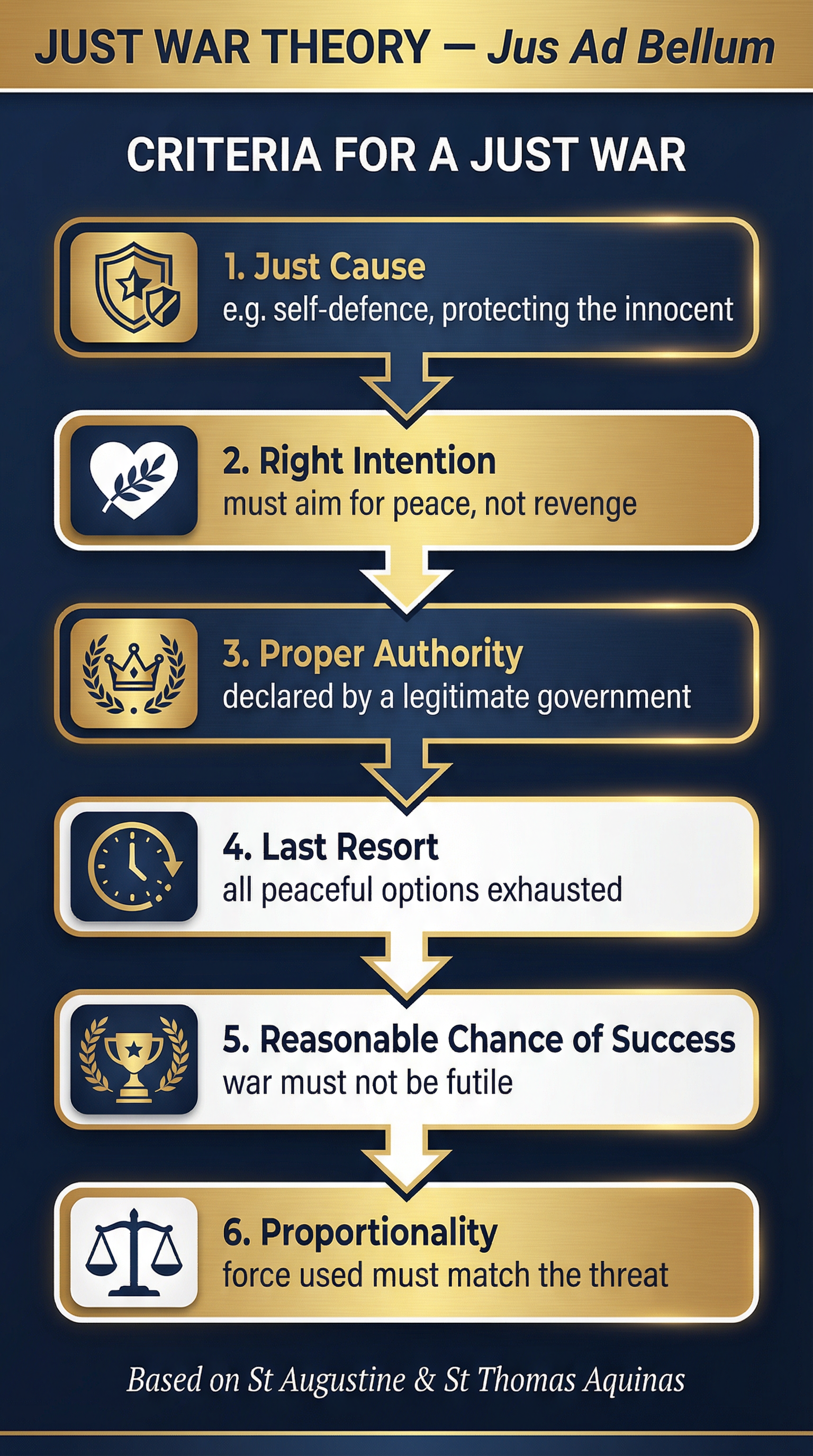
Specific Knowledge: The theory is divided into two parts: Jus ad bellum (the right to go to war) and Jus in bello (right conduct within war). The six key criteria for Jus ad bellum are:
- Just Cause: The war must be in self-defence or to protect the innocent from grave injustice.
- Right Intention: The primary motive must be to restore peace, not to seek revenge or material gain.
- Proper Authority: The war must be declared by a legitimate, sovereign authority, like a government.
- Last Resort: All peaceful and viable alternatives must have been exhausted.
- Reasonable Chance of Success: A war cannot be fought if it is futile and will only lead to pointless loss of life.
- Proportionality: The good achieved by the war must outweigh the evil that will be caused.
Holy War
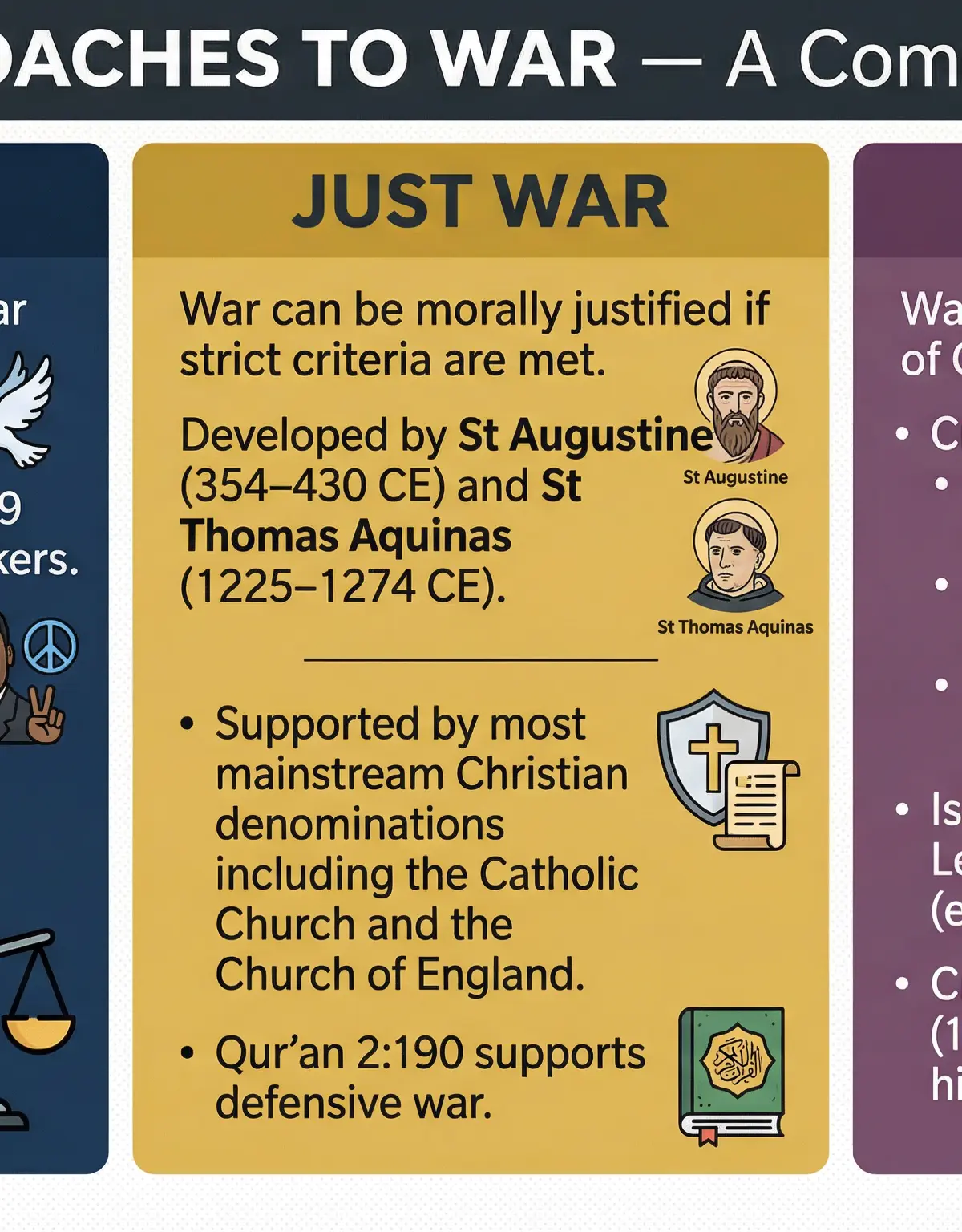
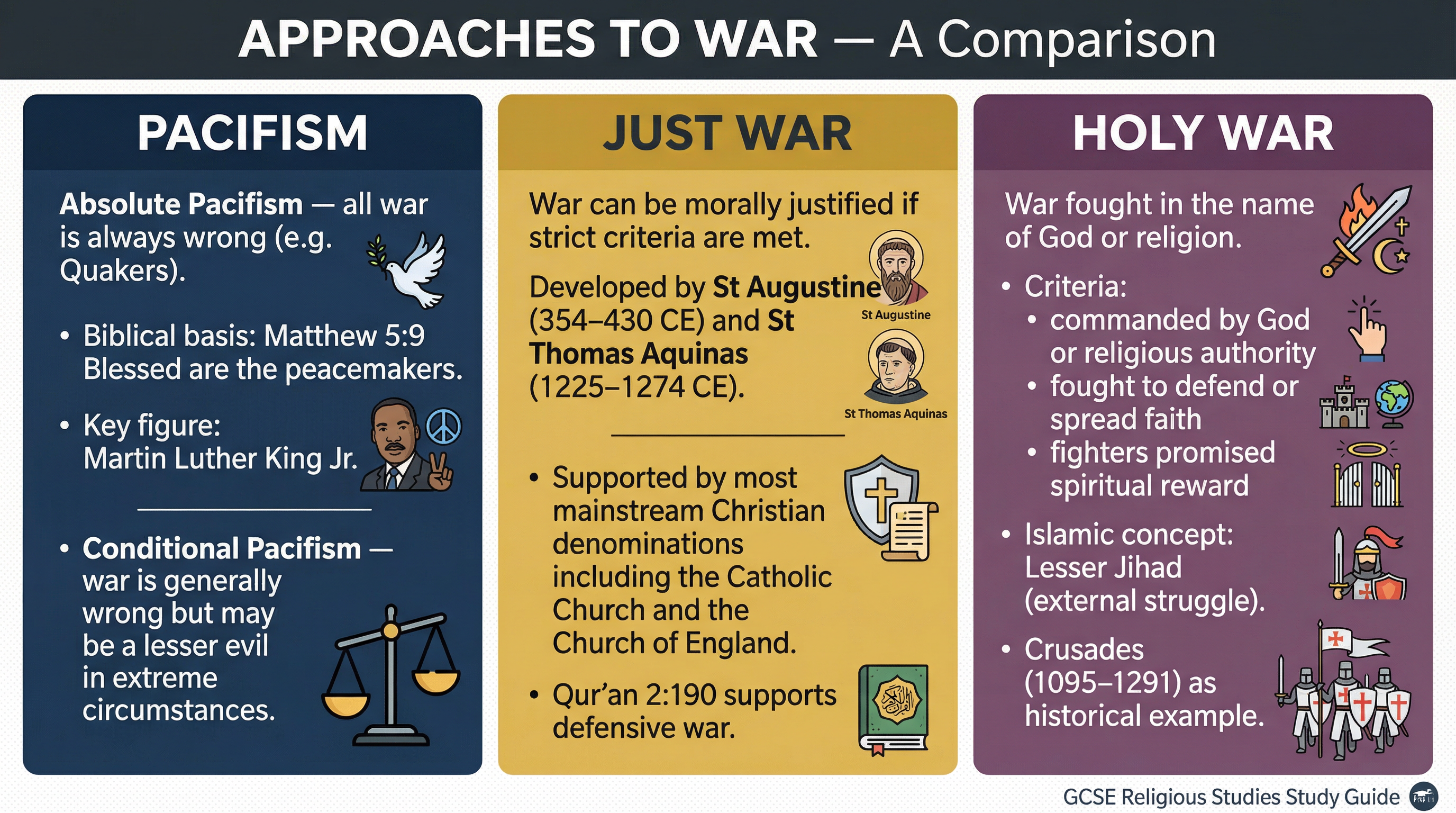
What it is: A war fought for a religious cause or under divine command. This is distinct from a Just War, which is fought for secular reasons of justice and peace.
Why it matters: This concept is often misunderstood. Examiners look for candidates who can clearly distinguish it from Just War theory and explain its specific criteria and historical context.
Specific Knowledge: Key features of a Holy War include:
- It is believed to be authorised by God.
- The aim is to defend or spread the faith.
- Those who fight are promised spiritual rewards.
- Christianity: The Crusades (1095-1291) are the primary example, initiated by Pope Urban II to reclaim Jerusalem.
- Islam: The concept of 'Lesser Jihad' (al-jihad al-asghar) can be interpreted as a Holy War, a physical struggle to defend Islam. However, its application is a matter of intense debate among Muslims. The Qur'an states, "Fight in the way of Allah those who fight you, but do not transgress. Indeed. Allah does not like transgressors" (Qur'an 2:190).
Pacifism
What it is: The belief that war and violence are unjustifiable and that all disputes should be settled by peaceful means.
Why it matters: Pacifism represents a major alternative ethical response to conflict. Candidates must understand its different forms and the religious principles that underpin it.
Specific Knowledge:
- Absolute Pacifism: The belief that it is never right to take part in war, even in self-defence. The Religious Society of Friends (Quakers) are a key example. They believe in the 'inner light' of God in every person, making it impossible to kill another human being.
- Conditional Pacifism: The belief that war is wrong, but there may be extreme circumstances where it is the lesser of two evils (e.g., to prevent a genocide). Many who hold this view are inspired by figures like Dietrich Bonhoeffer, a German pastor who was involved in a plot to assassinate Hitler.
- Biblical Basis: Pacifists often cite Jesus' teachings in the Sermon on the Mount: "Blessed are the peacemakers, for they will be called children of God" (Matthew 5:9) and his instruction to "Turn the other cheek" (Matthew 5:39).
Key Individuals
St. Augustine of Hippo (354-430 CE)
Role: Early Christian theologian and bishop.
Key Actions: First major Christian thinker to systematically develop the Just War Theory. He argued that while individuals should 'turn the other cheek', the state had a duty to protect its citizens from harm, which could necessitate war.
Impact: His work laid the foundation for almost all subsequent Christian thinking on warfare, moving the Church away from its earlier, more pacifist stance.
St. Thomas Aquinas (1225-1274 CE)
Role: Hugely influential Catholic philosopher and theologian.
Key Actions: Refined and systematised Augustine's ideas into the formal criteria for Jus ad bellum in his work, Summa Theologica.
Impact: Aquinas's framework remains the cornerstone of Catholic teaching on war and has profoundly influenced international law.
Martin Luther King Jr. (1929-1968)
Role: Baptist minister and leader of the American Civil Rights Movement.
Key Actions: Championed non-violent resistance as a means of achieving social and political change. He was inspired by his Christian faith and the example of Mahatma Gandhi.
Impact: Proved that non-violent action could be a powerful and effective force for justice, providing a modern example of principled, active pacifism.
Second-Order Concepts
Application of Beliefs
[The core of this topic is applying religious principles to ethical problems. For example, how does the principle of the sanctity of life (the belief that all life is sacred and a gift from God) conflict with or support the idea of a Just War? A top-level answer will explore this tension.]
Divergent Views
[Examiners reward candidates who can show that religions are not monolithic. For example, within Christianity, contrast the absolute pacifism of the Quakers with the Church of England's acceptance of Just War Theory. Within Islam, contrast the majority view that Lesser Jihad is a defensive struggle with the extremist interpretations of groups like ISIS.]
Significance
[Why do these debates matter now? Link the theories to contemporary issues. For example, discuss whether drone warfare can ever be considered 'just' according to the criteria. Can the use of Weapons of Mass Destruction (WMDs) ever be proportionate? The Catholic Church, in the Catechism (2314), states that the indiscriminate destruction of whole cities is a 'crime against God and man'.]
Visual Resources
2 diagrams and illustrations
Interactive Diagrams
1 interactive diagram to visualise key concepts
Conceptual Flow Outline
A flowchart showing the decision-making process of Just War Theory (*Jus ad bellum*).
Worked Examples
3 worked examples — open one to explore the question and available guidance.
Practice Questions
Test your understanding — click to reveal model answers
Describe two types of pacifism. (2 marks)
Hint: Think about whether the rule against violence is absolute or has exceptions.
Explain two contrasting Christian views on nuclear deterrence. (5 marks)
Hint: Consider how some might see it as a peace-keeper, while others see it as immoral.
Explain two ways religious believers work for peace. (4 marks)
Hint: Think about both individual actions and organisations.
'Holy War is never justified.' Evaluate this statement. (12 marks)
Hint: You must argue for and against the statement, considering the criteria for Holy War and modern ethical perspectives. Use examples like the Crusades and Lesser Jihad.
Explain two Muslim beliefs about peace. (4 marks)
Hint: Think about the meaning of the word 'Islam' and the role of justice.