OCR · A-Level · Religious Studies
Knowledge of God's Existence
This study guide explores the fundamental distinction between Natural and Revealed Theology within the OCR A-Level Religious Studies specification. It delves into the arguments of key thinkers from Bonaventure to Barth, providing a comprehensive toolkit for tackling exam questions on how God's existence can be known."
- 6 min read
- 3 worked examples
- 3 practice questions
Study Notes
Overview
This topic examines the critical distinction between Natural Theology (knowledge of God through reason and nature) and Revealed Theology (knowledge of God through divine disclosure). For the OCR H573 specification, this is not just a historical survey but a deep dive into the mechanics of faith and reason. Examiners expect candidates to navigate the complex arguments of thinkers like Bonaventure, Calvin, Barth, and Plantinga with precision. The debate hinges on a crucial question: to what extent did the Fall of humanity damage our innate capacity to know God? Understanding this allows candidates to analyse the core of Christian epistemology, from the medieval synthesis of faith and reason to the stark Christocentric rejection of Natural Theology in the 20th century. Marks are awarded for a clear, consistent, and evaluative engagement with these contrasting positions.

Key Thinkers & Developments
St. Bonaventure (c. 1221-1274)
Role: Franciscan theologian and philosopher.
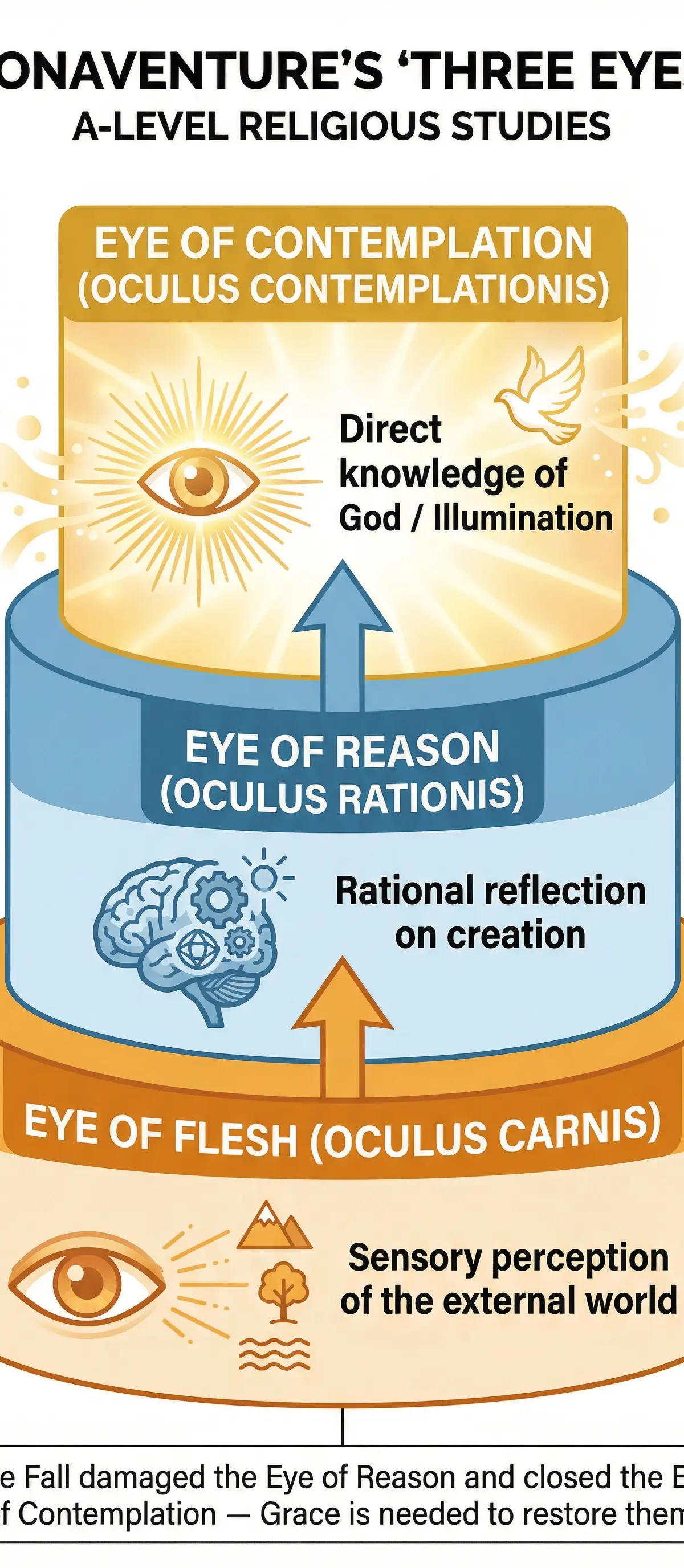
Key Actions: In his work 'Itinerarium Mentis in Deum' (The Journey of the Mind to God), Bonaventure proposed the metaphor of the 'Three Eyes' to explain the different ways humans can acquire knowledge.
Impact: Bonaventure provides a framework that integrates sensory experience, rational thought, and divine illumination. His argument that the Fall damaged the 'Eye of Reason' and closed the 'Eye of Contemplation' is crucial for understanding why Revealed Theology is considered necessary.
John Calvin (1509-1564)
Role: Leading figure of the Protestant Reformation.
Key Actions: In his 'Institutes of the Christian Religion', Calvin argued for an innate 'Sensus Divinitatis' (sense of the divine) and a 'Semen Religionis' (seed of religion) in all human beings.
Impact: Calvin posits a universal, basic awareness of God. However, he argues this innate sense is corrupted by sin and is insufficient for true knowledge of God, which requires the specific revelation of scripture and Christ. His use of the phrase 'si integer stetisset Adam' (if Adam had remained upright) is key to showing how the Fall limited Natural Theology.
The Barth-Brunner Debate (1934)
Date(s): 1934
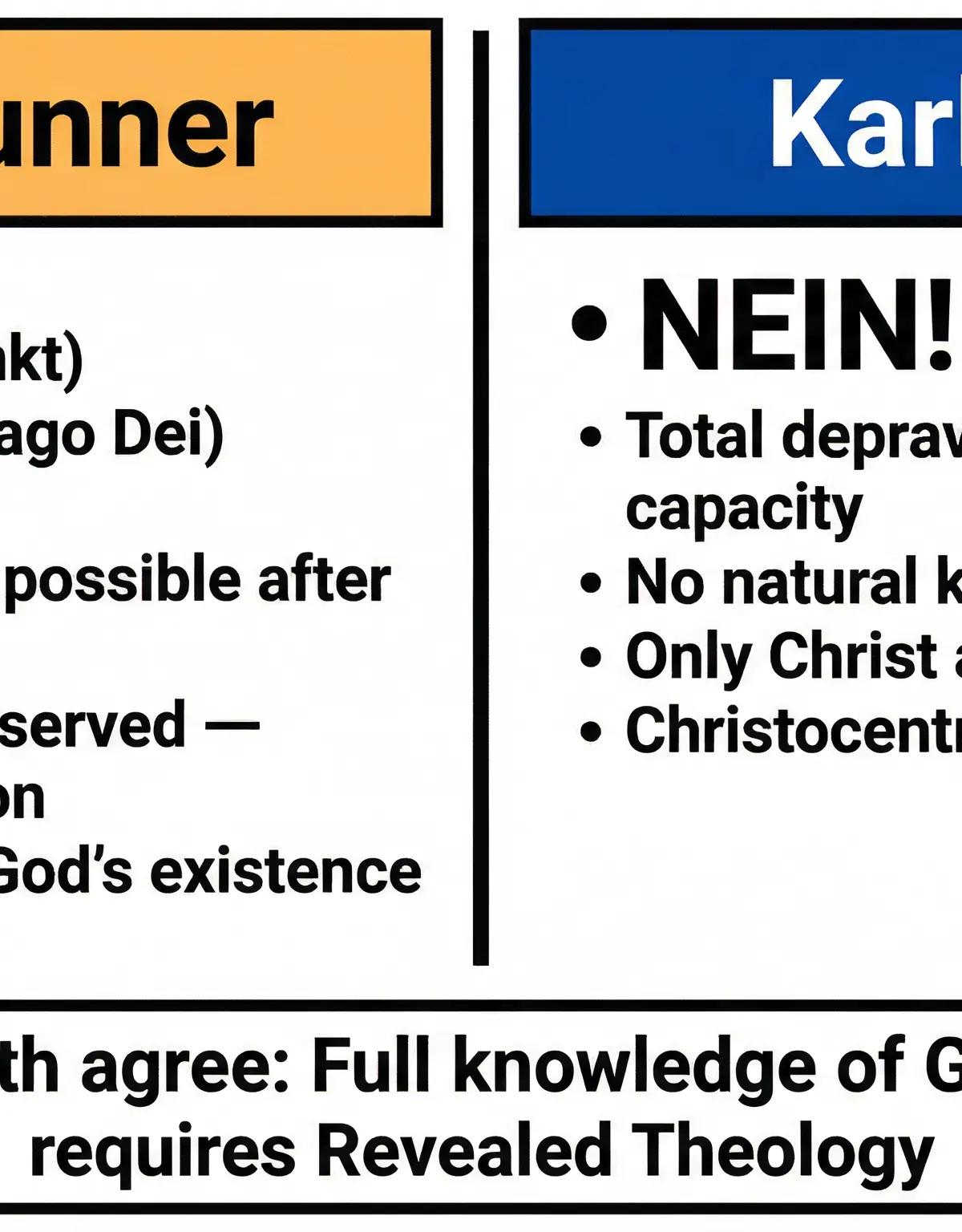
What happened: A famous theological dispute conducted through pamphlets between Swiss theologians Karl Barth and Emil Brunner over the validity of Natural Theology after the Fall.
Why it matters: This debate represents the 20th-century flashpoint between liberal and neo-orthodox Protestant thought. Brunner argued for a 'point of contact' (Anknüpfungspunkt) for divine revelation in human reason, suggesting the 'image of God' was only partially destroyed. Barth responded with his famous 'Nein!' (No!), arguing for total depravity and asserting that knowledge of God is possible only through Christ.
Specific Knowledge: Candidates must know the key terms: 'Anknüpfungspunkt', 'Imago Dei', and Barth's Christocentric focus.
Alvin Plantinga (b. 1932)
Role: Contemporary American philosopher.
Key Actions: Developed Reformed Epistemology, which argues that belief in God can be a 'properly basic belief' and does not require evidence or argument to be rational.
Impact: Plantinga provides a modern philosophical defence for holding belief in God without relying on the traditional arguments of Natural Theology. He builds on Calvin's Sensus Divinitatis to argue that certain experiences can trigger a rational, non-inferential belief in God.
John Polkinghorne (1930-2021)
Role: Physicist and Anglican Priest.
Key Actions: Proposed the concept of 'Binocular Vision' to argue that science (Natural Theology) and faith (Revealed Theology) are two complementary ways of seeing the same reality.
Impact: Polkinghorne offers a modern synthesis, arguing against the mutual exclusivity promoted by thinkers like Barth. He suggests that a full understanding requires looking through both 'eyes' – the lens of reason and the lens of faith – to achieve a deeper, three-dimensional view of reality.
Second-Order Concepts
Causation
- Long-term cause: The philosophical tradition, inherited from Plato and Aristotle, of using reason to understand the divine.
- Mid-term cause: The Protestant Reformation, which placed a renewed emphasis on scripture and the effects of the Fall, challenging the Catholic synthesis of faith and reason.
- Trigger: The rise of liberal theology in the 19th and early 20th centuries prompted a reaction from thinkers like Barth, who saw it as a dangerous accommodation to human-centred thinking.
Consequence
- Immediate: The Barth-Brunner debate created a sharp dividing line in Protestant theology, forcing a choice between those who saw value in Natural Theology and those who rejected it entirely.
- Long-term: The debate has shaped modern theological discussions on faith, reason, and the role of science, with thinkers like Plantinga and Polkinghorne developing new approaches to the problem.
Change & Continuity
- Continuity: The fundamental questions about faith and reason have remained constant since the early church.
- Change: The emphasis has shifted. While medieval thinkers like Aquinas and Bonaventure sought to synthesise faith and reason, post-Reformation and modern thinkers have often emphasised the conflict and distinction between them.
Significance
This topic is significant because it addresses the very foundation of religious belief. The conclusions a candidate reaches here will have profound implications for their understanding of other theological topics, such as the nature of God, the problem of evil, and the role of the church. It is a cornerstone of the A-Level course.
Source Skills
For this topic, sources will be philosophical texts. When analysing them, consider:
- Provenance: Who is the author? What is their theological tradition (e.g., Catholic, Reformed, Neo-Orthodox)? When were they writing, and what historical or philosophical context are they responding to?
- Content: What is the core argument? What key terms are being used? How does the author define Natural and Revealed Theology?
- Limitations: What is the author's bias? What assumptions are they making? What does their argument not address? For example, Barth's focus is so Christocentric that he gives little value to the general human experience of wonder or morality."
Worked Examples
3 worked examples — open one to explore the question and available guidance.
Practice Questions
Test your understanding — click to reveal model answers
To what extent was the Fall the decisive event for determining the value of Natural Theology? (20 marks)
Hint: Structure your answer by comparing thinkers who give the Fall central importance (Calvin, Barth) with those who see more continuity (Bonaventure, Brunner). Conclude with a clear judgement.
Explain Plantinga's concept of properly basic beliefs. (12 marks)
Hint: Start by defining what a basic belief is, then explain why Plantinga thinks belief in God can be one, linking it to Calvin's Sensus Divinitatis.
Analyse the claim that Natural Theology is of no value. (20 marks)
Hint: This is a classic AO2 question. You must evaluate the arguments for and against the value of Natural Theology, using the thinkers you have studied.