OCR · A-Level · Religious Studies
Religious Experience
This study guide provides a comprehensive analysis of Religious Experience for OCR A-Level Religious Studies (H573). It delves into the core philosophical debates, from William James' foundational criteria to modern scientific challenges, equipping candidates with the critical tools needed to excel in their exams.
- 6 min read
- 3 worked examples
- 5 practice questions
- 6 key terms
Study Notes

Overview
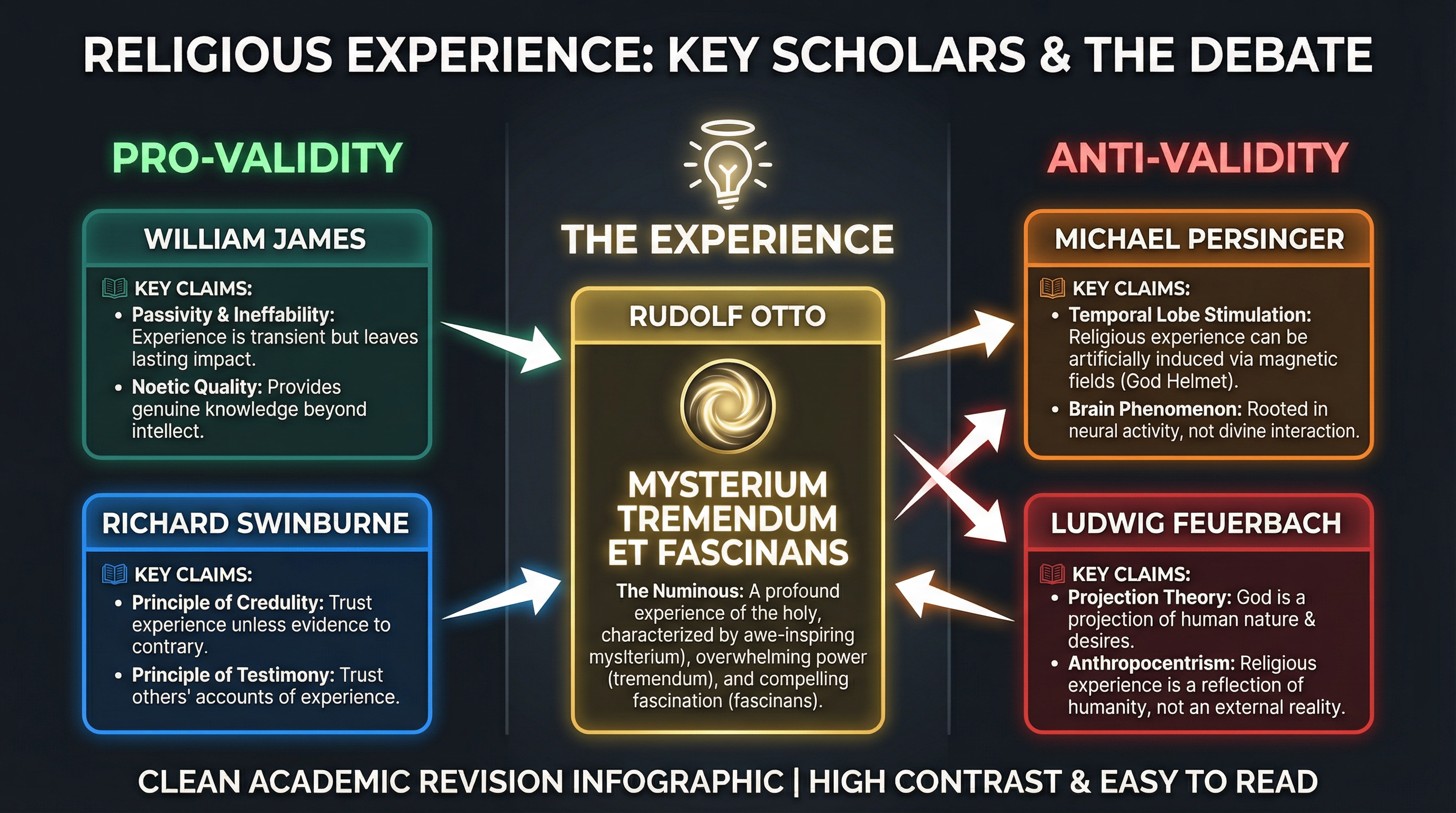
OCR H573 requires rigorous analysis of the nature and validity of religious experience. Candidates must interrogate William James' four characteristics (PINT) and Rudolf Otto's concept of the 'numinous' (mysterium tremendum et fascinans). Crucially, the study demands evaluation of verification arguments, specifically Swinburne's Principles of Credulity and Testimony, against physiological challenges (Persinger's God Helmet) and psychological critiques (Freud, Feuerbach). Examiners expect a 60% focus on AO2 (analysis and evaluation), rewarding candidates who can move beyond mere description to construct a sustained, critical argument. This guide will break down the key scholars, concepts, and exam techniques required to achieve the highest marks.

Key Scholars & Concepts
William James (1842-1910)
Role: American philosopher and psychologist, a key figure in pragmatism.
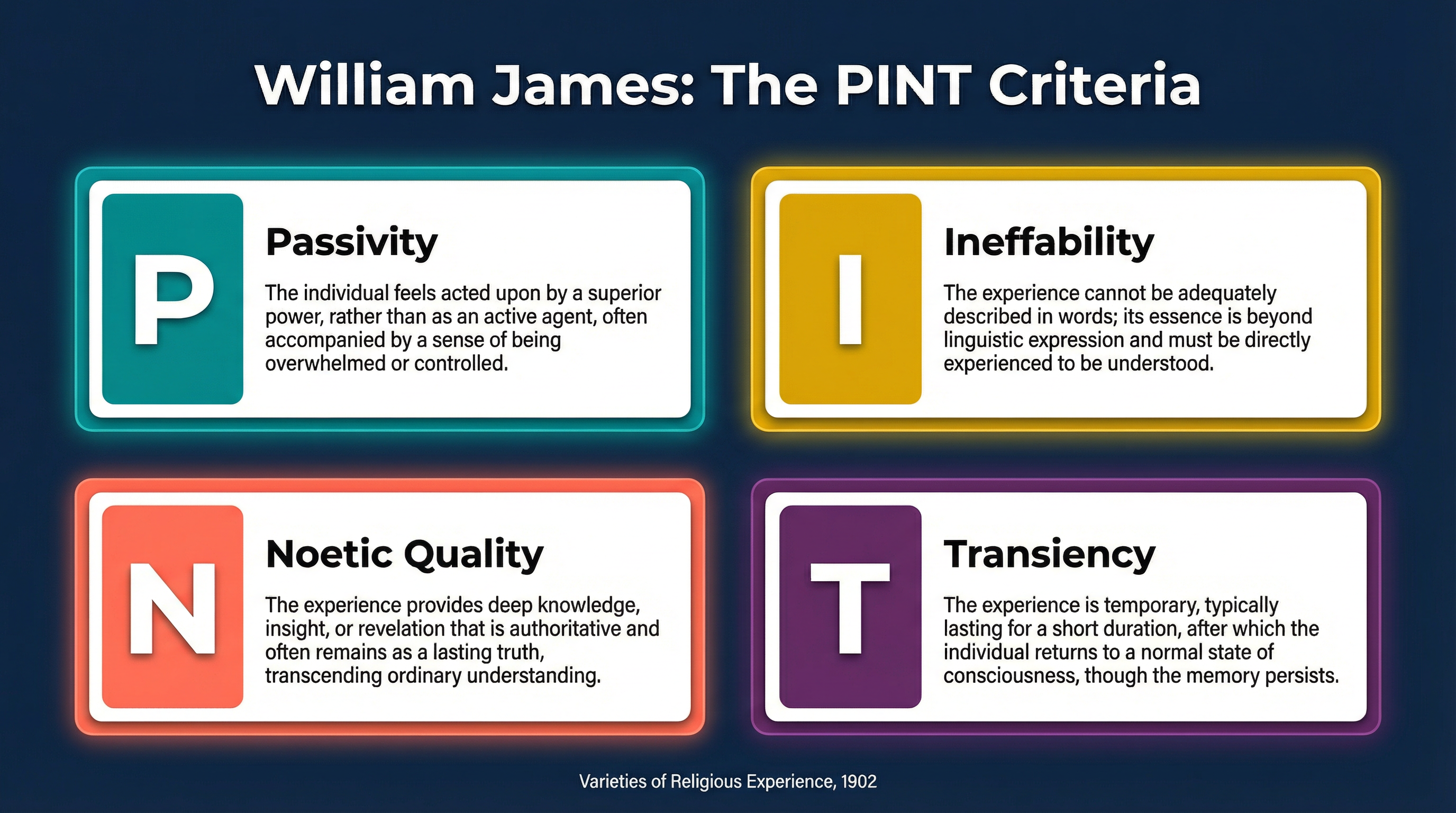
Key Actions: In his work The Varieties of Religious Experience (1902), James analyzed hundreds of first-person accounts to identify four common characteristics of mystical experiences.
Impact: James provided a systematic, empirical framework for studying religious experience, shifting the focus from theological dogma to the psychological reality of the phenomena. His PINT criteria remain the foundational starting point for any analysis of mystical states.
Rudolf Otto (1869-1937)
Role: German Lutheran theologian and philosopher.
Key Actions: In The Idea of the Holy (1917), Otto introduced the concept of the 'numinous' to describe the unique quality of religious experience. He defined it as 'mysterium tremendum et fascinans'.
Impact: Otto argued that religious experience is sui generis (in a class of its own) and cannot be reduced to other human emotions or psychological states. This provides a powerful counter-argument to reductionist explanations.
Richard Swinburne (1934-Present)
Role: Influential contemporary British philosopher of religion at the University of Oxford.
Key Actions: Swinburne argues for the rational credibility of religious experience using two key principles in The Existence of God (1979):
- Principle of Credulity: We should believe that things are as they seem to be, unless we have a specific reason to doubt it.
- Principle of Testimony: We should believe what others tell us, in the absence of special considerations.
Impact: Swinburne provides a robust philosophical defense for taking religious experience seriously as evidence for God's existence, placing the burden of proof on the skeptic.
Michael Persinger (1945-2018)
Role: Canadian-American neuroscientist.
Key Actions: Developed the 'God Helmet', a device that applied weak magnetic fields to the temporal lobes of the brain. Persinger claimed this could induce experiences of a 'sensed presence', similar to those reported in religious contexts.
Impact: Persinger's work represents a major physiological challenge, suggesting that religious experiences are not encounters with an external divine reality but are instead artifacts of brain activity. This forms a cornerstone of reductionist critiques.
Ludwig Feuerbach (1804-1872)
Role: German philosopher and anthropologist, a key figure in the Young Hegelian movement.
Key Actions: In The Essence of Christianity (1841), Feuerbach argued that God is a projection of idealized human nature. Humans take their best qualities (love, power, wisdom) and project them onto an external, divine being.
Impact: Feuerbach provides a powerful psychological critique, arguing that religious experience is not an encounter with God, but an encounter with a glorified version of ourselves. This challenges the very foundation of theistic interpretation.
Second-Order Concepts
Causation
Candidates must analyze the competing causal explanations for religious experience. Is the cause an external, transcendent reality (God), as Swinburne and Otto would argue? Or is it an internal, natural phenomenon caused by brain states (Persinger) or psychological projection (Feuerbach)? A top-level essay will weigh these competing causal claims, not just list them.
Consequence
The consequences of religious experience are often profound and life-changing. For individuals like St. Paul or Teresa of Avila, the experience led to a complete reorientation of their lives and had a massive historical impact. For AO2, candidates can argue whether the positive consequences of an experience lend weight to its validity.
Change & Continuity
While the language and cultural expression of religious experience have changed over time, proponents argue for a continuity of core features, as identified by James. The debate itself shows continuity: the tension between mystical claims and skeptical critiques has existed for centuries. The change is in the language of the critique, which has shifted from philosophical to neurological.
Significance
The significance of this topic lies in the question of evidence. If religious experiences are valid, they could represent the most direct and powerful evidence for the existence of God. If they are not, then a central pillar of religious belief is undermined. The entire debate is significant because it forces a confrontation between faith, reason, and science.
Visual Resources
2 diagrams and illustrations
Interactive Diagrams
1 interactive diagram to visualise key concepts
Conceptual Flow Outline
Flowchart of the core debate on the verification of religious experience.
Worked Examples
3 worked examples — open one to explore the question and available guidance.
Practice Questions
Test your understanding — click to reveal model answers
Explain Rudolf Otto's concept of the numinous. (12 marks)
Hint: Break down the Latin phrase 'mysterium tremendum et fascinans' and explain what each part means.
To what extent do physiological explanations invalidate religious experience? (18 marks)
Hint: Engage with Persinger's God Helmet, but also consider the philosophical counter-arguments. Does explaining the 'how' necessarily negate the 'what'?
Explain Swinburne's Principles of Credulity and Testimony. (12 marks)
Hint: Define each principle clearly and explain how they work together to form a cumulative case.
Assess the claim that William James offers the most useful approach to understanding religious experience. (18 marks)
Hint: Consider what 'useful' means. Useful for a psychologist? A philosopher? A believer? Compare James' pragmatic, descriptive approach with Otto's theological and Swinburne's philosophical approaches.
Explain the psychological critique of religious experience associated with Ludwig Feuerbach. (12 marks)
Hint: Focus on the concept of 'projection' and what Feuerbach believed was being projected.