OCR · A-Level · Religious Studies
Religious Pluralism and Inter-faith Dialogue
This study guide explores the complex and dynamic field of Christian attitudes towards other religions, a critical topic for OCR A-Level Religious Studies. It unpacks the key theological positions of exclusivism, inclusivism, and pluralism, equipping candidates to analyse the arguments of major thinkers like Rahner, Hick, and D'Costa and secure top marks.
- 6 min read
- 3 worked examples
- 5 practice questions
- 6 key terms
Study Notes

Overview
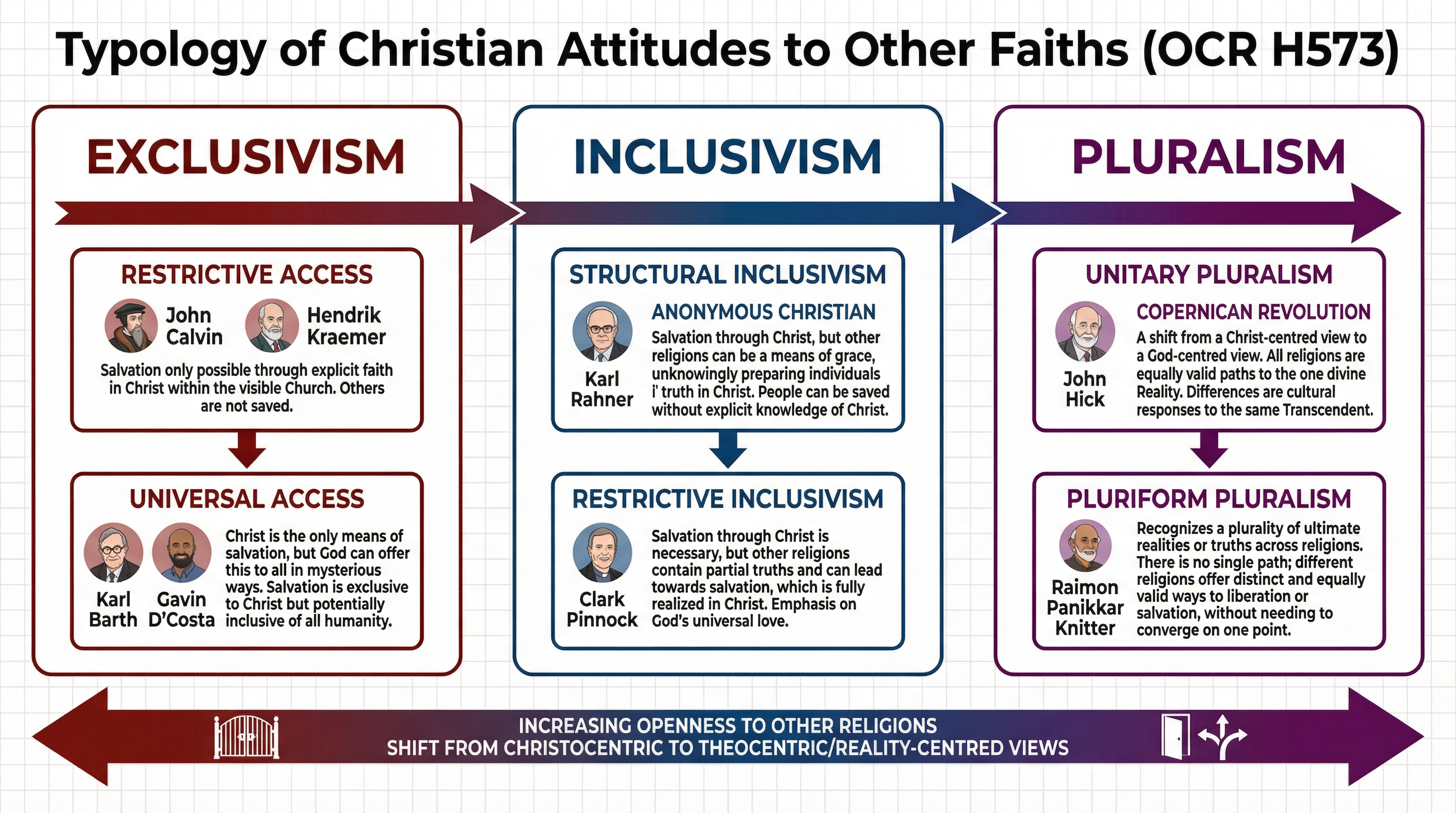
This topic requires a rigorous theological examination of Christian attitudes towards other faiths, specifically analysing the tripartite typology: Exclusivism, Inclusivism, and Pluralism. For the OCR H573 specification, candidates must evaluate the soteriological (related to salvation) and Christological (related to the nature of Christ) implications of these views. The debate is not merely abstract; it has profound consequences for inter-faith relations and missionary work in our globally connected world. Examiners expect candidates to move beyond simple descriptions of each stance and construct a critical dialogue between the key thinkers. High-level responses will demonstrate a precise understanding of the distinctions within each category (e.g., Restrictive vs. Universal Access Exclusivism) and apply these theological positions to the practical realities of inter-faith dialogue, such as the Scriptural Reasoning Movement. Success in this area hinges on deploying specific terminology accurately and evaluating the logical coherence and theological implications of each perspective.
The Tripartite Typology: A Spectrum of Belief
At the heart of this topic is a framework for understanding different Christian views. Think of it as a spectrum from 'closed' to 'open'.
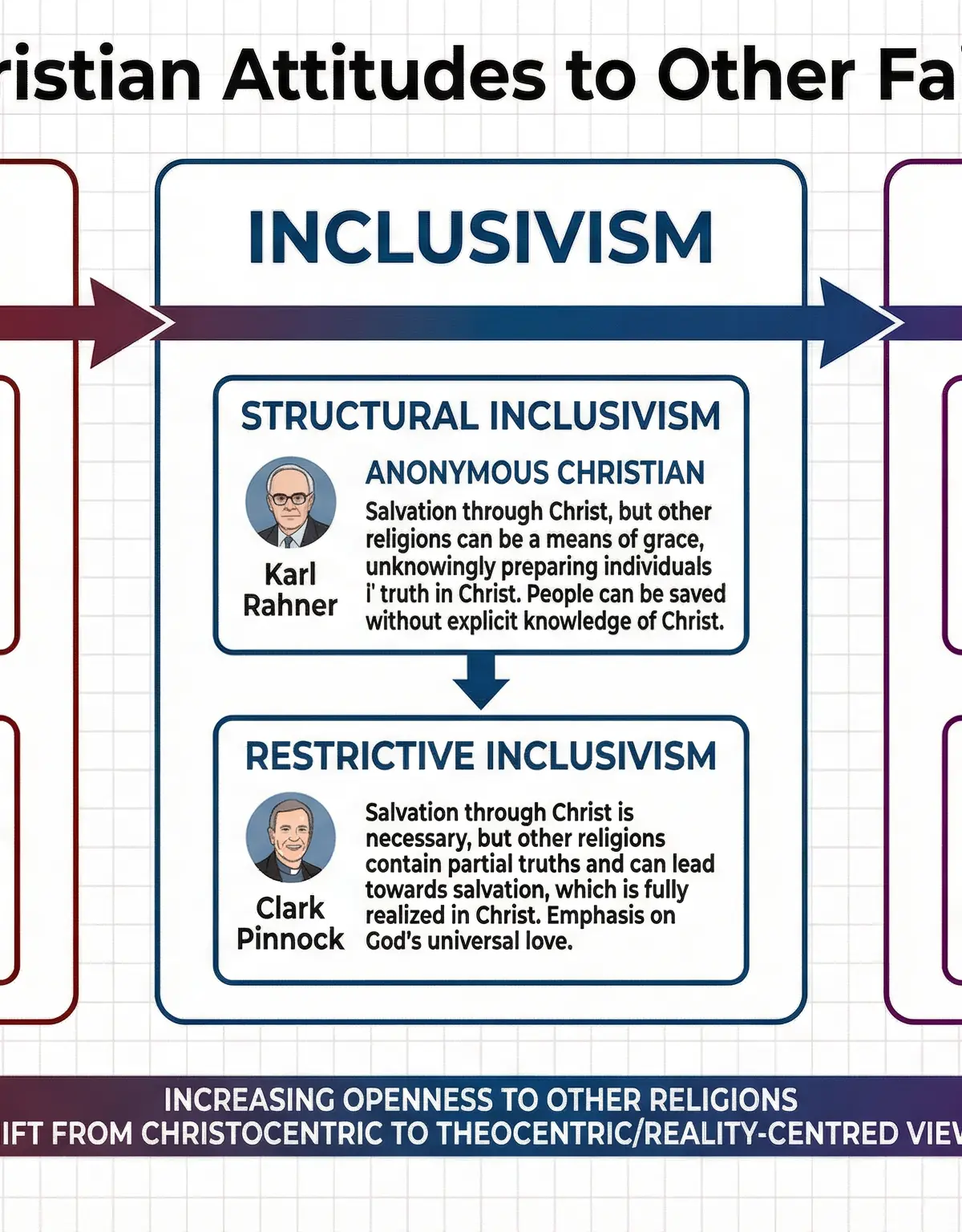
1. Theological Exclusivism: The One True Path
What it is: Exclusivism maintains that salvation is only possible through explicit faith in Jesus Christ. It asserts the unique and final revelation of God in Christ.
Why it matters: This is the most traditional and historically dominant Christian view. It provides a strong motivation for evangelism and missions, as articulated in the Papal Encyclical 'Redemptoris Missio' (1990), which affirms the Church's mandate to proclaim Christ. For examiners, the key is to distinguish between its two forms.
Specific Knowledge:
- Restrictive Access Exclusivism: Associated with figures like John Calvin and, more recently, Hendrik Kraemer. This position argues that salvation is only for those who consciously respond to the Gospel in this life. Kraemer, in his influential 1938 book The Christian Message in a Non-Christian World, argued that other religions are misguided human attempts to find God, whereas Christianity is God's unique revelation. Credit is given for using the Latin term fides ex auditu (faith comes from hearing).
- Universal Access Exclusivism: A more nuanced position held by theologians like Karl Barth and Gavin D'Costa. They agree that Christ is the only way to salvation (the ontological basis), but argue that God can make that salvation available to those who have never heard the Gospel (the epistemological possibility). This might happen post-mortem or through the hidden work of the Holy Spirit. The crucial point is that salvation is still exclusively through Christ, even if access to it is universal.
2. Theological Inclusivism: The Anonymous Christian
What it is: Inclusivism holds that while Jesus Christ is the definitive and unique path to salvation, that salvation can be accessed by people of other faiths, even if they don't have explicit knowledge of Christ.
Why it matters: This view attempts to reconcile the traditional Christian belief in Christ's uniqueness with a more optimistic view of the salvific potential of other religions. It's a middle ground between the harshness of exclusivism and the radicalism of pluralism.
Specific Knowledge:
- Karl Rahner (1904-1984): The most important thinker for inclusivism. A German Jesuit priest, Rahner developed the concept of the 'Anonymous Christian'. He argued that individuals who live a life of love and moral integrity, following the dictates of their conscience, are implicitly responding to the grace of Christ, even if they belong to a non-Christian religion. They have a votum ecclesiae (an implicit desire for the Church) and can be saved. Marks are awarded for explaining how Rahner maintains Christ's uniqueness while allowing for salvation outside the visible Church.
3. Theological Pluralism: Many Paths to the Summit
What it is: Pluralism is the view that all major world religions are equally valid paths to the same ultimate divine reality.
Why it matters: This is the most radical and controversial position. It requires a fundamental re-evaluation of traditional Christian doctrines about the finality of Christ.
Specific Knowledge:
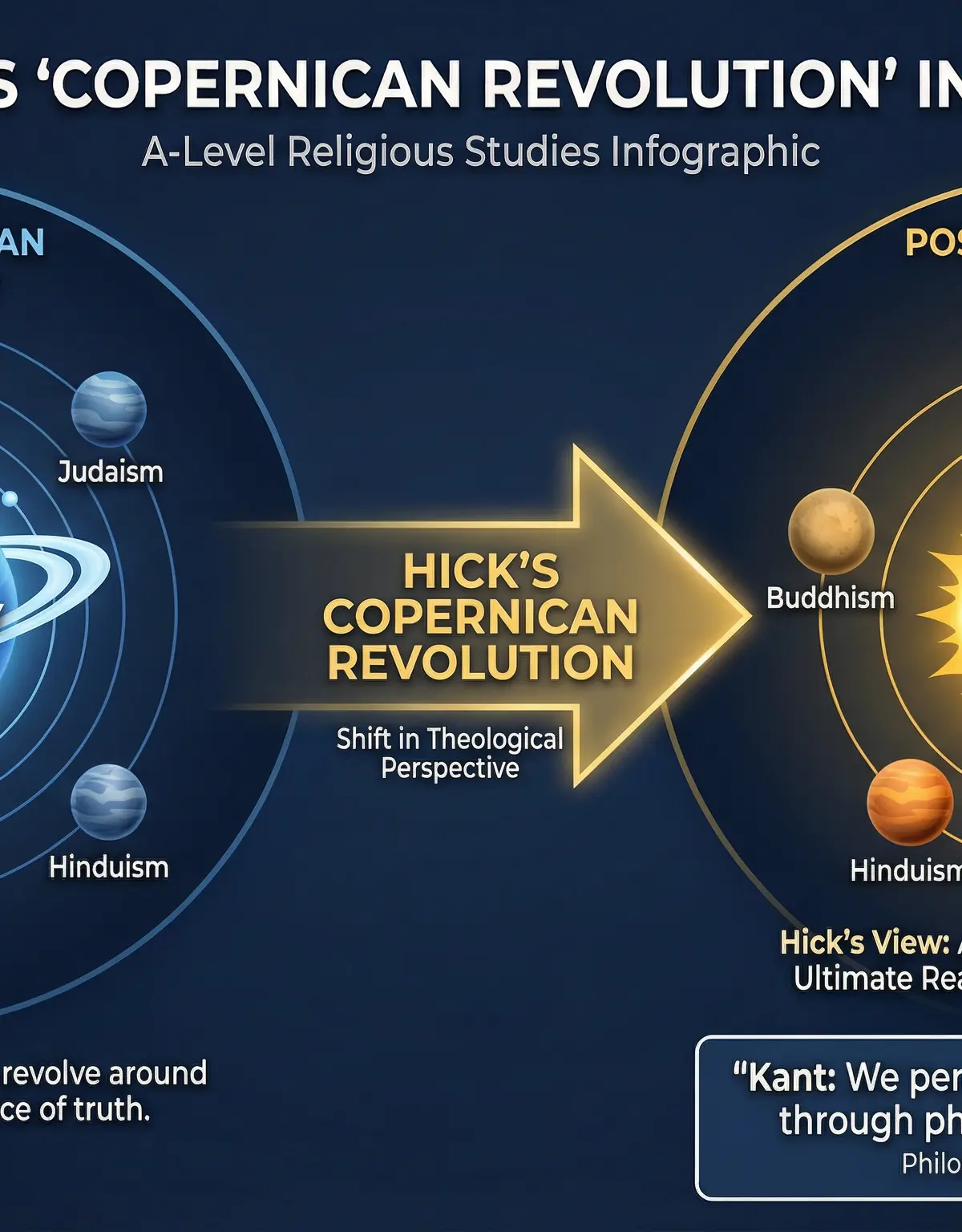
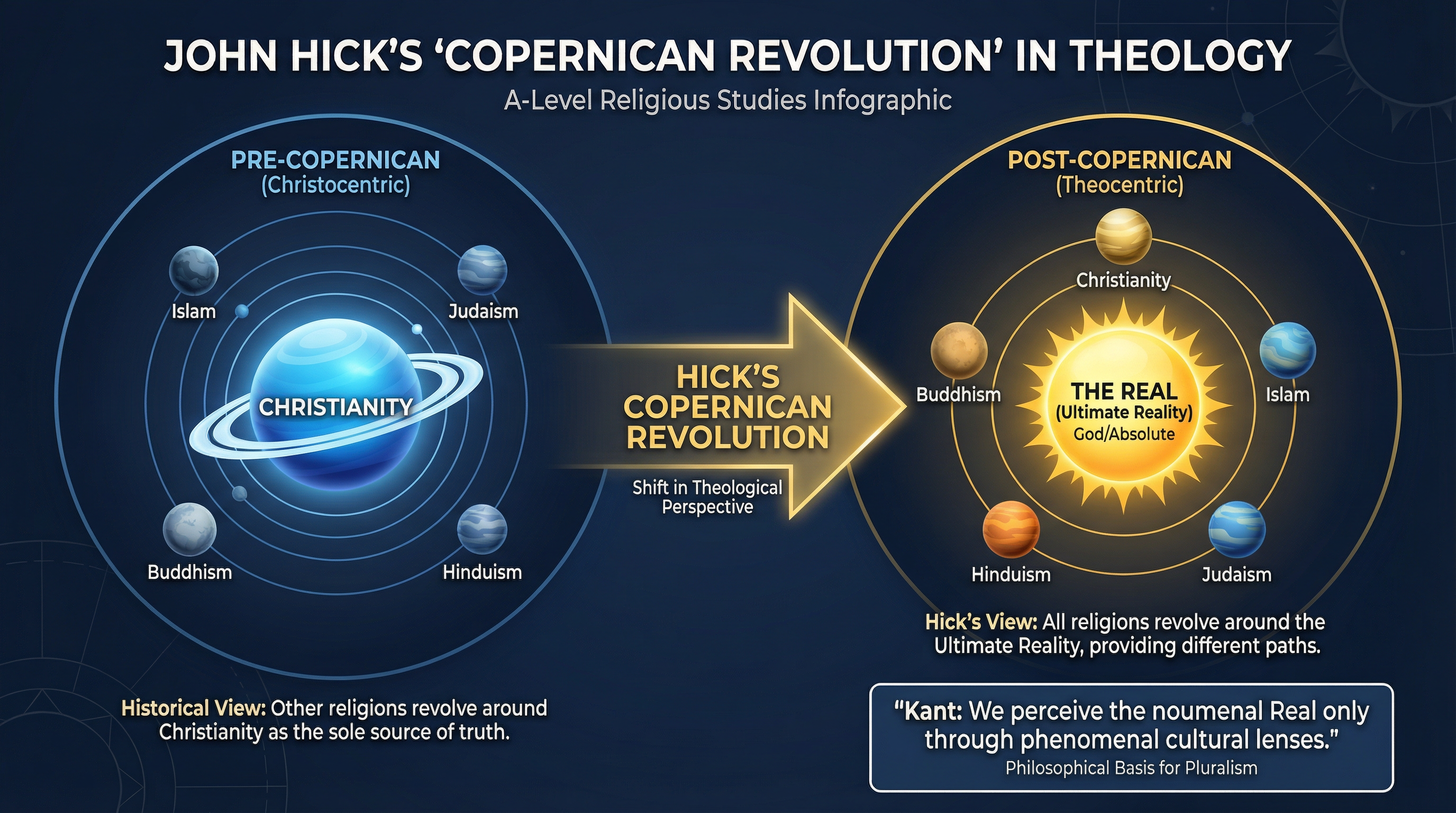
- John Hick (1922-2012): The leading proponent of pluralism. Hick proposed a 'Copernican Revolution' in theology. Just as Copernicus moved the Earth from the centre of the universe, Hick argued for a shift from a Christocentric (Christ-centred) model to a Theocentric (God-centred) model. He called the ultimate divine reality 'the Real'.
- Noumenal vs. Phenomenal: To explain his theory, Hick used the philosophy of Immanuel Kant. The divine reality as it is in itself (the noumenal 'Real') is unknowable. The world's religions are the different human, cultural responses to, and perceptions of, that reality (the phenomenal). So, 'God', 'Brahman', and 'Allah' are all culturally specific phenomenal masks of the one noumenal Real.
Inter-Faith Dialogue in Practice
The Scriptural Reasoning Movement
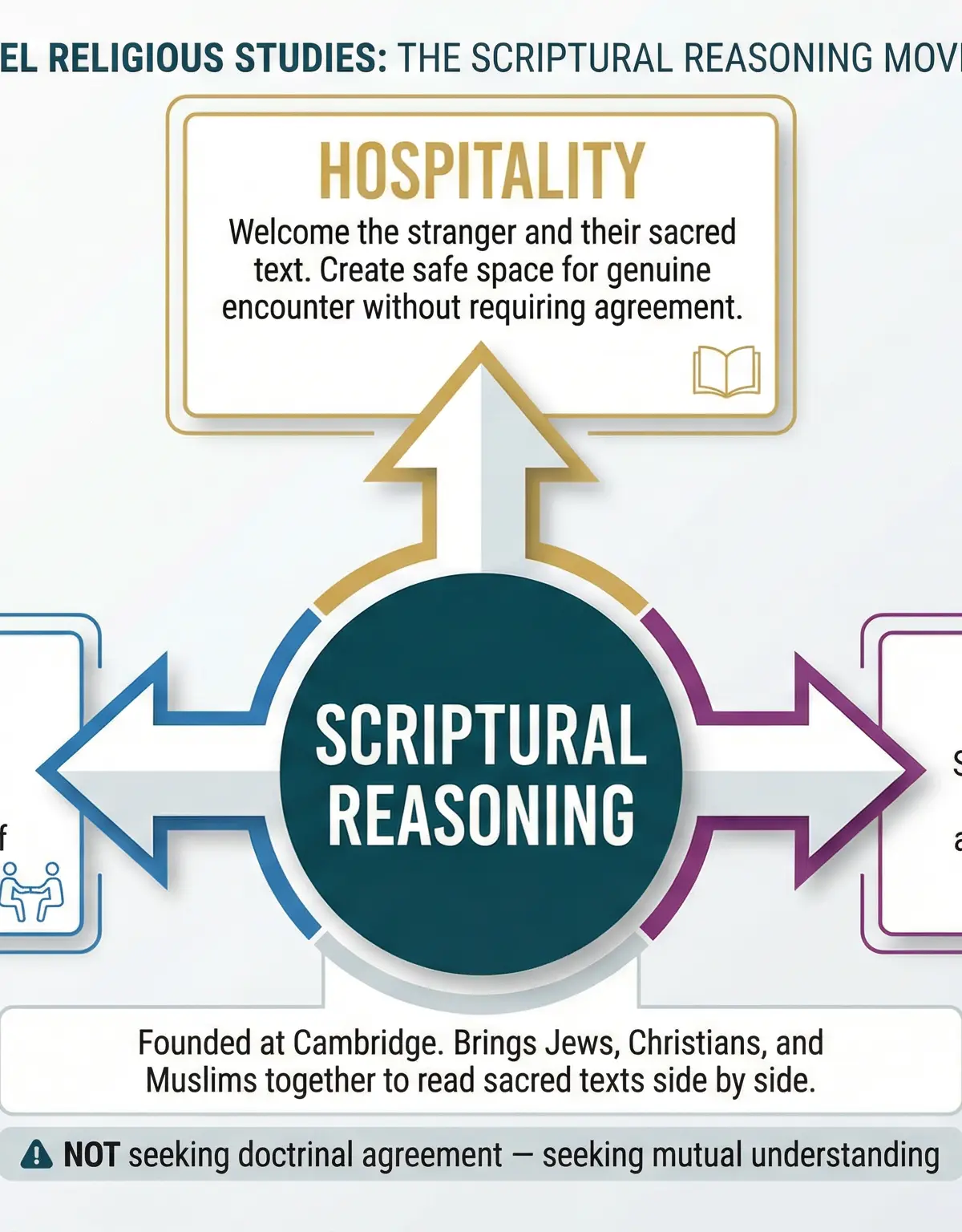
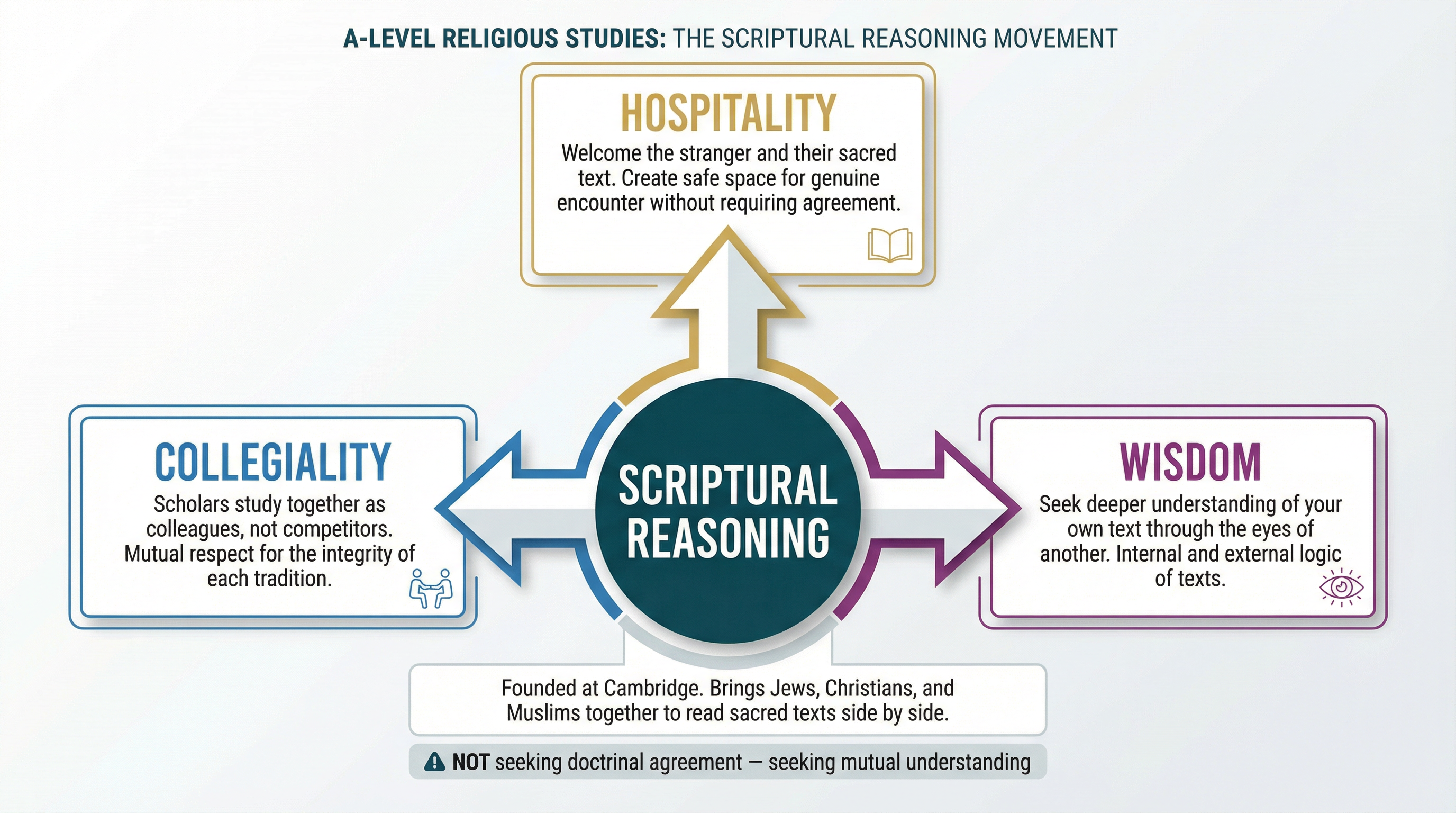
What it is: A practical application of inter-faith dialogue that brings together scholars and practitioners from Judaism, Christianity, and Islam to read and interpret their sacred texts together.
Why it matters: It provides a concrete example of how theological stances translate into real-world engagement. High-level responses must analyse its goals, not just describe it as a conversation.
Specific Knowledge: The movement is built on three core principles:
- Hospitality: Creating a safe, respectful space to encounter the sacred text of the 'other'.
- Collegiality: Participants study as colleagues, not competitors, respecting the integrity of each tradition.
- Wisdom: The goal is not to create a single, synthesized religion, but to gain deeper wisdom about one's own faith by seeing it through the eyes of another. It involves exploring both the 'internal' and 'external' logic of texts.
Worked Examples
3 worked examples — open one to explore the question and available guidance.
Practice Questions
Test your understanding — click to reveal model answers
To what extent is theological inclusivism a more coherent position than exclusivism?
Hint: Define both positions carefully. Consider the strengths of inclusivism (moral appeal) and its weaknesses (D'Costa's critique). Compare this with the logical consistency but potential moral problems of exclusivism.
Examine the aims and methods of the Scriptural Reasoning movement.
Hint: Go beyond a simple description. Focus on the three key goals: Hospitality, Collegiality, and Wisdom. Explain what each one means in practice.
Critically assess John Hick's use of Kant's philosophy in his pluralist theory.
Hint: This is a focused question. Explain *how* Hick uses the noumenal/phenomenal distinction first. Then, introduce the major criticism: that he contradicts himself by making claims about the unknowable noumenal 'Real'.
Examine the arguments presented in Redemptoris Missio regarding the Church's relationship with other faiths.
Hint: Focus on the dual message of the encyclical: affirming the universal missionary mandate while also acknowledging the work of the Holy Spirit outside the visible Church.
To what extent does theological pluralism undermine the central doctrines of Christianity?
Hint: Focus on the specific doctrines that are challenged: Christology (the uniqueness and divinity of Christ) and Soteriology (salvation through Christ alone). Argue whether 'undermine' is the right word, or if it simply 'reinterprets' them.