Religious Practices: Five Pillars and Beyond
The Five Pillars of Sunni Islam and the Ten Obligatory Acts of Twelver Shi'a Islam represent two of the most theologically rich and examiner-tested areas of the OCR H573 specification. Understanding the distinctions between Zakah and Khums, the symbolic depth of Hajj, and the unique Shi'a obligations of Tawalla and Tabarra is essential for accessing the highest mark bands. This guide equips candidates with the precise knowledge, evaluative frameworks, and scholarly references needed to excel in both AO1 and AO2 components of the 40-mark essay.
Study Notes
Overview
This study guide covers OCR H573 Islamic Religious Practices, focusing on the Five Pillars of Sunni Islam and the Ten Obligatory Acts (Furu al-Din) of Twelver Shi'a Islam. The topic sits at the intersection of orthopraxy (correct practice) and orthodoxy (correct belief), demanding that candidates not merely describe rituals but critically evaluate their theological significance, sociological impact, and the interplay between individual spirituality and communal obligation. OCR examiners consistently reward candidates who can distinguish precisely between Sunni and Shi'a obligations, connect practices to core theological concepts such as Taqwa and Tawhid, and deploy Quranic references and scholarly opinion in support of sustained evaluative arguments. AO2 carries 60% of the essay mark, so analysis and judgement must dominate your response.
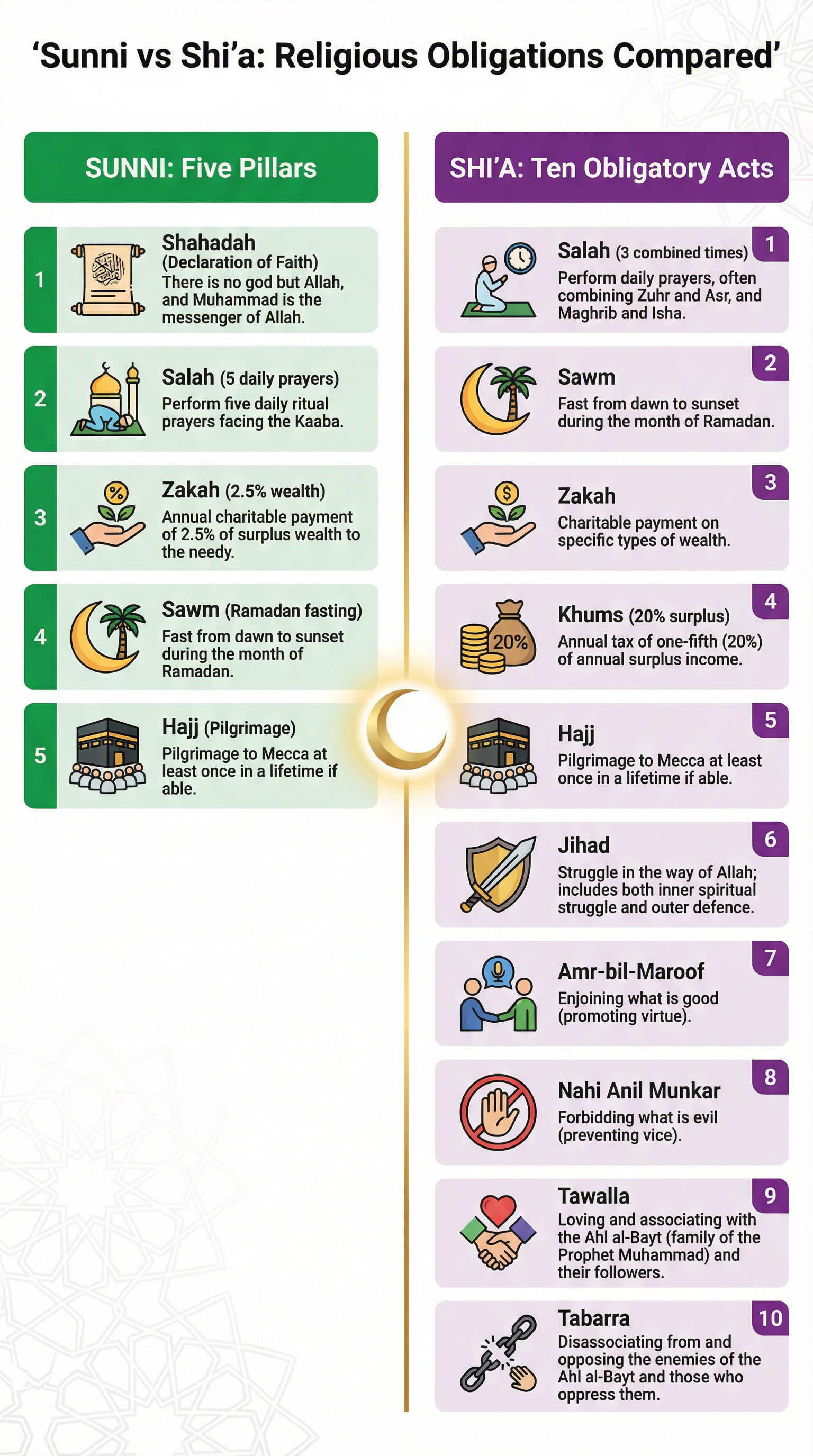
The Five Pillars of Sunni Islam (Arkan al-Islam)
1. Shahadah — Declaration of Faith
What it is: The Shahadah is the foundational declaration: 'La ilaha illa Allah, Muhammadun rasul Allah' — 'There is no god but Allah, and Muhammad is the messenger of Allah.' It is the entry point into Islam and the theological bedrock of all other pillars.
Why it matters for the exam: The Shahadah encapsulates Tawhid (the absolute oneness of God) and Nubuwwah (Prophethood). Examiners credit candidates who explain that the Shahadah is simultaneously an act of belief (orthodoxy) and an act of practice (orthopraxy), making it the clearest example of Islam's integration of faith and action. Candidates should argue whether the Shahadah is primarily a personal commitment or a public declaration of communal identity.
Specific Knowledge: The Shahadah is recited at birth into a Muslim child's ear, at conversion, and at death. In Shi'a Islam, a third clause is often added: 'wa Aliyyun wali Allah' — 'and Ali is the friend of God' — reflecting the theological centrality of the Imamate.
2. Salah — Ritual Prayer
What it is: Salah consists of five daily prayers at prescribed times: Fajr (dawn), Dhuhr (midday), Asr (afternoon), Maghrib (sunset), and Isha (night). Each prayer involves ritual purity (Wudu), specific postures (Raka'at), and recitation of Quranic verses.
Why it matters for the exam: Salah is theologically linked to Taqwa (God-consciousness). Quran 29:45 states that prayer 'restrains from shameful and unjust deeds.' Candidates must connect the ritual to its spiritual purpose rather than merely describing the mechanics. The Sunni–Shi'a distinction is critical: Twelver Shi'a Muslims permit combining Dhuhr with Asr and Maghrib with Isha, resulting in three prayer times. This reflects differences in jurisprudential authority between the Sunni Madhabs and the Ja'fari school.
Specific Knowledge: The four Sunni Madhabs (Hanafi, Maliki, Shafi'i, Hanbali) differ on minor details of prayer posture and intention (Niyyah). Al-Ghazali in his Ihya Ulum al-Din (Revival of the Religious Sciences, c. 1095 CE) argued that Salah without inner presence (Khushu) is spiritually empty — a point examiners reward as scholarly engagement.
3. Zakah — Obligatory Almsgiving
What it is: Zakah requires Muslims to give 2.5% of their surplus wealth (above the Nisab threshold, approximately the value of 85g of gold) to eight designated categories of recipients, including the poor, debtors, and travellers.
Why it matters for the exam: Zakah is not voluntary charity but a religious obligation — a purification of wealth. Quran 9:103 states: 'Take from their wealth a charity by which you purify them.' Examiners assess whether candidates can analyse Zakah as a mechanism for social justice (Adalat) within the Ummah, rather than simply defining it. The contrast with Shi'a Khums (20% of annual surplus income) is a mandatory comparison point.
Specific Knowledge: The Nisab threshold for gold is 85g; for silver, 595g. Zakah is distributed to eight categories listed in Quran 9:60, including the poor (Fuqara), the needy (Masakin), and those in debt (Gharimin). Approximately 1.8 trillion US dollars in Zakah is estimated to be paid globally each year, demonstrating its macroeconomic significance for Muslim-majority societies.
4. Sawm — Fasting During Ramadan
What it is: During Ramadan (the ninth month of the Islamic lunar calendar), Muslims abstain from food, drink, smoking, and sexual relations from dawn (Fajr) to sunset (Maghrib). The fast is broken each evening with Iftar.
Why it matters for the exam: Quran 2:183 explicitly links Sawm to Taqwa: 'O you who have believed, decreed upon you is fasting as it was decreed upon those before you that you may become righteous (Tattaqun).' Candidates must argue that Sawm is a spiritual discipline cultivating empathy, gratitude, and self-control — not merely a physical act. The communal dimension of Ramadan (shared Iftar meals, Tarawih prayers, increased charity) reinforces the concept of the Ummah.
Specific Knowledge: Laylat al-Qadr (the Night of Power), believed to fall in the last ten days of Ramadan, commemorates the first revelation of the Quran to the Prophet Muhammad in 610 CE. Quran 97:1–3 describes it as 'better than a thousand months.' This is a specific textual reference examiners reward.
5. Hajj — Pilgrimage to Makkah
What it is: Hajj is an annual pilgrimage to Makkah performed during the month of Dhul Hijjah. It is obligatory once in a lifetime for every Muslim who is physically and financially able (the condition of Istita'ah).
Why it matters for the exam: Hajj is the most powerful expression of the Ummah — approximately two million Muslims from every nation perform it simultaneously. The rituals carry profound symbolic significance that examiners expect candidates to analyse, not merely describe.
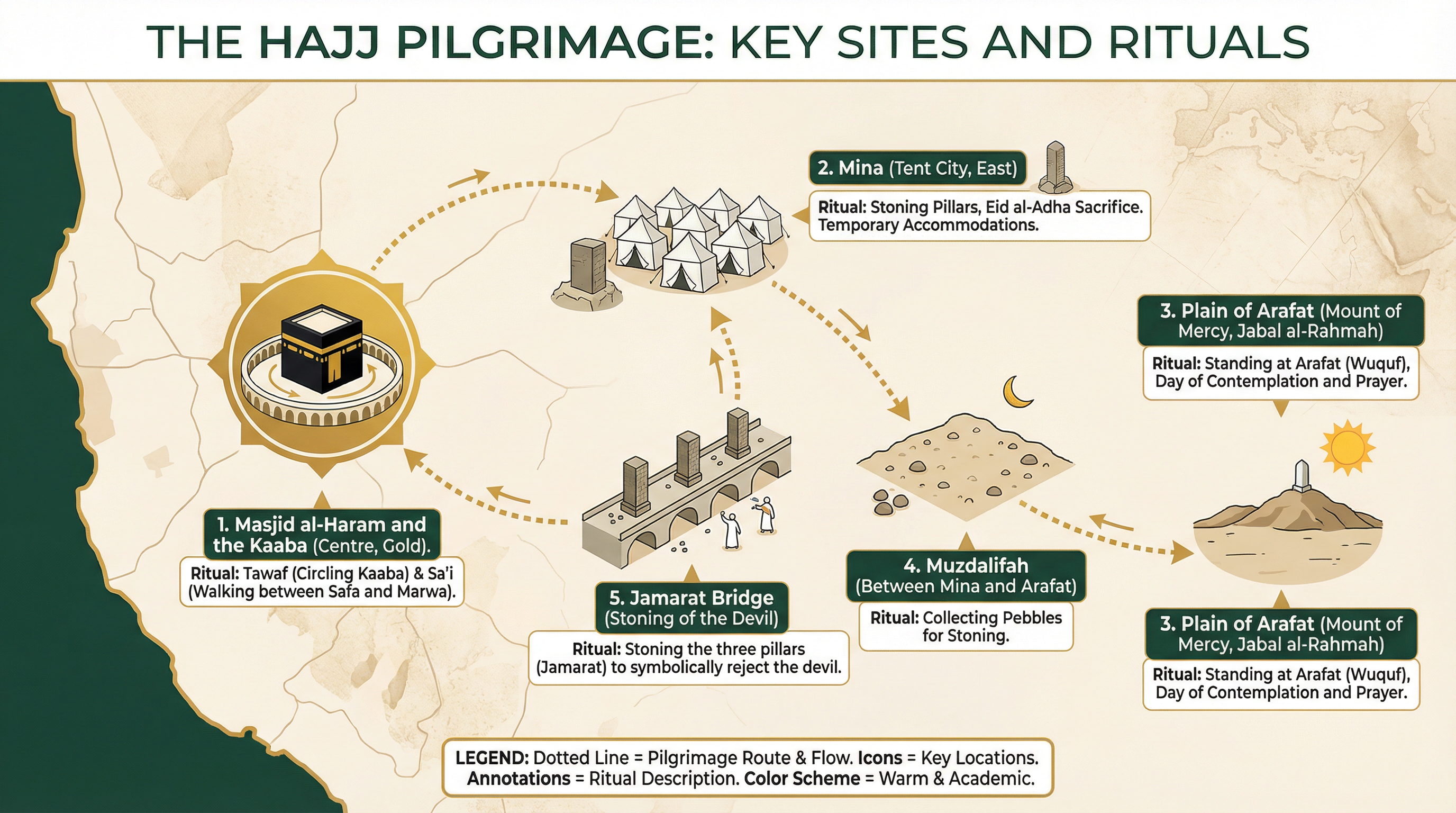
Key Rituals and Their Symbolism: Ihram (white seamless garments) symbolises equality before Allah, erasing distinctions of wealth, race, and class. Tawaf (seven circuits of the Kaaba) expresses the centrality of Allah in Muslim life. Wuquf at Arafat (standing in contemplation) is considered the spiritual pinnacle of Hajj. Sa'i (walking between Safa and Marwa) commemorates Hajar's search for water for her son Ismail. Stoning the Jamarat at Mina symbolises the rejection of Satan, echoing Ibrahim's rejection of temptation. Eid al-Adha sacrifice commemorates Ibrahim's willingness to sacrifice his son.
Specific Knowledge: Hajj was established in 9 AH (630 CE) when the Prophet Muhammad performed his only Hajj, known as the Farewell Pilgrimage (Hajjat al-Wida). His sermon at Arafat declared the equality of all humans: 'An Arab has no superiority over a non-Arab, nor a non-Arab over an Arab, except by piety (Taqwa).'
The Shi'a Ten Obligatory Acts (Furu al-Din)
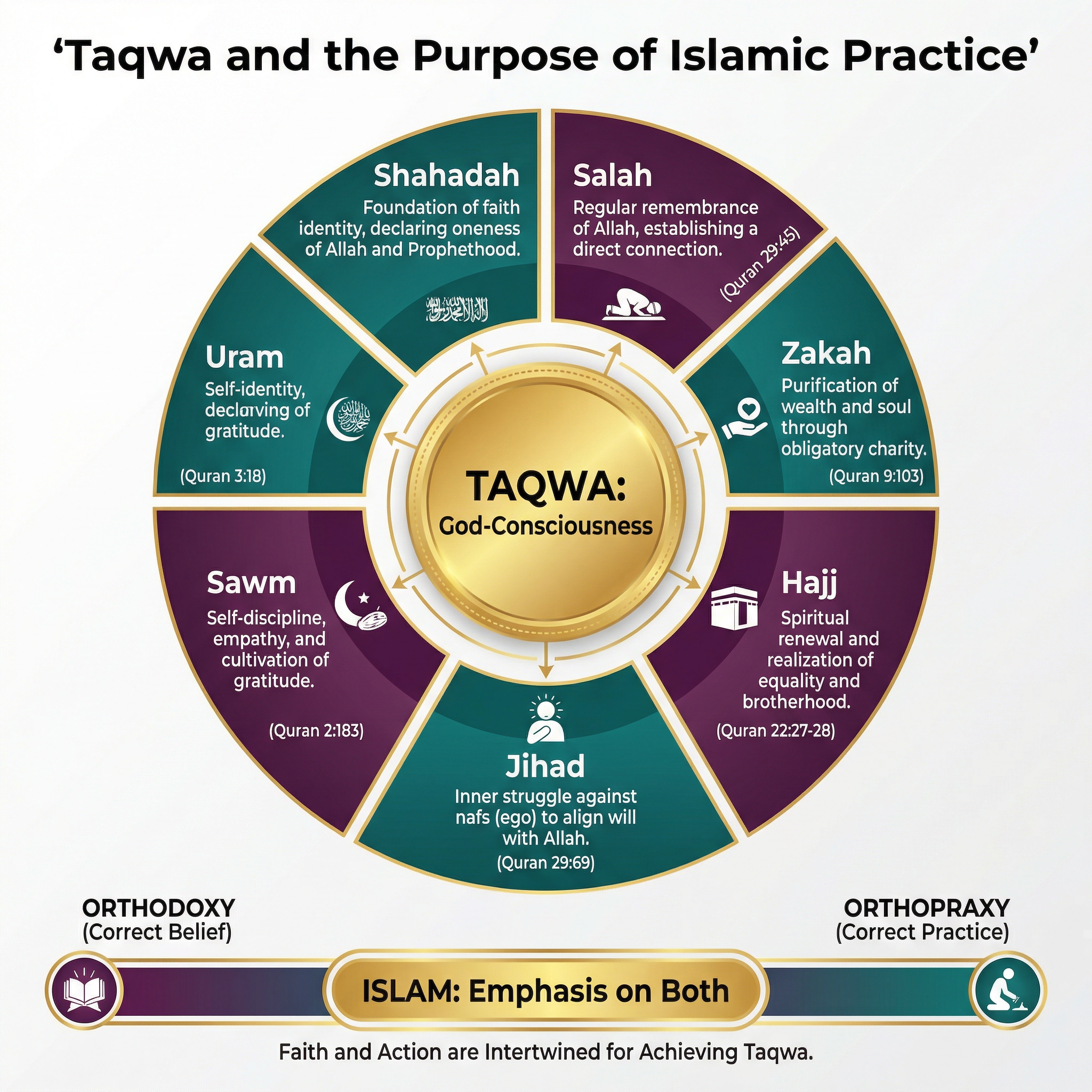
Twelver Shi'a Islam organises its obligations under the Furu al-Din (Branches of Religion), which includes the five shared practices plus five additional obligations that reflect the unique theological emphases of Shi'a Islam.
Khums — One-Fifth Tax
Khums (literally 'one fifth') requires Shi'a Muslims to pay 20% of their annual surplus income. It is divided into two equal portions: the Sahm al-Imam (share of the Imam, administered by the Marja — senior religious authority) and the Sahm al-Sadat (share for descendants of the Prophet). This system funds Shi'a religious institutions, seminaries (Hawzas), and social welfare. Examiners credit the distinction between Zakah (2.5% of accumulated wealth) and Khums (20% of annual surplus income) as a marker of precise knowledge.
Jihad — Struggle in the Way of Allah
Jihad is the sixth Obligatory Act in Shi'a Islam and is explicitly listed in the Furu al-Din. Examiners require candidates to distinguish between the Greater Jihad (al-Jihad al-Akbar) — the internal spiritual struggle against the nafs (ego) — and the Lesser Jihad (al-Jihad al-Asghar) — military defence of the faith. The Prophet Muhammad is reported to have said upon returning from battle: 'We have returned from the lesser jihad to the greater jihad.' Quran 2:190 states: 'Fight in the way of Allah those who fight you, but do not transgress.' This verse is essential for evaluating the ethics of Jihad.
Amr-bil-Maroof and Nahi Anil Munkar
Amr-bil-Maroof (enjoining what is good) and Nahi Anil Munkar (forbidding what is evil) are the seventh and eighth Obligatory Acts. They represent a social and political obligation to actively uphold moral order within the community. Ayatollah Khomeini invoked these principles to justify the 1979 Islamic Revolution in Iran, arguing that Muslims have a duty to resist unjust governance. This is a rich area for AO2 evaluation: candidates can argue whether these obligations are primarily personal, communal, or political.
Tawalla and Tabarra
Tawalla (loving and associating with the Ahl al-Bayt and their followers) and Tabarra (disassociating from the enemies of the Ahl al-Bayt) are the ninth and tenth Obligatory Acts. These are uniquely Shi'a and reflect the theological centrality of the Imamate. They explain the distinct devotional culture of Shi'a Islam, including the annual commemoration of Ashura — the martyrdom of Imam Husayn ibn Ali at the Battle of Karbala in 680 CE (61 AH). Ashura involves mourning rituals, processions, and the retelling of Husayn's sacrifice, which Shi'a Muslims interpret as the ultimate act of resistance against injustice.
Second-Order Concepts
Causation
The Five Pillars emerged from the foundational theological principle of Tawhid (divine unity) and the Prophetic model (Sunnah). The Hadith of Jibril (Gabriel), recorded in Sahih Muslim, identifies Islam, Iman (faith), and Ihsan (excellence) as three interconnected dimensions of Muslim life — the Pillars represent the practical expression of Islam. The Shi'a Ten Obligatory Acts developed partly in response to the political and theological disputes following the Prophet's death in 632 CE, particularly the question of legitimate succession (the Imamate), which led to the Sunni–Shi'a split formalised at the Battle of Karbala in 680 CE.
Consequence
The Five Pillars have profound sociological consequences: Salah structures daily life around God-consciousness; Zakah redistributes wealth and reduces inequality; Hajj creates a global expression of Muslim unity. The Shi'a obligations, particularly Khums, fund independent religious institutions that give Shi'a Islam significant political autonomy, as demonstrated by the authority of the Marja in Iran, Iraq, and Lebanon.
Change and Continuity
The core obligations have remained remarkably stable since the Prophetic period. However, jurisprudential interpretation has evolved: contemporary scholars debate whether Zakah should be calculated on modern financial instruments (stocks, pensions), and whether Jihad can be applied to non-military contexts such as environmental activism or social justice campaigns. The Shi'a Marja system allows for ongoing reinterpretation (Ijtihad), while Sunni Madhabs tend toward established precedent (Taqlid).
Significance
This topic is significant because it addresses the fundamental question of what it means to be Muslim — whether Islam is primarily a system of belief (orthodoxy) or a system of practice (orthopraxy). The answer, as most scholars argue, is that Islam insists on both: the Shahadah without Salah is incomplete; Salah without Taqwa is hollow. This integration of belief and practice is what makes Islamic religious obligations theologically distinctive.
Visual Resources
3 diagrams and illustrations
Interactive Diagrams
3 interactive diagrams to visualise key concepts
Conceptual Flow Outline
The theological architecture of the Five Pillars: from Tawhid through practice to Taqwa and Ummah
Conceptual Flow Outline
Sunni Five Pillars versus Shi'a Ten Obligatory Acts — structural comparison
Diagram could not be rendered
Timeline of key events in the development of Islamic religious practice
Worked Examples
3 detailed examples with solutions and examiner commentary
Practice Questions
Test your understanding — click to reveal model answers
'The concept of Taqwa is more important than the outward performance of the Five Pillars.' Critically evaluate this view. (40 marks)
Hint: Consider Al-Ghazali's argument about Khushu in Salah, the Quranic purpose of Sawm (2:183), and whether Islam is primarily orthopraxic or orthodox. Engage with the tension between inner spirituality and outward obligation.
Explain the significance of Zakah for the Muslim community. (20 marks)
Hint: Cover the theological purpose (purification, Quran 9:103), the practical mechanism (2.5%, Nisab, eight categories in Quran 9:60), and the sociological impact (Adalat, Ummah cohesion). Contrast with Khums for bonus marks.
'Hajj is the most important of the Five Pillars.' Assess this view. (40 marks)
Hint: Consider the arguments for Hajj (communal expression, equality, Ummah, Wuquf at Arafat) and against (Shahadah as foundation, Salah as daily practice, accessibility issues). Use Malcolm X's testimony and the Prophet's Farewell Sermon as evidence.
Explain the differences between the Sunni Five Pillars and the Shi'a Ten Obligatory Acts. (20 marks)
Hint: Identify shared obligations, then focus on the five additional Shi'a acts. Be specific about Khums (20% vs 2.5%), the theological basis for Tawalla and Tabarra (Imamate), and the social/political dimensions of Amr-bil-Maroof and Nahi Anil Munkar.
'Jihad is primarily a spiritual struggle, not a military one.' Assess this view. (40 marks)
Hint: Use the Greater/Lesser Jihad distinction, the Hadith about returning from battle, Quran 2:190, and scholarly perspectives including Ayatollah Khomeini (political Jihad) and Al-Ghazali (spiritual Jihad). Consider contemporary debates about the term.