OCR · A-Level · Religious Studies
Self, Death and the Afterlife
This study guide delves into the OCR A-Level Religious Studies topic of Self, Death and the Afterlife, a cornerstone of the Philosophy of Religion paper. It critically examines the mind-body problem, contrasting dualist and materialist perspectives, and evaluates the logical possibility of post-mortem existence, providing candidates with the analytical tools to excel in AO2-heavy questions."
- 20 min read
- 3 worked examples
- 5 practice questions
Study Notes
Overview
This topic explores one of the most profound questions in philosophy: what is the nature of the self, and can it survive death? For the OCR H573/01 Philosophy of Religion paper, candidates are required to navigate the complex terrain of dualism versus monism, evaluating arguments from key thinkers from Plato to Dawkins. Examiners expect a high degree of analytical rigour, moving beyond mere description to a sustained critical engagement with the material. A successful response will demonstrate precise use of technical language, a clear understanding of the logical strengths and weaknesses of each position, and the ability to construct a coherent argument. This guide will equip you with the knowledge, analytical frameworks, and exam techniques required to achieve the highest marks. Remember, with a 60% weighting on AO2, your ability to evaluate is paramount.

Key Concepts & Thinkers
Plato (c. 428-348 BCE): Substance Dualism
Role: Ancient Greek philosopher, foundational figure in Western thought.
Key Arguments: Plato posits that the soul (psyche) is a distinct, immortal substance separate from the physical body. His key arguments are:
- Argument from Opposites: All things come into being from their opposites. Therefore, life must come from death, implying a cycle of reincarnation where the soul persists.
- Argument from Recollection (Anamnesis): We possess knowledge of perfect concepts (like Equality) that we could not have learned through sensory experience. This knowledge must be remembered from a previous existence in the Realm of the Forms, proving the soul's pre-existence and immortality.
Impact: Plato establishes the tradition of substance dualism, profoundly influencing Christian theology and Western philosophy for centuries. His Charioteer analogy (from the Phaedrus) is a key memory hook, depicting reason as a charioteer guiding the unruly horses of appetite and emotion.
René Descartes (1596-1650): Cartesian Dualism
Role: French philosopher, mathematician, and scientist; the father of modern philosophy.
Key Arguments: Descartes sought to establish knowledge on a foundation of certainty.
- Cogito Ergo Sum ('I think, therefore I am'): By doubting everything, Descartes realised he could not doubt his own existence as a thinking thing (res cogitans).
- Argument from Indivisibility: The body (res extensa) is divisible, but the mind is indivisible. Therefore, they must be two fundamentally different substances.
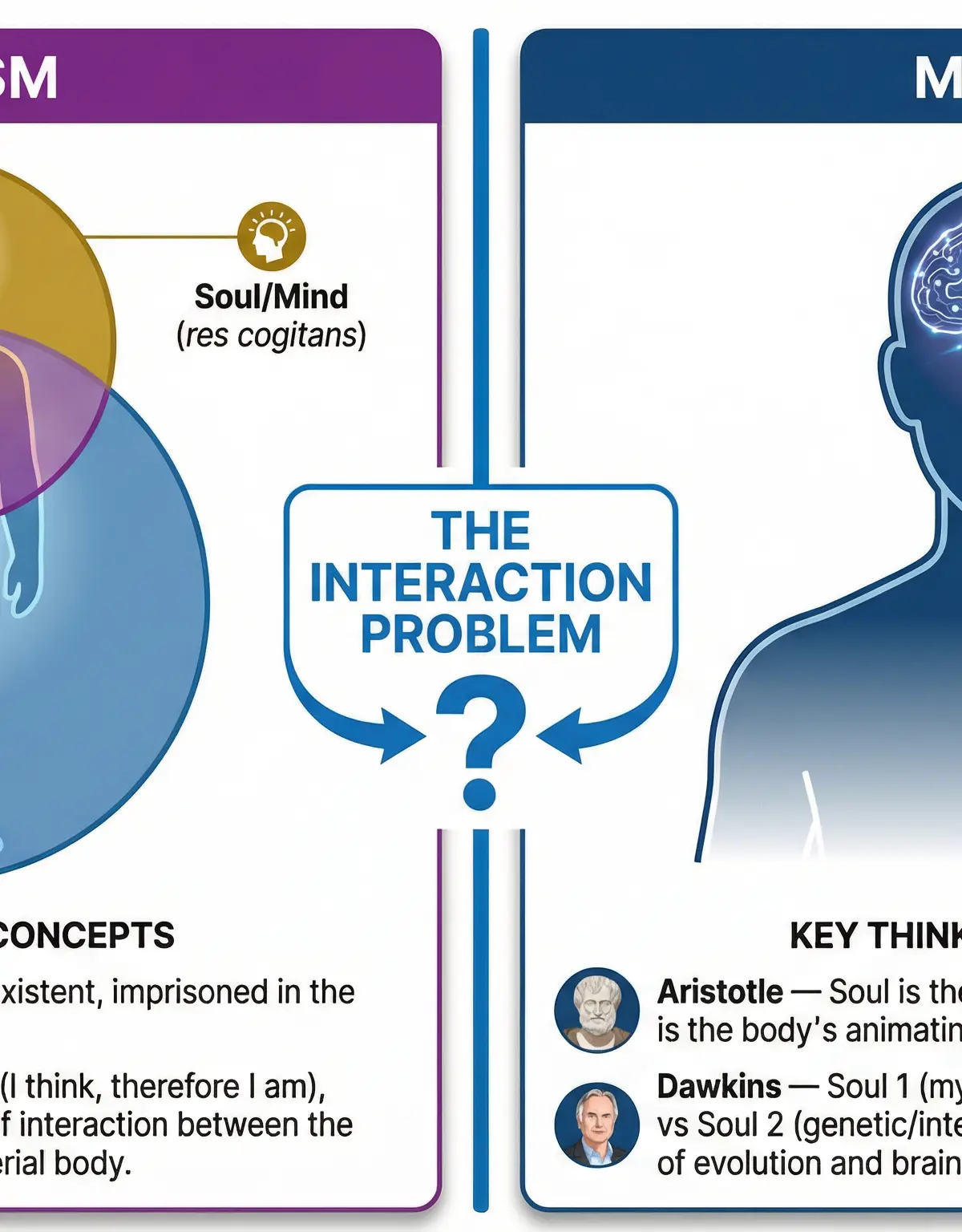
Impact: Descartes provides a modern, rationalist defence of dualism. However, his theory faces the critical Interaction Problem: how can a non-physical mind cause a physical body to move? His suggestion of the pineal gland as the point of interaction is widely seen as inadequate, a key point for AO2 evaluation.
Aristotle (384-322 BCE): Hylomorphic Monism
Role: Ancient Greek philosopher, student of Plato.
Key Actions: Aristotle rejected Plato's dualism. He argued the soul is the form of the body, its animating principle. The soul is not a separate substance but the set of capacities that make a body a living thing. He uses the analogy of an eye and its sight: the soul is to the body as sight is to the eye. You cannot separate the sight from the functioning eye.
Impact: Aristotle provides a monist (or, more accurately, hylomorphic) alternative to dualism. For him, the soul cannot survive the death of the body. It is crucial for candidates to distinguish this from modern materialism; Aristotle affirms the existence of the soul (anima), but as an inseparable principle of life, not a detachable entity.
Richard Dawkins (b. 1941): Modern Materialism
Role: Evolutionary biologist and prominent atheist author.
Key Actions: Dawkins, in works like The Selfish Gene, distinguishes between 'Soul 1' and 'Soul 2'.
- Soul 1: The traditional, supernatural, immortal soul. Dawkins rejects this as a pre-scientific superstition.
- Soul 2: The intellectual and spiritual power of a human being, our capacity for consciousness and deep feeling. Dawkins accepts this but sees it as an emergent property of the complex physical brain, which ceases to exist at death.
Impact: Dawkins represents a clear, modern, scientific materialist viewpoint that directly challenges dualism and any notion of post-mortem survival.
Gilbert Ryle (1900-1976): Linguistic Critique
Role: British philosopher, a representative of the linguistic philosophy movement.
Key Actions: In The Concept of Mind (1949), Ryle argues that dualism commits a 'Category Mistake'. Descartes mistakenly talks about the mind 'as if' it were a substance like the body, just a non-physical one. Ryle calls this the 'Ghost in the Machine'. He compares it to a tourist visiting Oxford who, after seeing all the colleges and libraries, asks, 'But where is the University?'. The University is not another building; it is the way all the buildings are organised. Similarly, the mind is not a ghost pulling levers in the body; it is the intelligent way the body behaves.
Impact: Ryle's work is not a theory of the soul but a powerful critique of the language of dualism. High-level responses will use this to question the very coherence of the dualist position.
John Hick (1922-2012): The Replica Theory
Role: British philosopher of religion and theologian.
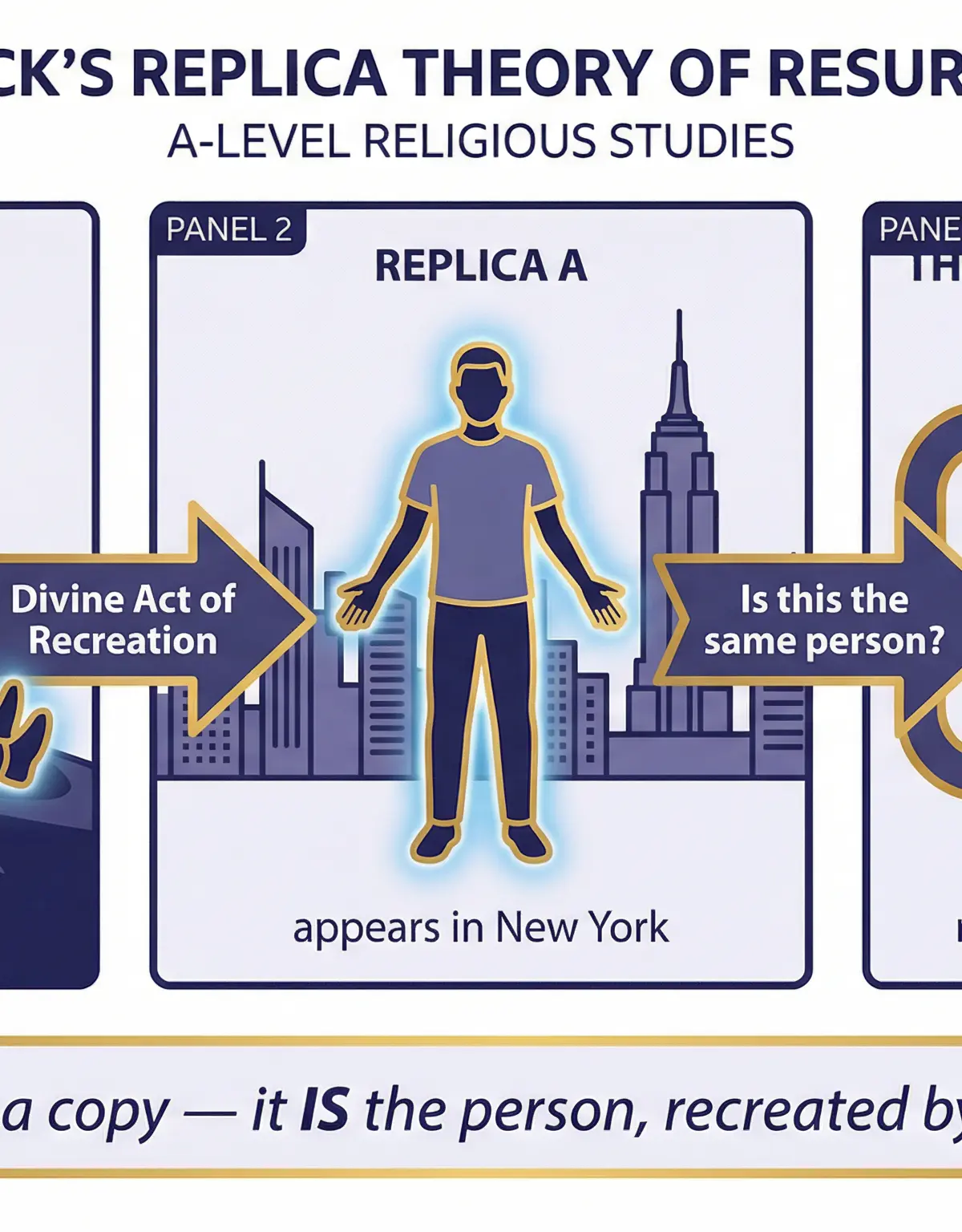
Key Actions: To make the Christian belief in resurrection philosophically plausible, Hick developed the Replica Theory. He proposes a thought experiment: a person dies in one place and an exact 'replica'—physically and psychologically identical—appears in another. Hick argues this replica is the same person because of the continuity of memory and personality. He applies this to death: at the moment of death, God creates a perfect replica in a 'resurrection world'.
Impact: Hick provides a modern, materialist-friendly account of resurrection that avoids traditional soul-body dualism. However, it faces strong criticism regarding personal identity: is a perfect copy truly the same person, or just a new individual who thinks they are? This is a rich area for AO2 analysis.
Second-Order Concepts
Causation
- Dualism's Causal Problem: The central weakness of substance dualism is explaining how a non-physical soul can cause physical events (the Interaction Problem). This is a primary line of attack for materialists.
- Materialism's Causal Chain: For materialists like Dawkins, all mental events are caused by physical brain events, forming an unbroken causal chain. There is no room for a non-physical soul to intervene.
Change & Continuity
- The Problem of Identity: This is the core issue for theories of the afterlife. What makes you 'you' over time? Is it your physical body (somatic identity) or your memories and personality (psychological continuity)?
- Hick's Replica Theory: This theory hinges on psychological continuity being sufficient for personal identity, a claim many philosophers challenge. If the original is destroyed, is the replica not just a new person?
Significance
- The Human Condition: This debate is significant because it addresses fundamental questions about what it means to be human, our place in the universe, and our ultimate fate.
- Ethical Implications: One's view on the soul can have profound implications for ethics. If there is no afterlife, does this life have more or less meaning? How does it affect our view of the value of the body?
Source Skills
While this is a philosophy topic, you will be dealing with texts from key thinkers (e.g., extracts from Plato's Phaedo or Descartes' Meditations). When analysing these texts:
- Provenance: Who wrote it, when, and why? Understanding the historical and philosophical context is crucial.
- Argument Identification: What is the core argument the philosopher is trying to make? Identify the premises and the conclusion.
- Critical Evaluation (AO2): Do the premises logically support the conclusion? What are the strengths and weaknesses of the argument? What counter-arguments could be made?",
"podcast_script": "Welcome to the OCR A-Level Religious Studies Podcast. I'm your tutor for today, and in the next ten minutes we're going to tackle one of the most philosophically rich and exam-rewarding topics on the entire specification: Self, Death, and the Afterlife. This sits within Paper H573 slash 01, Philosophy of Religion, and it is absolutely packed with opportunities to demonstrate both knowledge and critical evaluation. So let's get into it.
Let me start with the big picture. The central question of this topic is deceptively simple: what are we? Are human beings a combination of a physical body and a non-physical soul? Or are we simply biological organisms, and the idea of a separate soul is a philosophical confusion? Your ability to articulate this tension — and to evaluate the competing positions with precision — is exactly what examiners are looking for. Remember: AO1 is worth 40% and AO2 is worth 60%. That means for every minute you spend describing a theory, you need one and a half minutes evaluating it. Keep that ratio in your head throughout your revision.
Let's begin with Plato, writing in ancient Athens around 380 BCE. Plato is the founding father of substance dualism — the view that the soul and the body are two entirely separate substances. In the Phaedo, Plato presents several arguments for the immortality of the soul. The two you must know for OCR are the Argument from Opposites and the Argument from Recollection.
The Argument from Opposites — sometimes called the Cyclical Argument — claims that all things come from their opposites. The sleeping comes from the waking; the hot comes from the cold. Therefore, life must come from death, and death from life. The soul, Plato argues, must persist through death to be reborn. This is the philosophical foundation for reincarnation in the Western tradition.
The Argument from Recollection, developed in the Meno, is even more elegant. Plato observes that we can recognise perfect equality — the concept of two things being exactly equal — even though we have never encountered perfect equality in the physical world. Two sticks are never perfectly equal; they always fall short. So where did we learn the concept? Plato's answer: we knew it before birth. The soul pre-existed the body and brought this knowledge with it. This is called the Theory of Recollection, or Anamnesis. The soul is therefore immortal — it existed before birth and will persist after death.
Now, a crucial memory hook for Plato: think of the Charioteer. In the Phaedrus, Plato describes the soul as a charioteer driving two horses — one noble, representing reason, and one unruly, representing appetite. The charioteer — reason — must control the horses. This analogy tells you everything about Plato's view: the soul is the true self, the body is merely the vehicle. The soul is imprisoned in the body and longs to return to the realm of the Forms.
Moving forward to the seventeenth century and René Descartes. Descartes is the philosopher of substance dualism in the modern era. His famous declaration — Cogito Ergo Sum, I think therefore I am — appears in the Meditations on First Philosophy, published in 1641. Descartes begins by doubting everything he can possibly doubt. He can doubt his senses, his body, the external world. But there is one thing he cannot doubt: the very act of doubting is itself a form of thinking, and thinking requires a thinker. Therefore, he — the thinking thing — must exist.
This leads directly to his Argument from Indivisibility. The body is divisible — you can cut off a limb, remove an organ, and the body is diminished. But the mind — the thinking substance — is indivisible. You cannot cut a thought in half. Therefore, the mind and the body must be fundamentally different kinds of thing. The body is res extensa — extended, physical substance. The mind is res cogitans — thinking, non-physical substance. This is Cartesian Dualism.
Here is where examiners want you to go further. Descartes proposed that the soul and body interact via the pineal gland — a small structure in the brain. This generates what philosophers call the Interaction Problem. If the soul is genuinely non-physical — if it has no mass, no location, no physical properties — then how can it causally interact with a physical body? How does a non-physical thought cause a physical arm to move? This is not merely a puzzle Descartes failed to solve; it is a fundamental logical tension at the heart of substance dualism. High-level candidates evaluate this problem rather than simply stating it. Link it to modern neuroscience: brain imaging studies show that every mental event corresponds to a physical brain event. Damage to specific brain regions produces specific changes in personality and cognition. This strongly suggests that the mind is not separate from the brain — it is the brain.
Now let's turn to the opposition. Aristotle, writing in the fourth century BCE, offers a radically different account of the soul. For Aristotle, the soul is not a separate substance imprisoned in the body. The soul is the form of the body — its animating principle, its capacity for life. Aristotle uses the analogy of the eye and sight. If the eye were a living creature, its soul would be the power of sight. Sight is not a separate thing that happens to be located in the eye; it is what the eye does, what the eye is for. Similarly, the soul is not a separate thing located in the body; it is the body's capacity for life, sensation, and rational activity.
This position is called Hylomorphism — from the Greek hyle, meaning matter, and morphe, meaning form. Every living thing is a composite of matter and form. The soul is the form; the body is the matter. Crucially, this means that when the body dies, the soul — as the form of that body — ceases to exist. There is no survival of death in Aristotle's framework. This is why Aristotle's position is often described as a form of monism: there is only one substance, the living organism, and the soul is not separable from it.
A key examiner trap here: do not confuse Aristotle's monism with modern hard materialism. Aristotle absolutely believed in the soul — he wrote an entire treatise on it, De Anima. His point is not that the soul does not exist, but that it is not a separate substance. It is the animating principle of the body. The wax seal analogy is useful here: the shape of a seal can be transferred from wax to clay, but the shape is not a separate thing from the material it informs. The soul gives form to the body, but it is not independent of it.
Richard Dawkins, writing in The Selfish Gene in 1976, offers a contemporary materialist perspective. Dawkins distinguishes between what he calls Soul 1 and Soul 2. Soul 1 is the traditional, mystical concept of the soul — the immortal, non-physical entity that survives death. Dawkins rejects this entirely as scientifically incoherent. Soul 2, however, is something Dawkins accepts: the intellectual and spiritual power of a human being, the capacity for consciousness, creativity, and moral reasoning. For Dawkins, Soul 2 is a product of evolution — an emergent property of the extraordinarily complex biological machinery of the brain. It is real, it is remarkable, but it is entirely physical. When the brain dies, Soul 2 ceases to exist.
Now let's talk about the afterlife. Given that the body clearly dies, what philosophical frameworks allow for post-mortem existence? The two main options on the OCR specification are Resurrection and Reincarnation.
John Hick, writing in Death and Eternal Life in 1976, develops what is known as the Replica Theory of Resurrection. Hick is a Christian philosopher working within the tradition of bodily resurrection, but he wants to make it philosophically coherent for a modern audience. His thought experiment is brilliant in its simplicity. Imagine a man in Minneapolis who dies. At the moment of his death, an exact replica of him — with all his memories, personality, physical characteristics — appears in New York. Is this the same person? Hick argues yes, because psychological continuity is preserved. Now extend this: imagine the replica appears not in New York but in a resurrection world — a different space entirely, created by God. The replica is not a copy; it is the person, recreated by God through a divine act.
Hick's theory is important because it attempts to ground resurrection in a physicalist framework. He is not claiming the soul floats free of the body; he is claiming that God recreates the whole person — body and mind together — in a new environment. This is called eschatological verification: the truth of resurrection claims cannot be verified now, but could in principle be verified after death.
However, examiners expect you to critique this robustly. The most powerful objection concerns personal identity. If the original person in Minneapolis is dead — genuinely, completely dead — then the replica in the resurrection world is a numerically distinct individual who merely resembles the original. The replica has the memories and personality of the original, but it is not the original. This is the classic problem of personal identity continuity. Bernard Williams raises a related point: if the resurrected person is psychologically continuous with the original, they may not feel like themselves in a radically different resurrection body. The very features that make us who we are — our embodied habits, our physical relationships, our sensory experiences — are tied to our particular bodies.
Now, some rapid-fire exam tips before we move to the quiz.
First: the 40-60 split. Every essay question at A-Level is worth 40 marks: 16 for AO1 and 24 for AO2. This means your evaluation must dominate your essay. Do not spend three paragraphs describing Plato and one sentence evaluating him. Flip it.
Second: Gilbert Ryle. Ryle's concept of the Category Mistake, from The Concept of Mind published in 1949, is not a theory of the soul — it is a linguistic critique of Descartes. Ryle argues that Descartes made a category mistake by treating the mind as if it were a thing of the same logical type as the body, just made of different stuff. He uses the analogy of a visitor to Oxford University who, after being shown all the colleges, libraries, and faculties, asks: but where is the University? The University is not a separate thing alongside the colleges; it is the organisation of the colleges. Similarly, the mind is not a separate thing alongside the body — it is the organisation of the body's activities. Ryle famously calls Descartes' view the Ghost in the Machine. Candidates who present this as a positive theory of the soul rather than a critique of Descartes will lose marks.
Third: command words. For Discuss questions, you must present multiple perspectives and reach a reasoned conclusion. For Evaluate questions, you must assess the strengths and weaknesses of a position and make a sustained judgement. Avoid generic conclusions. Your final paragraph must resolve the specific tension raised in the question. If the question asks whether the soul is a category mistake, your conclusion must directly address that — not simply summarise what you have said.
Fourth: technical vocabulary. Use it precisely. Substance dualism, property dualism, hylomorphism, psyche, anima, eschatological verification, psychological continuity, numerical identity, qualitative identity. Examiners award marks for precise deployment of these terms.
Now, quick-fire recall quiz. I'll ask the questions — pause the podcast and try to answer before I give the answer.
Question one: What are Plato's two arguments for the immortality of the soul from the Phaedo and the Meno? Answer: The Argument from Opposites and the Argument from Recollection.
Question two: What does Descartes mean by res cogitans and res extensa? Answer: Res cogitans is thinking substance — the non-physical mind. Res extensa is extended substance — the physical body.
Question three: What is the Interaction Problem in Cartesian Dualism? Answer: If the mind is genuinely non-physical, it is unclear how it can causally interact with the physical body.
Question four: What is Aristotle's analogy for the body-soul relationship? Answer: The eye and sight — the soul is to the body as sight is to the eye.
Question five: What is Hick's Replica Theory, and what is the main objection to it? Answer: God recreates a perfect replica of the person in a resurrection world, preserving psychological continuity. The main objection is that the replica is numerically distinct from the original — it is not the same person.
Question six: What is Ryle's Category Mistake, and how does it apply to Descartes? Answer: A category mistake is treating something as belonging to a logical category it does not belong to. Ryle argues Descartes mistakenly treated the mind as a substance alongside the body, when in fact mental language describes the organisation of physical behaviour.
Let me leave you with a summary and a challenge. This topic is ultimately about what it means to be a person — what makes you you, and whether that thing can survive the death of your body. Plato and Descartes say yes: the soul is a separate, immortal substance. Aristotle and Dawkins say no: the soul is inseparable from the body, and when the body dies, so does the soul. Hick tries to thread the needle: resurrection is possible, but only through a divine act of recreation. And Ryle says the whole debate is built on a linguistic confusion.
Your job in the exam is not just to describe these positions, but to evaluate them. Which is most coherent? Which faces the most devastating objections? Where do the arguments break down? That is where the marks are — in the quality of your reasoning, not the quantity of your knowledge.
Good luck with your revision. You've got this.
This has been your OCR A-Level Religious Studies podcast on Self, Death and the Afterlife. See you next time."
Worked Examples
3 worked examples — open one to explore the question and available guidance.
Practice Questions
Test your understanding — click to reveal model answers
Explain Aristotle's view of the soul. (12 marks)
Hint: Focus on the concept of 'form' and 'matter' (hylomorphism) and use the key analogy of the eye and sight.
To what extent is Gilbert Ryle's critique of dualism successful? (40 marks)
Hint: Explain the 'Category Mistake' and the 'Ghost in the Machine' argument. Evaluate its success by considering whether it truly refutes dualism or simply re-describes the problem. Does it address the issue of consciousness?
Explain Plato's Argument from Recollection. (12 marks)
Hint: Start with the observation about perfect concepts. Link this to the Realm of the Forms and the soul's pre-existence.
Evaluate the view that personal identity is preserved in Hick's Replica Theory. (40 marks)
Hint: This is a question about personal identity. Is psychological continuity enough? Consider critiques from Bernard Williams and the problem of numerical vs. qualitative identity.
Explain the main challenges to substance dualism. (12 marks)
Hint: Focus on two key problems: the Interaction Problem and the evidence from neuroscience.