OCR · A-Level · Religious Studies
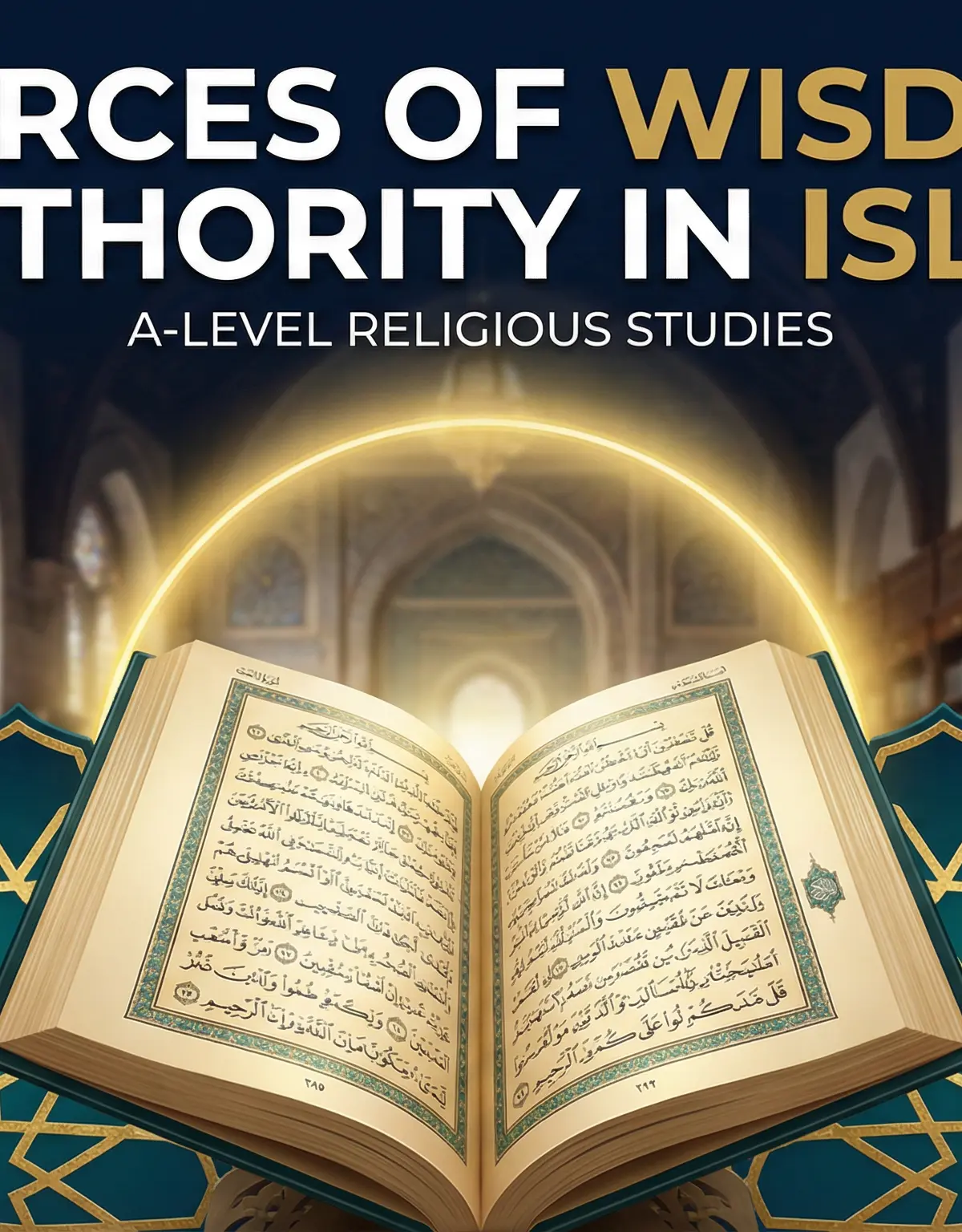
Sources of Wisdom and Authority in Islam
This study guide delves into the foundational sources of wisdom and authority in Islam, a cornerstone of the OCR A-Level Religious Studies specification. It unpacks the hierarchy of the Qur'an, Sunnah, Ijma, and Qiyas, equipping students to analyse the critical interplay between divine revelation and human jurisprudence, a skill essential for high-level marks."
- 9 min read
- 3 worked examples
- 3 practice questions
Study Notes
Overview
This topic explores the intricate framework of authority that underpins Islamic law and theology. For OCR H573, candidates are expected to move beyond a descriptive account of the sources and engage in a rigorous analysis of their hierarchy, application, and the historical processes that shaped them. The core of this study lies in understanding the distinction between the Qur'an as the verbatim word of God (kalam Allah) and the Sunnah as the inspired practice of the Prophet Muhammad. A key focus for examiners is the mechanism of Fiqh (Islamic jurisprudence), particularly the systematisation by Imam Al-Shafi'i and the ongoing debate surrounding Ijtihad (independent reasoning). High-level responses must demonstrate a nuanced understanding of the science of Hadith criticism (isnad and matn), contrast Sunni and Shi'a approaches, and evaluate the tension between textual immutability and the demands of modernity. Marks are awarded for precise use of terminology and engagement with both classical and contemporary scholarship.
Key Events & Developments
The Compilation of the Qur'an
Date(s): c. 633 CE (Abu Bakr's compilation) and c. 650 CE (Uthmanic Codex)
What happened: Following the death of the Prophet Muhammad in 632 CE, the Qur'an existed in the memories of his companions (huffaz) and on scattered materials like bones and palm leaves. After the Battle of Yamama (633 CE), where many huffaz were killed, the first Caliph, Abu Bakr, commissioned Zayd ibn Thabit to compile the first complete manuscript. Later, during the reign of the third Caliph, Uthman ibn Affan, variations in recitation across the expanding Islamic empire prompted the creation of a single, standardised version known as the Uthmanic Codex. All other versions were then destroyed to ensure unity.
Why it matters: This is crucial for AO2 analysis. The Uthmanic codex demonstrates the role of human authority in preserving what is held to be divine revelation. It raises questions about textual purity and the relationship between oral and written traditions. Candidates can earn credit by discussing the theological implications: does standardisation guarantee authenticity, or does it represent a human filtering of the divine? Mentioning critical scholars like John Wansbrough, who question the traditional timeline, demonstrates high-level academic engagement.
Specific Knowledge: Abu Bakr, Uthman ibn Affan, Zayd ibn Thabit, Battle of Yamama (633 CE), Uthmanic Codex (c. 650 CE).
The Systematisation of Fiqh by Al-Shafi'i
Date(s): Late 8th to early 9th century (d. 820 CE)
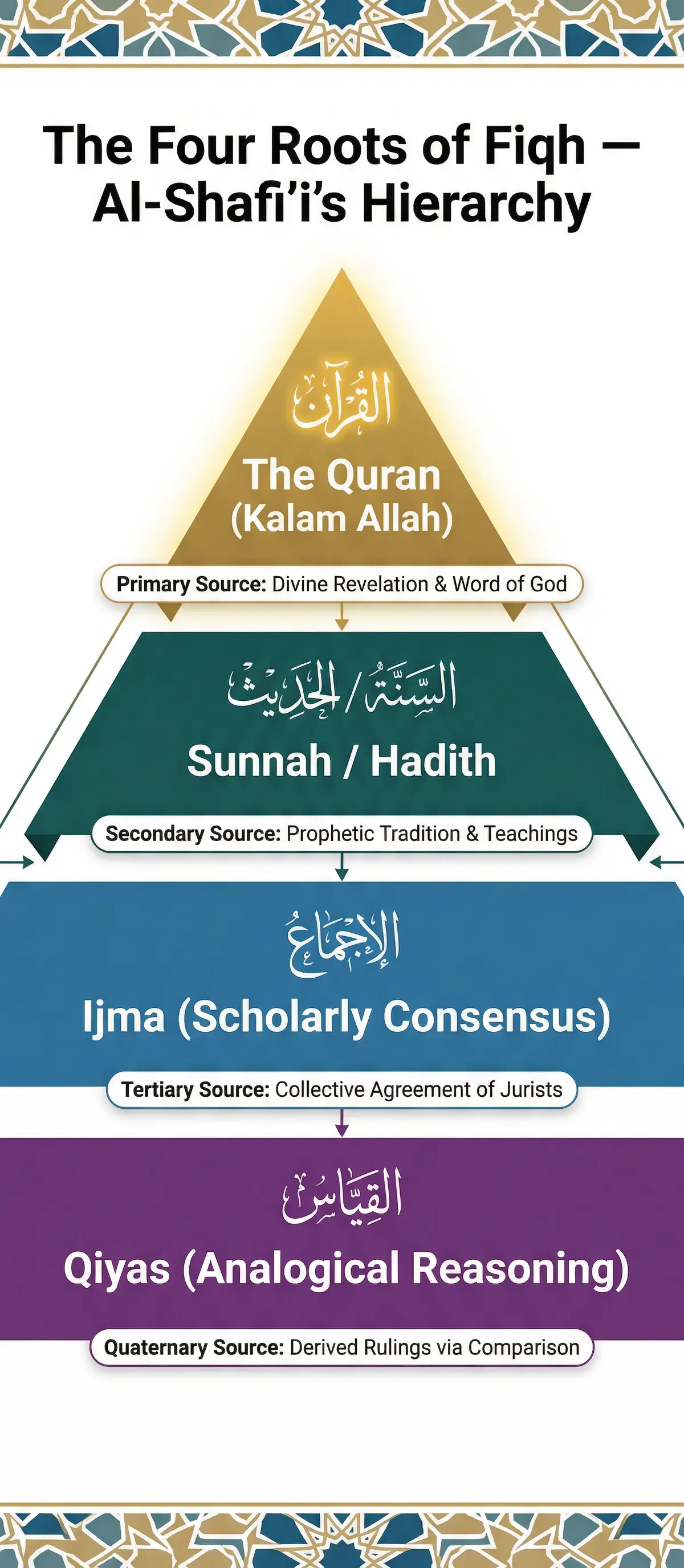
What happened: Muhammad ibn Idris al-Shafi'i, a brilliant jurist, authored 'Al-Risala', a foundational text that established a systematic methodology for Islamic law, known as Usul al-Fiqh (the roots of jurisprudence). He created a clear hierarchy of sources, solidifying the structure that has dominated Sunni Islam ever since.
Why it matters: Al-Shafi'i's hierarchy provided a clear, coherent framework for legal reasoning, preventing arbitrary interpretations. By placing the Qur'an and Sunnah as the primary sources, followed by Ijma (consensus) and Qiyas (analogy), he balanced textual fidelity with the need for legal development. Understanding this hierarchy is non-negotiable for the exam. It is the bedrock of how Sunni law functions.
Specific Knowledge: Al-Shafi'i (d. 820 CE), 'Al-Risala', Usul al-Fiqh, Qur'an, Sunnah, Ijma, Qiyas.
The 'Closing of the Gate of Ijtihad'
Date(s): c. 10th Century CE
What happened: Ijtihad, the practice of independent reasoning by a qualified scholar to derive a ruling, was common in early Islam and led to the formation of the major law schools (madhabs). However, by the 10th century, the majority of Sunni scholars declared that all major legal questions had been settled by the early masters. They argued that subsequent scholars should simply follow the established rulings (taqlid) rather than exercising independent reason. This is known as the 'closing of the gate of Ijtihad'.
Why it matters: This is a central debate for AO2. It represents the tension between tradition and modernity. Traditionalists argue that closing the gate preserves the integrity and continuity of the law. Modernists, like Fazlur Rahman and Tariq Ramadan, argue that it has led to stagnation and that Ijtihad is essential for Islam to address contemporary issues like bioethics, human rights, and modern finance. Evaluating the arguments for and against the reopening of the gate is a classic high-mark essay topic.
Specific Knowledge: Ijtihad, Taqlid, Madhabs (Hanafi, Maliki, Shafi'i, Hanbali), Fazlur Rahman, Wael Hallaq.
Key Individuals
The Prophet Muhammad (c. 570-632 CE)
Role: The final prophet in Islam, who received the revelations of the Qur'an from God.
Key Actions: Recited the Qur'an to his companions, established the first Muslim community in Medina, and his life example (Sunnah) became the second source of Islamic law.
Impact: His life is the model for Muslim behaviour and his sayings and actions (Hadith) are a primary source of guidance, second only to the Qur'an.
Al-Shafi'i (767-820 CE)
Role: Jurist and theologian, often called the 'Father of Islamic Jurisprudence'.
Key Actions: Systematised the sources of Islamic law (Usul al-Fiqh) in his book 'Al-Risala', establishing the hierarchy of Qur'an, Sunnah, Ijma, and Qiyas.
Impact: His work created the dominant framework for Sunni jurisprudence, providing a stable and consistent methodology for deriving law that is still used today. He is a pivotal figure in the intellectual history of Islam.
Al-Bukhari (810-870 CE)
Role: A Persian Islamic scholar and renowned compiler of Hadith.
Key Actions: Compiled the Hadith collection known as 'Sahih al-Bukhari', one of the two most authoritative collections in Sunni Islam. He famously sifted through hundreds of thousands of narrations, applying a rigorous methodology of criticism to select only the most authentic (sahih).
Impact: His work was instrumental in the development of the science of Hadith ('ilm al-rijal). 'Sahih al-Bukhari' is considered by Sunni Muslims to be the most authentic book after the Qur'an, providing a solid foundation for law, ethics, and theology.
Second-Order Concepts
Causation
The development of Islamic sources was driven by specific needs. The death of the Prophet created a leadership vacuum and a need to preserve his teachings, leading to the collection of the Qur'an and Hadith. The expansion of the empire brought Muslims into contact with new cultures and problems not explicitly addressed in the texts, necessitating the development of Fiqh through Ijma and Qiyas. The fear of fragmentation and incorrect interpretation led to both the standardisation of the Qur'an under Uthman and the later 'closing of the gate of Ijtihad'.
Consequence
The immediate consequence of the Uthmanic codex was unity in the text of the Qur'an. The long-term consequence of Al-Shafi'i's system was a stable and predictable legal framework. A major consequence of the 'closing of the gate of Ijtihad' was a decline in intellectual dynamism in some quarters, which modernists now seek to reverse. The development of Hadith science led to a clear hierarchy of reliability, but also to the Sunni/Shi'a split over which collections and narrators to trust.
Change & Continuity
Continuity: The Qur'an remains the ultimate, unchanged source of authority. The Prophet's Sunnah continues to be the primary lens through which the Qur'an is understood. Change: The methods of interpreting and applying these sources have evolved dramatically. The move from oral tradition to written compilations, the development of systematic Fiqh, the debate over Ijtihad, and the Sunni-Shi'a divergence over sources all represent significant changes in how authority is constructed and accessed.
Significance
This topic is significant because it addresses the fundamental question of how a religion based on ancient texts remains a living tradition. The debates over interpretation, authenticity, and authority are not just historical; they are live issues in the Muslim world today. For the exam, the significance lies in understanding that Islamic law is not a monolithic, static entity, but a dynamic process of human interaction with divine texts.
Source Skills
When presented with a source (e.g., an extract from a Hadith, a quote from Al-Shafi'i, or a view from a modern scholar), apply the following framework:
- Content: What does the source say? What is its explicit argument or message? Identify key terms and ideas.
- Provenance: Who wrote it? When and where? What type of source is it (e.g., primary legal text, secondary scholarly analysis)? The author's perspective (e.g., Sunni, Shi'a, traditionalist, modernist) is crucial.
- Usefulness/Limitations: How does the provenance affect its reliability? What are its strengths for understanding the topic? What are its weaknesses or biases? What does it not tell us? For example, a quote from Fazlur Rahman is useful for understanding modernist views on Ijtihad but is not representative of the traditionalist position."
Worked Examples
3 worked examples — open one to explore the question and available guidance.
Practice Questions
Test your understanding — click to reveal model answers
Explain the difference between Sunni and Shi'a sources of authority. (12 marks)
Hint: Focus on the role of the Imamate in Shi'a thought versus the role of consensus (Ijma) in Sunni thought, and name the different Hadith collections.
Explain Al-Shafi'i's contribution to Islamic jurisprudence. (12 marks)
Hint: Focus on his systematisation of the four sources in 'Al-Risala'.
'The 'closing of the gate of Ijtihad' was the single biggest mistake in the history of Islamic thought.' Assess this view. (40 marks)
Hint: This is a classic AO2 debate. Argue both sides. For the 'mistake' view, discuss stagnation and inability to adapt. For the counter-view, discuss stability, continuity, and prevention of chaos. Name modern and traditional scholars.